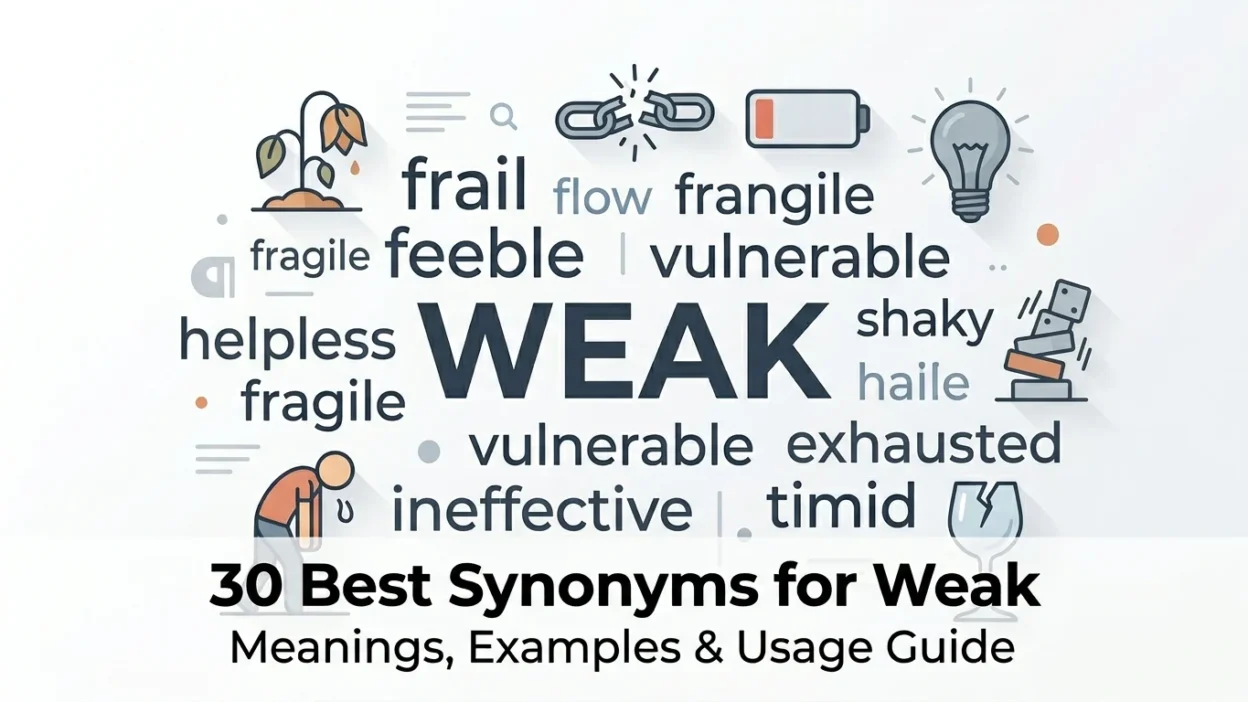
The word “weak” is commonly used in English to describe a lack of strength, power, effectiveness, or influence.
It can refer to physical condition, emotional resilience, arguments, performances, or even flavors and signals. Because it has many uses, understanding its synonyms can help you communicate more clearly and accurately.
For students, ESL learners, writers, and content creators, learning different synonyms for weak is an excellent way to expand vocabulary and avoid repeating the same word.
Each synonym carries a slightly different meaning, making it easier to express specific ideas in writing and conversation.
In this guide, you’ll learn the meaning of weak, explore 30 useful synonyms, discover example sentences, and understand the best situations for using each alternative.
Meaning of “Weak”
The word weak means lacking strength, power, energy, effectiveness, or influence.
Simple Definition:
Not strong; having little strength, force, or impact.
Example Sentence:
After being sick for a week, he felt weak and tired.
Common Usage Contexts:
- Physical strength
- Health and energy
- Arguments and opinions
- Performance and results
- Signals, sounds, and flavors
- Emotional resilience
30 Synonyms for Weak
1. Frail
Meaning: Physically weak and delicate.
Example Sentence:
The frail elderly man needed assistance walking.
Best Usage Context: Health and physical condition.
2. Feeble
Meaning: Lacking physical or mental strength.
Example Sentence:
She gave a feeble attempt to lift the box.
Best Usage Context: Physical effort and performance.
3. Fragile
Meaning: Easily damaged or broken.
Example Sentence:
The vase is fragile and should be handled carefully.
Best Usage Context: Objects and emotional states.
4. Delicate
Meaning: Easily affected or damaged.
Example Sentence:
The flower has delicate petals.
Best Usage Context: Objects, situations, and people.
5. Powerless
Meaning: Without the ability to influence events.
Example Sentence:
They felt powerless during the crisis.
Best Usage Context: Control and authority.
6. Vulnerable
Meaning: Easily harmed or attacked.
Example Sentence:
Young children are vulnerable to illness.
Best Usage Context: Safety and emotional discussions.
7. Helpless
Meaning: Unable to help oneself.
Example Sentence:
The stranded traveler felt helpless.
Best Usage Context: Difficult situations.
8. Infirm
Meaning: Weak due to age or illness.
Example Sentence:
The infirm patient required special care.
Best Usage Context: Medical and formal writing.
9. Sickly
Meaning: Frequently ill or unhealthy.
Example Sentence:
The sickly plant struggled to grow.
Best Usage Context: Health and appearance.
10. Exhausted
Meaning: Extremely tired and lacking energy.
Example Sentence:
After the marathon, she felt exhausted.
Best Usage Context: Physical energy.
11. Tired
Meaning: Lacking energy or strength.
Example Sentence:
I felt tired after work.
Best Usage Context: Everyday conversations.
12. Drained
Meaning: Completely lacking energy.
Example Sentence:
The long journey left him drained.
Best Usage Context: Physical and emotional exhaustion.
13. Ineffective
Meaning: Not producing the desired result.
Example Sentence:
The marketing campaign was ineffective.
Best Usage Context: Business and performance.
14. Unconvincing
Meaning: Not persuasive or believable.
Example Sentence:
His explanation sounded unconvincing.
Best Usage Context: Arguments and presentations.
15. Flimsy
Meaning: Weakly made or poorly supported.
Example Sentence:
The flimsy chair broke quickly.
Best Usage Context: Objects and arguments.
16. Thin
Meaning: Lacking strength, substance, or support.
Example Sentence:
The report provided only thin evidence.
Best Usage Context: Information and reasoning.
17. Poor
Meaning: Below average in quality or effectiveness.
Example Sentence:
The team delivered a poor performance.
Best Usage Context: Results and performance.
18. Deficient
Meaning: Lacking an important quality.
Example Sentence:
The proposal was deficient in detail.
Best Usage Context: Academic and professional writing.
19. Inadequate
Meaning: Not sufficient or effective enough.
Example Sentence:
The resources were inadequate for the project.
Best Usage Context: Formal situations.
20. Substandard
Meaning: Below the required quality.
Example Sentence:
The product was rejected for being substandard.
Best Usage Context: Quality assessments.
21. Mild
Meaning: Not strong in intensity.
Example Sentence:
She prefers mild coffee.
Best Usage Context: Taste, weather, and reactions.
22. Faint
Meaning: Difficult to see, hear, or detect.
Example Sentence:
We heard a faint sound in the distance.
Best Usage Context: Sounds and signals.
23. Dim
Meaning: Weak in brightness.
Example Sentence:
The room was lit by a dim lamp.
Best Usage Context: Light and visibility.
24. Soft
Meaning: Not strong or intense.
Example Sentence:
He spoke in a soft voice.
Best Usage Context: Sounds and behavior.
25. Timid
Meaning: Lacking confidence or courage.
Example Sentence:
The timid student avoided speaking in class.
Best Usage Context: Personality traits.
26. Shaky
Meaning: Unstable or uncertain.
Example Sentence:
The company has a shaky financial position.
Best Usage Context: Stability and confidence.
27. Unsteady
Meaning: Not firm or stable.
Example Sentence:
His unsteady steps worried the doctor.
Best Usage Context: Physical movement.
28. Lacking
Meaning: Missing something important.
Example Sentence:
The article was lacking clear examples.
Best Usage Context: General descriptions.
29. Worn-Out
Meaning: Extremely tired or weakened from use.
Example Sentence:
The worn-out shoes needed replacing.
Best Usage Context: People and objects.
30. Breakable
Meaning: Easy to damage or destroy.
Example Sentence:
The toy is breakable and should be handled carefully.
Best Usage Context: Physical objects.
Comparison Guide: When to Use Different Synonyms
| Synonym | Best For | Tone |
|---|---|---|
| Frail | Physical weakness | Neutral |
| Feeble | Lack of strength | Negative |
| Vulnerable | Risk and exposure | Neutral |
| Exhausted | Extreme tiredness | Common |
| Ineffective | Poor results | Professional |
| Flimsy | Weak objects or arguments | Informal |
| Mild | Low intensity | Neutral |
| Timid | Lack of confidence | Personal |
| Shaky | Instability | Informal |
| Inadequate | Insufficient quality | Formal |
How to Choose the Right Synonym
For Physical Weakness
Use:
- Frail
- Feeble
- Infirm
- Sickly
- Exhausted
These words describe health, strength, or energy.
For Emotional or Personal Weakness
Use:
- Vulnerable
- Helpless
- Timid
- Drained
These focus on emotions, confidence, and mental state.
For Weak Arguments or Ideas
Use:
- Unconvincing
- Thin
- Ineffective
- Flimsy
These work best when discussing reasoning or evidence.
For Poor Quality or Performance
Use:
- Inadequate
- Deficient
- Poor
- Substandard
These are useful in academic, professional, and business writing.
For Weak Signals, Sounds, or Intensity
Use:
- Faint
- Mild
- Soft
- Dim
These describe low levels of strength or intensity.
For Formal Writing
Use:
- Deficient
- Inadequate
- Ineffective
- Vulnerable
- Infirm
These words fit professional and academic contexts.
Common Mistakes When Using Synonyms for Weak
Assuming All Synonyms Mean the Same Thing
For example, frail usually refers to physical weakness, while ineffective refers to poor results.
Ignoring Context
A mild flavor is not the same as a feeble effort. Always consider the situation before choosing a synonym.
Using Negative Words Unnecessarily
Words like feeble, poor, and substandard may sound harsh in some situations.
Why Learning Synonyms for Weak Matters
Expanding your vocabulary helps you:
- Avoid repetitive writing
- Improve essays and assignments
- Express ideas more accurately
- Strengthen communication skills
- Understand subtle differences in meaning
- Create more engaging content
Learning the right synonym allows you to match your words to the exact meaning and tone you want to communicate.
Conclusion
Learning useful synonyms for weak can greatly improve your English vocabulary and writing quality.
While weak is a helpful everyday word, alternatives such as frail, vulnerable, ineffective, timid, and inadequate provide more specific meanings that fit different situations.
The key is understanding the context, tone, and purpose of each synonym.
By choosing the right word, students, ESL learners, writers, and content creators can communicate more clearly, naturally, and effectivel