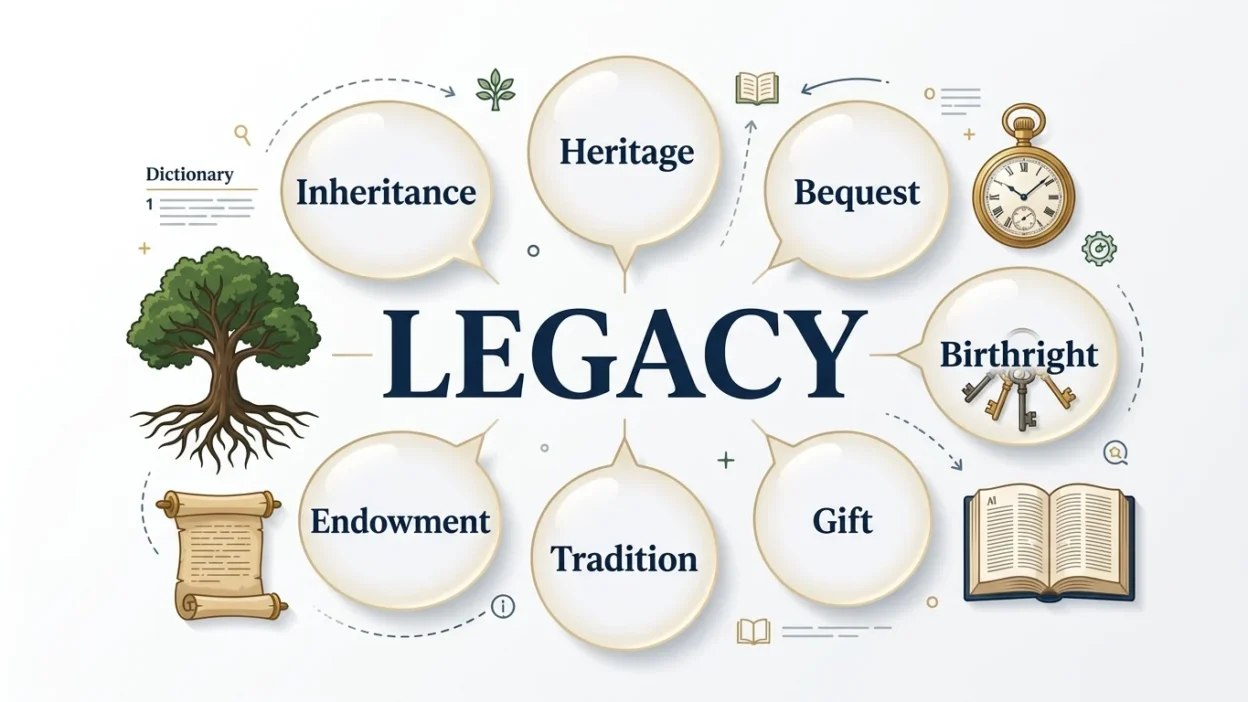
The word legacy is common in English, but its meaning can change depending on context.
It may describe something valuable that a person leaves behind, such as achievements, ideas, traditions, or memories.
It can also refer to something inherited from the past, including systems, practices, or even problems.
Learning legacy synonyms can help students, ESL learners, writers, and content creators express these ideas more precisely.
Instead of repeating “legacy,” you can choose a word that shows whether you mean an inheritance, tradition, influence, reputation, or something preserved from an earlier time.
What Does “Legacy” Mean?
Simple meaning of legacy
Legacy means something handed down from the past or something a person leaves behind for others. It can be positive, neutral, or negative, depending on the situation.
For example:
- Her legacy was her dedication to education.
- The company is still using a legacy computer system.
- His legacy continues through the students he taught.
In these examples, “legacy” refers to something that remains after a person, period, or system has passed.
Legacy as a noun
As a noun, legacy can describe:
- Something inherited from someone
- A person’s lasting achievements or influence
- A tradition passed from one generation to another
- An older system, method, or technology that remains in use
Because these meanings are slightly different, the best synonym depends on the context.
30 Legacy Synonyms
1. Inheritance
Meaning: Something received from a person who has died, especially money, property, or possessions.
Example: She received a small inheritance from her grandfather.
Best usage: Use “inheritance” when talking about money, property, possessions, or something passed down legally or personally.
2. Heritage
Meaning: The traditions, culture, history, and values passed from earlier generations.
Example: The festival celebrates the country’s rich cultural heritage.
Best usage: Best for culture, history, traditions, and national or family identity.
3. Tradition
Meaning: A belief, custom, or practice passed from one generation to another.
Example: Making this dish every winter is a family tradition.
Best usage: Use it for repeated customs, rituals, and practices.
4. Succession
Meaning: The process of something being passed from one person or group to another.
Example: The smooth succession of leadership helped the organization remain stable.
Best usage: Suitable for leadership, positions, ownership, or authority.
5. Bequest
Meaning: Money or property left to someone in a will.
Example: The museum received a generous bequest from a former supporter.
Best usage: Mainly used in legal, financial, and formal writing.
6. Inheritance
Meaning: Something passed to another person after someone’s death.
Example: The house became his inheritance after his mother’s death.
Best usage: Useful for property, money, possessions, and family assets.
7. Heritage
Meaning: Something valuable that comes from previous generations.
Example: The old building is an important part of the city’s heritage.
Best usage: Strong choice for historical, cultural, and architectural contexts.
8. Tradition
Meaning: A long-established way of doing something.
Example: The school has a tradition of celebrating its graduates every spring.
Best usage: Best when “legacy” means a continuing custom or practice.
9. Impact
Meaning: The strong effect that someone or something has on others.
Example: Her research had a lasting impact on modern medicine.
Best usage: Use “impact” when focusing on results or effects rather than what was directly passed down.
10. Influence
Meaning: The power to affect people’s ideas, actions, or development.
Example: His influence can still be seen in modern literature.
Best usage: Excellent for a person’s lasting effect on people, culture, or ideas.
11. Contribution
Meaning: Something valuable that a person gives or adds to a group, field, or society.
Example: Her contribution to science was recognized around the world.
Best usage: Use it when emphasizing someone’s work or achievements.
12. Achievement
Meaning: Something successfully accomplished through effort or ability.
Example: His greatest achievement was creating a successful educational program.
Best usage: Best when a legacy is based on specific accomplishments.
13. Reputation
Meaning: The general opinion people have about someone or something.
Example: The university has built a strong reputation for academic excellence.
Best usage: Use it when discussing how someone or something is remembered or regarded.
14. Memory
Meaning: Something remembered about a person, event, or experience.
Example: The scholarship keeps her memory alive among future students.
Best usage: Useful when legacy focuses on remembrance.
15. Remembrance
Meaning: The act of remembering and honoring someone or something.
Example: The monument was built in remembrance of the fallen soldiers.
Best usage: Appropriate for memorials, ceremonies, and respectful writing.
16. Memorial
Meaning: Something created to remember and honor a person or event.
Example: The park serves as a memorial to the community’s founders.
Best usage: Use it for physical places, objects, or events created in someone’s memory.
17. Continuity
Meaning: The state of continuing without interruption.
Example: The new director maintained continuity with the organization’s earlier work.
Best usage: Useful when focusing on something continuing from the past into the present.
18. Lineage
Meaning: A person’s family history or line of descent.
Example: The family is proud of its long artistic lineage.
Best usage: Best for family history, ancestry, and historical lines of descent.
19. Ancestry
Meaning: The people from whom someone is descended.
Example: She spent years researching her ancestry.
Best usage: Use it when discussing family origins and descent.
20. Descent
Meaning: The origin of a person or group from earlier generations.
Example: The family can trace its descent back several centuries.
Best usage: More formal than “ancestry” and common in historical or genealogical writing.
21. Posterity
Meaning: Future generations.
Example: The forest was protected for the benefit of posterity.
Best usage: A formal or literary choice when discussing what is preserved for future generations.
22. Tradition
Meaning: A practice or belief that continues across generations.
Example: The ceremony follows a tradition that is hundreds of years old.
Best usage: Especially useful when legacy means a cultural or family practice.
23. Heritage
Meaning: Historical or cultural value inherited from previous generations.
Example: The city works hard to protect its architectural heritage.
Best usage: Ideal for culture, historical places, art, and shared identity.
24. Relic
Meaning: An old object that remains from an earlier period.
Example: The museum displays a relic from the ancient civilization.
Best usage: Use it for physical objects from the past, especially historical ones.
25. Remnant
Meaning: A remaining part of something that once existed.
Example: The old tower is one of the last remnants of the medieval wall.
Best usage: Best when only part of something from the past remains.
26. Residue
Meaning: Something that remains after most of something else has disappeared or been removed.
Example: The conflict left a residue of distrust between the two communities.
Best usage: Often used figuratively for remaining feelings, effects, or problems.
27. Traces
Meaning: Small signs or remaining evidence of something from the past.
Example: Researchers found traces of an ancient settlement beneath the city.
Best usage: Useful for evidence, signs, or small remains.
28. Imprint
Meaning: A lasting effect or mark left by someone or something.
Example: The teacher left a lasting imprint on her students.
Best usage: Strong for describing emotional, intellectual, or cultural influence.
29. Mark
Meaning: A noticeable effect or sign left by a person or event.
Example: The scientist left his mark on the field of environmental research.
Best usage: Natural in everyday and professional writing when describing lasting influence.
30. Aftereffect
Meaning: An effect that continues after the original event has ended.
Example: The economic crisis had serious aftereffects for many years.
Best usage: Best for continuing consequences, especially after major events or problems.
Legacy Synonyms: Quick Comparison Guide
Different synonyms for “legacy” carry different meanings. Choosing the right one depends on what you want to emphasize.
| Synonym | Main idea | Tone | Common context |
|---|---|---|---|
| Inheritance | Something received | Neutral | Money, property |
| Heritage | Culture from the past | Neutral/Formal | History, culture |
| Tradition | Passed-down practice | Neutral | Family, society |
| Bequest | Property left in a will | Formal | Legal, financial |
| Influence | Effect on others | Neutral | People, ideas |
| Impact | Strong lasting effect | Neutral | Work, events |
| Contribution | Valuable work given | Neutral/Formal | Careers, society |
| Reputation | How someone is remembered | Neutral | Public image |
| Memory | What is remembered | Neutral | Personal remembrance |
| Memorial | Something honoring the past | Formal | Monuments, ceremonies |
| Lineage | Family or historical line | Formal | Genealogy |
| Relic | Object remaining from the past | Neutral | History, museums |
| Remnant | Remaining part | Neutral | Buildings, structures |
| Imprint | Lasting mark or effect | Figurative | Personal influence |
| Aftereffect | Continuing consequence | Neutral | Events, problems |
How to Choose the Right Synonym
For culture and history
Choose heritage, tradition, lineage, ancestry, or descent when discussing something connected to previous generations.
Example:
The region’s cultural heritage is an important part of its identity.
For personal influence
Choose influence, impact, imprint, mark, or contribution when talking about what a person has achieved or how they affected others.
Example:
The author’s influence can still be seen in contemporary fiction.
For money and property
Choose inheritance or bequest when “legacy” refers to assets received after someone’s death.
Example:
He used his inheritance to start a small business.
For memories and honoring someone
Choose memory, remembrance, or memorial when the focus is on keeping someone remembered.
Example:
The scholarship was established in remembrance of her dedication to education.
For things remaining from the past
Choose relic, remnant, trace, or residue when something from an earlier time still remains.
Example:
The ruins are remnants of an ancient settlement.
For continuing effects
Choose impact, influence, continuity, or aftereffect when something from the past continues to affect the present.
Example:
The policy had a lasting impact on the country’s education system.
Legacy vs. Its Closest Synonyms
Legacy vs. heritage
Legacy can describe what a person leaves behind, while heritage usually refers to cultural, historical, or family elements inherited from earlier generations.
Legacy: Her scientific legacy continues to inspire researchers.
Heritage: The country is proud of its cultural heritage.
Legacy vs. inheritance
Inheritance normally involves something received from someone, especially after death. Legacy has a broader meaning and can include ideas, achievements, values, and influence.
Inheritance: He received an inheritance from his uncle.
Legacy: His legacy was his commitment to helping young people.
Legacy vs. influence
Influence focuses on the power to affect others. Legacy focuses more on what remains after a person, event, or period has passed.
Influence: Her influence shaped a generation of artists.
Legacy: Her artistic legacy remains important today.
Legacy vs. tradition
A tradition is usually a practice or belief passed through generations. A legacy can be much broader.
Tradition: Eating together on holidays is a family tradition.
Legacy: The founder’s legacy includes the values he taught the company.
Common Mistakes When Using Legacy Synonyms
Using “inheritance” for every type of legacy
Not every legacy involves money or property. If you are talking about ideas, values, or achievements, influence, impact, or contribution may be better.
Using “heritage” for personal achievements
“Heritage” usually relates to culture, history, family, or a shared past. For a person’s professional achievements, legacy or contribution is often more natural.
Confusing influence with reputation
Influence means the ability to affect others. Reputation means how people generally view someone or something.
A person can have a strong influence without having a good reputation.
Choosing a synonym only because it sounds formal
A more complicated word is not always a better word. Good writing uses the word that communicates the exact meaning clearly.
Why Learning Legacy Synonyms Matters
Understanding legacy synonyms helps you become a more flexible English speaker and writer. It allows you to avoid repetition and express small differences in meaning.
For ESL learners, these distinctions are especially useful because English synonyms are rarely identical. Two words may share a basic meaning while differing in tone, context, or emotional effect.
For writers and content creators, choosing the precise synonym can make an article, story, essay, or professional message sound more natural and engaging.
Final Takeaways
The word legacy generally describes something that remains from the past or something a person leaves behind.
However, its best synonym depends on the exact meaning.
Use heritage for culture and history, inheritance for money or property, tradition for passed-down practices, influence or impact for lasting effects, and memorial or remembrance for honoring someone.
The most important lesson is simple: do not choose a synonym just because it looks similar in a dictionary.
Choose the word that matches your intended meaning, tone, and context.