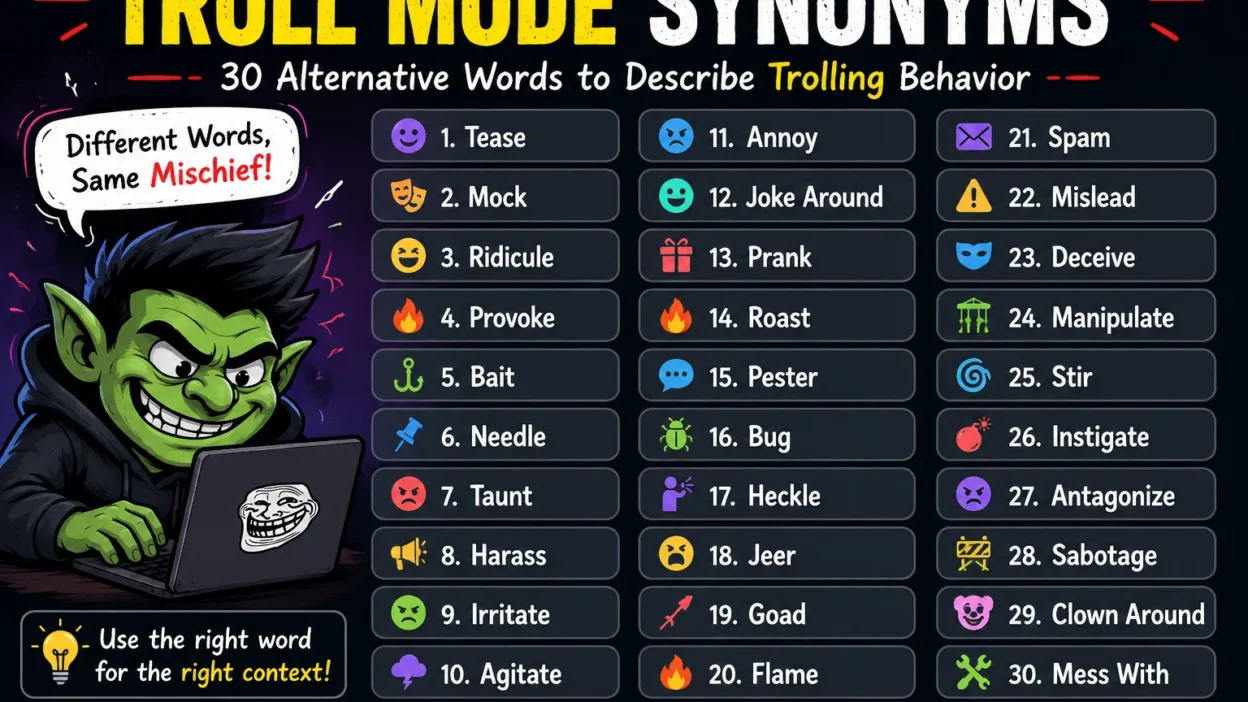
The phrase troll mode synonyms refers to words and expressions that can replace or describe the behavior of someone who is intentionally provoking, teasing, or irritating others, especially online.
Learning these synonyms helps you express ideas more accurately while understanding the different levels of humor, sarcasm, and negativity behind each word.
if you’re a student, ESL learner, writer, blogger, or content creator, knowing the right synonym for “troll mode” can make your writing more natural and engaging.
Some words describe playful teasing, while others refer to harmful online behavior. This guide explains each synonym in simple English with meanings, examples, and usage tips.
What Does “Troll Mode” Mean?
Simple Meaning
“Troll mode” describes a situation where someone deliberately tries to annoy, provoke, confuse, or entertain others by posting controversial, funny, sarcastic, or misleading comments. It is commonly used on social media, gaming platforms, online forums, and chat applications.
Tone and Usage Context
The phrase can have different meanings depending on the situation:
- Funny and playful among friends
- Sarcastic during conversations
- Negative when someone intentionally causes arguments
- Internet slang for provoking reactions online
Understanding the tone helps you choose the most appropriate synonym.
30 Troll Mode Synonyms With Meanings, Examples, and Usage
1. Tease
Meaning: To joke with someone in a playful way.
Example: He likes to tease his friends during online games.
Best Usage Context: Friendly conversations.
2. Mock
Meaning: To make fun of someone.
Example: She mocked his mistake in the group chat.
Best Usage Context: Critical or humorous situations.
3. Ridicule
Meaning: To laugh at someone unfairly.
Example: Nobody should ridicule others online.
Best Usage Context: Serious discussions.
4. Provoke
Meaning: To encourage someone to react emotionally.
Example: His comments were meant to provoke the audience.
Best Usage Context: Debates and arguments.
5. Bait
Meaning: To tempt someone into reacting.
Example: Don’t take the bait during online discussions.
Best Usage Context: Social media.
6. Needle
Meaning: To repeatedly annoy someone with small comments.
Example: He kept needling his teammate.
Best Usage Context: Informal conversations.
7. Taunt
Meaning: To insult or challenge someone.
Example: The player taunted his opponents after winning.
Best Usage Context: Sports and gaming.
8. Harass
Meaning: To repeatedly bother someone.
Example: Online harassment should always be reported.
Best Usage Context: Serious situations.
9. Irritate
Meaning: To make someone feel annoyed.
Example: Loud comments can irritate other users.
Best Usage Context: Everyday English.
10. Agitate
Meaning: To make someone upset or nervous.
Example: His messages agitated the entire group.
Best Usage Context: Emotional discussions.
11. Annoy
Meaning: To bother someone.
Example: Stop trying to annoy everyone.
Best Usage Context: General use.
12. Joke Around
Meaning: To behave in a playful way.
Example: We were only joking around.
Best Usage Context: Friendly settings.
13. Prank
Meaning: To trick someone for fun.
Example: They planned a harmless prank.
Best Usage Context: Entertainment.
14. Roast
Meaning: To make funny insults.
Example: Friends roasted each other during the livestream.
Best Usage Context: Comedy.
15. Pester
Meaning: To keep bothering someone.
Example: The child kept pestering his brother.
Best Usage Context: Informal English.
16. Bug
Meaning: To annoy someone.
Example: Stop bugging your classmates.
Best Usage Context: Casual speech.
17. Heckle
Meaning: To interrupt with rude comments.
Example: The audience heckled the speaker.
Best Usage Context: Public events.
18. Jeer
Meaning: To shout insulting remarks.
Example: Some fans jeered at the referee.
Best Usage Context: Sports.
19. Goad
Meaning: To push someone into reacting.
Example: He tried to goad his opponent.
Best Usage Context: Formal writing.
20. Flame
Meaning: To post angry or insulting messages online.
Example: Users should avoid flaming others.
Best Usage Context: Internet culture.
21. Spam
Meaning: To repeatedly post unwanted content.
Example: The account was banned for spamming.
Best Usage Context: Social media.
22. Mislead
Meaning: To give false information.
Example: Fake headlines can mislead readers.
Best Usage Context: News and education.
23. Deceive
Meaning: To trick someone.
Example: He deceived people with fake profiles.
Best Usage Context: Formal English.
24. Manipulate
Meaning: To influence someone unfairly.
Example: Trolls often manipulate conversations.
Best Usage Context: Psychology and communication.
25. Stir
Meaning: To create excitement or conflict.
Example: His post stirred unnecessary drama.
Best Usage Context: Media.
26. Instigate
Meaning: To start trouble or conflict.
Example: Someone tried to instigate an argument.
Best Usage Context: Formal discussions.
27. Antagonize
Meaning: To make someone angry on purpose.
Example: Constant criticism can antagonize people.
Best Usage Context: Professional writing.
28. Sabotage
Meaning: To deliberately ruin something.
Example: He sabotaged the discussion with offensive comments.
Best Usage Context: Serious situations.
29. Clown Around
Meaning: To act silly for attention.
Example: The students were clowning around before class.
Best Usage Context: Informal speech.
30. Mess With
Meaning: To play tricks on or bother someone.
Example: Don’t mess with people online.
Best Usage Context: Casual conversations.
Comparison Guide: When to Use Different Troll Mode Synonyms
Quick Comparison Table
| Synonym | Tone | Best Used For |
|---|---|---|
| Tease | Friendly | Friends |
| Joke Around | Casual | Informal chats |
| Roast | Funny | Comedy and social media |
| Mock | Negative | Criticism |
| Provoke | Neutral | Debates |
| Bait | Internet slang | Online discussions |
| Flame | Negative | Online arguments |
| Harass | Serious | Cyberbullying |
| Prank | Fun | Entertainment |
| Antagonize | Formal | Professional writing |
How to Choose the Right Synonym
For Friendly Humor
Choose these words when the intention is playful:
- Tease
- Joke Around
- Roast
- Clown Around
- Prank
For Online Conversations
These fit internet culture best:
- Troll
- Bait
- Flame
- Spam
- Stir
For Serious or Negative Situations
Use these when discussing harmful behavior:
- Harass
- Manipulate
- Antagonize
- Ridicule
- Sabotage
For Formal or Academic Writing
These are suitable for essays and professional content:
- Provoke
- Instigate
- Agitate
- Deceive
- Mislead
Why Learning Troll Mode Synonyms Matters
Understanding troll mode synonyms improves your vocabulary and helps you communicate with greater precision.
Instead of repeating the same word, you can choose a synonym that better matches the tone and situation.
This makes your writing more engaging, natural, and professional while also improving reading comprehension.
Students can strengthen essays, ESL learners can build vocabulary, writers can avoid repetition, and content creators can produce more interesting articles by using the right synonym in the right context.
Conclusion
Learning troll mode synonyms is an excellent way to expand your English vocabulary and understand different styles of communication.
Some synonyms describe harmless jokes among friends, while others refer to serious online behavior such as harassment or manipulation.
By understanding each word’s meaning, example, and best usage context, you can choose the most accurate expression for any situation.
if you’re writing articles, creating social media content, studying English, or simply improving your communication skills, these 30 synonyms will help you write with greater confidence, clarity, and variety.