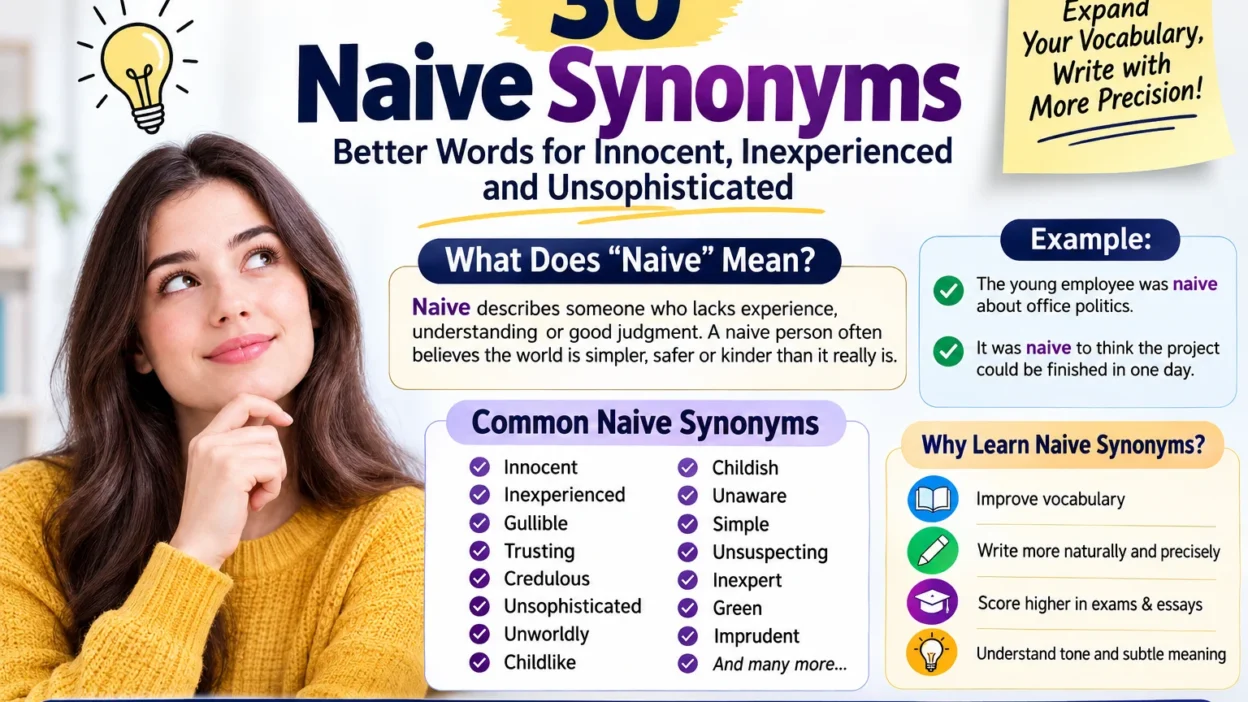
The word “naive” is commonly used to describe someone who lacks experience or expects people and situations to be simpler or safer than they really are.
It can describe a person, idea, belief, decision, or approach.
Understanding naive synonyms is useful for students, ESL learners, writers, and content creators because “naive” can have several shades of meaning.
Sometimes it means innocent and trusting.
In other situations, it means inexperienced, unrealistic, or lacking good judgment.
Choosing the right alternative helps you communicate your exact meaning. For example, calling someone “innocent” can sound kind, while calling them “gullible” suggests that they are too easily deceived.
This guide explains 30 useful alternatives with simple meanings, examples, and usage notes.
What Does “Naive” Mean?
Simple meaning of naive
Naive describes someone who has little experience or knowledge of how complicated the world can be.
For example:
The young employee was naive about office politics.
This means the employee did not yet understand how complicated workplace relationships could be.
“Naive” can also describe an idea or belief that is too simple or unrealistic:
It was naive to think the project would be completed in one day.
Here, “naive” suggests that the person did not properly understand the difficulties involved.
Is “naive” positive or negative?
The tone depends on context.
When describing a person as innocent and trusting, naive may sound sympathetic:
Her naive excitement about her first trip was charming.
When describing poor judgment or unrealistic thinking, it can sound critical:
His naive assumption caused serious problems.
Because of this, selecting the right synonym is important.
30 Naive Synonyms and Their Meanings
1. Innocent
Meaning: Not experienced in something, or not aware of unpleasant realities.
Example: She was innocent of the dangers involved in the journey.
Best usage context: Use when you want a gentle or sympathetic alternative to “naive.”
2. Inexperienced
Meaning: Having little practical experience or knowledge.
Example: The inexperienced worker needed guidance from her manager.
Best usage context: Best when lack of experience is the main idea.
3. Unsophisticated
Meaning: Lacking knowledge, experience, or understanding of complicated matters.
Example: His unsophisticated approach to business caused several problems.
Best usage context: Useful for formal or analytical writing.
4. Gullible
Meaning: Too willing to believe what other people tell you.
Example: The gullible customer believed the false advertisement.
Best usage context: Use when someone is easily tricked or deceived.
5. Trusting
Meaning: Willing to believe that other people are honest and reliable.
Example: Her trusting nature sometimes made her vulnerable.
Best usage context: Usually softer and more positive than “gullible.”
6. Credulous
Meaning: Too ready to believe something without enough evidence.
Example: The credulous reader accepted the strange story without questioning it.
Best usage context: More formal than “gullible,” especially in academic or literary writing.
7. Unworldly
Meaning: Having little experience of ordinary life and its difficulties.
Example: His unworldly attitude made city life difficult for him.
Best usage context: Literary or descriptive writing.
8. Unsuspecting
Meaning: Not realizing that something bad or unexpected is about to happen.
Example: The unsuspecting tourist followed the stranger’s directions.
Best usage context: Use when someone is unaware of a hidden situation or danger.
9. Unaware
Meaning: Not knowing or realizing something.
Example: She was unaware of the risks involved.
Best usage context: Good when the focus is lack of knowledge rather than personality.
10. Unknowing
Meaning: Not knowing about something.
Example: The unknowing participant agreed to the plan.
Best usage context: Useful when someone does something without understanding all the facts.
11. Childlike
Meaning: Having qualities associated with children, such as wonder, openness, or simplicity.
Example: His childlike excitement made everyone smile.
Best usage context: Often positive when describing enthusiasm, curiosity, or wonder.
12. Childish
Meaning: Behaving in an immature or unreasonable way.
Example: It was childish to believe that everyone would always agree with him.
Best usage context: Use when criticizing immature behavior; it is more negative than “childlike.”
13. Simple
Meaning: Not complicated or showing limited understanding of a complicated issue.
Example: Her simple view of the problem overlooked several important factors.
Best usage context: Use carefully because “simple” can be neutral, positive, or critical depending on context.
14. Unschooled
Meaning: Having little education or training in a particular subject.
Example: He was unschooled in the technical aspects of the industry.
Best usage context: Best when the lack of education or training matters.
15. Inexpert
Meaning: Not skilled or knowledgeable in a particular area.
Example: The inexpert user struggled to operate the equipment.
Best usage context: Formal alternative when someone lacks expertise.
16. Unseasoned
Meaning: Lacking experience, especially in a job, activity, or profession.
Example: The unseasoned journalist made several avoidable mistakes.
Best usage context: Useful for professional and workplace situations.
17. Green
Meaning: Lacking experience or knowledge.
Example: The green recruit needed several weeks of training.
Best usage context: Informal English, especially for someone new to a job or activity.
18. Raw
Meaning: Not yet developed through experience or training.
Example: The young athlete had raw talent but needed more experience.
Best usage context: Common for talent, skills, or developing abilities.
19. Unsophisticated
Meaning: Not familiar with complex social, cultural, or practical matters.
Example: His unsophisticated understanding of finance led to poor decisions.
Best usage context: Academic, professional, and analytical contexts.
20. Simple-minded
Meaning: Having a limited or overly simple way of thinking.
Example: The simple-minded explanation ignored the real complexity of the issue.
Best usage context: Usually negative; use carefully.
21. Injudicious
Meaning: Showing poor judgment or making an unwise decision.
Example: It was injudicious to invest all his savings without researching the company.
Best usage context: Formal writing when the problem is poor judgment.
22. Unwise
Meaning: Not sensible or showing poor judgment.
Example: It would be unwise to trust an unknown website with your personal information.
Best usage context: Clear and accessible alternative when criticizing a decision.
23. Imprudent
Meaning: Not careful enough about possible risks or consequences.
Example: His imprudent decision created unnecessary financial risks.
Best usage context: Formal writing, especially for decisions and actions.
24. Inexperienced
Meaning: Not having enough experience to deal confidently with a situation.
Example: The inexperienced driver found the difficult road challenging.
Best usage context: One of the safest alternatives when you simply mean “lacking experience.”
25. Unsuspecting
Meaning: Not expecting something, especially something harmful or deceptive.
Example: The unsuspecting buyer did not notice the warning signs.
Best usage context: Best for situations involving hidden intentions or unexpected events.
26. Trustful
Meaning: Showing a tendency to trust others.
Example: The trustful child believed that everyone wanted to help.
Best usage context: Use when focusing on a person’s willingness to trust.
27. Greenhorn
Meaning: A person who is new and inexperienced.
Example: As a greenhorn in the industry, he had much to learn.
Best usage context: Informal English; can sound humorous or old-fashioned.
28. Newcomer
Meaning: Someone who is new to a place, activity, organization, or field.
Example: As a newcomer to the industry, she asked many questions.
Best usage context: Neutral and polite; better than “naive” when you simply mean someone is new.
29. Unsuspecting
Meaning: Not aware that something is happening or about to happen.
Example: The unsuspecting customer clicked on the suspicious link.
Best usage context: Especially useful for deception, scams, surprises, or hidden dangers.
30. Wet behind the ears
Meaning: Very inexperienced or new to a particular situation.
Example: He was still wet behind the ears when he started his first management job.
Best usage context: Informal and conversational English.
Quick Comparison of Naive Synonyms
| Synonym | Main meaning | Tone | Best context |
|---|---|---|---|
| Innocent | Lacking experience or awareness | Gentle | Personal descriptions |
| Inexperienced | Lacking experience | Neutral | Work and education |
| Gullible | Easily deceived | Negative | Deception |
| Trusting | Ready to trust others | Positive/neutral | Personality |
| Credulous | Too ready to believe | Negative/formal | Academic or literary |
| Unsophisticated | Lacking worldly knowledge | Neutral/negative | Formal writing |
| Unsuspecting | Unaware of danger or deception | Neutral | Hidden situations |
| Childlike | Innocent and full of wonder | Positive | Personality |
| Childish | Immature | Negative | Behavior |
| Unworldly | Lacking life experience | Neutral/literary | Descriptive writing |
| Inexpert | Lacking expertise | Neutral/formal | Technical subjects |
| Unseasoned | Not experienced | Neutral | Professional settings |
| Green | New and inexperienced | Informal | Work or activities |
| Imprudent | Showing poor judgment | Negative/formal | Decisions |
| Unwise | Not sensible | Negative | Decisions and actions |
| Greenhorn | An inexperienced person | Informal | Conversation |
| Newcomer | Someone who is new | Neutral/positive | Work, groups, places |
| Wet behind the ears | Very inexperienced | Informal | Conversation |
How to Choose the Right Synonym for Naive
When you mean innocent
Choose:
- Innocent
- Childlike
- Trusting
These words can describe someone in a sympathetic or positive way.
For example:
Her childlike curiosity made learning enjoyable.
This sounds much warmer than saying:
Her gullible nature made her easy to deceive.
When you mean inexperienced
Choose:
- Inexperienced
- Unseasoned
- Inexpert
- Green
- Raw
These alternatives are useful when someone simply lacks practical experience.
For example:
The inexperienced employee needed additional training.
This is more precise than calling the employee “naive.”
When you mean easily deceived
Choose:
- Gullible
- Credulous
- Trusting
- Unsuspecting
These words are appropriate when someone believes things too easily or fails to recognize deception.
“Gullible” is usually the strongest and most direct choice.
When you mean lacking worldly knowledge
Choose:
- Unsophisticated
- Unworldly
- Unworldly
- Simple-minded
These words can describe someone who does not understand complicated social or practical realities.
Be careful with “simple-minded,” because it can sound insulting.
When you mean poor judgment
Choose:
- Imprudent
- Injudicious
- Unwise
These are better choices when the problem is not innocence but an unreasonable decision.
For example:
It was imprudent to spend the entire budget without a plan.
Calling the decision “naive” would be possible, but “imprudent” focuses more directly on poor judgment.
Naive vs. Innocent
What is the difference?
Naive and innocent are closely related, but they do not always have the same meaning.
“Naive” often suggests a lack of experience or realistic understanding.
“Innocent” can suggest purity, lack of guilt, or lack of harmful intentions.
Compare:
She was naive about how difficult the business would be.
This means she underestimated the challenges.
She was innocent and believed everyone was honest.
This emphasizes her trusting and pure nature.
Naive vs. Gullible
What is the difference?
Someone who is naive may simply lack experience.
Someone who is gullible is particularly easy to trick.
For example:
He was naive about investing.
This means he lacked experience with investments.
He was gullible and believed the fake investment advertisement.
This specifically suggests that he was easily deceived.
Naive vs. Inexperienced
What is the difference?
Inexperienced is usually more neutral than “naive.”
If a new employee does not know how to perform a task, you would normally call them inexperienced, not naive.
She is an inexperienced designer.
This simply states that she has limited experience.
She is naive about the design industry.
This suggests that she may not understand the industry’s realities or complications.
Naive vs. Childlike and Childish
Childlike
“Childlike” is often positive.
His childlike sense of wonder was inspiring.
It suggests qualities such as curiosity, openness, and enthusiasm.
Childish
“Childish” is usually negative.
His childish reaction to criticism was disappointing.
It suggests immaturity or unreasonable behavior.
Therefore, childlike and childish should not be treated as interchangeable synonyms.
Common Uses of “Naive”
Naive person
A naive person may have little life experience or may trust people too easily.
The naive traveler believed the stranger’s story.
Naive idea
A naive idea is usually too simple or unrealistic.
The idea that every problem can be solved quickly is naive.
Naive assumption
A naive assumption is a belief made without considering important facts.
It was a naive assumption that everyone would support the proposal.
Naive approach
A naive approach may fail to consider the complexity of a problem.
The team took a naive approach to solving the technical issue.
Tips for ESL Learners
Learn the difference between positive and negative words
Not every synonym has the same emotional effect.
More positive or gentle:
- Innocent
- Childlike
- Trusting
- Newcomer
Mostly neutral:
- Inexperienced
- Unaware
- Inexpert
- Unseasoned
More negative:
- Gullible
- Credulous
- Childish
- Simple-minded
- Imprudent
- Unwise
Understanding tone is just as important as understanding dictionary definitions.
Choose precision over repetition
Instead of repeatedly using “naive,” ask what you really mean.
If you mean new, use “inexperienced” or “newcomer.”
If you mean easily deceived, use “gullible.”
If you mean innocent, use “innocent.”
If you mean poor judgment, use “imprudent” or “unwise.”
This makes your writing more precise.
Avoid overly strong synonyms
Words such as “gullible,” “simple-minded,” and “childish” can sound insulting.
When writing about a person, choose a softer alternative if criticism is not your intention.
For example:
She was inexperienced with negotiations.
This sounds more professional than:
She was gullible during negotiations.
The second sentence suggests that she was easily deceived.
Naive Synonyms for Different Writing Styles
For academic writing
Consider:
- Inexperienced
- Unsophisticated
- Credulous
- Inexpert
- Imprudent
- Injudicious
These words can provide more precise descriptions in essays and reports.
For professional writing
Consider:
- Inexperienced
- Unseasoned
- Unaware
- Unfamiliar
- Unwise
Professional communication usually benefits from neutral language rather than personal criticism.
For creative writing
Consider:
- Innocent
- Childlike
- Unworldly
- Trusting
- Greenhorn
- Wet behind the ears
These alternatives can create stronger character descriptions.
For everyday conversation
Consider:
- Inexperienced
- Gullible
- Trusting
- Green
- Newcomer
These are generally easy for listeners to understand.
Frequently Asked Questions About Naive Synonyms
What is the best synonym for naive?
The best synonym depends on the intended meaning. Inexperienced is a good neutral choice, while innocent, gullible, and unsophisticated communicate different shades of meaning.
What is a positive synonym for naive?
Innocent, childlike, and trusting can be positive or sympathetic alternatives, depending on the sentence.
What is a negative synonym for naive?
Gullible, credulous, simple-minded, childish, and imprudent can have negative meanings, although each describes a different problem.
Is inexperienced the same as naive?
Not exactly. “Inexperienced” simply means lacking experience. “Naive” can also suggest unrealistic beliefs, excessive trust, or a failure to understand complexity.
Is gullible a synonym for naive?
Sometimes, but the words are not identical. “Gullible” specifically suggests that someone is too easily persuaded or deceived.
What is a formal word for naive?
Depending on the context, unsophisticated, credulous, inexperienced, inexpert, or injudicious may work as more formal alternatives.
What is a simple word for naive?
Inexperienced is often the clearest simple alternative. Innocent may also work when the intended meaning is trusting or unaware.
Final Thoughts on Naive Synonyms
The word “naive” has several meanings, so there is no single synonym that works perfectly in every sentence. The right choice depends on whether you are describing innocence, lack of experience, excessive trust, poor judgment, or a limited understanding of a complicated situation.
For a neutral description, inexperienced is often the safest choice. For a gentle tone, try innocent or childlike. When someone is easily deceived, gullible is more precise. For formal writing, words such as unsophisticated, credulous, imprudent, and injudicious may provide greater accuracy.
The most effective vocabulary is not necessarily the most complicated vocabulary. Good writing comes from selecting a word that expresses exactly what you mean while matching the tone of your audience.
By learning these 30 naive synonyms and understanding their differences, you can make your English more precise, natural, and flexible.
Meta Description: