The word important is one of the most commonly used words in English. We use it to describe something that has great value, significance, influence, or priority.
If you are writing an essay, creating content, speaking professionally, or learning English, knowing different ways to say “important” can make your communication stronger and more engaging.
Using a variety of synonyms helps avoid repetition and allows you to express more precise meanings.
Some alternatives sound formal, while others are better suited for academic writing, business communication, or everyday conversation.
Learning these words can improve your vocabulary and make your writing more effective.
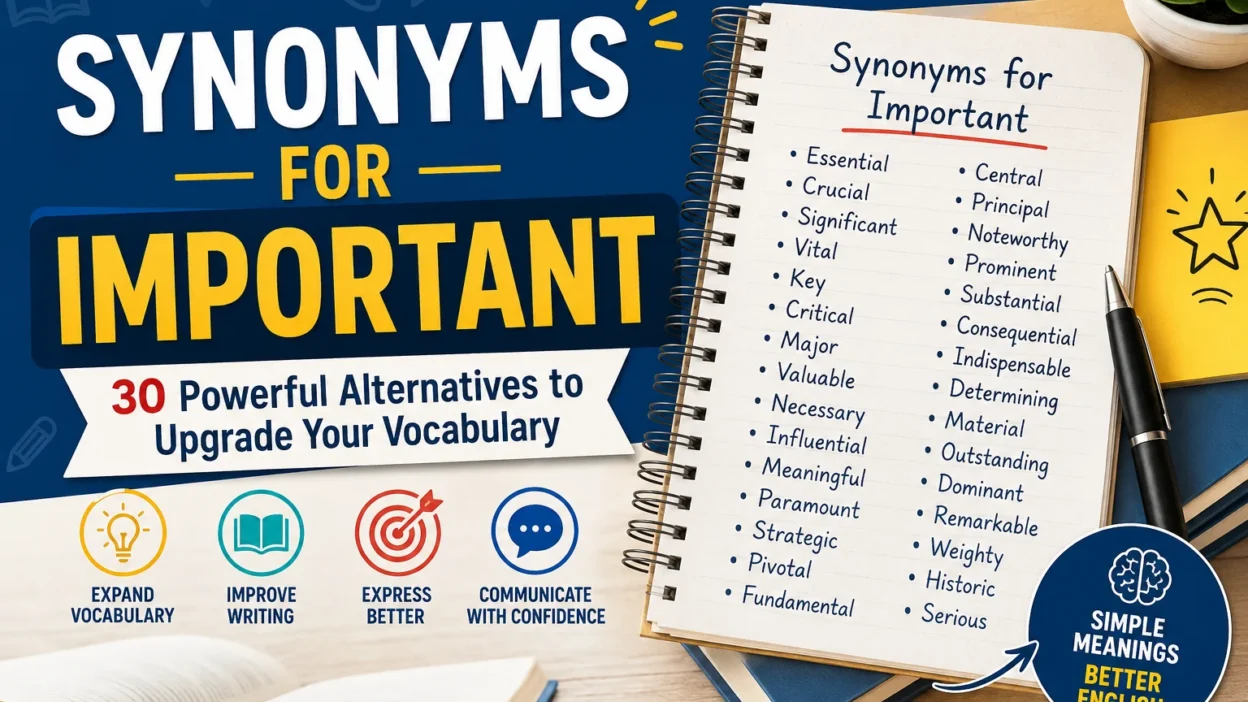
In this guide, you will discover 30 useful synonyms for important, their meanings, examples, and the best situations in which to use them.
What Does “Important” Mean?
The word important describes something that has value, influence, significance, or a strong effect on people, events, or outcomes.
Simple Definition
Something is important when it matters a lot or deserves special attention.
Example
“Education is important for personal and professional growth.”
Common Usage Contexts
- Academic writing
- Business communication
- Daily conversations
- Content creation
- Professional presentations
30 Synonyms for Important
1. Significant
Meaning: Having great meaning or value.
Example Sentence: Climate change is a significant global issue.
Best Usage Context: Academic and formal writing.
2. Essential
Meaning: Absolutely necessary.
Example Sentence: Water is essential for life.
Best Usage Context: Requirements and necessities.
3. Crucial
Meaning: Extremely important for success or failure.
Example Sentence: Good planning is crucial for project success.
Best Usage Context: Critical decisions and situations.
4. Vital
Meaning: Necessary for survival or effectiveness.
Example Sentence: Communication is vital in teamwork.
Best Usage Context: Health, business, and leadership topics.
5. Key
Meaning: Serving as a main factor.
Example Sentence: Customer satisfaction is a key business goal.
Best Usage Context: Business and professional writing.
6. Critical
Meaning: Extremely important and urgent.
Example Sentence: Quick action was critical during the emergency.
Best Usage Context: Serious situations.
7. Major
Meaning: Large in importance or influence.
Example Sentence: Technology plays a major role in education.
Best Usage Context: General discussions.
8. Fundamental
Meaning: Forming the basic foundation.
Example Sentence: Trust is fundamental to healthy relationships.
Best Usage Context: Principles and core concepts.
9. Necessary
Meaning: Required or needed.
Example Sentence: Proper training is necessary for new employees.
Best Usage Context: Everyday and professional use.
10. Influential
Meaning: Having the power to affect others.
Example Sentence: She is an influential leader in her industry.
Best Usage Context: People and organizations.
11. Meaningful
Meaning: Having deep value or purpose.
Example Sentence: The conversation was meaningful and inspiring.
Best Usage Context: Personal experiences.
12. Noteworthy
Meaning: Worth paying attention to.
Example Sentence: Her achievements are noteworthy.
Best Usage Context: Formal recognition.
13. Prominent
Meaning: Well-known and important.
Example Sentence: He is a prominent scientist.
Best Usage Context: Describing people or organizations.
14. Substantial
Meaning: Considerable in importance or size.
Example Sentence: The company made substantial progress.
Best Usage Context: Business and reports.
15. Consequential
Meaning: Producing important results.
Example Sentence: It was a consequential decision.
Best Usage Context: Formal writing.
16. Paramount
Meaning: More important than anything else.
Example Sentence: Safety is of paramount importance.
Best Usage Context: Formal and professional settings.
17. Central
Meaning: At the core of something.
Example Sentence: Communication is central to leadership.
Best Usage Context: Core ideas and concepts.
18. Principal
Meaning: Main or primary.
Example Sentence: The principal objective is customer satisfaction.
Best Usage Context: Business and academic writing.
19. Valuable
Meaning: Having worth or usefulness.
Example Sentence: Feedback is valuable for improvement.
Best Usage Context: General communication.
20. Weighty
Meaning: Serious and important.
Example Sentence: The committee discussed weighty issues.
Best Usage Context: Formal discussions.
21. Serious
Meaning: Requiring careful attention.
Example Sentence: This is a serious concern for parents.
Best Usage Context: Everyday communication.
22. Historic
Meaning: Important in history.
Example Sentence: The agreement was a historic achievement.
Best Usage Context: Historical events.
23. Strategic
Meaning: Important for long-term goals.
Example Sentence: The company made a strategic investment.
Best Usage Context: Business planning.
24. Indispensable
Meaning: Impossible to do without.
Example Sentence: Teamwork is indispensable for success.
Best Usage Context: Strong necessity.
25. Pivotal
Meaning: Serving as a turning point.
Example Sentence: The meeting was pivotal to the project.
Best Usage Context: Key moments and decisions.
26. Determining
Meaning: Influencing the final result.
Example Sentence: Experience was a determining factor.
Best Usage Context: Decision-making.
27. Material
Meaning: Relevant and significant.
Example Sentence: The lawyer presented material evidence.
Best Usage Context: Legal and professional writing.
28. Outstanding
Meaning: Exceptionally important or impressive.
Example Sentence: Her contribution was outstanding.
Best Usage Context: Achievements and recognition.
29. Dominant
Meaning: Having major influence or control.
Example Sentence: The company has a dominant position in the market.
Best Usage Context: Business and economics.
30. Remarkable
Meaning: Unusually important or impressive.
Example Sentence: The scientist made a remarkable discovery.
Best Usage Context: Accomplishments and achievements.
Comparison Guide: When to Use Different Synonyms
| Synonym | Best For | Tone |
|---|---|---|
| Essential | Necessities | Strong |
| Crucial | Critical situations | Serious |
| Vital | Survival and success | Strong |
| Significant | Academic writing | Formal |
| Key | Business communication | Professional |
| Meaningful | Personal experiences | Warm |
| Paramount | Top priority | Formal |
| Strategic | Planning and goals | Professional |
| Pivotal | Turning points | Formal |
| Valuable | General usefulness | Neutral |
How to Choose the Right Synonym
For Academic Writing
Use:
- Significant
- Fundamental
- Principal
- Consequential
- Paramount
These words sound formal and professional.
For Business Communication
Use:
- Key
- Strategic
- Critical
- Vital
- Central
These words are common in workplace communication.
For Everyday Conversation
Use:
- Important
- Necessary
- Valuable
- Serious
- Major
These are easy to understand and natural in speech.
For Emotional or Personal Topics
Use:
- Meaningful
- Remarkable
- Valuable
- Significant
These words help express deeper feelings and experiences.
For Urgent Situations
Use:
- Crucial
- Critical
- Vital
- Essential
These emphasize urgency and importance.
Common Mistakes When Using Synonyms for Important
Using Formal Words in Casual Conversations
Words like “paramount” and “consequential” may sound too formal in everyday speech.
Ignoring Context
Not all synonyms mean exactly the same thing. For example, “essential” suggests necessity, while “significant” focuses on importance or impact.
Overusing One Alternative
Even strong synonyms can become repetitive. Mix different words based on the context.
Benefits of Learning Synonyms for Important
Better Writing
Using varied vocabulary makes your writing more engaging.
Improved Speaking Skills
You can express ideas more accurately and confidently.
Stronger Academic Performance
A richer vocabulary often improves essays, assignments, and presentations.
Better SEO Content Creation
Content creators can avoid repetition and improve readability by using natural variations of important.
Conclusion
Learning different synonyms for important helps you communicate more clearly and effectively.
While the word “important” works in many situations, alternatives such as significant, essential, crucial, vital, and paramount can add precision and variety to your writing and speech.
The best synonym depends on your purpose, audience, and tone. Academic writers may prefer significant or consequential, while business professionals often use key, strategic, or critical.
By understanding the subtle differences between these words, you can choose the most accurate expression for every situation and strengthen your overall English vocabular