The English language offers many ways to express the same idea. Instead of repeating the same word over and over, you can choose a synonym that better matches your meaning and tone.
If you are searching for found synonyms, this guide will help you understand the best alternatives and when to use them.
Whether you are a student, ESL learner, writer, blogger, or content creator, learning different words for found can make your writing more natural, engaging, and professional.
Some synonyms are suitable for formal writing, while others work better in everyday conversations.
This guide explains each synonym in simple English with clear examples so you can confidently choose the right word.
What Does “Found” Mean?
Meaning of “Found”
The word found is the past tense and past participle of find. It means to discover, locate, notice, or obtain something after searching or by chance.
The word can also describe realizing something, uncovering information, or identifying a solution.
Common Usage
People use found in many situations, such as:
- Finding lost objects
- Discovering new information
- Identifying mistakes
- Reaching conclusions
- Making scientific discoveries
Example:
- I found my keys under the sofa.
- Scientists found a new species of butterfly.
- She found the answer after careful research.
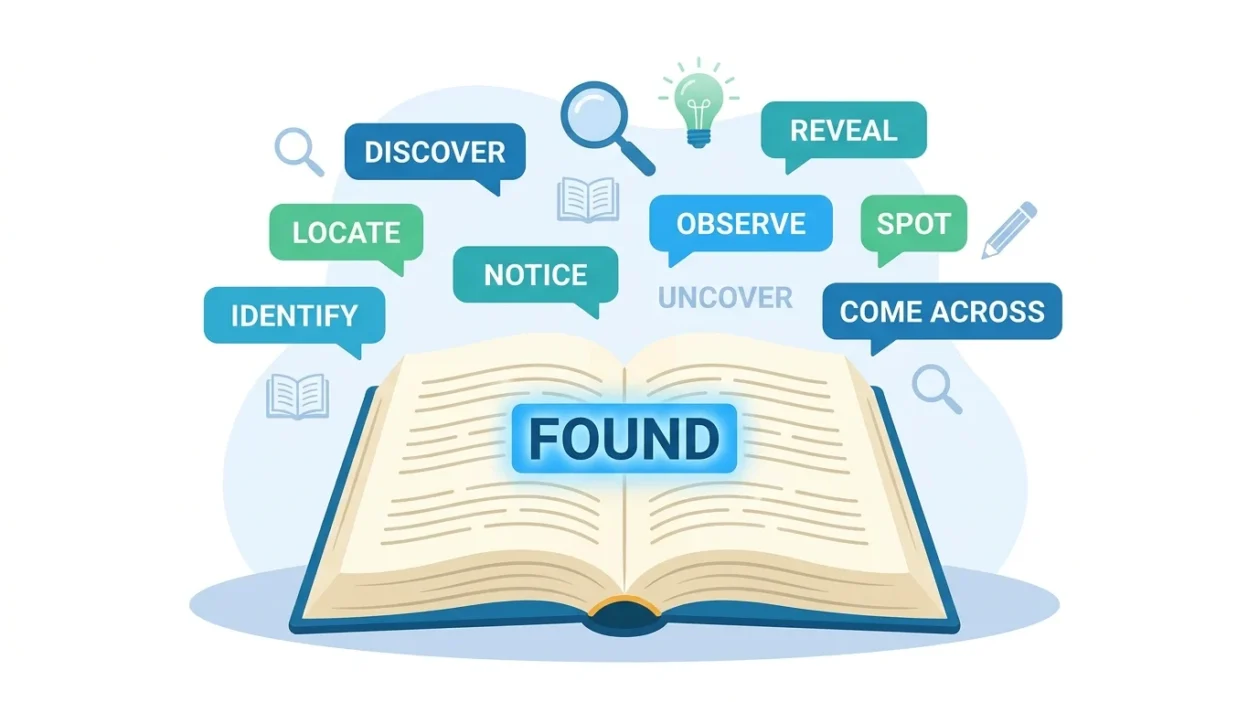
30 Found Synonyms with Meanings, Examples, and Best Usage
1. Discover
Meaning: To find something for the first time.
Example: We discovered a beautiful waterfall during our trip.
Best Usage: New discoveries, science, travel.
2. Locate
Meaning: To find the exact position of something.
Example: The police located the missing vehicle.
Best Usage: Formal writing, maps, investigations.
3. Identify
Meaning: To recognize or correctly name something.
Example: The doctor identified the cause of the illness.
Best Usage: Medical, education, research.
4. Detect
Meaning: To notice something that is difficult to see.
Example: The sensor detected smoke immediately.
Best Usage: Technology, science, security.
5. Notice
Meaning: To become aware of something.
Example: I noticed a small mistake in the report.
Best Usage: Everyday conversations.
6. Observe
Meaning: To carefully watch or notice something.
Example: Students observed the experiment closely.
Best Usage: Science, education.
7. Spot
Meaning: To see something quickly.
Example: I spotted my friend in the crowd.
Best Usage: Informal conversations.
8. Unearth
Meaning: To discover something hidden.
Example: Archaeologists unearthed ancient pottery.
Best Usage: History, archaeology.
9. Reveal
Meaning: To make something known.
Example: The report revealed important facts.
Best Usage: News, research.
10. Uncover
Meaning: To discover hidden information.
Example: Investigators uncovered new evidence.
Best Usage: Investigations, journalism.
11. Encounter
Meaning: To meet unexpectedly.
Example: We encountered heavy traffic.
Best Usage: Travel, storytelling.
12. Meet
Meaning: To come across someone.
Example: I met an old friend yesterday.
Best Usage: Personal conversations.
13. Come Across
Meaning: To find by chance.
Example: I came across an interesting article online.
Best Usage: Informal writing.
14. Run Into
Meaning: To unexpectedly meet someone.
Example: I ran into my teacher at the market.
Best Usage: Casual speech.
15. Obtain
Meaning: To get something successfully.
Example: She obtained permission to enter.
Best Usage: Formal documents.
16. Acquire
Meaning: To gain possession or knowledge.
Example: He acquired valuable skills.
Best Usage: Business, education.
17. Gain
Meaning: To receive or achieve something.
Example: She gained experience through practice.
Best Usage: Professional writing.
18. Retrieve
Meaning: To get something back.
Example: He retrieved his bag from the office.
Best Usage: Technology, everyday use.
19. Recover
Meaning: To find or get back something lost.
Example: Police recovered the stolen car.
Best Usage: News, legal writing.
20. Reach
Meaning: To arrive at or achieve something.
Example: They reached a solution together.
Best Usage: Problem-solving.
21. Learn
Meaning: To discover new information.
Example: We learned the truth yesterday.
Best Usage: Education, conversations.
22. Realize
Meaning: To suddenly understand something.
Example: I realized I forgot my wallet.
Best Usage: Everyday English.
23. Recognize
Meaning: To know someone or something.
Example: She recognized his voice immediately.
Best Usage: General English.
24. Ascertain
Meaning: To find out with certainty.
Example: Investigators ascertained the facts.
Best Usage: Formal reports.
25. Verify
Meaning: To confirm that something is true.
Example: Please verify your email address.
Best Usage: Business, technology.
26. Confirm
Meaning: To prove something is correct.
Example: The tests confirmed the diagnosis.
Best Usage: Medical, business.
27. Determine
Meaning: To discover after careful study.
Example: Scientists determined the cause.
Best Usage: Research.
28. Establish
Meaning: To prove or show clearly.
Example: The evidence established his innocence.
Best Usage: Legal, academic writing.
29. Find Out
Meaning: To learn information.
Example: I found out the meeting was canceled.
Best Usage: Informal conversations.
30. Track Down
Meaning: To find after searching for a long time.
Example: Detectives tracked down the suspect.
Best Usage: Investigations, storytelling.
When to Use Different Found Synonyms
Quick Comparison Guide
| Synonym | Best For | Tone |
|---|---|---|
| Discover | New discoveries | Neutral |
| Locate | Finding locations | Formal |
| Identify | Recognition | Formal |
| Detect | Hidden things | Technical |
| Notice | Everyday observations | Casual |
| Observe | Careful watching | Neutral |
| Spot | Quick visual finding | Informal |
| Unearth | Hidden discoveries | Formal |
| Reveal | Sharing information | Neutral |
| Uncover | Investigations | Formal |
| Come Across | Chance discoveries | Casual |
| Obtain | Receiving something | Formal |
| Acquire | Skills or possessions | Professional |
| Realize | Understanding | Casual |
| Determine | Research conclusions | Academic |
| Verify | Checking accuracy | Professional |
| Confirm | Proving facts | Formal |
| Recover | Getting something back | Neutral |
| Find Out | Learning information | Informal |
| Track Down | Long searches | Informal |
How to Choose the Right Synonym
For Everyday Conversation
Choose words that sound natural in daily speech.
- Notice
- Spot
- Meet
- Run Into
- Come Across
- Find Out
- Realize
For Academic Writing
Use more precise and formal vocabulary.
- Determine
- Identify
- Ascertain
- Establish
- Discover
- Observe
For Business and Professional Writing
These words sound polished and professional.
- Obtain
- Acquire
- Verify
- Confirm
- Locate
For Research and Science
These synonyms are commonly used in technical fields.
- Discover
- Detect
- Determine
- Observe
- Identify
- Reveal
For Investigations and Journalism
These words fit situations involving evidence or hidden information.
- Uncover
- Unearth
- Track Down
- Recover
- Ascertain
- Locate
Tips for Using Found Synonyms Naturally
Avoid Repetition
Using the same word repeatedly can make your writing sound repetitive. Replace found with a suitable synonym when the meaning stays clear.
Match the Context
Choose formal words for reports and essays, and casual words for conversations or blogs.
Consider the Meaning
Some synonyms imply careful searching, while others suggest accidental discovery. Always choose the word that best matches your intended meaning.
Common Examples Using Found Synonyms
Everyday Examples
- I found my phone under the bed.
- I located my phone using an app.
- I discovered an old photo album.
- I noticed a spelling mistake.
- I came across an interesting book.
- I realized I had left my keys at home.
Conclusion
Learning found synonyms is an excellent way to improve your English vocabulary and make your writing more engaging. While found is a useful and common word, choosing alternatives such as discover, locate, identify, notice, determine, or come across can make your communication clearer and more precise.
The best synonym depends on your purpose, audience, and tone. Casual conversations often use words like spot or find out, while academic and professional writing benefits from words like determine, verify, or ascertain. By understanding each synonym’s meaning, example, and usage context, you can express your ideas more naturally and confidently.