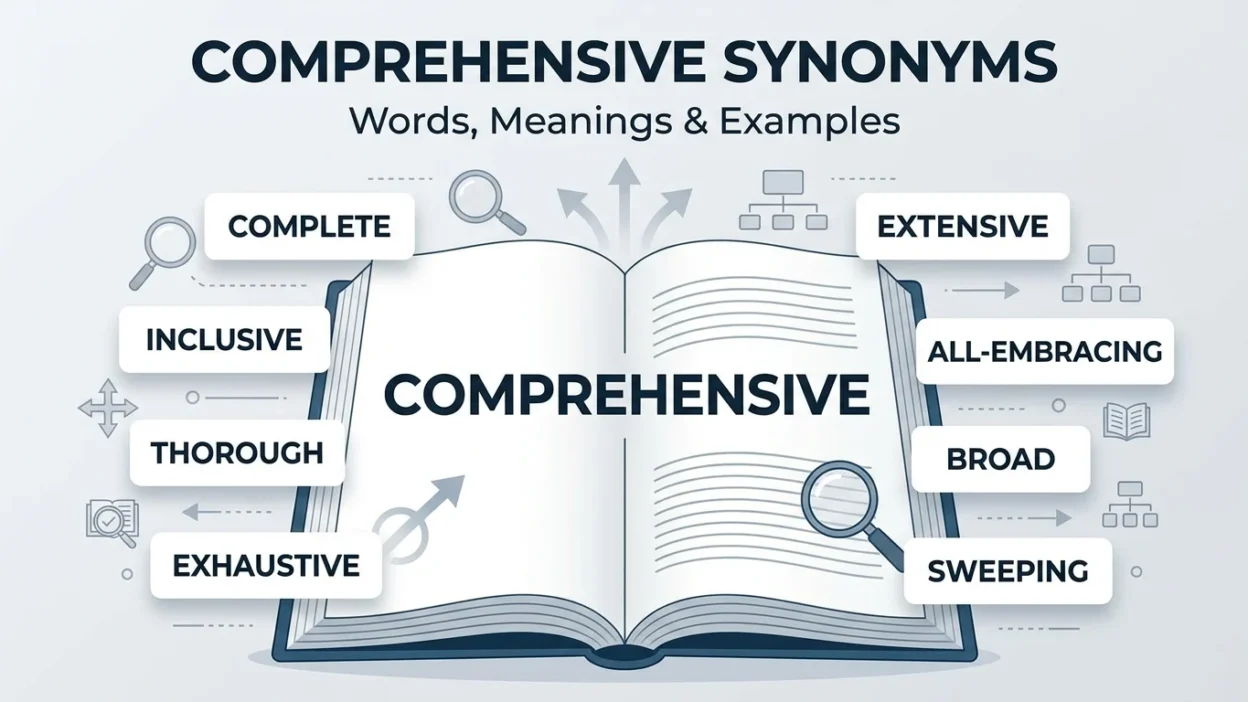
When you want to describe something as complete, detailed, or covering many important parts, the word comprehensive is a useful choice.
However, repeating the same word can make your writing feel less varied.
Learning comprehensive synonyms can help students, ESL learners, writers, and content creators express the same general idea with greater accuracy and style.
The word “comprehensive” can have slightly different meanings depending on context.
You might want to say that a report is detailed, a guide is thorough, a study is extensive, or an explanation is all-inclusive.
Choosing the right synonym allows you to communicate your exact meaning instead of simply replacing one word with another.
What Does “Comprehensive” Mean?
Comprehensive means including or covering nearly everything important about a particular subject. It suggests that something is complete, broad, detailed, or carefully covering the relevant parts.
For example:
“She prepared a comprehensive report on climate change.”
Here, comprehensive tells us that the report covers the subject in considerable detail.
Tone: Neutral, professional, academic, and informative.
Common contexts: Essays, reports, research, guides, instructions, reviews, education, business writing, and formal communication.
30 Comprehensive Synonyms
1. Complete
Meaning: Including all necessary or important parts.
Example:
The teacher gave us a complete explanation of the topic.
Best usage: Use “complete” when something contains all the parts that are needed.
2. Thorough
Meaning: Done carefully and with attention to all important details.
Example:
The researcher conducted a thorough investigation.
Best usage: Excellent for investigations, reviews, checks, explanations, and research.
3. Extensive
Meaning: Covering a large amount or wide range of information.
Example:
The website contains extensive information about the subject.
Best usage: Best when emphasizing size, range, or quantity.
4. Detailed
Meaning: Containing many specific facts or pieces of information.
Example:
He wrote a detailed description of the experiment.
Best usage: Use it when the focus is on specific information and details.
5. Inclusive
Meaning: Including all relevant people, things, or possibilities.
Example:
The survey provides an inclusive view of customer opinions.
Best usage: Useful when emphasizing that nothing important has been left out.
6. All-inclusive
Meaning: Including everything or almost everything needed.
Example:
The course offers an all-inclusive introduction to digital marketing.
Best usage: Common in packages, plans, courses, services, and broad descriptions.
7. Exhaustive
Meaning: Covering a subject in extremely great detail.
Example:
The lawyer conducted an exhaustive review of the documents.
Best usage: Best for formal or academic contexts where very detailed coverage is intended.
8. Broad
Meaning: Covering many areas, topics, or possibilities.
Example:
The course provides a broad introduction to psychology.
Best usage: Use when emphasizing range rather than depth.
9. Wide-ranging
Meaning: Covering many different areas or subjects.
Example:
The interview included a wide-ranging discussion of social issues.
Best usage: Natural for discussions, research, opinions, and topics that span several areas.
10. In-depth
Meaning: Exploring a subject deeply and carefully.
Example:
The article provides an in-depth analysis of the problem.
Best usage: Ideal for analysis, research, reports, articles, and studies.
11. Extensive-ranging
Meaning: Covering a very large range of subjects or information.
Example:
The library offers resources covering an extensive range of historical topics.
Best usage: Better expressed naturally as “covering an extensive range”; avoid using it as a direct replacement for comprehensive in most sentences.
12. Holistic
Meaning: Considering something as a whole rather than focusing on only one part.
Example:
The program takes a holistic approach to student development.
Best usage: Common in education, health, business, personal development, and systems thinking.
13. Universal
Meaning: Applying to or including everyone or everything in a particular category.
Example:
The organization developed a universal set of safety guidelines.
Best usage: Use when something is intended to apply broadly to everyone or everything.
14. Global
Meaning: Covering the whole subject, system, or world rather than only one part.
Example:
The report examines the global impact of technology.
Best usage: Especially useful for worldwide issues, business, economics, and international topics.
15. Sweeping
Meaning: Covering a very large area, range, or number of subjects.
Example:
The book offers a sweeping overview of modern history.
Best usage: Often used for broad ideas, changes, reforms, or overviews.
16. All-embracing
Meaning: Including or accepting many or all relevant aspects.
Example:
The policy provides an all-embracing approach to workplace safety.
Best usage: Formal writing when you want to emphasize broad coverage.
17. Encyclopedic
Meaning: Containing a very large amount of information about a subject.
Example:
Her knowledge of ancient history is encyclopedic.
Best usage: Useful when describing extremely broad or detailed knowledge.
18. Exhaustive-looking
Meaning: Appearing to cover a subject in great detail.
Example:
The website offers an exhaustive-looking collection of resources.
Best usage: This is not a standard direct synonym and is better avoided in polished academic writing.
19. Inclusive of
Meaning: Containing or considering a particular thing as part of a whole.
Example:
The price is inclusive of all basic services.
Best usage: Common in business, pricing, contracts, and formal communication.
20. Detailed-oriented
Meaning: Focused strongly on individual details.
Example:
The editor provided a detail-oriented review of the manuscript.
Best usage: More naturally written as detail-oriented. Use when emphasizing attention to small details rather than overall coverage.
21. Full
Meaning: Containing as much information or content as expected.
Example:
Please provide a full explanation of what happened.
Best usage: Simple and beginner-friendly; useful in everyday and professional English.
22. Complete-scale
Meaning: Covering something on a complete or large scale.
Example:
The company launched a complete-scale review of its operations.
Best usage: This is uncommon English and should generally be replaced with full-scale or comprehensive.
23. All-round
Meaning: Covering many different aspects or abilities.
Example:
The training provides an all-round understanding of the subject.
Best usage: Common in British English and useful for general abilities or development.
24. Full-spectrum
Meaning: Covering the complete range of relevant possibilities or aspects.
Example:
The program offers full-spectrum support for new employees.
Best usage: Common in business, technology, healthcare, and professional writing.
25. Panoramic
Meaning: Providing a broad view of something.
Example:
The documentary gives a panoramic view of the country’s history.
Best usage: More figurative and descriptive; useful when discussing broad perspectives.
26. Sweeping in scope
Meaning: Covering a very broad range of subjects or areas.
Example:
The study is sweeping in scope and includes several decades of data.
Best usage: Useful for academic and analytical writing.
27. Wide
Meaning: Covering a large range or variety.
Example:
The course attracts students with a wide range of interests.
Best usage: Simple and natural in everyday English.
28. Far-reaching
Meaning: Having an effect or range that extends a long way.
Example:
The new law could have far-reaching consequences.
Best usage: Best for effects, consequences, changes, decisions, and policies rather than simple information.
29. All-encompassing
Meaning: Including everything within a particular area or subject.
Example:
The company created an all-encompassing strategy for growth.
Best usage: Strong formal synonym when emphasizing very broad coverage.
30. Informed and detailed
Meaning: Based on good information and supported by substantial detail.
Example:
The committee produced an informed and detailed assessment.
Best usage: Useful when you want to emphasize both knowledge and detail rather than simply completeness.
Comprehensive Synonyms by Meaning
Not every synonym for “comprehensive” works in exactly the same situation. The best choice depends on what you want to emphasize.
When You Mean “Complete”
Use:
- Complete
- Full
- All-inclusive
- All-encompassing
- All-embracing
Example:
“We need a complete list of participants.”
These words work well when nothing important should be missing.
When You Mean “Detailed”
Use:
- Thorough
- Detailed
- In-depth
- Exhaustive
- Encyclopedic
Example:
“She wrote a thorough analysis of the issue.”
These choices emphasize depth and careful examination.
When You Mean “Broad”
Use:
- Broad
- Extensive
- Wide-ranging
- Sweeping
- Panoramic
Example:
“The conference covered a wide-ranging selection of topics.”
These words are better when you want to emphasize variety or scope.
When You Mean “Considering the Whole”
Use:
- Holistic
- All-encompassing
- Full-spectrum
- All-round
Example:
“The organization needs a holistic approach to employee development.”
These synonyms work especially well when multiple connected aspects must be considered together.
Comparison Table: Comprehensive vs. Its Synonyms
| Synonym | Main Meaning | Tone | Best Context |
|---|---|---|---|
| Comprehensive | Covers almost everything important | Neutral/Formal | General, academic, professional |
| Complete | Has all necessary parts | Neutral | Everyday and formal |
| Thorough | Carefully covers details | Formal | Research, reviews, investigations |
| Extensive | Covers a large range | Formal | Research, resources, information |
| Detailed | Contains many specific facts | Neutral | Reports, explanations |
| Inclusive | Includes relevant parts or groups | Neutral/Formal | Policies, plans, groups |
| Exhaustive | Extremely detailed | Formal | Research, legal, academic |
| Broad | Covers a wide area | Neutral | General discussions |
| Wide-ranging | Covers many subjects | Neutral/Formal | Discussions, research |
| In-depth | Goes deeply into a subject | Formal | Analysis, articles, studies |
| Holistic | Considers the whole system | Formal | Education, business, development |
| All-encompassing | Covers everything relevant | Formal | Strategies, policies |
| Encyclopedic | Very broad and informative | Formal | Knowledge, references |
| All-round | Covers many aspects | Neutral | Skills, development |
| Full-spectrum | Covers the entire range | Professional | Business, technology |
| Far-reaching | Extends widely or has broad effects | Formal | Policies, consequences |
How to Choose the Right Synonym
Choosing the right synonym is easier when you first decide what you want to emphasize.
For Academic Writing
Choose:
- Comprehensive
- Thorough
- Extensive
- In-depth
- Exhaustive
- Detailed
These words work well in essays, research papers, reports, and academic explanations.
For Simple Everyday English
Choose:
- Complete
- Full
- Wide
- Broad
- Detailed
These words are easy to understand and sound natural in ordinary conversation.
For Professional Writing
Choose:
- Comprehensive
- Extensive
- Inclusive
- All-encompassing
- Full-spectrum
- Thorough
These are useful for reports, business plans, policies, and professional documents.
For Very Detailed Information
Choose:
- Thorough
- Exhaustive
- In-depth
- Encyclopedic
- Detailed
These choices tell the reader that considerable attention has been given to the subject.
For Broad Coverage
Choose:
- Broad
- Extensive
- Wide-ranging
- Sweeping
- Panoramic
These words are appropriate when the main idea is range rather than detailed examination.
For a Whole-System Approach
Choose:
- Holistic
- All-encompassing
- All-embracing
- Full-spectrum
- All-round
These words are particularly useful when multiple connected factors are being considered.
Common Mistakes When Using Comprehensive Synonyms
Using “Exhaustive” When You Only Mean “Detailed”
“Exhaustive” is stronger than “detailed.” It suggests that an effort was made to cover virtually every relevant aspect.
Using “Broad” When You Mean “Detailed”
A broad explanation may cover many subjects without discussing each one deeply. If depth matters, thorough or in-depth may be better.
Using “Holistic” as a Direct Replacement Everywhere
“Holistic” specifically suggests looking at a whole system or situation. It does not simply mean “complete.”
Choosing a Synonym Without Checking Tone
Some alternatives sound more formal than others. For example, complete is common and simple, while exhaustive sounds more academic.
Comprehensive Synonyms for Essays
If you are writing an essay, some of the most useful alternatives include:
- Thorough
- Extensive
- Detailed
- In-depth
- Broad
- Wide-ranging
- Exhaustive
- Holistic
For example:
Basic:
“The essay gives a comprehensive analysis of social media.”
Alternative:
“The essay provides an in-depth analysis of social media.”
The second version emphasizes depth rather than simply saying that many aspects are covered.
Comprehensive Synonyms for Students and ESL Learners
For ESL learners, it is useful to start with simple words before learning advanced alternatives.
Easy: complete, full, broad, detailed
Intermediate: thorough, extensive, inclusive, wide-ranging
Advanced: exhaustive, holistic, encyclopedic, all-encompassing
Learning synonyms in groups makes vocabulary easier to remember because you can connect each word with its particular meaning and tone.
Frequently Asked Questions About Comprehensive Synonyms
Is “complete” a synonym for comprehensive?
Yes. Complete can be a synonym for comprehensive when you mean that something contains all necessary parts. However, “comprehensive” often suggests broader or more detailed coverage.
What is the best synonym for comprehensive?
There is no single best synonym. Thorough, complete, extensive, and detailed are among the most useful choices, depending on the sentence.
What is a simple synonym for comprehensive?
Complete is one of the simplest synonyms. Full and detailed can also work in suitable contexts.
Is “extensive” the same as “comprehensive”?
They are similar but not identical. Extensive emphasizes a large range or amount, while comprehensive emphasizes covering all or nearly all important aspects.
What is a stronger synonym for comprehensive?
Exhaustive or all-encompassing can be stronger choices when you want to emphasize extremely broad or detailed coverage.
Can I use comprehensive in academic writing?
Yes. Comprehensive is commonly used in academic writing because it has a professional and precise tone.
Final Thoughts
Learning comprehensive synonyms is about more than replacing one word with another. Each alternative carries a slightly different meaning, level of detail, or tone. Complete emphasizes all necessary parts, thorough emphasizes careful attention, extensive emphasizes range, and in depth emphasizes depth.
For everyday writing, simple words such as complete, full, and detailed are often the best choices. For academic or professional writing, words such as thorough, extensive, exhaustive, and all encompassing can provide greater precision. The key is to choose the word that matches your exact meaning instead of automatically selecting the most advanced synonym.