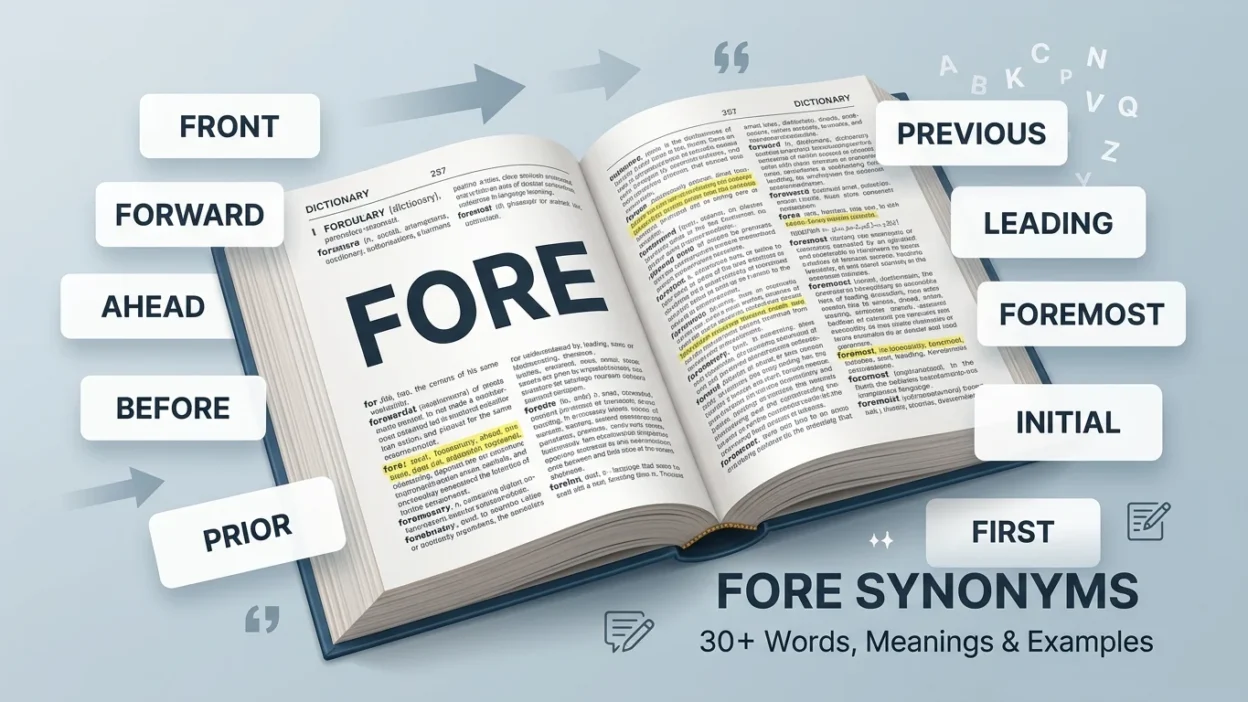
The word “fore” is short, but it can have several meanings depending on the context.
You may see it used to describe the front part of something, an earlier position in time, or a warning shouted on a golf course.
Because of these different meanings, finding the right fore synonyms can sometimes be confusing, especially for students, ESL learners, writers, and content creators.
Understanding synonyms for “fore” can help you choose words that sound more natural and precise.
For example, front, forward, ahead, and before may all relate to “fore,” but they are not always interchangeable. The best choice depends on what you are trying to say.
What Does “Fore” Mean?
Simple Meaning of Fore
Fore generally means the front part of something or a position that is toward the front.
For example:
- The passengers sat in the fore part of the boat.
- The ship’s fore section was damaged.
“Fore” can also refer to something that comes before or is positioned ahead.
In golf, “Fore!” is a warning shouted when a ball may hit another person.
Tone and Usage of “Fore”
“Fore” is usually a formal, literary, technical, or specialized word. In everyday English, people are more likely to say front, forward, ahead, or before.
The correct synonym depends heavily on the sentence and intended meaning.
30 Fore Synonyms With Meanings and Examples
1. Front
Meaning: The part of something that is nearest to the beginning or facing forward.
Example:
She stood at the front of the classroom.
Best usage: Everyday English and general descriptions.
2. Forward
Meaning: Toward the front or in the direction ahead.
Example:
The passengers moved forward when the doors opened.
Best usage: Movement, position, direction, and physical location.
3. Ahead
Meaning: In front of someone or something, or further forward.
Example:
There was a long road ahead of us.
Best usage: Direction, position, time, and progress.
4. Before
Meaning: Earlier than something else in time or order.
Example:
Please finish your work before lunch.
Best usage: Time and sequence.
5. Earlier
Meaning: Happening or existing before the present time or another event.
Example:
I had seen the movie earlier.
Best usage: Talking about past events or time.
6. Prior
Meaning: Existing or happening before something else.
Example:
You need prior approval before starting the project.
Best usage: Formal and professional writing.
7. Previous
Meaning: Happening or existing before the current one.
Example:
She discussed the previous chapter.
Best usage: Formal writing, academic work, and comparisons.
8. Former
Meaning: Something that was true or existed in the past but is not true now.
Example:
He met his former teacher at the event.
Best usage: People, positions, relationships, and past situations.
9. Preceding
Meaning: Coming immediately before something else.
Example:
Read the preceding paragraph carefully.
Best usage: Academic, technical, and formal writing.
10. Foremost
Meaning: Most important or at the front.
Example:
Safety should be our foremost concern.
Best usage: Formal writing when emphasizing importance.
11. Leading
Meaning: Being first, ahead, or most important.
Example:
She is a leading expert in the field.
Best usage: People, organizations, positions, and importance.
12. Frontward
Meaning: Toward the front.
Example:
The seats were arranged frontward toward the stage.
Best usage: Directional descriptions, although “forward” is much more common.
13. Foremost Part
Meaning: The section that is furthest toward the front.
Example:
The crew worked in the foremost part of the vessel.
Best usage: Ships, vehicles, structures, and technical descriptions.
14. Forward Part
Meaning: The part located toward the front.
Example:
The engine was located in the forward part of the vehicle.
Best usage: Technical and physical descriptions.
15. Frontmost
Meaning: Located furthest toward the front.
Example:
He sat in the frontmost row.
Best usage: Describing physical position.
16. Head
Meaning: The front, beginning, or leading position of something.
Example:
She walked at the head of the group.
Best usage: Groups, lines, organizations, and positions.
17. Lead
Meaning: To be ahead of others or in the first position.
Example:
Our team took the lead early in the competition.
Best usage: Competition, progress, and leadership.
18. Vanguard
Meaning: The leading position or people at the forefront of something.
Example:
The researchers were at the vanguard of medical innovation.
Best usage: Formal, literary, and intellectual writing.
19. Forepart
Meaning: The front part of something.
Example:
The damage was concentrated in the forepart of the ship.
Best usage: Technical or formal descriptions.
20. Proximal
Meaning: Located nearer to a particular point of reference.
Example:
The injury affected the proximal section of the bone.
Best usage: Medical, scientific, and anatomical writing.
21. Antecedent
Meaning: Something that comes before another thing.
Example:
The antecedent event influenced the final decision.
Best usage: Formal, academic, grammatical, and logical contexts.
22. Precursor
Meaning: Something that comes before and often leads to something else.
Example:
The early invention was a precursor to modern computers.
Best usage: History, science, technology, and development.
23. Preliminary
Meaning: Happening before the main event or final stage.
Example:
The researchers conducted a preliminary investigation.
Best usage: Academic, professional, scientific, and formal contexts.
24. Initial
Meaning: First or occurring at the beginning.
Example:
The initial response was positive.
Best usage: Reports, academic writing, business, and general English.
25. Opening
Meaning: First or beginning part of something.
Example:
The opening section explains the main idea.
Best usage: Speeches, books, events, articles, and presentations.
26. Beginning
Meaning: The first part or starting point of something.
Example:
At the beginning of the story, the character lives alone.
Best usage: Simple everyday English.
27. First
Meaning: Coming before all others in order, time, or position.
Example:
She was the first person to arrive.
Best usage: General English, especially order and sequence.
28. Foregoing
Meaning: Mentioned or occurring earlier.
Example:
The foregoing discussion explains the main problem.
Best usage: Very formal or legal writing.
29. Upfront
Meaning: At the front or at the beginning; sometimes meaning openly or in advance.
Example:
The company explained the costs upfront.
Best usage: Modern business and conversational English, depending on meaning.
30. In Front
Meaning: Located ahead of or before something else.
Example:
A large tree stood in front of the house.
Best usage: Everyday English and physical position.
Fore Synonyms by Meaning
When “Fore” Means Front
If “fore” refers to the physical front of something, the best choices are:
- Front
- Forward
- Frontmost
- Forepart
- Forward part
- In front
- Head
For example:
The crew worked in the fore section of the ship.
You could write:
The crew worked in the forward section of the ship.
Here, forward sounds more natural in modern English.
When “Fore” Means Before
When “fore” refers to something happening earlier, consider:
- Before
- Earlier
- Prior
- Previous
- Preceding
- Former
- Antecedent
For example:
The fore event influenced the outcome.
Depending on the intended meaning, previous, preceding, or earlier may be more appropriate.
When “Fore” Means Leading
When “fore” suggests being at the front or leading position, useful alternatives include:
- Leading
- Foremost
- Vanguard
- Lead
- Head
For example:
The organization is at the fore of environmental research.
A natural alternative is:
The organization is at the forefront of environmental research.
Comparison Guide: Which Fore Synonym Should You Use?
| Synonym | Main Meaning | Tone | Best Context |
|---|---|---|---|
| Front | Physical front | Neutral | Everyday English |
| Forward | Toward the front | Neutral | Direction and position |
| Ahead | In front or further on | Neutral | Direction and progress |
| Before | Earlier | Neutral | Time and sequence |
| Earlier | At a previous time | Neutral | Past events |
| Prior | Before | Formal | Academic/business |
| Previous | Earlier/current comparison | Neutral | Writing and speech |
| Preceding | Coming before | Formal | Academic/technical |
| Foremost | Most important/front | Formal | Emphasis |
| Leading | Ahead or important | Neutral/Formal | People and organizations |
| Vanguard | Leading position | Formal | Innovation and movements |
| Initial | First | Neutral/Formal | Reports and processes |
| Preliminary | Before the main stage | Formal | Research and business |
| First | Number one in order | Neutral | General English |
| Opening | Beginning | Neutral | Events and writing |
| Beginning | Starting point | Neutral | Everyday English |
| Precursor | Something that comes before | Formal | Science/history |
| Antecedent | Something preceding | Formal | Academic/technical |
| Frontmost | Furthest toward front | Formal | Physical position |
| Upfront | At the beginning/in advance | Informal | Business/conversation |
Fore vs Front
What Is the Difference?
Fore and front can both describe a position at the front, but front is much more common in everyday English.
Fore often sounds specialized, old-fashioned, nautical, or formal.
Front is the safer choice for most general situations.
Example:
- Formal/specialized: The crew moved toward the fore of the vessel.
- Common: The crew moved toward the front of the vessel.
Fore vs Forward
When Should You Use Each?
Forward usually describes movement or direction toward the front.
Fore more often identifies the front part or position.
Example:
- The passengers moved forward.
- The fore section of the ship was damaged.
For everyday writing, forward is usually more natural when describing movement.
Fore vs Before
Are They Interchangeable?
Not always.
Before is mainly used to describe time, order, or something occurring earlier.
Fore is more commonly connected with the front or leading position.
For example:
Wash your hands before eating.
You would not normally replace “before” with “fore” in this sentence.
Fore vs Ahead
Understanding the Difference
Ahead usually means farther forward, in front, or later in a process.
Fore tends to identify the front position itself.
For example:
There is a difficult journey ahead.
But:
The fore section of the ship was heavily damaged.
Both can relate to “front,” but their grammar and typical contexts differ.
How to Choose the Right Fore Synonym
For Everyday English
Use simple and familiar words such as:
- Front
- Ahead
- Forward
- Before
- First
- Beginning
These words are easy for readers to understand and work well in casual communication.
For Academic Writing
Choose more precise words such as:
- Prior
- Previous
- Preceding
- Antecedent
- Initial
- Preliminary
These choices can make academic writing clearer and more precise.
For Technical Writing
Technical contexts may require:
- Forward
- Forepart
- Proximal
- Frontmost
- Preceding
- Antecedent
Always consider the field before choosing a technical synonym.
For Formal Writing
Good options include:
- Foremost
- Prior
- Preceding
- Vanguard
- Antecedent
- Precursor
- Foregoing
These words can work well in formal reports, essays, and professional documents.
For Creative or Literary Writing
Writers may use:
- Fore
- Foremost
- Vanguard
- Head
- Opening
- Front
The choice depends on the atmosphere and style of the writing.
Why Understanding Fore Synonyms Matters
Better Vocabulary
Learning different alternatives to “fore” expands your vocabulary and helps you avoid repeating the same words.
Instead of repeatedly using “front,” you can choose forward, foremost, leading, or another suitable word.
More Accurate Writing
Synonyms are not always exact replacements. Learning their differences helps you communicate your intended meaning more accurately.
For example, prior refers to something earlier, while front refers to physical position.
Better ESL Skills
ESL learners often know a basic word but struggle to understand its formal or specialized alternatives.
Learning groups of related words makes it easier to recognize vocabulary when reading books, articles, academic papers, and professional documents.
Common Mistakes When Using Fore Synonyms
Using “Prior” for Physical Position
“Prior” usually means earlier, not physically in front.
Incorrect:
The prior part of the car.
Better:
The front part of the car.
Using “Former” for Any Front Position
“Former” normally refers to something from the past.
Example:
He is a former employee.
It does not normally mean the physical front of something.
Treating All Synonyms as Exact Replacements
Words that share a similar meaning may have different grammar, tone, or contexts.
For example, vanguard and front are related, but they are not interchangeable in every sentence.
Always check what the original sentence is trying to express.
Frequently Asked Questions About Fore Synonyms
What is the closest synonym for “fore”?
The closest synonym depends on the meaning. Front, forward, and ahead are common choices when “fore” means a front position.
What is a simple synonym for fore?
Front is one of the simplest and most common synonyms for “fore” when describing physical position.
What is the synonym of fore in formal English?
Depending on context, formal alternatives include prior, preceding, foremost, antecedent, precursor, and vanguard.
Is “before” a synonym for “fore”?
Sometimes, but not always. Before usually refers to earlier time or order, while fore often refers to the front or leading position.
Is “forward” a synonym for “fore”?
Yes, in contexts involving a frontward position or direction. However, forward is generally more common in modern English.
What is the opposite of fore?
The opposite depends on context. For physical position, rear, back, or aft may be opposites. For time, after can be an opposite of “before.”
Final Thoughts on Fore Synonyms
Understanding fore synonyms is useful because “fore” can have different meanings depending on the sentence. It may refer to the front of something, an earlier position, or a leading place.
For everyday English, front, forward, ahead, and before are often the easiest alternatives. For academic and formal writing, words such as prior, preceding, antecedent, and foremost can provide greater precision.
The most important rule is simple: do not choose a synonym only because it looks similar in a dictionary. Choose the word that matches the meaning, tone, and context of your sentence.

Liam Henry is a content author at Synonymed, specializing in vocabulary enrichment and synonym guides. He creates clear, engaging resources that help learners improve English word knowledge and language fluency.