If you are confused about bale vs bail, you are dealing with two words that sound alike but have different meanings, spellings, and uses.
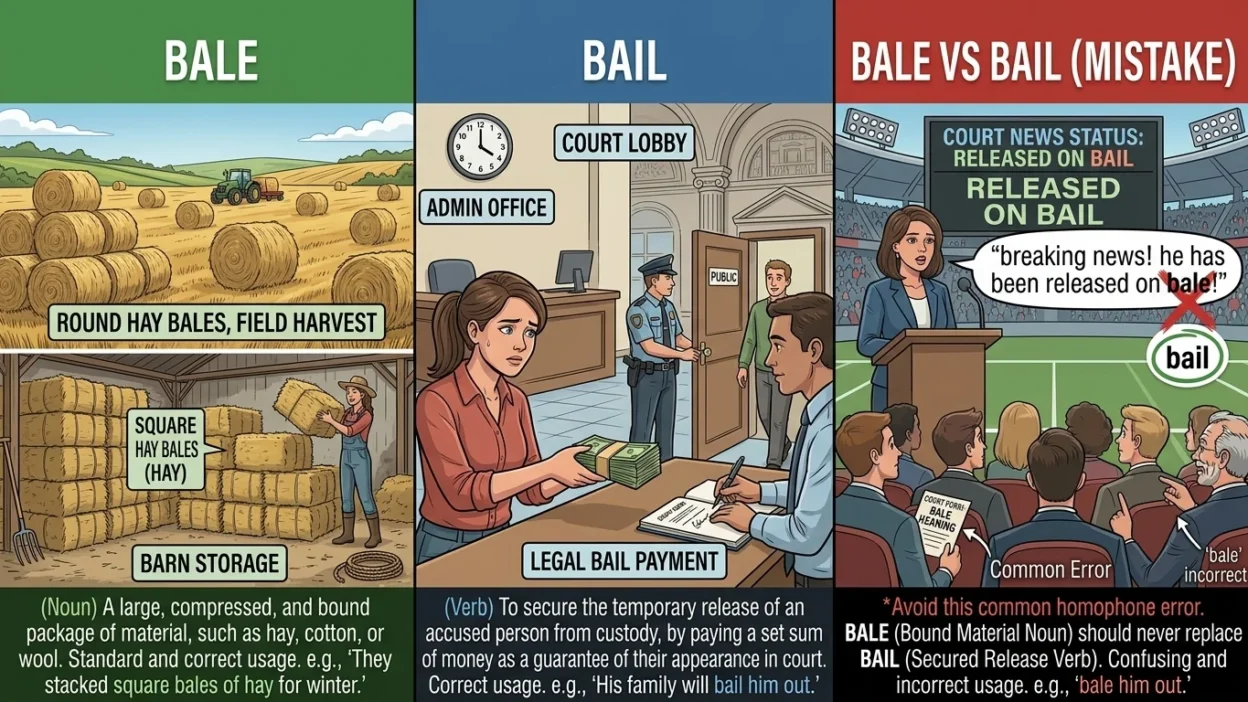
Bale usually refers to a large, tightly packed bundle of material such as hay, straw, cotton, or paper.
Bail, on the other hand, can mean money or a legal arrangement that allows an accused person to remain free while a case continues.
It can also mean removing water from a boat or bucket.
Although bale and bail are pronounced the same in many varieties of English, their meanings are easy to separate when you look at the context.
Knowing the difference is useful for students, ESL learners, writers, and anyone who wants to avoid spelling mistakes.
In this guide, you will learn what bale and bail mean, when to use each one, common mistakes, practical examples, and a simple trick that makes the difference easier to remember.
Quick Answer: Bale vs Bail
Bale usually means a large, tightly compressed bundle of material such as hay, cotton, or straw. Bail most commonly refers to the temporary release of someone accused of a crime, often involving money or conditions set by a court. Bail can also mean removing water from a boat.
Why Do People Confuse Bale and Bail?
People confuse bale and bail because they are homophones in many varieties of English. This means they sound the same but have different spellings and meanings.
The main difference is:
- Bale → a tightly packed bundle of material
- Bail → release from legal custody under specified conditions
- Bail → to remove water from a boat or container
For example:
- The farmer loaded a bale of hay onto the truck.
- The judge granted him bail.
- We had to bail water out of the boat.
The context usually makes the intended meaning clear.
What Does “Bale” Mean?
Bale is usually a noun meaning a large bundle of material that has been tightly compressed and secured.
Farmers commonly make bales of hay, straw, cotton, or similar materials for storage and transportation.
Examples of “bale”
- The farmer lifted a bale of hay.
- We stacked the bales of straw in the barn.
- The truck was carrying several bales of cotton.
- A large bale of paper was delivered to the recycling center.
“Bale” as a verb
Bale can also be used as a verb meaning to make material into bales.
For example:
- The workers baled the hay after it dried.
- The machine bales the straw into compact bundles.
So, bale is closely associated with compressed bundles of materials, especially agricultural products.
What Does “Bail” Mean?
Bail has several meanings, but one of its most common uses is in law.
Bail in law
In a legal context, bail refers to the release of an accused person from custody while legal proceedings continue, usually subject to conditions. Depending on the legal system and circumstances, bail may involve a payment, a guarantee, or other conditions.
For example:
- The court granted him bail.
- She was released on bail.
- The judge refused bail.
The exact rules surrounding bail vary by jurisdiction.
Bail as a verb: removing water
Bail can also be a verb meaning to remove water from a boat or other container.
For example:
- We had to bail water out of the boat.
- He used a bucket to bail the canoe.
- The boat began taking on water, so they started bailing.
This meaning is completely different from the legal meaning.
Bale vs Bail: Comparison Table
| Word | Main Meaning | Part of Speech | Example |
|---|---|---|---|
| Bale | A tightly compressed bundle of material | Noun | We loaded a bale of hay. |
| Bale | To make something into a bale | Verb | They baled the straw. |
| Bail | Release from legal custody under conditions | Noun/Verb | The court granted bail. |
| Bail | Remove water from a boat or container | Verb | They bailed water from the boat. |
When Should You Use “Bale” or “Bail”?
- hay
- straw
- cotton
- paper
- recycling materials
- tightly compressed bundles
- bail from police or court custody
- being released on bail
- posting or granting bail
- bailing water from a boat
- removing water from a container
A quick context test
Ask yourself:
Is it a compressed bundle?
→ Use bale.
Is it about legal release?
→ Use bail.
Are you removing water from a boat?
→ Use bail.
12 Examples of Bale and Bail
Examples with “bale”
- The farmer moved a bale of hay into the barn.
- We loaded three bales of straw onto the truck.
- The workers stacked the bales of cotton carefully.
- The machine can bale large amounts of hay quickly.
- The recycling center compressed the paper into a bale.
- The horse stood beside a large bale of hay.
Examples with “bail”
- The judge granted the defendant bail.
- She was released on bail pending the next hearing.
- The court set conditions for his bail.
- We had to bail water out of the boat.
- He used a small bucket to bail the canoe.
- The crew started bailing when the boat began filling with water.
Common Mistakes with Bale and Bail
Mistake 1: Using “bail” for a bundle of hay
Incorrect:
“The farmer loaded a bail of hay.”
Correct:
“The farmer loaded a bale of hay.”
A bundle of hay is a bale.
Mistake 2: Using “bale” for legal release
Incorrect:
“He was released on bale.”
Correct:
“He was released on bail.”
Legal release from custody is bail.
Mistake 3: Confusing “bail” with “bale” when removing water
Incorrect:
“They had to bale the boat.”
Correct:
“They had to bail the boat.”
When bail is used as a verb in this context, it means to remove water from a boat or container.
Mistake 4: Assuming pronunciation tells you the spelling
Because bale and bail sound alike, pronunciation does not tell you which spelling to use. Think about the meaning first.
Easy Memory Trick for Bale vs Bail
Use this simple trick:
Bale = bundle.
Think of a bale of hay as a tightly packed bundle.
Bail = law or water.
Think of bail in court or bailing water from a boat.
A useful sentence to remember is:
A bale is a bundle; bail is for court or water.
For example:
- Bale of hay
- Bail from jail
- Bail water from a boat
American vs British English
The basic meanings and spellings of bale and bail are generally the same in American and British English.
Both varieties use bale for compressed bundles such as hay or cotton. Both also use bail for legal release and for removing water from a boat.
Legal procedures and terminology surrounding bail can differ between countries and legal systems, however. The general meaning remains similar, but the specific rules, conditions, and procedures should be understood according to the relevant jurisdiction.
Similar Words to Bale and Bail
Several English words are related to the meanings of bale and bail.
Words related to “bale”
- bundle — a group of things gathered together
- pack — a collection of things put together
- roll — material wound into a cylindrical form
- stack — a group of items placed one on another
- compress — to press something into a smaller space
Words related to “bail”
For the legal meaning:
- release — freedom from custody or detention
- custody — legal or official control of a person
- court — the institution where legal proceedings take place
- bond — a financial or legal guarantee in some bail systems
For the water-related meaning:
- drain — remove liquid
- scoop — lift something using a tool or container
- empty — remove the contents of something
Final Verdict: Bale or Bail?
Use bale when you mean a tightly packed bundle of material, such as hay, straw, cotton, or paper.
Use bail when you mean legal release from custody or the act of removing water from a boat or container.
The easiest rule is:
Bale = bundle.
Bail = court or water.
Once you connect each spelling with its main meaning, it becomes much easier to choose the correct word.
Frequently Asked Questions
Is it “bale of hay” or “bail of hay”?
The correct phrase is “bale of hay.” A bale is a tightly compressed bundle of hay.
What is the difference between bale and bail?
Bale usually means a tightly compressed bundle of material. Bail commonly means legal release from custody or removing water from a boat or container.
Is “bale” a verb?
Yes. Bale can be a verb meaning to make something into a bale. For example, “The farmers baled the hay.”
What does “bail” mean in law?
In law, bail generally refers to the release of an accused person from custody while a case proceeds, subject to conditions that may vary by jurisdiction.
Can “bail” mean to remove water?
Yes. As a verb, bail can mean to remove water from a boat or container. For example, “They bailed water out of the canoe.”
Are bale and bail homophones?
Yes. Bale and bail are pronounced alike in many varieties of English but have different spellings and meanings.
Is it “bale out” or “bail out”?
Both expressions exist, but they have different meanings. Bail out can mean to remove water, leave a difficult situation, or provide financial help. Bale is associated with making or handling bundles.
How can I remember bale vs bail?
Remember: bale = bundle. Think of a bale of hay. Bail = court or water. Think of bail from custody or bailing water from a boat.
Remember This
Bale = a bundle.
Bail = legal release or removing water.
If you see hay, straw, cotton, or another compressed material, think bale. If you see court, custody, or a boat filling with water, think bail.
Conclusion
The difference between bale and bail becomes clear when you focus on context. Bale refers mainly to a tightly packed bundle of material and can also describe the process of making such bundles. Bail has several uses, most notably legal release from custody and removing water from a boat or container.
Although the two words sound the same, their meanings are quite different. Remember the simple rule “bale = bundle; bail = court or water,” and you will be able to choose the correct spelling with confidence in most situations.