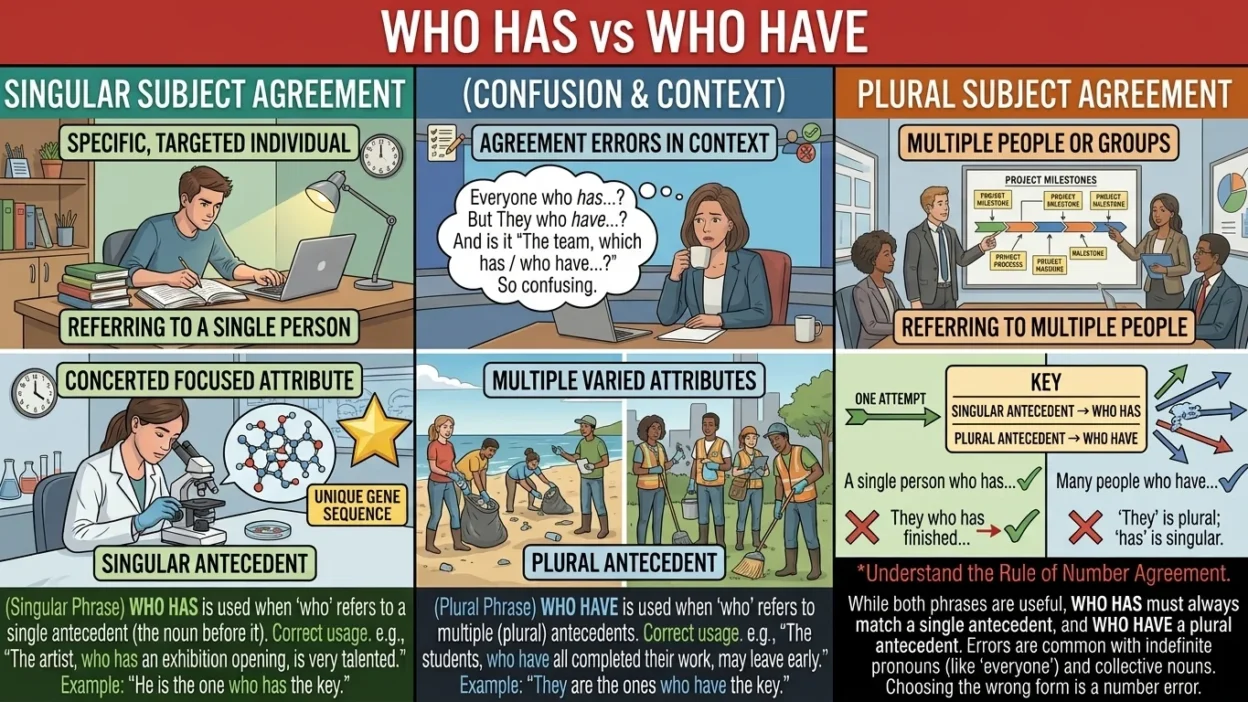
Choosing between “who has” and “who have” can be confusing because who can refer to one person or several people.
The correct verb depends on the person or people who “who” refers to, not simply on the word “who” itself.
For example, we say, “Who has my phone?” when asking about one person, but “Who have the tickets?”
is normally incorrect in standard English because the natural question is “Who has the tickets?”
When who refers to a plural noun inside a relative clause, however, “who have” can be correct.
The most important point is that “who has” and “who have” are both grammatically correct in different situations. “
Has” is the third-person singular form of have, while “have” is used with plural subjects and with I/you.
Understanding what who refers to will help you choose the correct form in questions, relative clauses, and everyday conversation.
Quick Answer
Use “who has” when who refers to one person or when the question naturally treats an unknown person as singular. Use “who have” when who refers to multiple people in a relative clause. The correct choice depends on the subject represented by who.
Why Do People Confuse “Who Has” and “Who Have”?
The word who does not itself tell us whether the person is singular or plural.
Consider these two sentences:
The student who has the key is waiting outside.
Here, who refers to the student, which is singular. Therefore, we use has.
The students who have the keys are waiting outside.
Here, who refers to the students, which is plural. Therefore, we use have.
The difficulty becomes greater in questions because the identity of the person is unknown:
Who has my pen?
In standard English, who has is the normal form in this type of question.
First Word: “Who”
Who is a pronoun used to refer to people.
It can appear in:
- questions
- relative clauses
- indirect questions
- formal and informal conversation
Examples:
Who called you?
The woman who called you is my teacher.
Do you know who called?
When who is the subject of a relative clause, the verb agrees with the noun that who represents.
The boy who has a bicycle…
“Who” represents the boy, so has is used.
The boys who have bicycles…
“Who” represents the boys, so have is used.
Second Word: “Has” or “Have”?
Has and have are different forms of the verb have.
Use has with third-person singular subjects:
- he has
- she has
- it has
- the student has
- the teacher has
Use have with:
- I have
- you have
- we have
- they have
- students have
- teachers have
The same subject-verb agreement principle applies when who represents a noun.
The employee who has the information…
The employees who have the information…
“Who Has” vs. “Who Have”: Comparison Table
| Expression | When to Use It | Example |
|---|---|---|
| who has | Who refers to one person | The woman who has the blue bag is my sister. |
| who have | Who refers to multiple people | The women who have blue bags are waiting outside. |
| who has | Common in direct questions | Who has my keys? |
| who have | When “who” refers to a plural noun in a relative clause | The students who have finished may leave. |
| who had | Past tense, singular or plural | The people who had tickets entered first. |
When Should You Use “Who Has”?
Use “who has” with a singular noun
If who refers to one person, use has.
The man who has the red car is my neighbor.
“Who” = the man.
Because man is singular, we use has.
Use “who has” in many direct questions
When asking which person possesses something, “Who has…?” is standard.
Who has my phone?
Who has the answer?
Who has the key?
Who has finished the assignment?
These questions are asking which person is responsible for or possesses something.
When Should You Use “Who Have”?
Use “who have” when who clearly refers to a plural group of people.
The students who have completed the test can leave.
Here:
who = the students
Because students is plural, we use have.
More examples:
Employees who have experience should apply.
People who have pets often understand this problem.
The children who have permission may enter.
Candidates who have completed the form should wait outside.
10+ Examples of “Who Has”
- Who has my notebook?
- Do you know the student who has the highest score?
- She is the woman who has the blue car.
- I need to speak to the person who has the key.
- Who has the answer to this question?
- He is the employee who has the most experience.
- Can you identify the person who has called several times?
- Who has finished the assignment?
- The boy who has the broken bicycle needs help.
- She knows someone who has lived in London for many years.
- The teacher who has the documents is absent today.
- Who has a question?
10+ Examples of “Who Have”
- The students who have finished their work can leave.
- People who have experience in teaching may apply.
- Employees who have completed the training can start work.
- The children who have permission may go outside.
- Applicants who have submitted their forms will receive an email.
- The players who have practiced regularly performed well.
- People who have visited the museum know how large it is.
- The teachers who have completed the course received certificates.
- Customers who have questions can contact the support team.
- Workers who have experience with the equipment should lead the project.
- The candidates who have passed the first test will continue to the next stage.
- Students who have not submitted their assignments should speak with the teacher.
A Special Point: “Who Have” in Questions
This is where many learners become confused.
In standard English, we normally say:
Who has the keys?
rather than:
Who have the keys?
Even though the answer could be plural:
The students have the keys.
The question “Who has the keys?” asks for the identity of the person or people who possess them.
However, “who have” can occur in a question when another noun has already established a plural reference:
Which students are the ones who have completed the test?
Here, who refers to students, which is plural.
Common Mistakes
Mistake 1: Using “have” simply because the answer could be plural
❌ Who have my keys?
✅ Who has my keys?
In an ordinary question asking for the identity of the person or people, who has is the standard construction.
Mistake 2: Using “has” after a plural noun
❌ The students who has finished can leave.
✅ The students who have finished can leave.
“Who” refers to students, so the verb must be plural.
Mistake 3: Looking only at “who”
Do not decide between has and have by treating “who” as permanently singular or plural.
Instead, identify its referent:
The woman who has the book…
who = woman → singular → has
The women who have the books…
who = women → plural → have
Mistake 4: Confusing “who has” with “who’s”
Who has and who’s are not always interchangeable.
Who’s can mean:
- who is
- who has
For example:
Who’s finished?
can mean:
Who has finished?
But:
Who has the book?
cannot become:
Who’s the book?
because who’s would change the grammatical structure and meaning.
Memory Trick
Use this simple rule:
One person → who has
Several people → who have
Look at the noun that who represents.
The student who has…
The students who have…
For questions, remember:
Who has…?
is normally the standard choice when you are asking which person or people possess or have something.
American vs. British English
The basic rule is the same in American English and British English.
Both varieties use:
The person who has the information…
and:
The people who have the information…
They also commonly use:
Who has my phone?
The difference is therefore not mainly about American versus British English. It is about subject-verb agreement and sentence structure.
Similar Words and Expressions
That
For things and sometimes people in restrictive relative clauses, that can replace who in many contexts.
The students that have finished can leave.
However, who is often preferred when referring specifically to people.
Which
Which is generally used for things, not people.
The book which has a red cover is mine.
Whoever
Whoever means “any person who” or “the person who.”
Whoever has the key should open the door.
Here, whoever is normally treated as singular in this structure.
Those who
Those who refers to multiple people, so the verb is plural.
Those who have questions should raise their hands.
Someone who
Someone is singular:
She is someone who has a lot of experience.
People who
People is plural:
People who have experience often recognize the problem quickly.
Final Verdict
Both “who has” and “who have” are correct. The choice depends on what who refers to.
Use “who has” when who refers to a singular person, and use “who have” when who refers to a plural group.
In ordinary questions such as “Who has the keys?”, who has is the standard form. In relative clauses such as “The students who have the keys,” use who have because who refers to the plural noun students.
The easiest approach is to find the noun represented by who and then make the verb agree with that noun.
Frequently Asked Questions
Is “who has” or “who have” correct?
Both are correct, but they are used in different situations. Use “who has” when who refers to one person or in standard questions such as “Who has the key?” Use “who have” when who refers to a plural noun, such as “the students who have the key.”
Should I say “Who has” or “Who have”?
In a normal question asking which person or people possess something, use “Who has?”
Who has my phone?
Who has the answer?
Is “the people who has” correct?
No. In standard English, say:
The people who have…
Because people is plural, have is required.
Is “the person who have” correct?
No. Say:
The person who has…
Because person is singular.
Why do we say “Who has the keys?” if several people could have the keys?
Because who is asking for the identity of the person or people involved. In ordinary questions, “Who has…?” is the standard construction.
Is “people who have” correct?
Yes.
People who have experience can apply.
The plural noun people requires have.
Is “someone who have” correct?
No. Someone is singular, so use has:
Someone who has experience should apply.
What is the easiest way to remember “who has” and “who have”?
Find the noun that who represents. A singular noun takes has, while a plural noun takes have.
Remember This
The core rule is simple:
- one person → who has
- more than one person → who have
Examples:
The woman who has the key.
The women who have the keys.
But in a normal question:
Who has the key?
When in doubt, identify what who stands for and make the verb agree with it.
Conclusion
The difference between “who has” and “who have” comes down to subject-verb agreement. Has is used when the person represented by “who” is singular, while have is used when “who” represents a plural group. This rule is especially clear in relative clauses: “the student who has” versus “the students who have.”
Questions require a little more attention because the person or people are unknown. In ordinary questions such as “Who has the keys?”, “who has” is the standard construction. Once you learn to look beyond the word “who” and identify the person or group it represents, choosing between has and have becomes much easier.