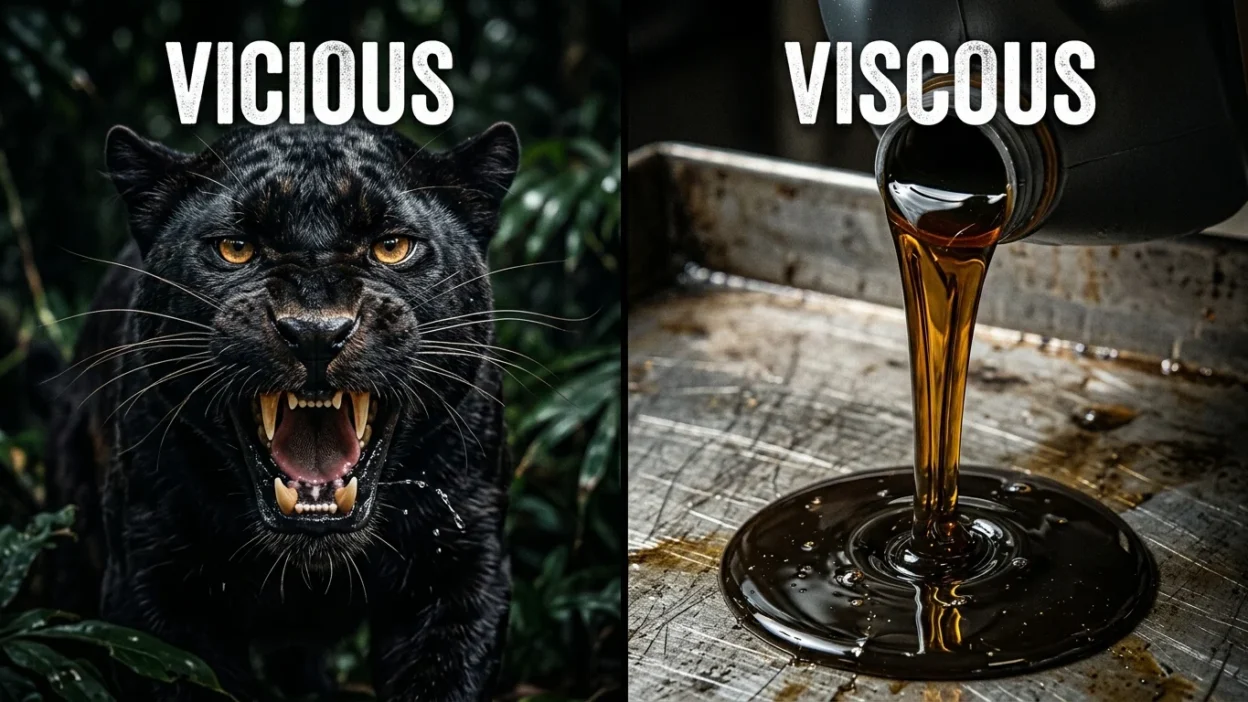
Vicious and viscous are commonly confused English words, but they have completely different meanings.
Vicious describes something cruel, violent, aggressive, or harmful, while viscous describes a thick fluid that flows slowly. For example, a dangerous dog can be vicious, while honey can be viscous.
The confusion is understandable because the two words look almost identical and have similar pronunciations.
However, they belong to very different areas of meaning. Vicious is usually connected with behavior, attacks, criticism, arguments, or negative situations.
Viscous is mainly used when discussing liquids and their resistance to flow. Once you connect viscous with viscosity, the scientific term for resistance to flow, the difference becomes much easier to remember.
Learning this distinction will help you choose the correct word in everyday, academic, scientific, and professional writing.
Quick Answer
Vicious means cruel, violent, aggressive, or harmful. Viscous means thick and resistant to flow, especially when describing liquids. Use vicious for aggressive behavior, attacks, criticism, or harmful situations. Use viscous for substances such as honey, syrup, oil, and other thick fluids.
Why Do People Confuse Them?
People confuse vicious and viscous mainly because their spelling and pronunciation are very similar.
Both words begin with vis-, and the difference can be difficult to notice when someone says them quickly.
Compare:
- vicious → cruel or aggressive
- viscous → thick and slow-flowing
There is also a useful connection between viscous and viscosity. Both relate to the behavior of fluids.
The important point is that these words are not interchangeable.
What Does “Vicious” Mean?
Vicious is an adjective meaning cruel, violent, aggressive, malicious, or deliberately harmful.
It can describe people, animals, actions, words, attacks, arguments, criticism, and situations.
Common Uses of “Vicious”
You might describe these things as vicious:
- a violent attack
- an aggressive animal
- cruel behavior
- harsh criticism
- a hostile argument
- a malicious comment
- a harmful cycle or pattern
For example:
The dog became vicious when it felt threatened.
Here, vicious means aggressive and potentially dangerous.
You can also use the word for verbal or emotional behavior:
She received vicious criticism after the announcement.
In this sentence, vicious means extremely harsh or hostile.
What Does “Vicious Cycle” Mean?
A vicious cycle is a repeating negative situation in which one problem causes another, and the new problem makes the original problem worse.
For example:
Stress can cause poor sleep, and poor sleep can increase stress, creating a vicious cycle.
This is a very common expression.
What Does “Viscous” Mean?
Viscous is an adjective used to describe a fluid that is thick and resistant to flow.
A viscous liquid generally flows more slowly than a less viscous liquid.
Common examples include:
- honey
- molasses
- syrup
- some oils
- certain gels
- some industrial fluids
For example:
Honey is more viscous than water.
Water flows easily, whereas honey flows more slowly.
What Is Viscosity?
Viscosity is a property of a fluid that describes its resistance to flow.
In simple terms:
- High viscosity → thicker and slower-flowing
- Low viscosity → thinner and easier-flowing
For example, honey has a higher viscosity than water.
The adjective is viscous:
The honey is viscous.
The noun is viscosity:
Honey has relatively high viscosity.
Vicious vs Viscous: Comparison Table
| Feature | Vicious | Viscous |
|---|---|---|
| Meaning | Cruel, violent, aggressive, or harmful | Thick and resistant to flow |
| Usually describes | People, animals, behavior, attacks, criticism, situations | Liquids and fluids |
| Related word | Vice | Viscosity |
| Common expression | Vicious cycle | Viscous liquid |
| Example | A vicious attack | A viscous syrup |
| Part of speech | Adjective | Adjective |
| Main idea | Cruelty or aggression | Thickness and flow |
When Should You Use Each?
Use “Vicious” for Cruel or Aggressive Things
Use vicious when something is cruel, violent, aggressive, malicious, or harmful.
Examples:
The animal made a vicious attack.
The argument became vicious.
He made a vicious personal remark.
The newspaper published a vicious criticism of the proposal.
Ask yourself:
Am I describing cruelty, violence, aggression, or harmful behavior?
If yes, vicious is likely the correct choice.
Use “Viscous” for Thick Fluids
Use viscous when describing a fluid that is thick and resists flowing.
Examples:
The honey is highly viscous.
The syrup is too viscous to pour easily.
The laboratory examined the viscous substance.
The oil becomes less viscous when heated.
Ask yourself:
Am I describing how easily a liquid flows?
If yes, viscous is the word you need.
12 Examples of Vicious and Viscous
Examples With “Vicious”
- The dog gave a vicious growl.
- The attacker launched a vicious assault.
- The two animals became involved in a vicious fight.
- She received vicious criticism online.
- The argument turned into a vicious dispute.
- He made a vicious personal comment.
Examples With “Viscous”
- Honey is a viscous liquid.
- Molasses is highly viscous.
- The syrup became more viscous as it cooled.
- The scientist tested the viscous substance.
- The machine requires a suitable viscous lubricant.
- Motor oil is generally more viscous than water.
Compare the Two in Context
The dog was vicious.
The dog was aggressive or dangerous.
The liquid was viscous.
The liquid was thick and slow-flowing.
The surrounding context tells you which word is appropriate.
Common Mistakes
1. Using “Viscous” to Mean Violent
Incorrect:
The attacker was viscous.
Correct:
The attacker was vicious.
If you mean cruel, violent, or aggressive, choose vicious.
2. Using “Vicious” for Thick Liquids
Incorrect:
Honey is very vicious.
Correct:
Honey is very viscous.
3. Confusing “Viscous” and “Viscosity”
These words have different grammatical roles.
Viscous is an adjective:
The oil is viscous.
Viscosity is a noun:
The oil has high viscosity.
4. Writing “Viscous Cycle”
When you mean a repeating negative situation, the correct phrase is vicious cycle.
Correct:
The problem created a vicious cycle.
Viscous is associated with fluids, not negative behavioral patterns.
Memory Trick
Use this easy rule:
Vicious = violence or cruelty.
Viscous = viscosity and liquids.
Another useful connection is:
Viscous → viscosity → fluid
If you are talking about how thick or slow-flowing a liquid is, choose viscous.
If you are talking about cruelty, aggression, violence, or harmful behavior, choose vicious.
American vs British English
There is no significant American-versus-British spelling difference between vicious and viscous.
Both American English and British English use:
- vicious
- viscous
- viscosity
The distinction is therefore about meaning, not regional spelling.
For example, both varieties can use:
The attack was vicious.
And:
The substance was highly viscous.
Similar Words
Words Similar to “Vicious”
Depending on the context, related words include:
- cruel
- violent
- aggressive
- brutal
- malicious
- hostile
- harsh
- savage
These words are related but are not always exact synonyms.
Words Similar to “Viscous”
Related words and expressions include:
- thick
- syrupy
- sticky
- gooey
- gelatinous
- slow-flowing
- high-viscosity
In technical or scientific writing, viscous is more precise than simply saying something is “thick.”
Final Verdict
Vicious and viscous have completely different meanings.
Use vicious to describe something cruel, violent, aggressive, or harmful.
Use viscous to describe a thick fluid that resists flowing easily.
The easiest rule is:
Vicious = cruel or violent.
Viscous = thick and slow-flowing.
FAQs
What is the difference between vicious and viscous?
Vicious means cruel, violent, aggressive, or harmful. Viscous means thick and resistant to flow, especially when describing liquids.
Is honey vicious or viscous?
Honey is viscous because it is relatively thick and flows more slowly than water.
Is a violent dog vicious or viscous?
A violent or highly aggressive dog can be described as vicious.
What does viscous mean in simple English?
Viscous means thick and slow-flowing. Honey, syrup, and molasses are familiar examples of viscous substances.
What does vicious mean in simple English?
Vicious means cruel, violent, aggressive, or deliberately harmful.
Is it “vicious cycle” or “viscous cycle”?
The standard expression is vicious cycle when referring to a repeating pattern of negative events or problems.
What is the noun form of viscous?
The noun is viscosity, which refers to a fluid’s resistance to flow.
Are vicious and viscous pronounced the same?
They have very similar pronunciations, but they are different words. Their spelling and meaning distinguish them.
Remember This
- Vicious = cruel, violent, aggressive, or harmful
- Viscous = thick and slow-flowing
- Vicious cycle = a repeating negative pattern
- Viscosity = resistance to fluid flow
- Honey and molasses are viscous
- An aggressive attack can be vicious
- Viscous → viscosity → liquid
Conclusion
The difference between vicious and viscous is easy to understand once you connect each word with its meaning. Vicious describes cruelty, aggression, violence, or harmful behavior. Viscous, by contrast, describes a fluid that is thick and resistant to flowing. Although the words look and sound similar, they are not interchangeable.
When choosing between them, focus on what you are describing. If the sentence involves an aggressive animal, violent attack, cruel behavior, harsh criticism, or a vicious cycle, use vicious. If it involves honey, syrup, oil, or another thick fluid, use viscous. Remembering viscous → viscosity → liquid is a simple way to avoid this common mistak