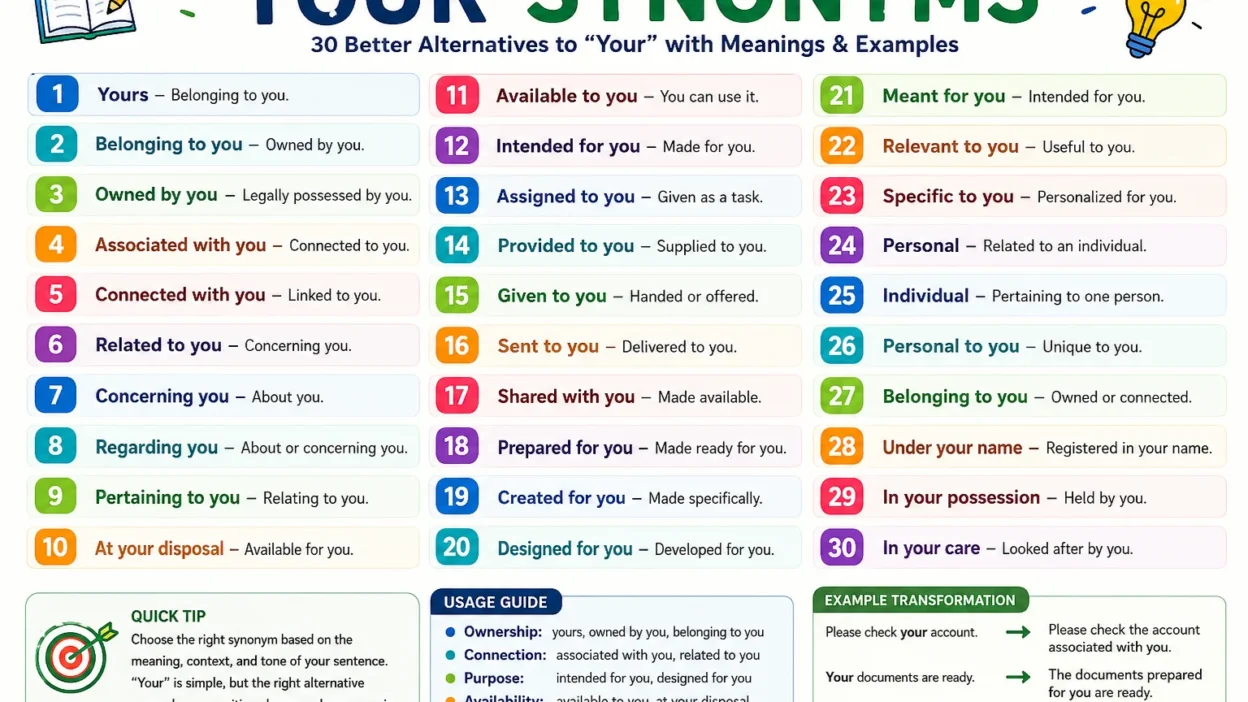
The word “your” is one of the most common words in English. It shows that something belongs to, relates.
Learning your synonyms can help students, ESL learners, writers, and content creators make their English more varied and precise.
Connected with the person or people being spoken to. For example, “your book” means the book belongs to you.
This makes the list useful for everyday English, academic writing, professional communication, and creative writing.
In this guide, you will learn 30 words and phrases that can sometimes replace “your.” Each option includes a simple meaning, an example sentence, and advice about where it works best.
However, “your” does not always have a perfect one-word replacement. The best alternative depends on the sentence, meaning, grammar, and tone.
What Does “Your” Mean?
Simple meaning of “your”
Your is a possessive determiner. It usually tells us that something belongs to, concerns, or is associated with the person being addressed.
For example:
- Your phone is ringing.
- Please check your email.
- I enjoyed your presentation.
- What is your opinion?
“Your” can refer to one person or several people.
Why learn synonyms for “your”?
Using the same word repeatedly can sometimes make writing sound repetitive. Learning alternatives can help you choose language that is more specific or appropriate for a particular situation.
For example:
- “Your responsibility” → “the responsibility assigned to you”
- “Your personal information” → “the information you provided”
- “Your choice” → “the choice available to you”
Remember that these alternatives are not always interchangeable. Your synonyms are often phrases rather than exact single-word replacements.
30 Synonyms and Alternatives for “Your”
1. Yours
Meaning: Something that belongs to you.
Example: This notebook is yours.
Best usage context: Use yours when the noun does not need to be repeated.
Note: “Yours” usually replaces a noun phrase, while “your” comes before a noun.
- Your car is new.
- The new car is yours.
2. Belonging to You
Meaning: Something that is owned by or connected with you.
Example: The jacket belonging to you is on the chair.
Best usage context: Formal or explanatory writing.
Note: This phrase can sound awkward in casual conversation, so “your” is usually more natural.
3. Owned by You
Meaning: Something is legally or personally possessed by you.
Example: The property owned by you must be registered.
Best usage context: Legal, business, or property-related writing.
4. Associated With You
Meaning: Connected with you in some way.
Example: The account associated with you has been updated.
Best usage context: Technical, professional, and formal contexts.
5. Connected With You
Meaning: Related or linked to you.
Example: We reviewed all records connected with you.
Best usage context: Formal explanations and professional communication.
6. Related to You
Meaning: Connected to you or concerning you.
Example: The documents related to you are ready.
Best usage context: Formal and informational writing.
7. Concerning You
Meaning: About you or involving you.
Example: We have received new information concerning you.
Best usage context: Formal writing, official notices, and professional communication.
8. Regarding You
Meaning: About or connected with you.
Example: I have a question regarding you and your application.
Best usage context: Formal communication.
Note: “Regarding you” is not always a natural replacement for “your.” It works best when the meaning is “about you.”
9. Pertaining to You
Meaning: Relating specifically to you.
Example: Please review the documents pertaining to you.
Best usage context: Formal, academic, legal, or administrative writing.
10. At Your Disposal
Meaning: Available for you to use.
Example: All the necessary resources are at your disposal.
Best usage context: Professional and formal writing.
Note: This phrase does not mean “your” by itself. It expresses availability or access.
11. Available to You
Meaning: Something that you can use, access, or receive.
Example: Several learning resources are available to you.
Best usage context: Educational, customer-service, and professional writing.
12. Intended for You
Meaning: Designed, prepared, or meant specifically for you.
Example: This message is intended for you.
Best usage context: Notices, instructions, marketing, and professional communication.
13. Assigned to You
Meaning: Given to you as a responsibility, task, or duty.
Example: Please complete the project assigned to you.
Best usage context: Schools, workplaces, and task-related situations.
14. Provided to You
Meaning: Given or supplied to you.
Example: Please use the information provided to you.
Best usage context: Instructions, business writing, customer service, and formal documents.
15. Given to You
Meaning: Something that someone has handed, offered, or presented to you.
Example: Use the instructions given to you.
Best usage context: Everyday and general writing.
16. Sent to You
Meaning: Something delivered or transmitted to you.
Example: The confirmation email was sent to you yesterday.
Best usage context: Email, messaging, customer service, and digital communication.
17. Shared With You
Meaning: Information or something made available for you to see or use.
Example: The document shared with you contains the latest results.
Best usage context: Workplace, education, online collaboration, and digital communication.
18. Prepared for You
Meaning: Something created or arranged specifically for you.
Example: We have prepared a special report for you.
Best usage context: Customer service, professional writing, and personalized communication.
19. Created for You
Meaning: Something made specifically for you.
Example: This guide was created for you.
Best usage context: Marketing, blogs, educational content, and personalized writing.
20. Designed for You
Meaning: Something developed with your needs in mind.
Example: This course is designed for you.
Best usage context: Education, product descriptions, websites, and marketing.
21. Meant for You
Meaning: Intended specifically for you.
Example: I think this opportunity is meant for you.
Best usage context: Friendly, conversational, and emotional writing.
22. Relevant to You
Meaning: Directly useful or connected to your situation.
Example: We selected information relevant to you.
Best usage context: Professional, academic, and informational writing.
23. Specific to You
Meaning: Especially connected to one particular person.
Example: The recommendations are specific to you.
Best usage context: Personalized services, technology, education, and professional writing.
24. Personal
Meaning: Related to an individual rather than a group.
Example: Please keep your personal details private.
Alternative phrasing: Please keep personal details private.
Best usage context: Writing where the context already makes ownership clear.
25. Individual
Meaning: Relating to one particular person.
Example: Every student has individual learning needs.
Best usage context: Academic, educational, and professional writing.
26. Personal to You
Meaning: Especially connected with your individual experience, feelings, or identity.
Example: The decision is personal to you.
Best usage context: Emotional, reflective, and conversational writing.
27. Belonging to You
Meaning: Owned by you or connected to you.
Example: The items belonging to you are in this box.
Best usage context: Formal descriptions and situations where ownership needs emphasis.
28. Under Your Name
Meaning: Registered, listed, or recorded using your name.
Example: There are two accounts under your name.
Best usage context: Banking, business, records, accounts, and official communication.
29. In Your Possession
Meaning: Something is currently held or controlled by you.
Example: The documents are currently in your possession.
Best usage context: Formal, legal, and professional writing.
30. In Your Care
Meaning: Something or someone is being looked after by you.
Example: The child is now in your care.
Best usage context: Formal, medical, legal, caregiving, and official contexts.
Comparison Guide: Which Alternative Should You Use?
Not every alternative to “your” has the same meaning. Choosing the right expression depends on what you want to communicate.
| Alternative | Main meaning | Best context |
|---|---|---|
| Yours | Belongs to you | Everyday English |
| Belonging to you | Owned by you | Formal descriptions |
| Owned by you | Legal or physical ownership | Business/legal |
| Associated with you | Connected with you | Professional/technical |
| Related to you | Connected or relevant | Formal/general |
| Concerning you | About you | Official writing |
| Pertaining to you | Specifically related | Academic/legal |
| Available to you | You can use it | Education/service |
| Intended for you | Made for you | Notices/marketing |
| Assigned to you | Given as a task | School/work |
| Provided to you | Supplied to you | Professional writing |
| Given to you | Handed or offered | General English |
| Sent to you | Delivered to you | Email/digital communication |
| Shared with you | Made available to you | Collaboration |
| Prepared for you | Made ready for you | Service/professional |
| Created for you | Made specifically for you | Content/marketing |
| Designed for you | Developed around your needs | Education/marketing |
| Meant for you | Intended for you | Casual/conversational |
| Relevant to you | Useful or connected | Academic/professional |
| Specific to you | Personalized | Technical/professional |
| Personal to you | Individual or emotional connection | Personal writing |
| Under your name | Registered in your name | Official records |
| In your possession | Held by you | Legal/formal |
| In your care | Looked after by you | Formal/caregiving |
How to Choose the Right Synonym
For ownership
Use yours, belonging to you, or owned by you when the main idea is possession.
Example:
- Is this book yours?
- The property owned by you is listed below.
Use yours for normal conversation and owned by you when ownership needs to be stated clearly.
For formal or official writing
Choose expressions such as concerning you, pertaining to you, associated with you, or related to you.
Example:
“Please review the documents pertaining to you.”
This sounds more formal than simply saying:
“Please review your documents.”
For education
Use assigned to you, available to you, provided to you, or designed for you.
Example:
“Please complete the exercises assigned to you.”
This is particularly useful in school, university, and online learning environments.
For professional communication
Expressions such as provided to you, shared with you, prepared for you, and available to you work well.
Example:
“The report shared with you includes the latest figures.”
These phrases can make business writing more precise.
For personalized content
Use created for you, designed for you, specific to you, or intended for you.
Example:
“This learning plan was designed for you.”
These expressions are common in websites, educational platforms, marketing, and customer experiences.
For casual conversation
Keep it simple with yours, meant for you, or available to you.
Example:
“That seat is yours.”
Simple language is often better than replacing common words with complicated expressions.
Your vs. Yours: What Is the Difference?
Your
Your comes before a noun.
Examples:
- your house
- your idea
- your computer
- your friend
Yours
Yours normally stands alone and replaces “your + noun.”
Examples:
- This is your bag.
- This bag is yours.
A common mistake is writing “your’s.” This is incorrect. The correct spelling is “yours.”
Common Mistakes When Using Synonyms for “Your”
Using a synonym that changes the meaning
Not every alternative means exactly the same thing.
For example, “owned by you” emphasizes possession, while “associated with you” only means that something is connected to you.
Choose the expression based on the intended meaning.
Making simple sentences unnecessarily complicated
You do not need to replace “your” every time you write it.
For example:
“Please bring your notebook.”
is more natural than:
“Please bring the notebook belonging to you.”
The second sentence is grammatically possible but unnecessarily wordy.
Confusing “your” and “you’re”
Your shows possession.
You’re is short for you are.
Examples:
- Your answer is correct.
- You’re correct.
Remember: if you can replace the word with “you are,” use you’re.
Examples of “Your Synonyms” in Different Sentences
Here are a few quick transformations:
Original: Please check your account.
Alternative: Please check the account associated with you.
Original: Complete your assigned work.
Alternative: Complete the work assigned to you.
Original: Your documents are ready.
Alternative: The documents prepared for you are ready.
Original: Your information has been updated.
Alternative: The information associated with you has been updated.
Original: This course is for your needs.
Alternative: This course is designed for you.
These examples show an important point: alternatives to “your” often require restructuring the entire sentence rather than simply replacing one word.
Why Context Matters When Choosing a Synonym
A good synonym should preserve both the meaning and the tone of the original sentence.
For example, “your responsibility” can become:
- the responsibility assigned to you — focuses on a task
- the responsibility under your care — emphasizes responsibility or supervision
- the responsibility associated with you — emphasizes a connection
- your responsibility — the most natural general choice
The correct option depends on what the writer wants the reader to understand.
For ESL learners, this is especially important. A synonym can be grammatically correct but still sound unnatural in everyday English.
Tips for Students, ESL Learners, and Writers
Learn synonyms by meaning
Do not memorize a long list without context. Group words according to their purpose.
For example:
Ownership: yours, owned by you, belonging to you
Connection: related to you, associated with you, connected with you
Purpose: intended for you, designed for you, created for you
Availability: available to you, at your disposal
Responsibility: assigned to you, in your care
This approach makes vocabulary easier to remember.
Pay attention to tone
Some expressions are natural in conversation, while others are more formal.
“Yours” sounds normal and friendly.
“Pertaining to you” sounds formal and may be better suited to official documents.
Do not replace words just to sound advanced
Strong writing is not about using the most complicated synonym. It is about choosing the clearest and most accurate expression.
If “your” is the clearest choice, keep it.
Frequently Asked Questions About Your Synonyms
What is the closest synonym for “your”?
The closest alternative depends on the sentence. Yours is closely related, but it usually replaces “your + noun” rather than directly replacing “your.”
What can I say instead of “your”?
You can use phrases such as belonging to you, associated with you, related to you, intended for you, assigned to you, or designed for you, depending on the meaning.
Is “yours” the same as “your”?
No. Your comes before a noun, while yours usually stands alone.
For example:
- This is your pen.
- This pen is yours.
What is a formal synonym for “your”?
There is no single formal synonym that works in every situation. Phrases such as pertaining to you, associated with you, concerning you, and provided to you can work in formal contexts.
Can I use “belonging to you” instead of “your”?
Sometimes. However, it can make a sentence longer and less natural. Use it when emphasizing ownership or when restructuring a sentence improves clarity.
Conclusion
Understanding your synonyms is useful for building stronger vocabulary and improving sentence variety. However, there is no single replacement that works in every situation.
Words and phrases such as yours, belonging to you, associated with you, related to you, pertaining to you, designed for you, assigned to you, and available to you express different shades of meaning.
The most important lesson is to choose a synonym based on meaning, context, grammar, and tone.
For everyday English, “your” is often the best and most natural choice. In formal, academic, professional, or creative writing, a carefully selected alternative can provide greater precision.
If you are learning English, do not simply memorize the 30 alternatives in this guide.
Study the example sentences and notice how each expression changes the meaning or tone. With practice, you will be able to choose the right word naturally and confidently.