When you are looking for the right word to describe something that considers the whole rather than just individual parts, holistic is often a strong choice.
However, using the same word repeatedly can make your writing sound less varied. Learning holistic synonyms gives you more ways to express ideas clearly and naturally.
The word holistic appears in many areas, including education, health, business, personal development, psychology, and writing.
Its meaning can change slightly depending on the context.
For example, comprehensive may work well when discussing a plan, while integrated may be better when describing different parts working together.
This guide explains 30 useful alternatives to holistic in simple English.
Each synonym includes its meaning, an example sentence, and the situation where it works best.
This makes the list useful for vocabulary building, academic writing, SEO content, and everyday communication.
What Does “Holistic” Mean?
Simple Meaning of Holistic
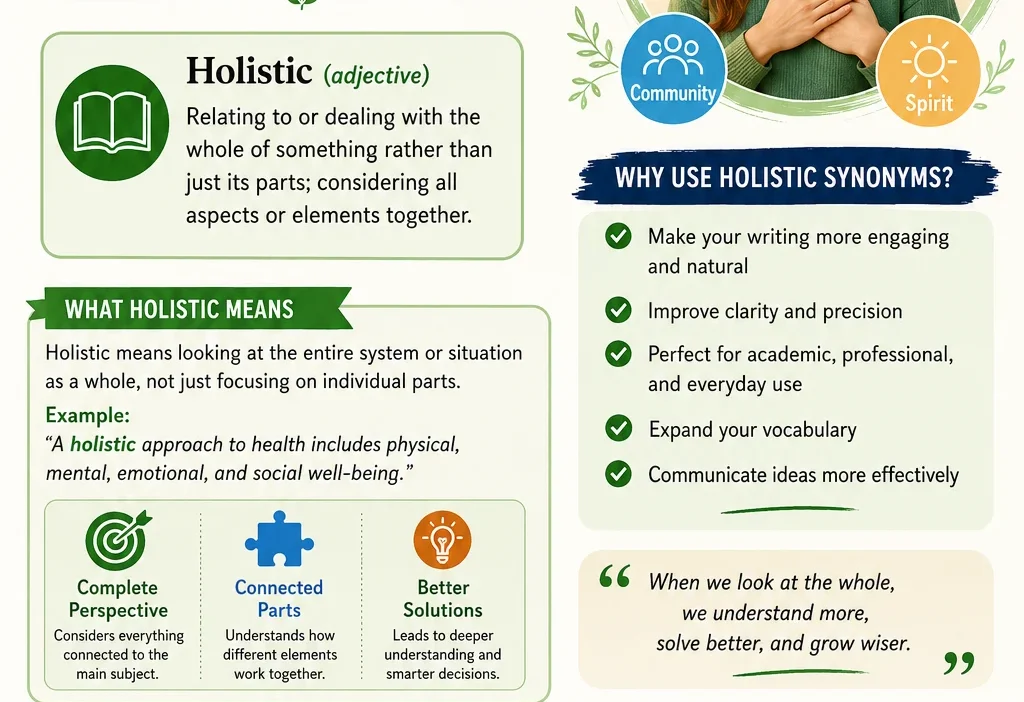
Holistic means looking at something as a complete whole instead of focusing only on separate parts.
For example, a holistic approach to education considers not only a student’s grades but also their emotional, social, creative, and physical development.
Example:
“The school takes a holistic approach to student development.”
Here, holistic means that the school considers many aspects of a student’s development rather than academic performance alone.
Holistic: Tone and Usage
Holistic usually has a positive, thoughtful, and comprehensive tone. It suggests that different parts are connected and should be understood together.
You may see it used in phrases such as:
- Holistic approach
- Holistic development
- Holistic health
- Holistic education
- Holistic view
- Holistic strategy
- Holistic solution
- Holistic understanding
The closest synonym depends on what you are describing.
30 Holistic Synonyms
1. Comprehensive
Meaning: Including all or nearly all important parts of something.
Example sentence:
“The report provides a comprehensive analysis of the problem.”
Best usage context: Academic writing, reports, research, plans, and analysis.
2. All-Inclusive
Meaning: Including everything important rather than leaving major parts out.
Example sentence:
“The program offers an all-inclusive approach to employee development.”
Best usage context: Programs, plans, services, and strategies.
3. Complete
Meaning: Having all the necessary parts.
Example sentence:
“We need a complete understanding of the situation before making a decision.”
Best usage context: General writing and everyday English.
4. Integrated
Meaning: Combining different parts so they work together as one system.
Example sentence:
“The company created an integrated marketing strategy.”
Best usage context: Business, technology, education, healthcare, and systems.
5. Whole
Meaning: Considering something as one complete thing.
Example sentence:
“We should understand the problem as a whole.”
Best usage context: General explanations and simple writing.
6. Unified
Meaning: Joined together into one connected system or idea.
Example sentence:
“The organization needs a unified approach to customer service.”
Best usage context: Organizations, strategies, teams, and systems.
7. Comprehensive-Minded
Meaning: Thinking about many important aspects of an issue.
Example sentence:
“She has a comprehensive-minded approach to solving complex problems.”
Best usage context: Describing a person’s approach or thinking style.
8. Multidimensional
Meaning: Having or considering several different aspects.
Example sentence:
“Success is a multidimensional concept that includes more than financial wealth.”
Best usage context: Academic writing, psychology, sociology, and analysis.
9. Broad
Meaning: Covering many subjects, areas, or possibilities.
Example sentence:
“The course provides a broad understanding of environmental science.”
Best usage context: Education, knowledge, topics, and general descriptions.
10. Wide-Ranging
Meaning: Covering many different areas or subjects.
Example sentence:
“The researcher conducted a wide-ranging study of modern education.”
Best usage context: Research, discussions, studies, and reports.
11. Extensive
Meaning: Large in amount, range, or scope.
Example sentence:
“The team carried out an extensive review of the existing system.”
Best usage context: Research, reviews, investigations, and projects.
12. Thorough
Meaning: Complete and careful, without ignoring important details.
Example sentence:
“The doctor performed a thorough assessment of the patient.”
Best usage context: Assessments, investigations, reviews, and analysis.
13. All-Encompassing
Meaning: Including almost everything within a particular subject or area.
Example sentence:
“The new policy provides an all-encompassing framework for workplace safety.”
Best usage context: Formal writing, policies, strategies, and frameworks.
14. Inclusive
Meaning: Including different people, ideas, or aspects instead of excluding them.
Example sentence:
“The teacher uses an inclusive approach to classroom learning.”
Best usage context: Education, communities, organizations, and social topics.
15. Interconnected
Meaning: Connected to one another so that changes in one part can affect another.
Example sentence:
“Environmental and economic issues are deeply interconnected.”
Best usage context: Science, society, environment, systems, and relationships.
16. Synergistic
Meaning: Working together in a way that produces a stronger result.
Example sentence:
“The project combines several synergistic strategies to improve performance.”
Best usage context: Business, teamwork, science, and organizational strategy.
17. Systemic
Meaning: Relating to an entire system rather than just one individual part.
Example sentence:
“The organization needs systemic changes rather than a temporary solution.”
Best usage context: Business, politics, healthcare, society, and organizational problems.
18. Global
Meaning: Considering something on a broad or complete scale.
Example sentence:
“We need a global view of the company’s long-term challenges.”
Best usage context: Business, international topics, strategy, and large-scale issues.
19. Extensive-Scale
Meaning: Covering a large range or area.
Example sentence:
“The project requires an extensive-scale evaluation of community needs.”
Best usage context: Large projects and formal descriptions.
20. Balanced
Meaning: Giving appropriate attention to different parts or viewpoints.
Example sentence:
“The course provides a balanced approach to physical and mental well-being.”
Best usage context: Education, health, opinions, arguments, and decision-making.
21. Coordinated
Meaning: Organized so that different parts work effectively together.
Example sentence:
“A coordinated strategy helped the departments achieve their shared goals.”
Best usage context: Business, organizations, healthcare, and projects.
22. Collective
Meaning: Considered or done by a group as a whole.
Example sentence:
“The team made a collective effort to solve the problem.”
Best usage context: Groups, communities, teams, and social issues.
23. Overarching
Meaning: Covering or connecting several smaller ideas or areas.
Example sentence:
“The overarching goal is to improve the quality of education.”
Best usage context: Academic writing, strategies, goals, and policies.
24. Globalized
Meaning: Connected across different countries, regions, or systems.
Example sentence:
“The company needs a globalized strategy for its growing international market.”
Best usage context: Business, economics, technology, and international studies.
25. Multifaceted
Meaning: Having many different aspects or features.
Example sentence:
“Climate change is a multifaceted problem requiring several types of solutions.”
Best usage context: Complex problems, people, issues, and academic writing.
26. Eclectic
Meaning: Combining ideas, methods, or styles from different sources.
Example sentence:
“The therapist uses an eclectic approach based on several psychological methods.”
Best usage context: Art, education, psychology, treatment approaches, and creative work.
27. Holistic-Oriented
Meaning: Focused on understanding or addressing something as a complete system.
Example sentence:
“The organization promotes a holistic-oriented approach to employee well-being.”
Best usage context: Professional and educational descriptions.
28. Total
Meaning: Including everything or the entire amount.
Example sentence:
“The project requires a total review of its current processes.”
Best usage context: General writing, although comprehensive is often more natural for formal analysis.
29. Panoramic
Meaning: Providing a broad view of many parts of a subject.
Example sentence:
“The book gives readers a panoramic view of the country’s history.”
Best usage context: History, literature, analysis, and descriptive writing.
30. Contextual
Meaning: Considering something in relation to the surrounding situation or circumstances.
Example sentence:
“A contextual approach helps teachers understand why students learn differently.”
Best usage context: Education, psychology, research, communication, and social studies.
Holistic Synonyms Comparison Guide
Not every synonym for holistic means exactly the same thing. Some focus on completeness, while others emphasize connections, different perspectives, or cooperation.
| Synonym | Main Idea | Tone | Best Used For |
|---|---|---|---|
| Comprehensive | Covers all important parts | Formal | Reports and research |
| Integrated | Parts work together | Professional | Systems and strategies |
| Inclusive | Includes different people or aspects | Positive | Education and society |
| Multifaceted | Has many aspects | Analytical | Complex problems |
| Interconnected | Parts affect each other | Analytical | Systems and relationships |
| Systemic | Concerns the entire system | Formal | Organizations and social issues |
| Thorough | Careful and complete | Formal | Reviews and assessments |
| Broad | Covers a wide area | Neutral | General topics |
| Wide-ranging | Covers many areas | Formal | Research and studies |
| Balanced | Gives attention to different sides | Positive | Education and opinions |
| Unified | Brings parts together | Professional | Teams and strategies |
| Collective | Relates to a group as a whole | Neutral | Communities and teams |
| Overarching | Covers several smaller ideas | Formal | Goals and frameworks |
| Contextual | Considers surrounding circumstances | Academic | Research and education |
| All-encompassing | Includes almost everything | Strong/Formal | Policies and frameworks |
How to Choose the Right Synonym
The best synonym depends on the specific idea you want to emphasize. Instead of replacing holistic randomly, think about the relationship between the parts of your sentence.
Use Comprehensive for Completeness
Choose comprehensive when you mean that something covers all important information or areas.
Example:
“The website offers a comprehensive guide to English grammar.”
This is especially useful in academic and professional writing.
Use Integrated for Connected Parts
Choose integrated when separate elements are combined and designed to work together.
Example:
“The school developed an integrated learning program.”
The focus is on cooperation between different components.
Use Multifaceted for Complexity
Choose multifaceted when a subject has many different sides or characteristics.
Example:
“Career development is a multifaceted process.”
This word works especially well when discussing complicated subjects.
Use Interconnected for Relationships
Choose interconnected when different parts influence or depend on one another.
Example:
“Economic and environmental problems are interconnected.”
Here, the important idea is the relationship between the parts.
Use Inclusive for People and Perspectives
Choose inclusive when you want to emphasize that different people, experiences, ideas, or groups are included.
Example:
“The university is working toward a more inclusive learning environment.”
Use Systemic for Entire Systems
Choose systemic when a problem or solution involves an entire system rather than one small part.
Example:
“The organization needs systemic reform.”
This word is common in professional, political, social, and organizational writing.
Use Balanced for Equal Attention
Choose balanced when you want to show that several important areas receive appropriate attention.
Example:
“A balanced education develops academic and social skills.”
Use Contextual for Surrounding Circumstances
Choose contextual when understanding something requires considering its environment, background, or circumstances.
Example:
“Teachers need a contextual understanding of student behavior.”
Use Overarching for a Main Idea
Choose overarching when one broad idea connects several smaller goals or topics.
Example:
“The overarching objective is to improve public health.”
Holistic vs. Similar Words
Understanding the differences between related words can help you choose more naturally.
Holistic vs. Comprehensive
Both words suggest looking at many or all important parts.
However, holistic often emphasizes how the parts relate to the whole, while comprehensive mainly emphasizes completeness.
Holistic:
“We need a holistic approach to student well-being.”
Comprehensive:
“We need a comprehensive report on student performance.”
Holistic vs. Integrated
Integrated focuses on combining separate parts so they work together.
Holistic focuses on understanding the complete picture.
For example, an integrated healthcare system may connect different healthcare services, while a holistic healthcare approach may consider physical, emotional, social, and other aspects of well-being.
Holistic vs. Multifaceted
Multifaceted means something has many sides or aspects.
Holistic means looking at those aspects together as part of a whole.
A problem can therefore be multifaceted, while the method used to understand it can be holistic.
Holistic vs. Systemic
Systemic refers to an entire system and is often used when discussing large-scale problems.
Holistic is broader and can be used for individuals, systems, strategies, education, health, and many other subjects.
Holistic vs. Inclusive
Inclusive focuses on including different people, groups, viewpoints, or elements.
Holistic focuses on understanding or addressing the whole.
They may overlap, but they do not always mean the same thing.
Common Uses of “Holistic”
Holistic Approach
A holistic approach considers several connected aspects of a subject instead of concentrating on only one.
Example:
“The company takes a holistic approach to employee development.”
Holistic Health
Holistic health generally refers to considering different dimensions of well-being rather than focusing only on one symptom or area.
Example:
“The program promotes a holistic view of well-being.”
Holistic Education
Holistic education considers different aspects of a learner’s development, such as academic, emotional, social, physical, and creative growth.
Example:
“The school believes in holistic education.”
Holistic Development
Holistic development means supporting several areas of growth together.
Example:
“Sports and creative activities can contribute to holistic development.”
Holistic View
A holistic view means considering the complete situation rather than examining only one detail.
Example:
“Managers need a holistic view of the business before making major changes.”
Why Learn Holistic Synonyms?
Learning synonyms makes your vocabulary more flexible.
For ESL learners, understanding related words makes it easier to communicate precise ideas without repeating the same vocabulary.
For students, synonyms can make essays, assignments, and presentations more varied and precise.
For writers, choosing the right alternative can change the tone and meaning of a sentence.
For content creators, a broader vocabulary can make articles easier to read and more natural while avoiding unnecessary repetition.
The important point is not simply to memorize 30 words. It is to understand why and when each word works.
Quick Guide to the Best Holistic Synonyms
If you need a quick reference, use these choices:
- Holistic → considers the complete picture
- Comprehensive → covers all important parts
- Integrated → combines parts so they work together
- Multifaceted → has many different aspects
- Interconnected → parts are connected and influence one another
- Systemic → relates to an entire system
- Inclusive → includes different people or perspectives
- Thorough → complete and carefully detailed
- Broad → covers a wide area
- Wide-ranging → covers many different subjects
- Balanced → gives appropriate attention to different sides
- Unified → brings separate parts together
- Collective → relates to a group as a whole
- Overarching → covers several smaller ideas
- Contextual → considers the surrounding circumstances
Frequently Asked Questions About Holistic Synonyms
What is the closest synonym for holistic?
Comprehensive is often one of the closest alternatives, especially when holistic means considering all important aspects of something. However, integrated, multifaceted, and inclusive may be more accurate in specific contexts.
What is a simple word for holistic?
A simple alternative is whole or complete, depending on the sentence. For example, “look at the whole situation” can communicate a similar basic idea.
Is comprehensive the same as holistic?
Not exactly. Comprehensive emphasizes covering many or all important parts, while holistic often emphasizes understanding those parts as a connected whole.
What is a positive synonym for holistic?
Words such as comprehensive, balanced, inclusive, integrated, unified, and thorough can have positive meanings depending on the context.
What is the opposite of holistic?
Possible opposites include fragmented, narrow, partial, limited, and isolated, depending on the intended meaning.
Can holistic be used in academic writing?
Yes. Holistic is common in academic writing, particularly in education, psychology, healthcare, sociology, business, and other fields. However, the synonym should match the exact idea being discussed.
What is the difference between holistic and comprehensive?
Holistic emphasizes the complete picture and the relationships between parts. Comprehensive emphasizes covering all or most important information.
Conclusion
Understanding holistic synonyms can help you communicate complex ideas with greater accuracy and variety. Although many related words suggest completeness, they each emphasize something different.
Use comprehensive when you want to highlight complete coverage, integrated when different parts work together, multifaceted when something has many sides, and interconnected when different elements influence each other.
For students and ESL learners, practicing these distinctions can make vocabulary easier to remember. For writers and content creators, choosing the most precise synonym can make sentences clearer, more natural, and more engaging.
The best synonym is not always the word that looks most similar to holistic. It is the word that expresses the exact relationship, scope, or perspective you