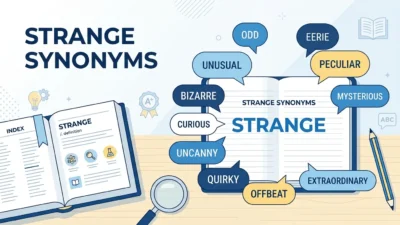
The English language offers many ways to describe something unusual or unexpected. Learning strange synonyms helps you express your ideas more clearly and makes your writing more interesting.
Instead of repeating the word strange, you can choose a synonym that better matches the situation, emotion, or tone.
if you are a student, an ESL learner, a writer, or a content creator, understanding different words for strange can improve your vocabulary and communication skills.
This guide explains each synonym in simple English with meanings, examples, and tips to help you choose the right word.
What Does “Strange” Mean?
Simple Meaning
The word strange describes something that is unusual, unfamiliar, unexpected, or difficult to understand. It can refer to people, places, situations, ideas, or behavior that seem different from what we normally expect.
Tone and Usage
The word strange is neutral and can be used in both casual and formal English. Depending on the situation, a stronger or softer synonym may be more appropriate.
Examples:
- That was a strange sound coming from the attic.
- She gave me a strange look.
- The weather has been strange this week.
30 Strange Synonyms with Meanings, Examples, and Usage
1. Odd
Meaning: Different from what is normal.
Example: He wore an odd hat to the party.
Best Usage: Everyday conversations.
2. Weird
Meaning: Very unusual or surprising.
Example: That movie had a weird ending.
Best Usage: Informal speech and writing.
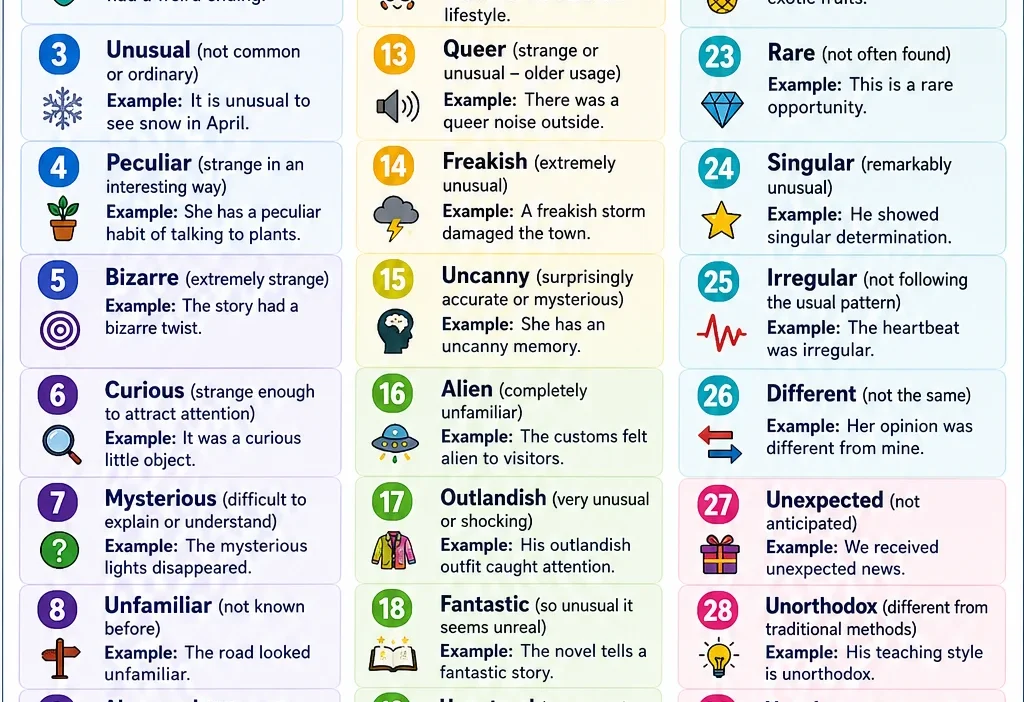
3. Unusual
Meaning: Not common or ordinary.
Example: It is unusual to see snow in April.
Best Usage: Formal and general writing.
4. Peculiar
Meaning: Strange in an interesting way.
Example: She has a peculiar habit of talking to plants.
Best Usage: Describing habits or behavior.
5. Bizarre
Meaning: Extremely strange.
Example: The story had a bizarre twist.
Best Usage: Strong descriptions.
6. Curious
Meaning: Strange enough to attract attention.
Example: It was a curious little object.
Best Usage: Formal descriptions.
7. Mysterious
Meaning: Difficult to explain or understand.
Example: The mysterious lights disappeared quickly.
Best Usage: Stories and mysteries.
8. Unfamiliar
Meaning: Not known before.
Example: The road looked unfamiliar.
Best Usage: Places and experiences.
9. Abnormal
Meaning: Different from what is expected.
Example: The doctor noticed abnormal results.
Best Usage: Medical and scientific contexts.
10. Uncommon
Meaning: Rare or not often seen.
Example: This bird is uncommon in our area.
Best Usage: Facts and observations.
11. Extraordinary
Meaning: Very unusual and impressive.
Example: She showed extraordinary talent.
Best Usage: Positive achievements.
12. Eccentric
Meaning: Having unusual habits.
Example: The artist was known for his eccentric lifestyle.
Best Usage: Personalities.
13. Queer
Meaning: Strange or unusual (older usage).
Example: There was a queer noise outside.
Best Usage: Historical or literary writing.
14. Freakish
Meaning: Extremely unusual.
Example: A freakish storm damaged the town.
Best Usage: Rare events.
15. Uncanny
Meaning: Surprisingly accurate or mysterious.
Example: She has an uncanny memory.
Best Usage: Mystery or suspense.
16. Alien
Meaning: Completely unfamiliar.
Example: The customs felt alien to visitors.
Best Usage: New environments.
17. Outlandish
Meaning: Very unusual or shocking.
Example: His outlandish outfit caught everyone’s attention.
Best Usage: Fashion and opinions.
18. Fantastic
Meaning: So unusual it seems unreal.
Example: The novel tells a fantastic story.
Best Usage: Fiction.
19. Unnatural
Meaning: Not normal or expected.
Example: His smile looked unnatural.
Best Usage: Behavior and appearance.
20. Surreal
Meaning: Dreamlike and unreal.
Example: The experience felt surreal.
Best Usage: Emotional experiences.
21. Quirky
Meaning: Unusually charming or interesting.
Example: She has a quirky sense of humor.
Best Usage: Positive personality traits.
22. Exotic
Meaning: Unusual because it comes from another place.
Example: We tasted exotic fruits.
Best Usage: Travel and culture.
23. Rare
Meaning: Not often found.
Example: This is a rare opportunity.
Best Usage: Valuable situations.
24. Singular
Meaning: Remarkably unusual.
Example: He showed singular determination.
Best Usage: Formal writing.
25. Irregular
Meaning: Not following the usual pattern.
Example: The heartbeat was irregular.
Best Usage: Medical and technical topics.
26. Different
Meaning: Not the same.
Example: Her opinion was different from mine.
Best Usage: General conversations.
27. Unexpected
Meaning: Not anticipated.
Example: We received unexpected news.
Best Usage: Daily communication.
28. Unorthodox
Meaning: Different from traditional methods.
Example: His teaching style is unorthodox.
Best Usage: Education and business.
29. Novel
Meaning: New and unusual.
Example: The company introduced a novel idea.
Best Usage: Innovation.
30. Offbeat
Meaning: Unusual in an interesting way.
Example: The café has an offbeat atmosphere.
Best Usage: Creative writing and reviews.
When to Use Different Strange Synonyms
Quick Comparison Guide
| Synonym | Best For | Tone |
|---|---|---|
| Odd | Everyday situations | Neutral |
| Weird | Casual conversation | Informal |
| Unusual | General writing | Neutral |
| Peculiar | Habits and behavior | Neutral |
| Bizarre | Extremely strange events | Strong |
| Mysterious | Unknown situations | Serious |
| Curious | Interesting observations | Neutral |
| Extraordinary | Exceptional qualities | Positive |
| Eccentric | Unique personalities | Neutral |
| Surreal | Unreal experiences | Emotional |
| Quirky | Charming differences | Positive |
| Exotic | Foreign culture or food | Positive |
| Rare | Limited occurrences | Neutral |
| Unorthodox | New methods | Formal |
| Offbeat | Creative ideas | Positive |
How to Choose the Right Synonym
For Everyday Conversation
Use odd, weird, different, or unexpected because they are easy to understand and commonly used.
For Academic or Formal Writing
Choose unusual, peculiar, abnormal, singular, unorthodox, or novel for a more professional tone.
For Creative Writing
Use bizarre, surreal, uncanny, mysterious, fantastic, or offbeat to create vivid descriptions.
For Positive Descriptions
Words like quirky, extraordinary, rare, novel, and exotic often have a positive or appreciative meaning.
For Strong or Dramatic Situations
Choose bizarre, freakish, alien, unnatural, or outlandish when you want to emphasize how unusual something is.
Tips for Using Strange Synonyms Effectively
Match the Tone
Always select a synonym that fits the situation. A formal report usually requires unusual rather than weird.
Avoid Repetition
Using different strange synonyms keeps your writing fresh and more engaging.
Consider Your Audience
Simple words work best for beginners and ESL learners, while advanced readers may appreciate more precise vocabulary.
Learn Through Context
Reading books, articles, and conversations helps you understand when each synonym sounds natural.
Conclusion
Learning strange synonyms is an excellent way to build a richer English vocabulary. While the word strange is useful in many situations, its alternatives allow you to express different shades of meaning more accurately.
if you need a casual word like weird, a formal choice like unusual, or a dramatic option like bizarre, choosing the right synonym makes your communication clearer and more effective.
Practice these words in your speaking and writing, and over time they will become a natural part of your vocabulary. With the right synonym, your English will sound more confident, precise, and engaging.