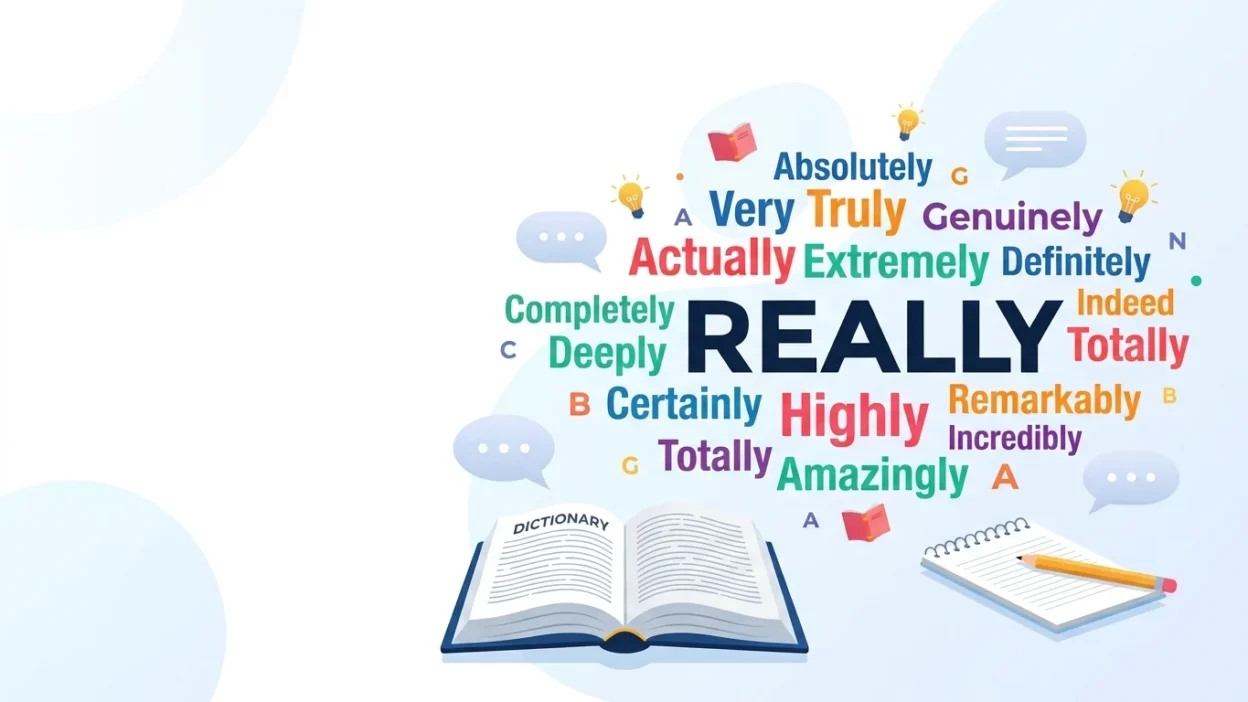
The word really is one of the most common words in English.
People use it every day to add emphasis, express strong feelings, or make a statement sound more convincing.
While it is useful, using really too often can make your writing repetitive and less engaging.
Learning really synonyms helps you expand your vocabulary, sound more natural, and choose words that better match the situation.
If you are a student, an ESL learner, a writer, or a content creator, knowing different ways to say really can make your communication clearer and more interesting.
What Does “Really” Mean?
The word really is an adverb that is mainly used to add emphasis. It can show that something is true, very strong, or surprising.
For example:
- I really enjoyed the movie.
- She is really kind.
- Do you really believe that?
Depending on the sentence, really can mean:
- Very
- Truly
- Actually
- Genuinely
- Certainly
The best synonym depends on the meaning and tone you want to express.
30 Really Synonyms with Meanings and Examples
1. Very
Meaning: To a high degree.
Example: She is very happy today.
Best Usage: Everyday conversations and general writing.
2. Truly
Meaning: In a truthful or sincere way.
Example: I am truly grateful for your help.
Best Usage: Formal writing and heartfelt expressions.
3. Genuinely
Meaning: Honestly and sincerely.
Example: He was genuinely surprised.
Best Usage: Showing honest emotions.
4. Actually
Meaning: In fact.
Example: I actually enjoyed the lecture.
Best Usage: Correcting information or adding facts.
5. Certainly
Meaning: Without doubt.
Example: She will certainly succeed.
Best Usage: Formal conversations and confident statements.
6. Absolutely
Meaning: Completely or totally.
Example: The food was absolutely delicious.
Best Usage: Strong agreement or emphasis.
7. Extremely
Meaning: To a very great degree.
Example: It was extremely cold outside.
Best Usage: Strong descriptions.
8. Highly
Meaning: To a great extent.
Example: This book is highly recommended.
Best Usage: Reviews and recommendations.
9. Quite
Meaning: Fairly or completely depending on context.
Example: The exam was quite difficult.
Best Usage: British English and moderate emphasis.
10. So
Meaning: To such a degree.
Example: She was so excited.
Best Usage: Casual speech.
11. Totally
Meaning: Completely.
Example: I totally agree with you.
Best Usage: Informal conversations.
12. Completely
Meaning: Fully.
Example: The room was completely empty.
Best Usage: Formal and informal writing.
13. Entirely
Meaning: Wholly.
Example: The decision was entirely yours.
Best Usage: Professional writing.
14. Fully
Meaning: Entirely or completely.
Example: She fully understands the problem.
Best Usage: Academic and business writing.
15. Indeed
Meaning: In fact.
Example: It was indeed a wonderful experience.
Best Usage: Formal writing.
16. Honestly
Meaning: Truthfully.
Example: I honestly don’t know.
Best Usage: Personal conversations.
17. Seriously
Meaning: In a serious manner.
Example: I seriously need some rest.
Best Usage: Informal emphasis.
18. Definitely
Meaning: Without question.
Example: I will definitely come tomorrow.
Best Usage: Everyday conversations.
19. Undoubtedly
Meaning: Without doubt.
Example: She is undoubtedly talented.
Best Usage: Formal writing.
20. Surely
Meaning: Certainly.
Example: You will surely succeed.
Best Usage: Encouragement and confidence.
21. Positively
Meaning: Definitely.
Example: He was positively thrilled.
Best Usage: Strong positive emphasis.
22. Intensely
Meaning: With great strength.
Example: She felt intensely nervous.
Best Usage: Emotional descriptions.
23. Deeply
Meaning: Strongly or emotionally.
Example: I am deeply sorry.
Best Usage: Emotional situations.
24. Especially
Meaning: More than others.
Example: I like summer, especially June.
Best Usage: Highlighting importance.
25. Remarkably
Meaning: In an impressive way.
Example: The results were remarkably accurate.
Best Usage: Academic and professional writing.
26. Exceptionally
Meaning: Better than usual.
Example: She is an exceptionally talented artist.
Best Usage: Compliments and evaluations.
27. Considerably
Meaning: By a noticeable amount.
Example: Prices have considerably increased.
Best Usage: Reports and analysis.
28. Particularly
Meaning: Especially.
Example: I particularly enjoyed the ending.
Best Usage: Formal and informal writing.
29. Incredibly
Meaning: Extremely.
Example: The view was incredibly beautiful.
Best Usage: Excited or emotional descriptions.
30. Amazingly
Meaning: In a surprising way.
Example: She performed amazingly well.
Best Usage: Positive praise.
Comparison Guide: When to Use Different Really Synonyms
| Synonym | Best For | Tone |
|---|---|---|
| Very | Everyday speech | Neutral |
| Truly | Honest feelings | Formal |
| Genuinely | Sincere emotions | Friendly |
| Actually | Correcting information | Neutral |
| Absolutely | Strong agreement | Enthusiastic |
| Extremely | Strong descriptions | Neutral |
| Totally | Casual conversations | Informal |
| Definitely | Promises and certainty | Friendly |
| Completely | Full emphasis | Neutral |
| Indeed | Academic and formal writing | Formal |
| Seriously | Casual emphasis | Informal |
| Deeply | Emotional situations | Emotional |
| Highly | Recommendations | Professional |
| Remarkably | Impressive results | Formal |
| Incredibly | Excited descriptions | Informal |
How to Choose the Right Synonym
Choosing the best synonym depends on your purpose and audience.
For Everyday Conversation
Use:
- Very
- So
- Totally
- Definitely
- Seriously
These words sound natural in daily speech.
For Formal Writing
Choose:
- Truly
- Indeed
- Certainly
- Undoubtedly
- Entirely
These fit essays, reports, and professional communication.
For Emotional Writing
Use:
- Deeply
- Genuinely
- Honestly
- Intensely
- Absolutely
These express genuine feelings.
For Academic Writing
Prefer:
- Considerably
- Remarkably
- Highly
- Particularly
- Exceptionally
These sound more precise and professional.
For Creative Writing
Use:
- Amazingly
- Incredibly
- Absolutely
- Truly
- Deeply
These add color and emotion to your storytelling.
Why Learn Really Synonyms?
Learning alternatives to really offers many benefits.
- Improves your English vocabulary.
- Makes essays more engaging.
- Helps avoid repetitive writing.
- Creates stronger descriptions.
- Makes conversations sound more natural.
- Improves SEO writing and content quality.
- Builds confidence for students and ESL learners.
Instead of repeating really several times, choosing the right synonym makes your message clearer and more interesting.
Common Mistakes When Using Really Synonyms
Many learners replace really with a synonym without considering the context. This can change the meaning or make the sentence sound unnatural.
For example:
❌ I absolutely like coffee.
✔ I really like coffee.
✔ I truly appreciate your support.
Always think about whether you are expressing emotion, certainty, intensity, or honesty before selecting a synonym.
Conclusion
The word really is useful, but relying on it too often can make your writing repetitive. Learning these 30 really synonyms gives you more flexibility to express ideas with greater precision and style.
If you are writing an essay, creating online content, speaking English, or improving your vocabulary, selecting the right synonym helps your communication become more natural, engaging, and effective.
Practice using these alternatives in everyday conversations and writing. Over time, you’ll build a richer vocabulary and gain confidence in choosing the perfect word for every situation.