Everyone experiences emotional highs and lows. Sometimes you may suddenly feel sad, tired, disappointed, or emotionally drained for no clear reason.
Many people describe this feeling as a mood crash. However, using the same phrase repeatedly can make your writing sound repetitive.
Learning different mood crash synonyms helps you express emotions more accurately and naturally.
if you’re a student, ESL learner, writer, blogger, or content creator, expanding your emotional vocabulary improves both your writing and speaking skills.
In this guide, you’ll discover simple and easy-to-understand mood crash synonyms, their meanings, example sentences, and the best situations to use each one.
Meaning of “Mood Crash”
What Does “Mood Crash” Mean?
A mood crash is a sudden drop in someone’s emotional state. A person who was feeling happy, energetic, or excited may quickly begin feeling sad, discouraged, anxious, or emotionally exhausted.
A mood crash may happen because of stress, disappointment, lack of sleep, hormonal changes, difficult news, or emotional overload. The phrase is commonly used in everyday conversations, mental health discussions, and creative writing.
Example:
“After hearing the bad news, she experienced a sudden mood crash.”
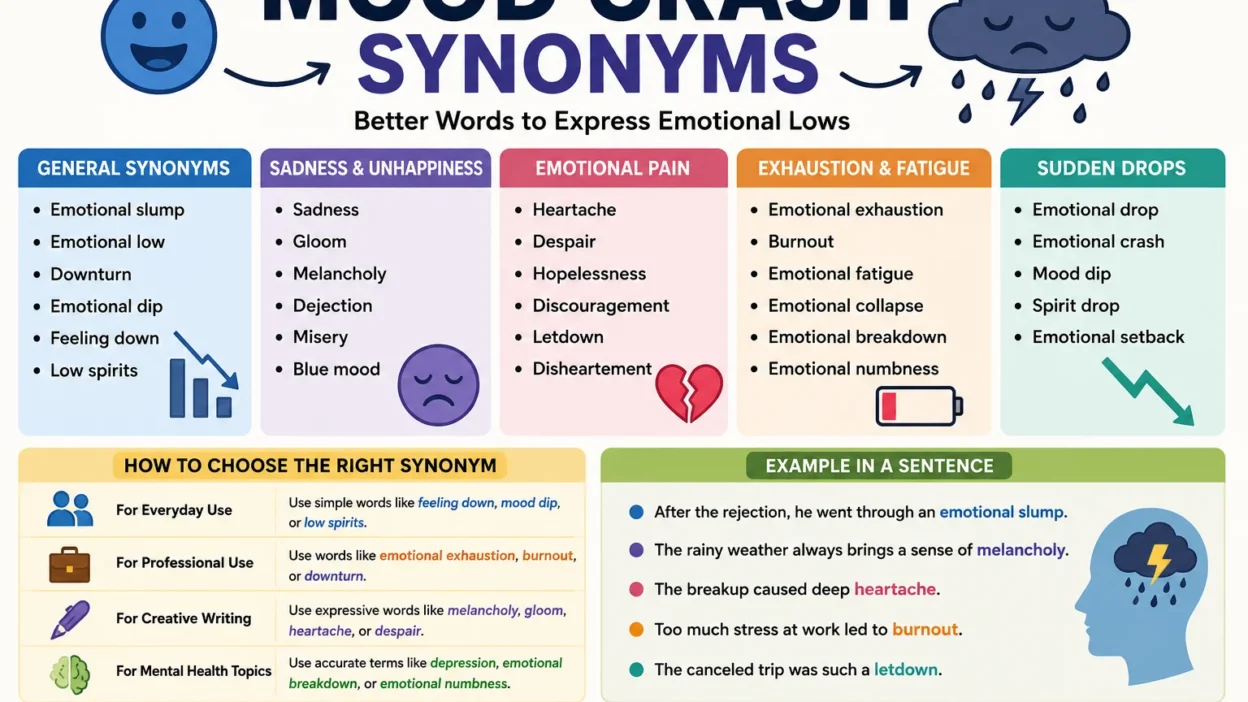
30 Mood Crash Synonyms
1. Emotional Slump
Meaning: A period of feeling emotionally low.
Example: After the exam, he went through an emotional slump.
Best Usage: Everyday conversations and mental health writing.
2. Emotional Low
Meaning: A time when someone feels sad or discouraged.
Example: Everyone experiences emotional lows sometimes.
Best Usage: General discussions.
3. Downturn
Meaning: A decline in mood or emotions.
Example: Her emotional downturn lasted several days.
Best Usage: Formal and professional writing.
4. Emotional Dip
Meaning: A small or temporary drop in mood.
Example: I had a brief emotional dip yesterday.
Best Usage: Casual conversations.
5. Feeling Down
Meaning: Feeling sad or unhappy.
Example: He’s been feeling down this week.
Best Usage: Everyday English.
6. Sadness
Meaning: The emotion of being unhappy.
Example: A feeling of sadness came over her.
Best Usage: General writing.
7. Gloom
Meaning: A dark or unhappy emotional state.
Example: Gloom filled the room after the announcement.
Best Usage: Descriptive writing.
8. Melancholy
Meaning: A quiet, thoughtful sadness.
Example: The rainy weather brought a sense of melancholy.
Best Usage: Literature and creative writing.
9. Depression
Meaning: Deep or long-lasting sadness.
Example: He sought help for depression.
Best Usage: Medical or mental health contexts.
10. Emotional Exhaustion
Meaning: Feeling mentally and emotionally worn out.
Example: Emotional exhaustion affected her work.
Best Usage: Workplace and wellness topics.
11. Burnout
Meaning: Extreme mental and emotional fatigue.
Example: Long working hours caused burnout.
Best Usage: Professional settings.
12. Discouragement
Meaning: Loss of confidence or hope.
Example: Repeated failures led to discouragement.
Best Usage: Educational and motivational writing.
13. Despair
Meaning: A complete loss of hope.
Example: He felt despair after the accident.
Best Usage: Strong emotional situations.
14. Heartache
Meaning: Deep emotional pain.
Example: The breakup caused heartache.
Best Usage: Relationships and storytelling.
15. Emotional Collapse
Meaning: A complete emotional breakdown.
Example: She experienced an emotional collapse.
Best Usage: Serious emotional situations.
16. Emotional Breakdown
Meaning: Losing emotional control.
Example: Stress caused an emotional breakdown.
Best Usage: Mental health discussions.
17. Blue Mood
Meaning: A mildly sad emotional state.
Example: Rainy days often bring a blue mood.
Best Usage: Informal English.
18. Low Spirits
Meaning: Feeling unhappy or discouraged.
Example: He arrived with low spirits.
Best Usage: Everyday writing.
19. Dejection
Meaning: Feeling disappointed and unhappy.
Example: Her face showed dejection.
Best Usage: Formal writing.
20. Misery
Meaning: Extreme unhappiness.
Example: Months of stress created misery.
Best Usage: Strong emotional descriptions.
21. Emotional Drop
Meaning: A sudden decrease in emotional energy.
Example: I noticed an emotional drop after lunch.
Best Usage: Casual conversations.
22. Emotional Crash
Meaning: A sudden emotional decline.
Example: Winning excitement turned into an emotional crash.
Best Usage: Informal writing.
23. Mood Dip
Meaning: A temporary decrease in happiness.
Example: Afternoon mood dips are common.
Best Usage: Daily conversations.
24. Emotional Fatigue
Meaning: Feeling emotionally tired.
Example: Caregiving caused emotional fatigue.
Best Usage: Wellness articles.
25. Hopelessness
Meaning: Feeling that nothing will improve.
Example: Hopelessness made it difficult to stay motivated.
Best Usage: Serious emotional discussions.
26. Disheartenment
Meaning: Losing enthusiasm or confidence.
Example: Constant criticism caused disheartenment.
Best Usage: Formal writing.
27. Emotional Numbness
Meaning: Feeling disconnected from emotions.
Example: Trauma sometimes causes emotional numbness.
Best Usage: Mental health topics.
28. Letdown
Meaning: Feeling disappointed after excitement.
Example: The canceled trip was a huge letdown.
Best Usage: Everyday English.
29. Spirit Drop
Meaning: A decline in enthusiasm or energy.
Example: Bad feedback caused a spirit drop.
Best Usage: Informal writing.
30. Emotional Setback
Meaning: An event that negatively affects emotions.
Example: Losing the competition was an emotional setback.
Best Usage: Motivational and personal development writing.
Comparison Guide
When Should You Use Each Mood Crash Synonym?
| Synonym | Best For | Tone |
|---|---|---|
| Feeling Down | Everyday conversation | Casual |
| Mood Dip | Temporary sadness | Casual |
| Emotional Slump | General emotional decline | Neutral |
| Emotional Low | Daily writing | Neutral |
| Melancholy | Literature | Thoughtful |
| Gloom | Descriptive writing | Dramatic |
| Burnout | Work stress | Professional |
| Emotional Exhaustion | Wellness | Professional |
| Depression | Medical discussions | Clinical |
| Heartache | Relationships | Emotional |
| Letdown | Disappointment | Casual |
| Emotional Breakdown | Serious situations | Strong |
How to Choose the Right Synonym
For Everyday Conversations
Choose simple expressions like:
- Feeling Down
- Mood Dip
- Emotional Low
- Low Spirits
- Letdown
These sound natural and are easy for everyone to understand.
For Academic or Professional Writing
Use words such as:
- Emotional Exhaustion
- Burnout
- Emotional Setback
- Discouragement
- Downturn
These fit reports, essays, and workplace communication.
For Creative Writing
These synonyms create vivid emotional descriptions:
- Melancholy
- Gloom
- Heartache
- Despair
- Dejection
They add emotional depth to stories and poems.
For Mental Health Discussions
Use accurate and respectful language like:
- Emotional Crash
- Emotional Breakdown
- Depression
- Emotional Numbness
- Emotional Exhaustion
These terms are appropriate when discussing emotional well-being or psychology.
Why Learning Mood Crash Synonyms Matters
Better Writing
Using different words keeps your writing fresh and avoids repetition.
Stronger Vocabulary
Learning emotional vocabulary helps students and ESL learners communicate more naturally.
More Accurate Expression
Different situations require different words. Choosing the right synonym makes your message clearer.
Improved SEO and Content Writing
For bloggers and content creators, using related vocabulary helps create richer, more helpful content while satisfying search intent without overusing one keyword.
Conclusion
Understanding mood crash synonyms allows you to describe emotions with greater accuracy and variety.
While mood crash refers to a sudden emotional decline, many related words carry slightly different meanings and tones.
Casual expressions like feeling down or mood dip work well in daily conversations, while terms such as burnout, melancholy, emotional exhaustion, and despair fit more specific situations.
By learning these 30 synonyms, you can improve your vocabulary, write more naturally, and communicate emotions more effectively.
if you’re an ESL learner, student, writer, or content creator, choosing the right emotional word helps your message become clearer, richer, and more engaging.