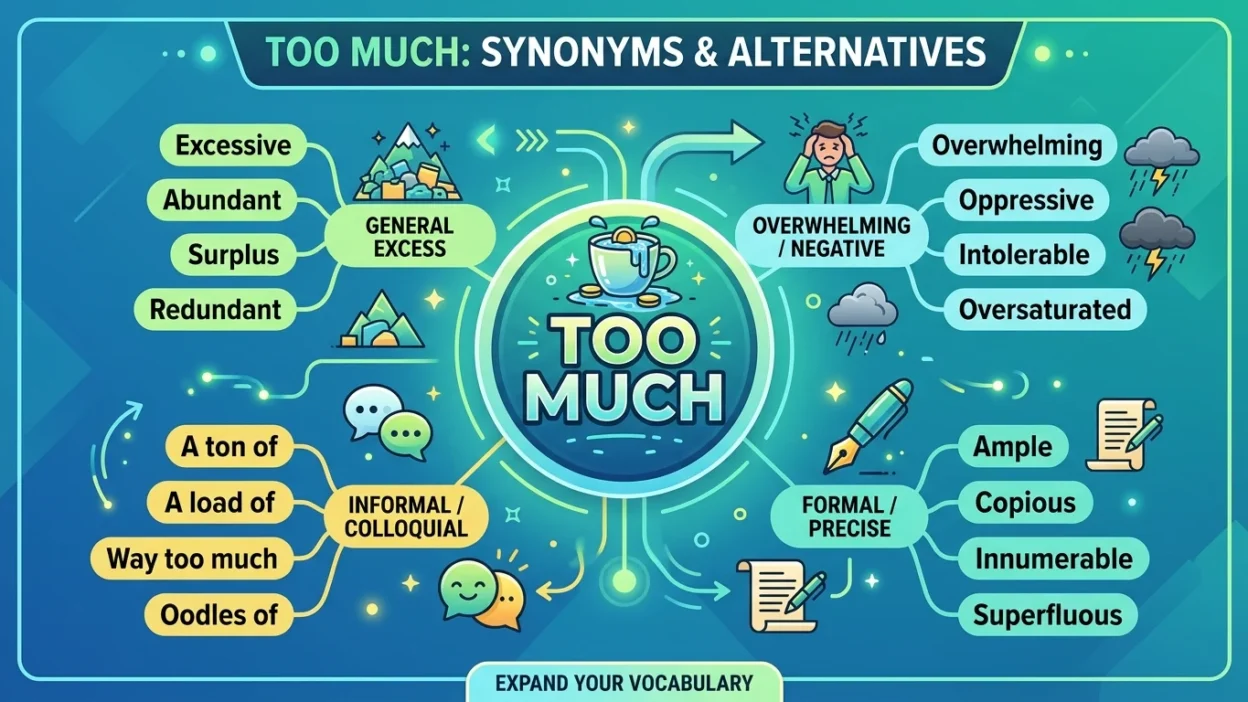
Finding the right too much synonyms can make your English more natural, precise, and interesting.
The phrase “too much” is very common, but using different words can help you describe excess, unnecessary amounts, or extreme situations more clearly.
For students, ESL learners, writers, and content creators, knowing these alternatives is useful because “too much” can have different meanings depending on the situation.
You might mean excessive, excess, overwhelming, unnecessary, or simply more than needed.
This guide explains 30 alternatives with simple meanings, examples, and usage notes. It also shows how to choose the best synonym based on tone and context.
What Does “Too Much” Mean?
Simple Meaning of “Too Much”
Too much means more than is necessary, suitable, wanted, or acceptable.
For example:
“There is too much sugar in this tea.”
This means the amount of sugar is greater than what the speaker wants or considers appropriate.
“Too much” can describe quantity, behavior, emotion, effort, noise, information, or almost anything that goes beyond a reasonable level.
Tone and Usage of “Too Much”
“Too much” is a common and natural phrase in everyday English. It is usually neutral, but the tone depends on the situation.
For example:
- “You are talking too much.” — critical
- “I ate too much.” — casual
- “There is too much information here.” — neutral
- “The workload is too much for one person.” — concerned
In formal or polished writing, alternatives such as excessive, excess, overabundant, or disproportionate may be more suitable.
30 Too Much Synonyms
1. Excessive
Meaning: More than is reasonable, necessary, or acceptable.
Example sentence:
“Excessive screen time can affect your concentration.”
Best usage context: Formal writing, academic work, health, business, and general descriptions of excess.
2. Excess
Meaning: An amount that is greater than what is needed or allowed.
Example sentence:
“The factory produced an excess of materials.”
Best usage context: Formal, academic, financial, and business contexts.
3. Overmuch
Meaning: More than is needed or appropriate.
Example sentence:
“He worried overmuch about what other people thought.”
Best usage context: Literary or formal writing; uncommon in everyday conversation.
4. Overabundant
Meaning: Existing in a much larger amount than necessary.
Example sentence:
“The report contains overabundant detail.”
Best usage context: Formal and descriptive writing.
5. Abundant
Meaning: Existing in large quantities.
Example sentence:
“The region has abundant natural resources.”
Best usage context: When you want to emphasize a large amount, although it does not always mean “too much.”
Note: “Abundant” usually means a lot, not necessarily more than acceptable.
6. Excessive Amount
Meaning: An amount that is unreasonably large.
Example sentence:
“The project required an excessive amount of time.”
Best usage context: Formal writing, reports, and professional communication.
7. More Than Necessary
Meaning: Greater than what is needed.
Example sentence:
“She brought more than necessary for the short trip.”
Best usage context: Everyday English and clear explanations.
8. More Than Enough
Meaning: An amount greater than what is needed.
Example sentence:
“We have more than enough food for everyone.”
Best usage context: Everyday conversation and positive situations.
Note: “More than enough” is not always negative. It can simply mean there is plenty.
9. Overly
Meaning: To an excessive or unnecessary degree.
Example sentence:
“The instructions were overly complicated.”
Best usage context: Writing, reviews, criticism, and formal communication.
10. Overly Much
Meaning: To an unnecessarily high degree.
Example sentence:
“She does not complain overly much.”
Best usage context: Limited use; more natural alternatives are usually “too much” or “excessively.”
11. Excessively
Meaning: To a greater degree than is reasonable or necessary.
Example sentence:
“He was excessively worried about the exam.”
Best usage context: Formal, academic, professional, and analytical writing.
12. Undue
Meaning: More than is appropriate, necessary, or reasonable.
Example sentence:
“The decision caused undue stress for the employees.”
Best usage context: Formal and professional writing.
13. Inordinate
Meaning: Unusually or unreasonably large in amount or degree.
Example sentence:
“She spent an inordinate amount of time checking her work.”
Best usage context: Formal, academic, and sophisticated writing.
14. Disproportionate
Meaning: Much larger or greater than what is reasonable compared with something else.
Example sentence:
“The punishment seemed disproportionate to the mistake.”
Best usage context: Formal writing, law, politics, criticism, and analysis.
15. Overwhelming
Meaning: So large, strong, or intense that it becomes difficult to handle.
Example sentence:
“The amount of work became overwhelming.”
Best usage context: Emotions, workloads, information, experiences, and difficult situations.
16. Overwhelmingly Large
Meaning: Extremely large and difficult to manage.
Example sentence:
“The amount of data was overwhelmingly large.”
Best usage context: Technical, academic, and descriptive writing.
17. Unnecessary
Meaning: Not needed or required.
Example sentence:
“The article contains several unnecessary details.”
Best usage context: Writing, editing, instructions, work, and everyday English.
18. Unneeded
Meaning: Not required or wanted.
Example sentence:
“Remove any unneeded files from the computer.”
Best usage context: Everyday English, technology, instructions, and practical writing.
19. Surplus
Meaning: More of something than is needed.
Example sentence:
“The company sold its surplus equipment.”
Best usage context: Business, economics, agriculture, manufacturing, and formal writing.
20. Superfluous
Meaning: Unnecessary because there is already enough.
Example sentence:
“Several sentences in the paragraph are superfluous.”
Best usage context: Formal writing, editing, academic work, and criticism.
21. Extravagant
Meaning: Excessive, especially in spending, behavior, or style.
Example sentence:
“They spent an extravagant amount of money on the celebration.”
Best usage context: Money, lifestyles, design, celebrations, and criticism.
22. Overdone
Meaning: Done too much or taken too far.
Example sentence:
“The decorations were attractive but slightly overdone.”
Best usage context: Food, design, performances, writing, fashion, and creative work.
23. Overloaded
Meaning: Given or carrying more than can be comfortably handled.
Example sentence:
“The team is overloaded with work this month.”
Best usage context: Workloads, computers, vehicles, schedules, and systems.
24. Excessive Quantity
Meaning: A quantity that is greater than necessary or appropriate.
Example sentence:
“The recipe uses an excessive quantity of salt.”
Best usage context: Formal, technical, scientific, and instructional writing.
25. Overflowing
Meaning: Filled beyond the normal or desired limit.
Example sentence:
“The kitchen bin was overflowing with rubbish.”
Best usage context: Physical objects, containers, emotions, and descriptive writing.
26. Immoderate
Meaning: Not controlled or reasonable because there is too much of something.
Example sentence:
“Immoderate spending can create serious financial problems.”
Best usage context: Formal, academic, financial, and serious writing.
27. Unrestrained
Meaning: Not controlled or limited.
Example sentence:
“Unrestrained spending can quickly lead to debt.”
Best usage context: Spending, emotions, behavior, growth, and formal writing.
28. Overkill
Meaning: Much more effort, force, or action than is necessary.
Example sentence:
“Hiring ten people to complete such a small task would be overkill.”
Best usage context: Informal English, technology, work, problem-solving, and conversation.
29. Too Great
Meaning: Greater than what can reasonably be accepted, handled, or tolerated.
Example sentence:
“The pressure became too great for the small team.”
Best usage context: Stress, responsibility, pressure, and serious situations.
30. Beyond Reasonable Limits
Meaning: Going past what is considered acceptable or reasonable.
Example sentence:
“His demands went beyond reasonable limits.”
Best usage context: Formal discussions, criticism, workplace situations, and arguments.
Comparison Table: Which Synonym Should You Use?
| Synonym | Main Meaning | Tone | Best Context |
|---|---|---|---|
| Excessive | More than reasonable | Neutral/Formal | General writing |
| Excess | Extra amount | Formal | Business, economics |
| Overabundant | More than necessary | Formal | Resources, information |
| Excessively | To an unreasonable degree | Formal | Academic writing |
| Undue | More than appropriate | Formal | Stress, attention |
| Inordinate | Unreasonably large | Formal | Time, effort, amounts |
| Disproportionate | Too large compared with something | Formal | Analysis, law |
| Overwhelming | Too much to handle | Neutral | Work, emotions |
| Unnecessary | Not needed | Neutral | Writing, instructions |
| Surplus | Extra amount | Formal | Business, production |
| Superfluous | Unnecessary extra | Formal | Editing, writing |
| Extravagant | Excessive or wasteful | Neutral/Formal | Spending, lifestyle |
| Overdone | Taken too far | Casual | Design, food, style |
| Overloaded | More than can be handled | Neutral | Work, systems |
| Immoderate | Beyond reasonable limits | Formal | Spending, behavior |
| Overkill | Far more than necessary | Informal | Everyday conversation |
How to Choose the Right Synonym
For Formal or Academic Writing
Choose:
- Excessive
- Excessively
- Inordinate
- Undue
- Disproportionate
- Superfluous
- Immoderate
Example:
“The excessive use of technical language made the article difficult for beginners.”
These words are useful when writing essays, reports, research papers, and formal articles.
For Everyday English
Choose:
- Too much
- More than necessary
- More than enough
- Unnecessary
- Overdone
- Overkill
Example:
“Adding another paragraph would be overkill.”
These expressions sound natural in conversations and informal writing.
For Work and Productivity
Choose:
- Excessive
- Overwhelming
- Overloaded
- Undue
- Too great
Example:
“The employees were overwhelmed by the excessive workload.”
For Money and Spending
Choose:
- Excessive
- Extravagant
- Immoderate
- Unrestrained
- Overkill
Example:
“The company was criticized for excessive spending.”
For Writing and Editing
Choose:
- Unnecessary
- Superfluous
- Overdone
- Excessive
- Overabundant
Example:
“The editor removed several unnecessary details.”
For Information
Choose:
- Excessive
- Overabundant
- Overwhelming
- Superfluous
- More than necessary
Example:
“The website provides an overwhelming amount of information for new users.”
“Too Much” vs. “Excessive”
What Is the Difference?
Both expressions describe more than is appropriate.
However, too much is more common in everyday English, while excessive is more formal.
Compare:
“He spends too much time online.”
“He spends an excessive amount of time online.”
The second sentence sounds more formal and analytical.
“Too Much” vs. “Excess”
What Is the Difference?
Too much is a phrase that can be used in many sentence structures.
Excess is usually a noun describing an additional or unnecessary amount.
For example:
“There is too much food.”
But:
“The restaurant had an excess of food.”
Both communicate the idea of more food than necessary, but their grammatical structures differ.
“Too Much” vs. “Overwhelming”
What Is the Difference?
“Too much” simply means there is more than desired or appropriate.
Overwhelming goes further. It suggests that the amount or intensity is difficult to handle emotionally or practically.
For example:
“There is too much work.”
This means the workload is larger than desired.
“The workload is overwhelming.”
This suggests that the amount of work is so large that it is difficult to cope with.
“Too Much” vs. “Unnecessary”
What Is the Difference?
Too much focuses on quantity or degree.
Unnecessary focuses on whether something is needed.
For example:
“There are too many details in this article.”
“Some of the details are unnecessary.”
The first sentence focuses on quantity. The second focuses on usefulness.
“Too Much” vs. “Overkill”
What Is the Difference?
Overkill is an informal expression meaning that something involves far more effort, power, or resources than necessary.
For example:
“Using a professional camera to take a picture of a shopping list would be overkill.”
It is useful in casual conversation but usually not appropriate for formal academic writing.
Common Phrases Related to “Too Much”
Too Much Information
This means there is more information than someone can easily understand or process.
Example:
“The presentation gave us too much information in a short time.”
Possible alternatives include overwhelming information, excessive information, and an overload of information.
Too Much Work
This means the amount of work is greater than a person can reasonably handle.
Example:
“I have too much work to finish today.”
Possible alternatives include an excessive workload, an overwhelming workload, and an overloaded schedule.
Too Much Money
This can mean an unnecessarily large amount of money or spending.
Example:
“They spent too much money on the project.”
Possible alternatives include excessive spending, extravagant spending, and unrestrained spending.
Too Much Time
This means more time than is necessary or desirable.
Example:
“He spends too much time checking his phone.”
Possible alternatives include excessive time, an excessive amount of time, and an inordinate amount of time.
Too Much Effort
This means more effort than the situation requires.
Example:
“You are putting too much effort into a simple task.”
Possible alternatives include excessive effort, unnecessary effort, and overkill.
Tips for ESL Learners
Understand That Synonyms Are Not Always Exact Matches
A synonym can be similar without having exactly the same meaning.
For example:
- Excessive = more than reasonable
- Unnecessary = not needed
- Overwhelming = difficult to handle because of size or intensity
- Extravagant = excessive, often involving money or style
- Surplus = an extra amount
Understanding these differences will help you sound more natural.
Learn the Grammar of Each Word
Some alternatives replace the phrase “too much” directly, while others require a different sentence structure.
For example:
“He eats too much.”
Can become:
“He eats excessively.”
But:
“He has too much food.”
Could become:
“He has an excess of food.”
The grammar changes even though the basic idea remains similar.
Choose Simple Words When Possible
ESL learners do not need to use complicated vocabulary to sound fluent.
“Excessive” may be useful in an essay, but “too much” may be better in casual conversation.
Good English is not about using the longest word. It is about using the right word.
Frequently Asked Questions
What is another word for “too much”?
Common alternatives include excessive, excessive amount, excess, overly, excessively, overwhelming, unnecessary, surplus, superfluous, and overabundant.
What is a simple synonym for “too much”?
More than necessary is a simple and clear alternative. Depending on the sentence, excessive is also a useful one-word synonym.
What is a formal word for “too much”?
Excessive is one of the most common formal alternatives. Other choices include inordinate, undue, disproportionate, and immoderate.
What is a synonym for “too much” in an essay?
For academic writing, words such as excessive, excessively, undue, disproportionate, inordinate, and superfluous can be useful.
What is the opposite of “too much”?
Depending on the context, possible opposites include too little, insufficient, inadequate, limited, and not enough.
Is “excessive” the same as “too much”?
They are very similar. “Excessive” means more than is reasonable, necessary, or acceptable, while “too much” is a more common everyday expression.
What is a synonym for “too much work”?
Useful alternatives include excessive workload, overwhelming workload, overloaded schedule, and an unreasonable amount of work.
Final Takeaway
Learning too much synonyms gives you more ways to describe excess, unnecessary amounts, and extreme situations. The best choice depends on exactly what you want to communicate.
Use excessive for a clear formal alternative, unnecessary when something is not needed, overwhelming when something is difficult to handle, and surplus when you mean an extra amount.
For formal writing, words such as inordinate, undue, disproportionate, and superfluous can add precision. In casual conversation, phrases such as more than necessary and overkill may sound more natural.
The most important rule is simple: choose the synonym that matches your meaning, tone, and audience. A precise word will always make your writing stronger than a complicated word used in the wrong context.

Liam Henry is a content author at Synonymed, specializing in vocabulary enrichment and synonym guides. He creates clear, engaging resources that help learners improve English word knowledge and language fluency.