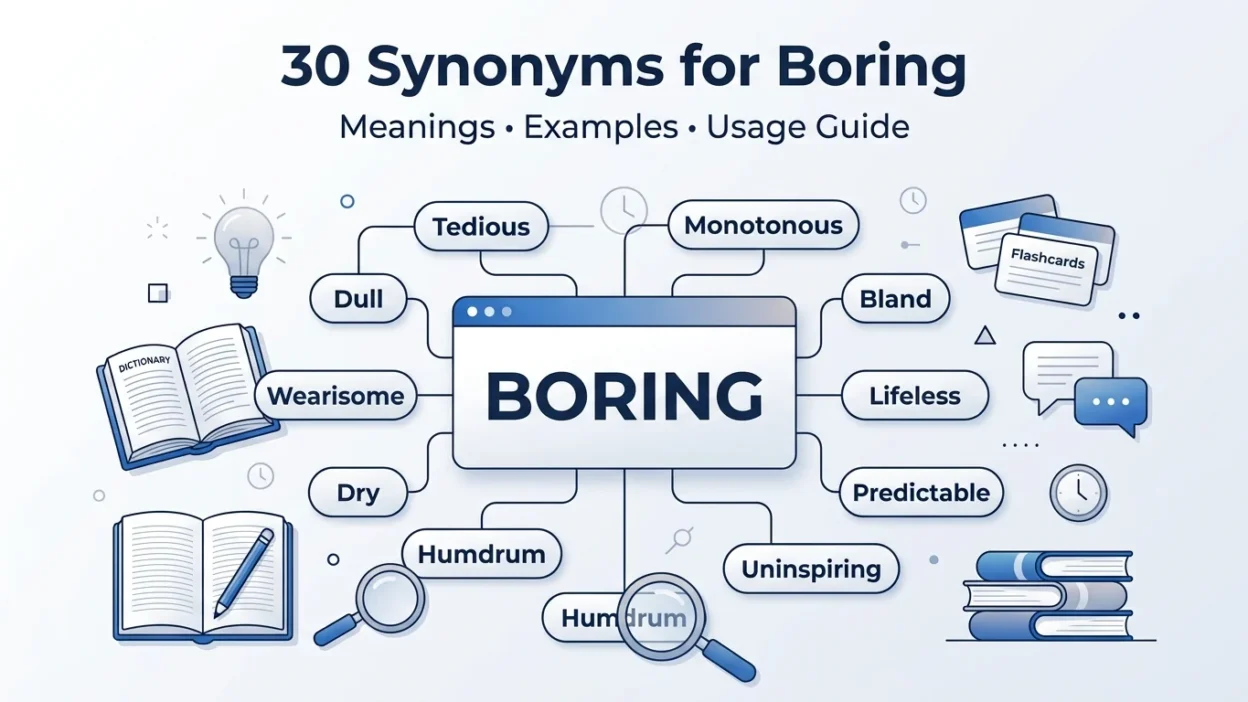
The word boring is commonly used in English to describe something that is not interesting, exciting, or enjoyable.
If you’re talking about a movie, a lesson, a conversation, or a task, the word “boring” helps express a lack of excitement. However, using the same word repeatedly can make your writing feel repetitive.
Learning different synonyms for boring helps students, ESL learners, writers, and content creators build a richer vocabulary. Each synonym has its own shade of meaning. Some words describe something that is simply dull, while others suggest that it is slow, repetitive, or lacking energy.
In this guide, you’ll learn 30 useful synonyms for boring, along with simple meanings, example sentences, and the best situations for using each one.
What Does “Boring” Mean?
The word boring means not interesting, exciting, or enjoyable. It describes people, activities, books, movies, conversations, or experiences that fail to hold someone’s attention.
Common Examples
- A boring lecture
- A boring movie
- A boring meeting
- A boring book
- A boring afternoon
Choosing the right synonym helps you describe different kinds of boredom more accurately.
30 Synonyms for Boring
1. Dull
Meaning: Not interesting or exciting.
Example Sentence: The lecture was dull.
Best Usage Context: Books, classes, and conversations.
2. Tedious
Meaning: Long, repetitive, and tiring.
Example Sentence: Filing paperwork can be tedious.
Best Usage Context: Repetitive tasks.
3. Monotonous
Meaning: Always the same and lacking variety.
Example Sentence: His job became monotonous.
Best Usage Context: Daily routines and work.
4. Uninteresting
Meaning: Not attracting attention.
Example Sentence: The documentary was uninteresting.
Best Usage Context: General descriptions.
5. Tiresome
Meaning: Making you feel tired or annoyed.
Example Sentence: The long speech became tiresome.
Best Usage Context: Activities and conversations.
6. Wearisome
Meaning: Causing mental or physical tiredness.
Example Sentence: The journey felt wearisome.
Best Usage Context: Formal writing.
7. Dreary
Meaning: Dull and depressing.
Example Sentence: It was a dreary afternoon.
Best Usage Context: Weather and places.
8. Lifeless
Meaning: Lacking energy or excitement.
Example Sentence: The performance felt lifeless.
Best Usage Context: Entertainment.
9. Flat
Meaning: Lacking excitement or emotion.
Example Sentence: The joke fell flat.
Best Usage Context: Performances and humor.
10. Bland
Meaning: Lacking flavor, excitement, or originality.
Example Sentence: The presentation was bland.
Best Usage Context: Food, writing, and speeches.
11. Dry
Meaning: Serious and not entertaining.
Example Sentence: The textbook is quite dry.
Best Usage Context: Writing and lectures.
12. Stale
Meaning: No longer fresh or interesting.
Example Sentence: The jokes became stale.
Best Usage Context: Ideas and humor.
13. Repetitive
Meaning: Happening again and again.
Example Sentence: The music sounded repetitive.
Best Usage Context: Tasks and entertainment.
14. Routine
Meaning: Done regularly without excitement.
Example Sentence: The work became routine.
Best Usage Context: Daily life.
15. Predictable
Meaning: Easy to guess because nothing new happens.
Example Sentence: The movie had a predictable ending.
Best Usage Context: Stories and films.
16. Ordinary
Meaning: Common and not special.
Example Sentence: It was an ordinary day.
Best Usage Context: Everyday situations.
17. Plain
Meaning: Simple without exciting features.
Example Sentence: The design looked plain.
Best Usage Context: Appearance and design.
18. Colorless
Meaning: Lacking personality or excitement.
Example Sentence: His speech sounded colorless.
Best Usage Context: Writing and speaking.
19. Uninspiring
Meaning: Not motivating or exciting.
Example Sentence: The lesson was uninspiring.
Best Usage Context: Education and work.
20. Mind-Numbing
Meaning: Extremely boring.
Example Sentence: Waiting in line was mind-numbing.
Best Usage Context: Informal writing.
21. Sleepy
Meaning: Making people feel sleepy.
Example Sentence: The slow presentation felt sleepy.
Best Usage Context: Informal conversation.
22. Humdrum
Meaning: Ordinary and lacking excitement.
Example Sentence: Life became humdrum after retirement.
Best Usage Context: Daily routines.
23. Uneventful
Meaning: Nothing exciting happened.
Example Sentence: We had an uneventful weekend.
Best Usage Context: Events and trips.
24. Forgettable
Meaning: Not memorable.
Example Sentence: It was a forgettable movie.
Best Usage Context: Entertainment.
25. Mechanical
Meaning: Done without emotion or creativity.
Example Sentence: His speech sounded mechanical.
Best Usage Context: Work and performances.
26. Spiritless
Meaning: Lacking energy or enthusiasm.
Example Sentence: The crowd seemed spiritless.
Best Usage Context: People and events.
27. Passive
Meaning: Not active or energetic.
Example Sentence: The audience remained passive.
Best Usage Context: Behavior.
28. Slow-Paced
Meaning: Moving slowly with little excitement.
Example Sentence: The movie was slow-paced.
Best Usage Context: Films and books.
29. Trivial
Meaning: Not important or interesting.
Example Sentence: They argued about trivial matters.
Best Usage Context: Discussions.
30. Forgettable
Meaning: Easy to forget because it lacks impact.
Example Sentence: The song was forgettable.
Best Usage Context: Movies, books, and music.
Comparison Guide: When to Use Different Synonyms
| Synonym | Best For | Tone |
|---|---|---|
| Dull | General situations | Neutral |
| Tedious | Long tasks | Neutral |
| Monotonous | Repetitive work | Professional |
| Bland | Writing and food | Mild |
| Dry | Academic content | Neutral |
| Predictable | Stories | Descriptive |
| Humdrum | Daily life | Informal |
| Uneventful | Events | Neutral |
| Mind-Numbing | Extreme boredom | Informal |
| Lifeless | Performances | Expressive |
How to Choose the Right Synonym
For School and Work
Use:
- Tedious
- Monotonous
- Dry
- Uninspiring
- Routine
These words describe repetitive tasks and educational content.
For Movies and Books
Use:
- Predictable
- Forgettable
- Lifeless
- Bland
- Slow-Paced
These words describe entertainment that fails to engage.
For Everyday Life
Use:
- Dull
- Ordinary
- Humdrum
- Uneventful
These words describe daily experiences.
For Strong Criticism
Use:
- Mind-Numbing
- Wearisome
- Tiresome
- Dreary
These words express stronger feelings of boredom.
For Writing and Speaking
Use:
- Colorless
- Flat
- Mechanical
- Spiritless
These words describe communication that lacks energy.
Common Mistakes When Using Synonyms for Boring
Using “Tedious” for Everything
“Tedious” usually describes something long and repetitive, not every boring situation.
Confusing “Predictable” with “Boring”
A story can be predictable but still entertaining.
Using Strong Words Too Often
Words like “mind-numbing” should be reserved for situations that are extremely boring.
Repeating the Same Synonym
Mix different synonyms to make your writing more engaging.
Why Learning Synonyms for Boring Matters
Expanding your vocabulary helps you:
- Avoid repetitive writing
- Improve essays and stories
- Express opinions more clearly
- Communicate naturally
- Build English fluency
- Choose the perfect word for every situation
Knowing multiple synonyms for boring allows you to describe different levels and types of boredom more accurately.
Conclusion
The word boring is useful, but English offers many alternatives that better describe different situations.
If you’re talking about a tedious task, a predictable movie, a dull lecture, or a lifeless performance, choosing the right synonym makes your writing clearer and more engaging.
By learning these 30 synonyms for boring, students, ESL learners, writers, and content creators can expand their vocabulary, improve communication skills, and express ideas with greater confidence.