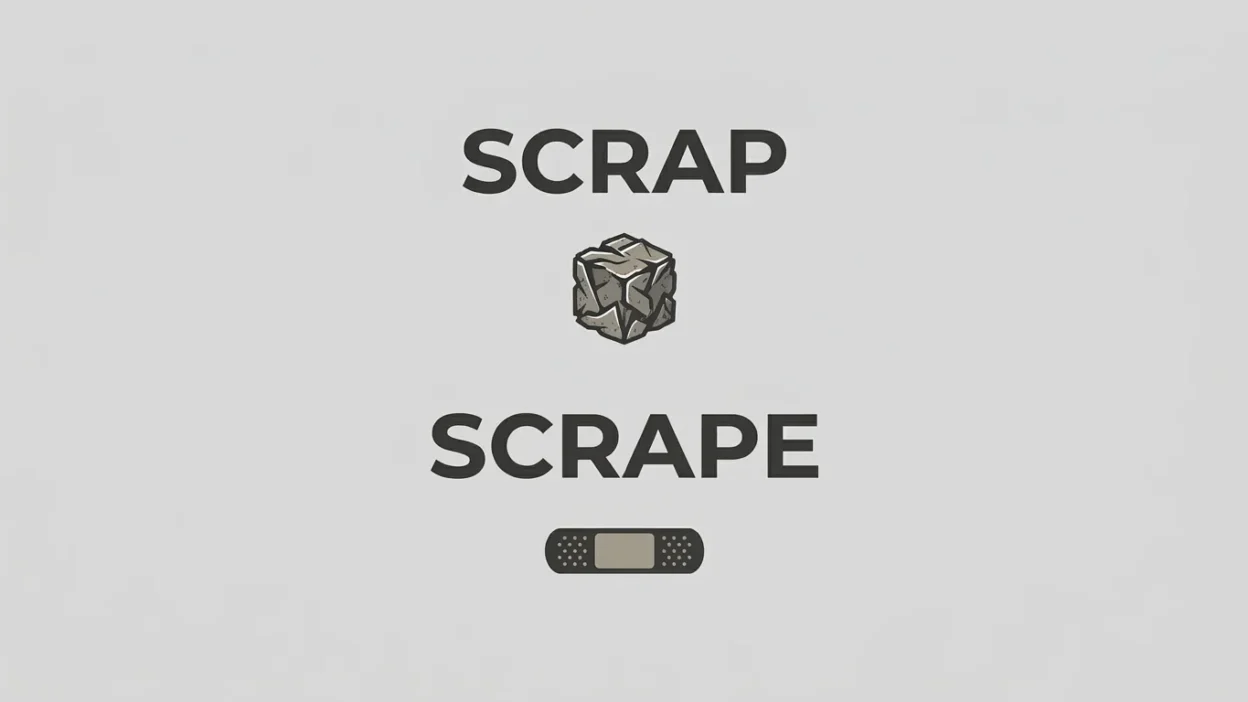
Scrap and scrape are two English words that look and sound similar, but they have different meanings and uses.
Scrap can mean a small leftover piece of material, something discarded, or the act of getting rid of a plan or idea.
Scrape usually means to rub or drag something against a surface, or to remove something from a surface by rubbing it.
These words can be confusing because both are connected with removing, damaging, or getting rid of something in some contexts.
For example, you might scrape paint off a wall, but you might throw the leftover pieces of metal into the scrap pile.
Understanding the difference is especially useful for students, ESL learners, and anyone who wants to improve everyday English vocabulary. The easiest way to remember them is: scrape involves rubbing or removing from a surface, while scrap usually refers to leftover material or something being discarded.
Quick Answer
Scrap means a small leftover piece of material, discarded material, or something that is abandoned or canceled. Scrape means to rub against a surface, remove something by rubbing, or make a shallow injury by rubbing against something rough. Remember: scrap = leftover or discard; scrape = rub or remove by rubbing.
Why Do People Confuse Scrap and Scrape?
People often confuse scrap and scrape because the words differ by only one letter. They also share the same beginning sound and can appear in similar situations involving removal or damage.
Compare these sentences:
- I put the metal scrap in the recycling bin.
- I scraped the paint off the wall.
The first sentence refers to leftover or discarded material. The second describes an action involving rubbing and removing something from a surface.
There is also a difference in grammar. Scrap can be a noun or a verb, while scrape can be a noun or a verb as well.
First Word: Scrap
Scrap has several related meanings, but it commonly refers to a small leftover piece of something, especially material that is no longer needed.
For example:
I used a scrap of paper to write the note.
Here, scrap means a small leftover piece of paper.
Scrap as a Noun
As a noun, scrap can mean:
- a small leftover piece of material
- discarded material
- waste material that may be recycled
- a small amount of something
Examples:
She saved a scrap of fabric for the project.
The factory sells scrap metal for recycling.
He found a scrap of paper on the floor.
Scrap as a Verb
Scrap can also mean to discard, cancel, or abandon something.
Examples:
The company scrapped its old plan.
They decided to scrap the project.
Here, scrapped means canceled or abandoned.
Second Word: Scrape
Scrape usually means to rub something against a rough or hard surface, often causing damage or removing material.
For example:
I scraped my knee when I fell.
It can also mean to remove something from a surface.
She scraped the mud off her shoes.
Scrape as a Verb
Common uses of scrape include:
- scrape paint from a wall
- scrape mud from shoes
- scrape food from a plate
- scrape ice from a windshield
- scrape your knee
- scrape against a wall
Examples:
He scraped the ice off the car.
The chair scraped against the floor.
Scrape as a Noun
A scrape can also mean a shallow injury caused by rubbing against something rough.
I have a scrape on my elbow.
It can also describe a difficult or troublesome situation in some expressions:
He got into a scrape while traveling.
Scrap vs Scrape: Comparison Table
| Word | Part of Speech | Main Meaning | Example |
|---|---|---|---|
| scrap | Noun / Verb | Leftover material; discard or cancel | We recycled the scrap metal. |
| scrape | Noun / Verb | Rub against a surface; remove by rubbing; shallow injury | I scraped my knee. |
The simplest difference
Scrap = leftover material or discard
Scrape = rub, scratch, or remove by rubbing
When Should You Use Scrap or Scrape?
Use scrap when you mean a small leftover piece, waste material, or something that has been discarded or canceled.
We collected the scrap metal for recycling.
The manager decided to scrap the old plan.
Use scrape when you mean rubbing against a surface, removing something from a surface, or causing a shallow injury.
I scraped my arm against the wall.
She scraped the paint from the door.
A useful question is:
Am I talking about leftover material or something being discarded?
Use scrap.
Am I talking about rubbing, scratching, or removing something from a surface?
Use scrape.
14 Examples of Scrap and Scrape
Examples with Scrap
- I used a scrap of paper to make a shopping list.
- The workers collected scrap metal.
- She kept some scrap fabric for future projects.
- We sold the old car for scrap.
- The factory produces a lot of scrap material.
- They decided to scrap the original plan.
- The company scrapped the project because it was too expensive.
Examples with Scrape
- I scraped my knee when I fell.
- Please scrape the mud off your shoes.
- She scraped the paint from the wall.
- He scraped the food from the bottom of the pan.
- The car scraped against the gate.
- I had to scrape the ice off the windshield.
- The box left a scrape on the floor.
Common Mistakes with Scrap and Scrape
Mistake 1: Using scrape when you mean leftover material
Incorrect:
Put the metal in the scrape pile.
Correct:
Put the metal in the scrap pile.
Scrap refers to discarded or leftover material.
Mistake 2: Using scrap when you mean rubbing
Incorrect:
I scrapped my knee when I fell.
Correct:
I scraped my knee when I fell.
A knee can be scraped when it rubs against a rough surface.
Mistake 3: Confusing “scrap the plan” with “scrape the plan”
When you mean cancel or abandon a plan, use scrap:
They scrapped the plan.
Scrape does not have this meaning.
Mistake 4: Confusing scrap metal with scrape marks
These phrases have different meanings:
scrap metal = unwanted or leftover metal
scrape mark = a mark caused by rubbing against a surface
Easy Memory Trick for Scrap vs Scrape
Use this simple memory trick:
Scrap = Stuff left over
Think:
Scrap = leftover stuff
Scrap paper, scrap metal, and scrap fabric are all leftover or discarded materials.
Scrape = Surface contact
Think:
Scrape = rub a surface
You scrape your knee, scrape paint from a wall, or scrape ice from a windshield.
So remember:
Scrap = leftover or discard
Scrape = rub or remove
American vs British English
The meanings and standard spellings of scrap and scrape are essentially the same in American and British English.
Both varieties commonly use:
- scrap for leftover or discarded material
- scrap for canceling or abandoning something
- scrape for rubbing or removing something from a surface
- scrape for a shallow injury
Some expressions involving scrap may differ in frequency or context between varieties, but the basic distinction remains the same.
Similar Words
Several words are related to scrap and scrape.
Words Similar to Scrap
Depending on the context, scrap can be similar to:
- leftover
- fragment
- piece
- waste
- debris
- discard
- cancel
- abandon
For example:
The factory recycled the scrap.
You could describe the material as waste material or leftover material, depending on the context.
Words Similar to Scrape
Depending on the context, scrape can be similar to:
- scratch
- rub
- remove
- peel
- scratch off
- graze
For example:
She scraped her knee.
A graze can also describe a minor injury caused by rubbing against a rough surface.
Final Verdict
The difference between scrap and scrape becomes clear when you focus on what the word describes.
Scrap usually refers to leftover or discarded material, and as a verb it can mean to cancel, abandon, or get rid of something.
Scrape usually refers to rubbing against a surface or removing something from a surface by rubbing. As a noun, it can also mean a shallow injury or mark.
Remember:
Scrap = leftover or discarded
Scrape = rub or remove by rubbing
Frequently Asked Questions
1. What is the difference between scrap and scrape?
Scrap usually means leftover or discarded material, while scrape means to rub against a surface or remove something by rubbing.
2. Is it scrap metal or scrape metal?
The correct phrase is scrap metal. It refers to unwanted or leftover metal that can often be reused or recycled.
3. Is it scrape your knee or scrap your knee?
The correct expression is scrape your knee. A scrape is a minor injury caused by rubbing your skin against a rough surface.
4. What does scrap mean as a verb?
As a verb, scrap can mean to discard, cancel, or abandon something.
The company scrapped the project.
5. What does scrape mean as a verb?
As a verb, scrape means to rub something against a surface or remove something from a surface by rubbing.
He scraped the mud from his shoes.
6. Is scrap a noun or a verb?
Scrap can be both a noun and a verb. As a noun, it can mean a leftover piece of material. As a verb, it can mean to discard or cancel something.
7. Is scrape a noun or a verb?
Scrape can also be both a noun and a verb. As a verb, it describes rubbing or removing something. As a noun, it can refer to a shallow injury or mark.
8. What is an easy way to remember scrap vs scrape?
Remember scrap = leftover and scrape = rub. If you are talking about scrap metal or canceling a plan, use scrap. If you are talking about scraping paint or scraping your knee, use scrape.
Remember This
Scrap = leftover, waste, or discard
Scrape = rub, scratch, or remove
Think of scrap metal as material left over from something, and scrape your knee as an injury caused by rubbing against a rough surface.
If you remember “scrap is stuff” and “scrape is a surface action,” you can usually choose the correct word quickly.
Conclusion
Scrap and scrape are similar-looking words with different meanings. Scrap commonly refers to leftover or discarded material, such as scrap metal, scrap paper, or scrap fabric. As a verb, it can also mean to cancel or abandon something, such as a plan or project.
Scrape is connected to rubbing and surfaces. You can scrape your knee, scrape paint from a wall, or scrape mud from your shoes. When deciding between the two, ask whether you mean leftover or discarded material or an action involving rubbing or removing from a surface. That simple distinction will help you use both words correctly.