The English language has many words that can replace simple, depending on what you want to express.
Learning different synonyms for simple helps students, ESL learners, writers, and content creators improve their vocabulary and make their writing more interesting.
Using the same word repeatedly can make your writing sound repetitive.
By understanding the subtle differences between synonyms, you can choose the most suitable word for different situations.
Some alternatives describe something that is easy to understand, while others emphasize honesty, modesty, or a lack of complexity.
In this guide, you’ll learn the meaning of simple, discover 30 useful synonyms, see example sentences, and find out when each word works best.
Meaning of “Simple”
What Does “Simple” Mean?
The word simple describes something that is easy to understand, uncomplicated, plain, or not difficult. It can also describe a person’s personality, a design, an explanation, or a process that is straightforward.
Simple meaning:
Easy to understand, easy to do, or not complicated.
Usage examples:
- The teacher gave a simple explanation.
- This recipe is simple to follow.
- She prefers simple clothing.
- We found a simple solution to the problem.
The word simple is commonly used in everyday English, education, business, technology, and creative writing.
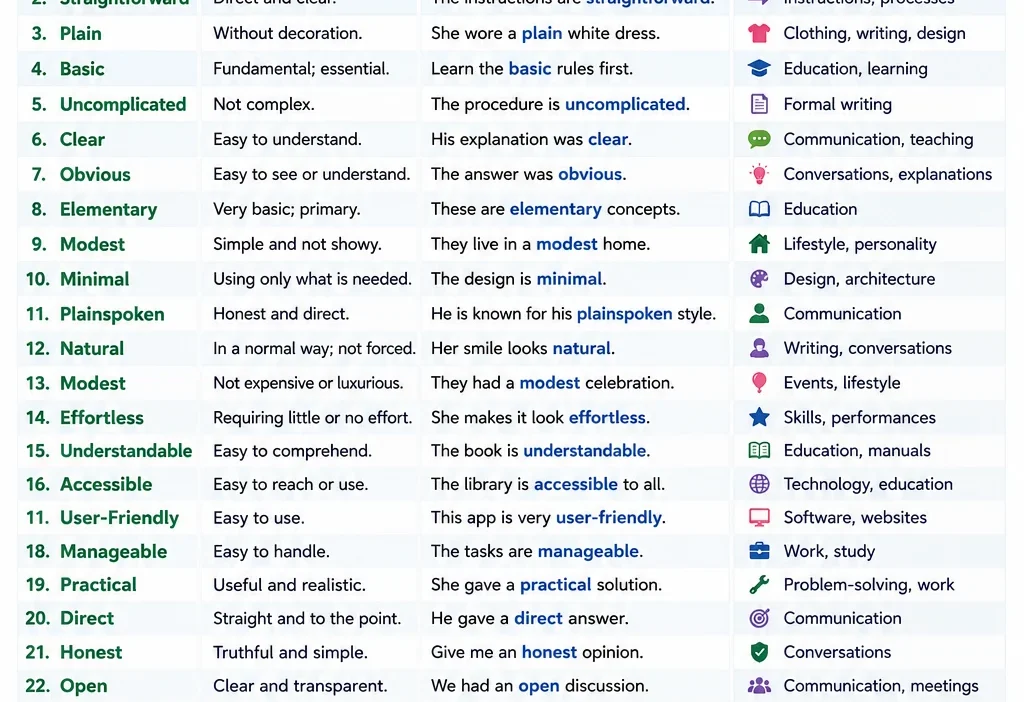
30 Synonyms for Simple
1. Easy
Meaning: Not difficult to do or understand.
Example: The instructions are easy to follow.
Best usage context: Everyday conversations, education.
2. Straightforward
Meaning: Clear and uncomplicated.
Example: The process is straightforward.
Best usage context: Business, instructions.
3. Plain
Meaning: Basic without decoration.
Example: She wore a plain white shirt.
Best usage context: Clothing, writing, design.
4. Basic
Meaning: Having only the most important features.
Example: We learned the basic rules first.
Best usage context: Education, learning.
5. Uncomplicated
Meaning: Not complex.
Example: Their plan was uncomplicated.
Best usage context: Formal writing.
6. Clear
Meaning: Easy to understand.
Example: His explanation was clear.
Best usage context: Teaching, communication.
7. Obvious
Meaning: Easy to notice or understand.
Example: The answer was obvious.
Best usage context: Discussions, explanations.
8. Elementary
Meaning: Very basic or introductory.
Example: These are elementary math concepts.
Best usage context: Education.
9. Modest
Meaning: Simple without being showy.
Example: They live in a modest home.
Best usage context: Lifestyle, personality.
10. Minimal
Meaning: Using only what is necessary.
Example: The room has a minimal design.
Best usage context: Design, architecture.
11. Plainspoken
Meaning: Speaking honestly and simply.
Example: She gave a plainspoken answer.
Best usage context: Communication.
12. Natural
Meaning: Free from unnecessary complexity.
Example: His writing feels natural.
Best usage context: Writing, conversations.
13. Modest
Meaning: Not fancy or expensive.
Example: They chose a modest celebration.
Best usage context: Events, lifestyle.
14. Effortless
Meaning: Appearing very easy.
Example: She made the performance look effortless.
Best usage context: Skills, performances.
15. Understandable
Meaning: Easy to understand.
Example: The guide is understandable for beginners.
Best usage context: Education, manuals.
16. Accessible
Meaning: Easy for everyone to understand or use.
Example: The website is accessible to new users.
Best usage context: Technology, education.
17. User-Friendly
Meaning: Easy to use.
Example: The app is user-friendly.
Best usage context: Software, websites.
18. Manageable
Meaning: Easy to handle.
Example: The workload is manageable.
Best usage context: Work, study.
19. Practical
Meaning: Useful and simple.
Example: She offered a practical solution.
Best usage context: Problem-solving.
20. Direct
Meaning: Clear without unnecessary details.
Example: He gave a direct answer.
Best usage context: Communication.
21. Honest
Meaning: Simple and truthful.
Example: She gave an honest opinion.
Best usage context: Conversations.
22. Open
Meaning: Clear and transparent.
Example: We had an open discussion.
Best usage context: Communication.
23. Neat
Meaning: Clean and simple.
Example: His desk is neat.
Best usage context: Organization.
24. Clean
Meaning: Free from clutter.
Example: The design is clean and modern.
Best usage context: Design, branding.
25. Smooth
Meaning: Easy without problems.
Example: The presentation went smoothly.
Best usage context: Processes, events.
26. Convenient
Meaning: Easy and practical.
Example: Online banking is convenient.
Best usage context: Daily life.
27. Readable
Meaning: Easy to read.
Example: The article is readable for beginners.
Best usage context: Writing, publishing.
28. Concise
Meaning: Short and clear.
Example: Her report was concise.
Best usage context: Business writing.
29. Brief
Meaning: Short and simple.
Example: Please give a brief explanation.
Best usage context: Emails, reports.
30. Straight
Meaning: Direct and simple.
Example: Tell me the straight answer.
Best usage context: Informal conversations.
Comparison Guide
When to Use Different Synonyms
| Synonym | Best Used For | Tone |
|---|---|---|
| Easy | Everyday English | Casual |
| Straightforward | Instructions | Professional |
| Plain | Design, clothing | Neutral |
| Basic | Learning | Neutral |
| Uncomplicated | Formal writing | Formal |
| Clear | Communication | Universal |
| Elementary | Education | Academic |
| Minimal | Interior and graphic design | Modern |
| Accessible | Technology and education | Professional |
| User-Friendly | Apps and software | Technical |
| Practical | Solutions | Professional |
| Concise | Business writing | Formal |
| Brief | Emails and reports | Neutral |
| Readable | Articles and books | Informative |
| Convenient | Daily life | Casual |
How to Choose the Right Synonym
For Academic Writing
Use clear, understandable, elementary, concise, and straightforward when writing essays, reports, or educational materials.
For Business and Professional Writing
Choose practical, concise, accessible, manageable, and direct to create professional and effective communication.
For Technology
Words such as user-friendly, accessible, convenient, readable, and straightforward are excellent for software, websites, and digital products.
For Creative Writing
Use plain, natural, modest, minimal, and clean to describe people, places, objects, or writing styles.
For Everyday Conversations
The most common choices include easy, simple, clear, direct, practical, and honest, making your speech sound natural and easy to understand.
Conclusion
Learning different synonyms for simple helps you express yourself more accurately and naturally.
While every synonym shares a similar meaning, each one fits a different situation, tone, or purpose.
Choosing the right word makes your writing more engaging, avoids repetition, and improves communication.
if you’re writing an essay, creating online content, learning English, or speaking in everyday situations, these 30 synonyms will help you build a stronger vocabulary and communicate with greater confidence.