
Sometimes saying “no” directly can sound too harsh. In conversations, emails, workplaces, schools, and everyday life, people often choose softer words to refuse, decline, or express disagreement politely.
These words are known as soft rejection synonyms because they communicate rejection in a kind and respectful way.
Learning soft rejection synonyms can improve your English vocabulary and help you communicate more professionally.
if you are a student, ESL learner, writer, or content creator, understanding these words will help you write naturally, avoid misunderstandings, and choose the right tone for different situations.
What Does “Soft Rejection” Mean?
Meaning
A soft rejection is a polite or gentle way of saying no, declining an offer, refusing a request, or showing that something is not possible without sounding rude.
Instead of giving a direct refusal, people often use softer language to protect the other person’s feelings.
Example
Instead of saying:
“No, I don’t want it.”
You might say:
“I’ll have to pass this time.”
The second sentence is a soft rejection because it sounds kinder and more respectful.
Common Usage Context
Soft rejection is commonly used in:
- Professional emails
- Job interviews
- Business communication
- Friendships
- Customer service
- Dating conversations
- Academic discussions
- Everyday polite conversations
30 Soft Rejection Synonyms
1. Decline
Meaning: Politely refuse something.
Example: I must decline your invitation.
Best Usage Context: Formal emails and invitations.
2. Refuse
Meaning: Say no to something.
Example: She refused the offer politely.
Best Usage Context: General conversations.
3. Pass
Meaning: Decide not to accept something.
Example: I’ll pass on this opportunity.
Best Usage Context: Casual conversations.
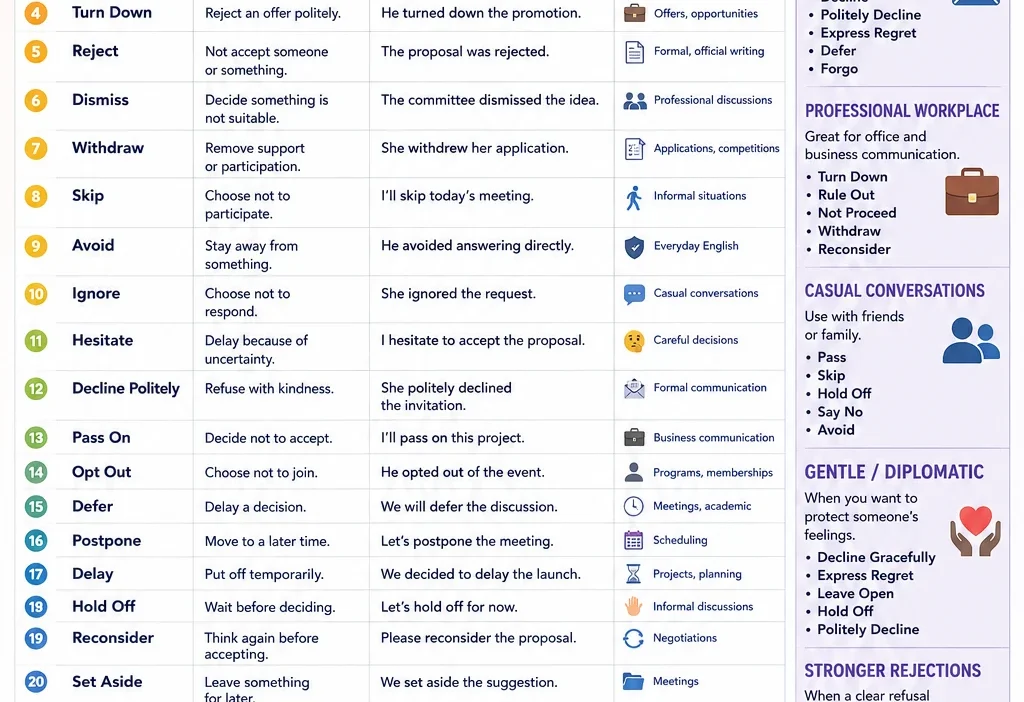
4. Turn Down
Meaning: Reject an offer politely.
Example: He turned down the promotion.
Best Usage Context: Job offers and invitations.
5. Reject
Meaning: Not accept someone or something.
Example: The proposal was rejected.
Best Usage Context: Formal or official writing.
6. Dismiss
Meaning: Decide something is not suitable.
Example: The committee dismissed the idea.
Best Usage Context: Professional discussions.
7. Withdraw
Meaning: Remove support or participation.
Example: She withdrew her application.
Best Usage Context: Applications and competitions.
8. Skip
Meaning: Choose not to participate.
Example: I’ll skip today’s meeting.
Best Usage Context: Informal situations.
9. Avoid
Meaning: Stay away from something.
Example: He avoided answering directly.
Best Usage Context: Everyday English.
10. Ignore
Meaning: Choose not to respond.
Example: She ignored the request.
Best Usage Context: Casual conversations.
11. Hesitate
Meaning: Delay because of uncertainty.
Example: I hesitate to accept the proposal.
Best Usage Context: Careful decisions.
12. Decline Politely
Meaning: Refuse with kindness.
Example: She politely declined the invitation.
Best Usage Context: Formal communication.
13. Pass On
Meaning: Decide not to accept.
Example: I’ll pass on this project.
Best Usage Context: Business communication.
14. Opt Out
Meaning: Choose not to join.
Example: He opted out of the event.
Best Usage Context: Programs and memberships.
15. Defer
Meaning: Delay a decision.
Example: We will defer the discussion.
Best Usage Context: Meetings and academic settings.
16. Postpone
Meaning: Move something to a later time.
Example: Let’s postpone the meeting.
Best Usage Context: Scheduling.
17. Delay
Meaning: Put off temporarily.
Example: We decided to delay the launch.
Best Usage Context: Projects and planning.
18. Hold Off
Meaning: Wait before deciding.
Example: Let’s hold off for now.
Best Usage Context: Informal discussions.
19. Reconsider
Meaning: Think again before accepting.
Example: Please reconsider the proposal.
Best Usage Context: Negotiations.
20. Set Aside
Meaning: Leave something for later.
Example: We set aside the suggestion.
Best Usage Context: Meetings.
21. Forgo
Meaning: Decide not to have something.
Example: She chose to forgo the reward.
Best Usage Context: Formal writing.
22. Bypass
Meaning: Choose another option.
Example: They bypassed the invitation.
Best Usage Context: Professional contexts.
23. Rule Out
Meaning: Decide something is not possible.
Example: We ruled out that option.
Best Usage Context: Decision-making.
24. Decline Gracefully
Meaning: Refuse respectfully.
Example: He declined gracefully.
Best Usage Context: Professional communication.
25. Leave Open
Meaning: Avoid giving a final answer.
Example: Let’s leave the option open.
Best Usage Context: Negotiations.
26. Say No
Meaning: Refuse directly but politely.
Example: She said no kindly.
Best Usage Context: Everyday conversations.
27. Not Proceed
Meaning: Decide not to continue.
Example: We decided not to proceed.
Best Usage Context: Business decisions.
28. Pass Up
Meaning: Choose not to accept an opportunity.
Example: He passed up the scholarship.
Best Usage Context: Opportunities.
29. Politely Decline
Meaning: Refuse respectfully.
Example: They politely declined the request.
Best Usage Context: Formal emails.
30. Express Regret
Meaning: Say no while showing sympathy.
Example: We regret that we cannot accept your proposal.
Best Usage Context: Business letters and customer service.
Comparison Guide: When to Use Different Soft Rejection Synonyms
| Synonym | Tone | Best Used For |
|---|---|---|
| Decline | Formal | Invitations, emails |
| Refuse | Neutral | General situations |
| Pass | Casual | Friends and informal chats |
| Turn Down | Neutral | Offers and opportunities |
| Reject | Strong | Official decisions |
| Opt Out | Neutral | Memberships and events |
| Hold Off | Casual | Delaying decisions |
| Postpone | Neutral | Meetings and schedules |
| Rule Out | Professional | Planning and analysis |
| Express Regret | Very Polite | Business communication |
How to Choose the Right Synonym
Formal Situations
Use these words in professional emails, business meetings, and official documents:
- Decline
- Politely Decline
- Express Regret
- Defer
- Forgo
Professional Workplace
These work well in offices and business communication:
- Turn Down
- Rule Out
- Not Proceed
- Withdraw
- Reconsider
Casual Conversations
Use these with friends or family:
- Pass
- Skip
- Hold Off
- Say No
- Avoid
Gentle or Diplomatic Responses
When you want to protect someone’s feelings, choose:
- Decline Gracefully
- Express Regret
- Leave Open
- Hold Off
- Politely Decline
Stronger Rejections
When a clear refusal is necessary, use:
- Reject
- Refuse
- Dismiss
- Rule Out
Tips for Using Soft Rejection Synonyms
- Match your word to the situation.
- Choose formal words in professional settings.
- Use casual expressions with friends.
- Consider the other person’s feelings.
- Add polite phrases such as “thank you” or “I appreciate the offer” when appropriate.
- Avoid overly direct language when diplomacy is important.
Why Learning Soft Rejection Synonyms Matters
Expanding your vocabulary helps you communicate with confidence. Soft rejection synonyms allow you to refuse requests, decline invitations, or reject ideas without sounding rude. They also make your writing more natural, improve your professional communication, and help you build positive relationships.
For students, ESL learners, writers, and content creators, mastering these expressions is an excellent way to sound more fluent and choose words that fit the right tone.
Conclusion
Understanding soft rejection synonyms makes it easier to communicate politely and effectively in English.
Instead of always saying “no,” you can choose words like decline, turn down, pass, opt out, or express regret, depending on the situation.
Using the right synonym helps you sound respectful, professional, and thoughtful while improving both your speaking and writing skills.
Keep practicing these expressions, and you’ll become more confident in handling conversations with kindness and clarity.

Liam Henry is a content author at Synonymed, specializing in vocabulary enrichment and synonym guides. He creates clear, engaging resources that help learners improve English word knowledge and language fluency.