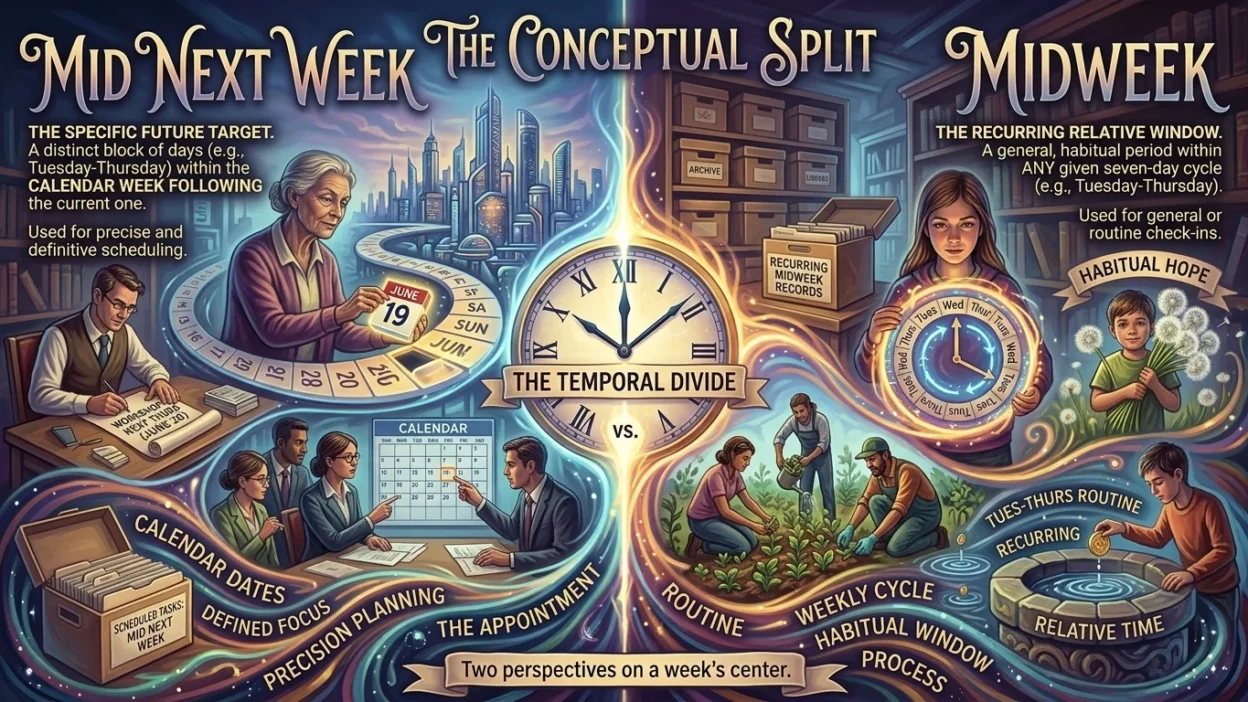
“Mid next week” and “midweek” are both correct expressions, but they do not mean exactly the same thing. “Mid next week” refers to the middle part of the week that comes after the current week, while “midweek” means the middle of a week in general.
For example, “I’ll call you mid next week” refers to the upcoming week, while “We usually have a midweek meeting” describes a regular meeting held around the middle of the week.
These expressions can be confusing because both contain the idea of the middle of a week.
The important difference is whether you are referring to a specific upcoming week or talking about the middle of a week generally. Understanding this distinction will help you use the expressions naturally in emails, conversations, schedules, and everyday English.
Quick Answer
“Mid next week” means around the middle of the week after this week, usually around Tuesday, Wednesday, or Thursday. “Midweek” means the middle part of a week, usually around Wednesday. Use “mid next week” for a specific future time and “midweek” for a general period or recurring event.
Why Do People Confuse It?
People confuse “mid next week” and “midweek” because both expressions describe a time around the middle of a week.
The main difference is specificity:
- Mid next week = the middle of the next week
- Midweek = the middle of a week
- Mid next week usually refers to a future time.
- Midweek can refer to the current week, a future week, or weeks in general.
Compare:
I’ll send the report mid next week.
This means the report will be sent around the middle of the upcoming week.
We have a midweek meeting every Wednesday.
Here, “midweek” describes a regular event that occurs around the middle of each week.
First Word: “Mid Next Week”
“Mid next week” is a time expression meaning around the middle of next week.
The phrase refers to a particular upcoming week. It is especially useful when discussing plans, deadlines, appointments, deliveries, work, or future events.
Examples
- I’ll finish the project mid next week.
- We should receive the package mid next week.
- Let’s schedule the meeting for mid next week.
- I’ll give you an update mid next week.
What day is “mid next week”?
There is no universally fixed day for “mid next week.” In ordinary usage, it generally means approximately the middle portion of the upcoming week.
Depending on the context, it might mean:
- Tuesday
- Wednesday
- Thursday
If an exact date matters, it is better to give the specific day:
I’ll send it on Wednesday next week.
This avoids ambiguity.
Second Word: “Midweek”
“Midweek” means the middle part of a week.
It is commonly used as a noun or adjective.
As a noun
I usually feel more tired by midweek.
Here, “midweek” refers to the middle of the week.
As an adjective
We have a midweek meeting.
Here, “midweek” describes the meeting.
There is a midweek discount at the hotel.
Here, it describes a discount available during the middle part of the week.
Unlike “mid next week,” the word “midweek” does not automatically identify which week you mean.
Mid Next Week vs Midweek: Comparison Table
| Expression | Meaning | Specificity | Example |
|---|---|---|---|
| Mid next week | Around the middle of the upcoming week | Specific future week | I’ll call you mid next week. |
| Midweek | Around the middle of a week | General or context-dependent | We have a midweek meeting. |
| Midweek next week | Around the middle of the upcoming week | Specific future week | The event is scheduled for midweek next week. |
| By mid next week | No later than around the middle of next week | Specific deadline | Please finish it by mid next week. |
| In the middle of next week | Around the middle of the upcoming week | Specific future week | I’ll be traveling in the middle of next week. |
When Should You Use Each?
Use “mid next week” for a specific future time
Use “mid next week” when you are talking about the upcoming week.
I expect to have an answer mid next week.
The listener understands that you mean the middle part of the week that follows the current week.
Use “midweek” for a general period
Use “midweek” when the exact week is not the main focus.
We normally have a midweek meeting.
This could refer to a recurring meeting held in the middle of each week.
Use “midweek” with another time reference when necessary
You can make the meaning more specific:
We are planning a midweek visit next week.
Here, “next week” tells us which week is being discussed.
You can also say:
The deadline is midweek next week.
This means approximately the middle of the upcoming week.
10+ Examples
Examples with “Mid Next Week”
- I’ll send you the documents mid next week.
- We should know the results mid next week.
- The repairs should be completed mid next week.
- I’m expecting a response mid next week.
- Let’s discuss the proposal mid next week.
- The new employee will start mid next week.
- I’ll probably be available mid next week.
- The shipment is expected to arrive mid next week.
Examples with “Midweek”
- I usually have a lot of work midweek.
- We have a midweek staff meeting.
- The restaurant offers a midweek special.
- Business is usually quieter midweek.
- She plans to take a midweek break.
- The hotel has cheaper rates midweek.
- By midweek, everyone was feeling tired.
Examples Comparing the Two
I’ll call you mid next week.
This refers to the middle of the upcoming week.
I usually call clients midweek.
This describes a general habit.
We have a meeting midweek next week.
This identifies the middle of a particular future week.
Common Mistakes
1. Treating “midweek” as exactly Wednesday
Midweek usually refers to the middle portion of the week, but it does not always mean exactly Wednesday.
For some speakers or situations, it can include Tuesday or Thursday.
If precision matters, use a specific day:
The meeting is on Wednesday.
2. Assuming “mid next week” has one exact meaning
“Mid next week” is approximate.
It does not guarantee that the speaker means Wednesday at a particular time.
If the timing is important, ask:
Do you mean Wednesday or Thursday?
3. Confusing “midweek” with “next week”
These expressions have different functions.
I’ll see you next week.
This refers to the entire upcoming week.
I’ll see you midweek.
This refers to approximately the middle of the week.
I’ll see you mid next week.
This combines the two ideas and refers to the middle of the upcoming week.
4. Using “mid next week” for the current week
If today is Monday and you mean Wednesday of the current week, “mid next week” is incorrect because “next week” refers to the following week.
Instead, say:
I’ll finish it midweek.
Or:
I’ll finish it by Wednesday.
Memory Trick
Think of “next” as pointing forward.
Mid + next week = middle of the upcoming week
Think of “midweek” as describing a position within a week.
Midweek = middle of a week
A simple way to remember it:
Specific future week → mid next week
General middle period → midweek
American vs British English
Both “mid next week” and “midweek” are understandable in American and British English.
The basic distinction remains the same: “mid next week” identifies the middle of the upcoming week, while “midweek” refers to the middle part of a week.
There can be differences in how people interpret approximate expressions such as “midweek,” particularly because working weeks, calendars, and local habits can vary. When exact timing matters in either variety of English, giving the day or date is clearer.
For example:
I’ll send it on Wednesday next week.
is more precise than:
I’ll send it mid next week.
Similar Words and Expressions
Next week
Next week means the week following the current week.
I’ll visit you next week.
Midweek
Midweek means around the middle of a week.
The office is usually busy midweek.
Mid next week
Mid next week means around the middle of the upcoming week.
We should have an answer mid next week.
Middle of next week
This has essentially the same basic meaning as “mid next week.”
I’ll be available in the middle of next week.
By mid next week
This means no later than approximately the middle of next week.
Please send me the report by mid next week.
Later next week
This refers to a later part of the upcoming week but is less specific than “mid next week.”
I’ll probably have more information later next week.
Final Verdict
“Mid next week” and “midweek” are both correct, but they are used differently.
Use “mid next week” when you mean approximately the middle of the upcoming week:
I’ll contact you mid next week.
Use “midweek” when you mean approximately the middle of a week, especially when talking about a general period, habit, or event:
We usually have a midweek meeting.
If you need to communicate an exact deadline or appointment, avoid relying on either approximate expression. Give the specific day or date instead.
FAQs
What does “mid next week” mean?
“Mid next week” means approximately the middle of the week after the current week. Depending on context, it may refer to Tuesday, Wednesday, Thursday, or another nearby time.
Is “mid next week” grammatically correct?
Yes. “Mid next week” is a natural English time expression used to refer approximately to the middle of the upcoming week.
What does “midweek” mean?
“Midweek” means the middle part of a week. It can describe a general time period or an event that occurs around the middle of the week.
Is “midweek next week” correct?
Yes. “Midweek next week” can be used to clarify that the midweek period being discussed belongs to the upcoming week.
Does “midweek” mean Wednesday?
Not necessarily. Wednesday is often considered the middle of a Monday-to-Sunday week, but “midweek” is an approximate expression and can refer to the surrounding days as well.
What is the difference between “midweek” and “mid next week”?
“Midweek” refers generally to the middle part of a week, while “mid next week” specifically refers to the middle part of the upcoming week.
Should I say “mid next week” or “in the middle of next week”?
Both are correct. “Mid next week” is shorter and natural in everyday communication, while “in the middle of next week” is a little more explicit.
What does “by mid next week” mean?
“By mid next week” means something should happen no later than approximately the middle of the upcoming week. It describes a deadline rather than simply an approximate appointment time.
Remember This
Mid next week = the middle of the upcoming week.
Midweek = the middle part of a week.
By mid next week = no later than approximately the middle of the upcoming week.
If you need exact timing, use a day or date:
I’ll call you on Wednesday next week.
Conclusion
The difference between “mid next week” and “midweek” is simple once you focus on what each expression points to. “Mid next week” identifies the middle of a particular upcoming week, while “midweek” describes the middle portion of a week more generally.
Both expressions are useful in everyday English, especially when discussing plans, schedules, deadlines, meetings, travel, and work. Because both are approximate, use a specific day or date whenever precise timing is important.