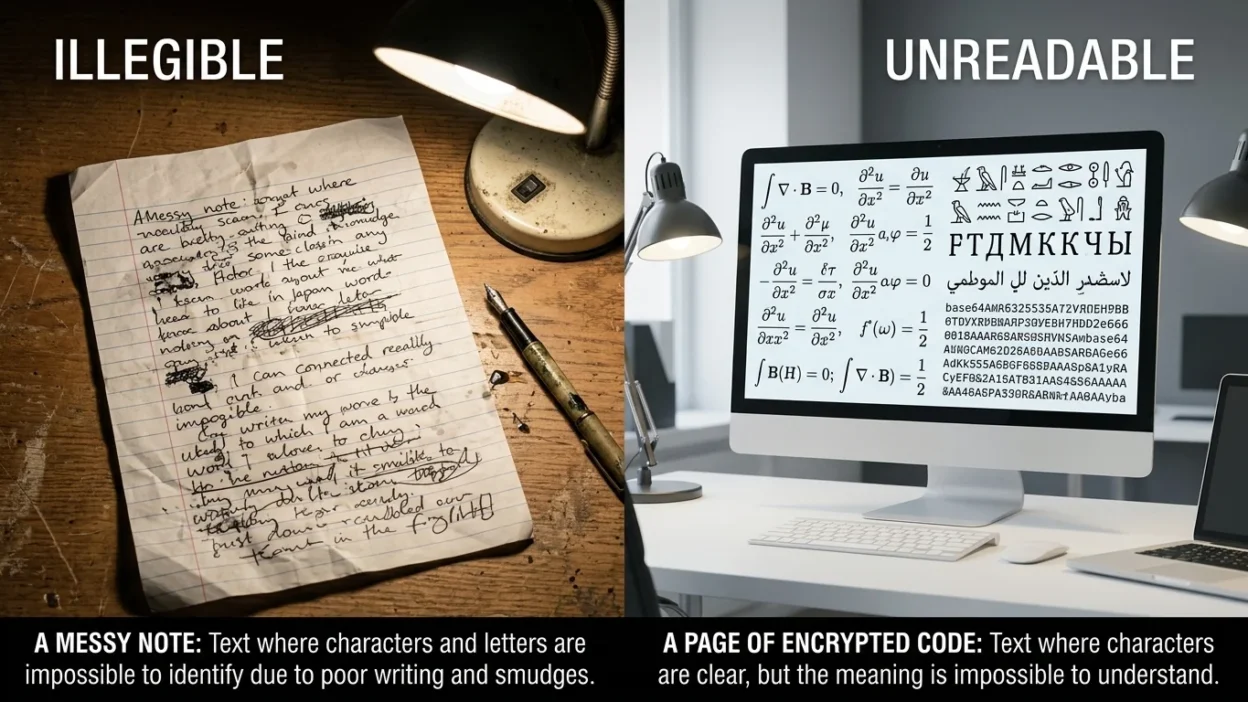
Illegible and unreadable both describe text that is difficult or impossible to read, but they are not always interchangeable.
Illegible usually means that the writing or printed characters cannot be identified clearly, often because of poor handwriting, bad printing, or unclear letters.
Unreadable is broader: something can be unreadable because the letters are unclear, the text is too difficult to understand, or the quality makes reading impossible.
For example, if a doctor writes so quickly that you cannot recognize the letters, the handwriting may be illegible.
If a book is written in extremely complicated language that you cannot understand, it may be unreadable, even though every word is clearly printed.
Understanding this distinction helps students, writers, editors, and English learners choose the right word when describing handwriting, documents, books, screens, signs, and other written material.
Quick Answer
Illegible means difficult or impossible to read because the letters, handwriting, or printed characters are unclear. Unreadable is a broader word that can mean impossible to read for many reasons, including unclear text, poor formatting, tiny print, or extremely difficult language. So, illegible focuses more on appearance, while unreadable has a wider meaning.
Why People Confuse It
People confuse illegible vs unreadable because both words can describe writing that a person cannot read.
The main difference is the reason the reader cannot read the text.
- Illegible usually means the actual letters or characters are unclear.
- Unreadable can mean the text is unclear, inaccessible, too complicated, badly presented, or otherwise impossible to read.
- Something illegible is usually also unreadable.
- Something unreadable is not necessarily illegible.
For example:
“His handwriting is illegible.”
The letters themselves are difficult to identify.
But:
“The legal document is unreadable.”
This could mean the document uses extremely complicated language, has terrible formatting, or is simply too difficult to understand.
First Word: Illegible
Illegible is an adjective meaning not clear enough to be read or recognized.
It is commonly used for:
- Handwriting
- Signatures
- Numbers
- Letters
- Printed text
- Labels
- Documents
- Scanned copies
Simple definition
Illegible = impossible or very difficult to read because the characters are unclear.
Examples
“The doctor’s handwriting is illegible.”
The handwriting is so unclear that the letters cannot easily be recognized.
“The signature at the bottom of the form is illegible.”
The signature cannot be identified clearly.
“Several words on the photocopy are illegible.”
The copying process has made some words too unclear to read.
Common causes of illegible writing
Writing can become illegible because of:
- Very poor handwriting
- Smudged ink
- Blurred printing
- Faded text
- Damaged paper
- Low-quality scanning
- Overlapping characters
- Extremely small or distorted letters
The important idea is that the visual form of the text is the problem.
Second Word: Unreadable
Unreadable is an adjective meaning too difficult or impossible to read.
It has a broader meaning than illegible.
Something can be unreadable because:
- The letters are unclear.
- The text is too small.
- The page is badly formatted.
- The image is blurry.
- The language is extremely complicated.
- The writing is confusing.
- The text is poorly organized.
- The content is difficult to understand.
Simple definition
Unreadable = too difficult or impossible to read, understand, or make sense of.
Examples
“The scan is unreadable.”
The image may be too blurry or distorted to read.
“The instructions are unreadable.”
This could mean the words are unclear, or that the instructions are so confusing that they are extremely difficult to understand.
“The novel was technically correct but almost unreadable.”
Here, unreadable can describe the quality or difficulty of the writing, not simply the appearance of the letters.
Illegible vs Unreadable: Comparison Table
| Feature | Illegible | Unreadable |
|---|---|---|
| Basic meaning | Cannot be read because the characters are unclear | Cannot be read or understood easily |
| Main focus | Appearance of letters or characters | Reading or understanding overall |
| Common with handwriting | Very common | Possible |
| Common with blurry text | Yes | Yes |
| Common with complicated language | No, usually | Yes |
| Common with bad formatting | Sometimes | Yes |
| Can describe difficult ideas? | Rarely | Yes |
| Can describe poor writing style? | Rarely | Yes |
| Broader meaning | Narrower | Broader |
The easiest distinction
Illegible = I cannot make out the letters.
Unreadable = I cannot read or understand the text.
When to Use Each
Use “illegible” when the letters are unclear
Choose illegible when the problem is primarily the physical appearance of the writing.
“Your handwriting is illegible.”
“The number on the receipt is illegible.”
“The old document contains several illegible words.”
Use “unreadable” when the problem is broader
Choose unreadable when you cannot read or understand something for any number of reasons.
“The text on this website is unreadable because the font is too small.”
“The report is unreadable because it is full of unnecessary technical language.”
“The image is too blurry and completely unreadable.”
Can they overlap?
Yes.
For example:
“The handwriting is illegible and therefore unreadable.”
This sentence uses both words correctly. The handwriting is illegible because the letters are unclear, and it is unreadable because the reader cannot read it.
10+ Examples of Illegible vs Unreadable
1. Bad handwriting
“His handwriting is illegible.”
The letters are difficult to recognize.
2. Tiny text
“The instructions are unreadable on my phone.”
The text may technically be clear, but it is too small to read comfortably.
3. Blurry photograph
“The photograph of the document is unreadable.”
The image quality prevents you from reading the document.
4. Smudged ink
“The last few words are illegible because the ink was smudged.”
The characters themselves cannot be identified clearly.
5. Complicated writing
“The academic article is almost unreadable for beginners.”
The words are visible, but the language is extremely difficult to understand.
6. Faded document
“The faded writing is partly illegible.”
Some characters can no longer be recognized.
7. Poor website design
“The website is unreadable because the text is too small and crowded.”
The problem is overall readability and presentation.
8. Difficult handwriting
“I couldn’t read her note because it was illegible.”
The handwriting itself is unclear.
9. Confusing instructions
“The instructions are so poorly written that they are unreadable.”
Here, unreadable refers to difficulty understanding the writing.
10. Damaged sign
“The damaged road sign is almost illegible.”
The characters are physically difficult to recognize.
11. Poorly scanned page
“The scanned copy is unreadable.”
The quality of the entire document makes reading difficult.
12. Extremely complex report
“The report is technically accurate but unreadable for ordinary customers.”
The problem is not necessarily the letters; the language and presentation are too difficult.
Common Mistakes
Mistake 1: Thinking “illegible” means “bad English”
It does not.
Illegible usually describes text that cannot be visually recognized.
“The handwriting is illegible.”
This says nothing about the writer’s grammar or English ability.
Mistake 2: Using “illegible” for every difficult book
A difficult book may be unreadable, but it is not necessarily illegible.
If the words are printed clearly but the ideas are extremely complicated, unreadable is more appropriate.
Mistake 3: Assuming “unreadable” only means unclear letters
It does not.
A text can be unreadable because it is:
- Too complicated
- Too small
- Poorly organized
- Badly formatted
- Blurry
- Confusing
Mistake 4: Confusing “illegible” with “illegal”
These words look similar but have completely different meanings.
- Illegible = impossible or difficult to read
- Illegal = against the law
“The handwriting is illegible.”
“Parking here is illegal.”
Mistake 5: Saying “illegible to understand”
Usually, this is incorrect.
Say:
“The handwriting is illegible.”
or:
“The explanation is difficult to understand.”
For ideas and explanations, unreadable may sometimes work, but unclear, confusing, or difficult to understand may be more precise.
Memory Trick
Think of letters when you hear illegible.
Illegible → I can’t identify the letters.
Think of reading when you hear unreadable.
Unreadable → I can’t read or understand the text.
A useful shortcut is:
Illegible = unclear characters
Unreadable = impossible or difficult reading
American vs British English
There is no important spelling difference between American and British English for these words.
Both varieties use:
- illegible
- unreadable
The meanings are also essentially the same.
For example:
American English:
“The handwriting is illegible.”
British English:
“The handwriting is illegible.”
Likewise:
American English:
“The instructions are unreadable.”
British English:
“The instructions are unreadable.”
The distinction between the two words is therefore about meaning and context, not regional English.
Similar Words
Several words are related to illegible and unreadable, but they are not exact synonyms.
Unclear
Means difficult to understand or recognize.
“The instructions are unclear.”
Indecipherable
Means extremely difficult or impossible to understand or interpret.
“The old handwriting was indecipherable.”
This is often stronger than illegible.
Incomprehensible
Means impossible or extremely difficult to understand.
“The explanation was incomprehensible to the students.”
Blurred
Means lacking sharpness or clear detail.
“The scanned image is blurred.”
Unintelligible
Usually means impossible to understand, especially speech or language.
“His explanation was unintelligible.”
Difficult to read
A neutral phrase that can replace unreadable in many situations.
“The small print is difficult to read.”
Indistinct
Means not clearly defined or distinguishable.
“The writing was indistinct.”
Final Verdict
The simplest way to understand illegible vs unreadable is to focus on what makes the text difficult.
Illegible usually describes writing or characters that are visually unclear and cannot be identified easily.
Unreadable is broader. It describes something that is too difficult or impossible to read or understand, whether because of unclear characters, tiny print, poor formatting, confusing language, or another problem.
So, if you cannot recognize the letters, choose illegible. If you cannot successfully read or understand the text for any reason, unreadable is usually the better choice.
FAQs
1. What is the difference between illegible and unreadable?
Illegible usually means that the letters or characters are too unclear to recognize. Unreadable is broader and can refer to text that is difficult to read or understand for many reasons.
2. Is illegible the same as unreadable?
Not exactly. Something illegible is generally unreadable, but something unreadable is not necessarily illegible. A clearly printed book written in extremely complicated language can be unreadable without being illegible.
3. Is handwriting illegible or unreadable?
Illegible is usually the more precise word when handwriting is difficult to recognize.
“The doctor’s handwriting is illegible.”
You can also say:
“I can’t read the doctor’s handwriting.”
4. Can a book be illegible?
Yes, but unreadable is usually more natural when the problem is the book’s content, style, organization, or complexity. Illegible is more appropriate if the printed words themselves cannot be recognized.
5. What is the opposite of illegible?
The most direct opposite is legible, meaning clear enough to read.
“Her handwriting is neat and legible.”
6. What is the opposite of unreadable?
Depending on the context, the opposite can be readable, clear, or easy to understand.
“The instructions are clear and easy to read.”
7. Is “unreadable handwriting” correct?
Yes. Unreadable handwriting is grammatically correct. However, illegible handwriting is often more precise when the individual letters cannot be recognized.
8. What is a stronger word than illegible?
Depending on the context, indecipherable can be stronger. It suggests that something is extremely difficult or impossible to interpret or understand.
Remember This
Illegible = the letters are unclear.
Unreadable = the text cannot be successfully read or understood.
Use illegible for unclear handwriting, signatures, numbers, or characters.
Use unreadable for text that is too difficult, unclear, tiny, badly presented, confusing, or otherwise impossible to read.
Conclusion
The difference between illegible and unreadable is small but important. Illegible focuses mainly on the appearance of written characters: the letters, numbers, or symbols are too unclear to identify. Unreadable has a wider meaning and can describe anything that makes reading or understanding difficult.
For everyday English, remember the simple rule: illegible describes unclear writing, while unreadable describes text that cannot be successfully read or understood. When you are talking about handwriting that you cannot make out, illegible is usually the best choice. When the problem is broader, unreadable is often more natural.