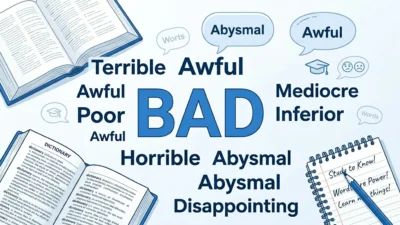
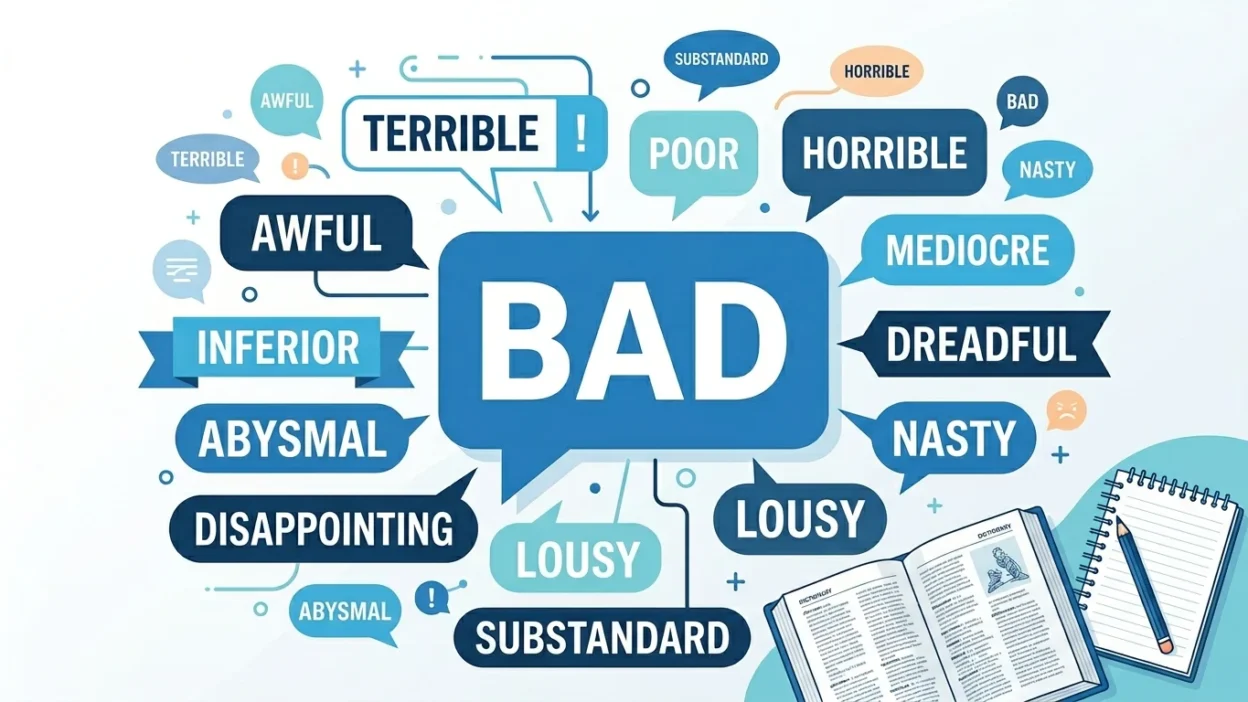
The English word “bad” is one of the most common words used in everyday conversations and writing. People use it to describe something negative
, unpleasant, poor in quality, harmful, or disappointing. While the word is useful, using it repeatedly can make your writing sound repetitive and less engaging.
Learning different synonyms for bad can help students, ESL learners, writers, and content creators express ideas more clearly and accurately.
Different situations require different words, and understanding these alternatives can improve both spoken and written English.
What Does “Bad” Mean?
Simple Meaning of Bad
The word bad generally means something that is not good, unpleasant, poor in quality, harmful, or undesirable.
Usage Context
The meaning of “bad” can change depending on the situation. For example:
- A bad movie may be boring or poorly made.
- A bad person may behave in a harmful way.
- Bad weather may create problems or discomfort.
- A bad decision may lead to negative results.
Because “bad” has many meanings, choosing the right synonym can help communicate your message more effectively.
30 Synonyms for Bad
1. Poor
Meaning: Not good in quality or performance.
Example Sentence: The restaurant received poor reviews from customers.
Best Usage Context: Quality, performance, services.
2. Terrible
Meaning: Extremely bad or unpleasant.
Example Sentence: We had terrible weather during our vacation.
Best Usage Context: Strong negative situations.
3. Awful
Meaning: Very unpleasant or bad.
Example Sentence: The food tasted awful.
Best Usage Context: Experiences, opinions.
4. Horrible
Meaning: Shockingly unpleasant or unpleasant.
Example Sentence: It was a horrible mistake.
Best Usage Context: Serious negative events.
5. Dreadful
Meaning: Extremely bad or disappointing.
Example Sentence: The team’s performance was dreadful.
Best Usage Context: Formal writing and reviews.
6. Inferior
Meaning: Lower in quality than others.
Example Sentence: This product is inferior to the original version.
Best Usage Context: Comparisons.
7. Defective
Meaning: Having faults or problems.
Example Sentence: The company replaced the defective item.
Best Usage Context: Products and manufacturing.
8. Faulty
Meaning: Not working correctly.
Example Sentence: The machine stopped because of a faulty part.
Best Usage Context: Equipment and technology.
9. Harmful
Meaning: Causing damage or injury.
Example Sentence: Smoking is harmful to health.
Best Usage Context: Health and safety.
10. Negative
Meaning: Unfavorable or pessimistic.
Example Sentence: She had a negative attitude toward change.
Best Usage Context: Opinions and attitudes.
11. Unpleasant
Meaning: Not enjoyable or comfortable.
Example Sentence: The smell was unpleasant.
Best Usage Context: Sensory experiences.
12. Unacceptable
Meaning: Not suitable or allowed.
Example Sentence: Such behavior is unacceptable.
Best Usage Context: Rules and standards.
13. Unsatisfactory
Meaning: Not meeting expectations.
Example Sentence: The results were unsatisfactory.
Best Usage Context: Work and performance.
14. Weak
Meaning: Lacking strength or effectiveness.
Example Sentence: The argument was weak and unconvincing.
Best Usage Context: Ideas and performance.
15. Ineffective
Meaning: Not producing desired results.
Example Sentence: The treatment proved ineffective.
Best Usage Context: Methods and strategies.
16. Inadequate
Meaning: Not enough or insufficient.
Example Sentence: The resources were inadequate for the project.
Best Usage Context: Supplies and support.
17. Damaging
Meaning: Causing harm or loss.
Example Sentence: False rumors can be damaging.
Best Usage Context: Reputation and relationships.
18. Dangerous
Meaning: Likely to cause harm.
Example Sentence: Driving too fast is dangerous.
Best Usage Context: Safety-related situations.
19. Evil
Meaning: Morally wrong or wicked.
Example Sentence: The story featured an evil character.
Best Usage Context: Morality and storytelling.
20. Wicked
Meaning: Intentionally harmful or immoral.
Example Sentence: The wicked ruler oppressed his people.
Best Usage Context: Literature and narratives.
21. Corrupt
Meaning: Dishonest or unethical.
Example Sentence: The official was accused of being corrupt.
Best Usage Context: Politics and ethics.
22. Rotten
Meaning: Very poor or morally bad.
Example Sentence: He had a rotten attitude.
Best Usage Context: Informal speech.
23. Lousy
Meaning: Very poor in quality.
Example Sentence: We received lousy service.
Best Usage Context: Casual conversation.
24. Substandard
Meaning: Below the required standard.
Example Sentence: The construction work was substandard.
Best Usage Context: Professional evaluations.
25. Mediocre
Meaning: Average but not impressive.
Example Sentence: The movie was mediocre at best.
Best Usage Context: Reviews and criticism.
26. Disappointing
Meaning: Not as good as expected.
Example Sentence: The final result was disappointing.
Best Usage Context: Expectations and outcomes.
27. Appalling
Meaning: Extremely shocking and bad.
Example Sentence: The living conditions were appalling.
Best Usage Context: Serious criticism.
28. Atrocious
Meaning: Extremely unpleasant or terrible.
Example Sentence: The customer service was atrocious.
Best Usage Context: Strong negative reviews.
29. Abysmal
Meaning: Extremely poor or inadequate.
Example Sentence: The test scores were abysmal.
Best Usage Context: Academic and professional contexts.
30. Miserable
Meaning: Causing great discomfort or unhappiness.
Example Sentence: We felt miserable during the storm.
Best Usage Context: Feelings and experiences.
Comparison Guide: When to Use Different Synonyms
Quick Reference Table
| Synonym | Strength | Best Used For |
|---|---|---|
| Poor | Mild | Quality, performance |
| Weak | Mild | Arguments, skills |
| Unsatisfactory | Mild | Results, work |
| Mediocre | Mild | Reviews |
| Unpleasant | Moderate | Experiences |
| Harmful | Moderate | Health, safety |
| Dangerous | Moderate | Risky situations |
| Terrible | Strong | General criticism |
| Awful | Strong | Personal opinions |
| Horrible | Strong | Serious mistakes |
| Appalling | Very Strong | Severe criticism |
| Atrocious | Very Strong | Reviews and complaints |
| Abysmal | Very Strong | Extremely poor results |
| Evil | Moral Judgment | Character and behavior |
| Corrupt | Ethical Issues | Politics and business |
How to Choose the Right Synonym
For Poor Quality
Use:
- Poor
- Inferior
- Mediocre
- Substandard
- Defective
These words focus on quality and performance.
For Strong Negative Opinions
Use:
- Terrible
- Awful
- Horrible
- Dreadful
- Atrocious
These words express strong dissatisfaction.
For Harm or Risk
Use:
- Harmful
- Dangerous
- Damaging
These words describe situations that can cause problems or injury.
For Morality and Behavior
Use:
- Evil
- Wicked
- Corrupt
These words describe unethical or immoral actions.
For Disappointment
Use:
- Unsatisfactory
- Disappointing
- Ineffective
- Inadequate
These words work well when expectations are not met.
Why Learning Synonyms for Bad Matters
Better Communication
Using precise vocabulary helps people understand exactly what you mean.
Improved Writing
Writers can avoid repetition and make content more engaging.
Stronger English Skills
Students and ESL learners can expand their vocabulary and become more confident communicators.
Better SEO and Content Creation
Content creators can write richer, more natural articles by using varied vocabulary instead of repeating the same word.
Conclusion
Understanding and using different synonyms for bad can greatly improve your English vocabulary and communication skills.
While “bad” is a useful general word, alternatives such as poor, terrible, harmful, disappointing, atrocious, and corrupt allow you to express ideas with greater accuracy and impact.
The best synonym depends on the situation, tone, and meaning you want to communicate.
By learning these 30 alternatives and their usage contexts, students, ESL learners, writers, and content creators can write more naturally, avoid repetition, and communicate more effectively