
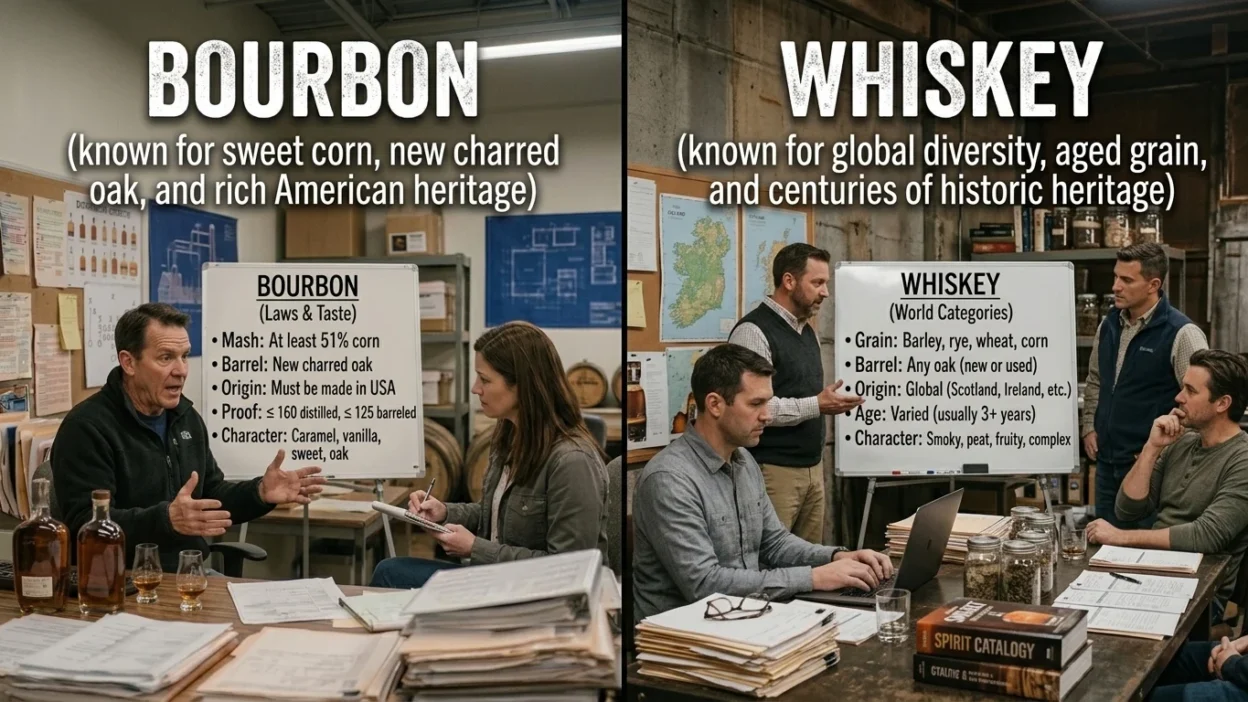
Bourbon vs whiskey is a common comparison for people who want to understand these two popular types of spirits.
The main difference is simple: bourbon is a type of whiskey, but not all whiskey is bourbon.
Whiskey is the broader category, while bourbon is an American whiskey that must follow specific production rules.
These rules include using a grain mixture containing at least 51% corn and aging the spirit in new, charred oak containers.
Understanding the difference between bourbon and whiskey can help you read drink menus, understand product labels, and learn more about how spirits are made.
Bourbon is often associated with sweet notes such as vanilla, caramel, and oak, while other whiskeys can have a wide range of flavors, including fruit, spice, smoke, and malt.
However, the taste depends on the ingredients, production method, aging process, and individual bottle.
In this guide, you will learn what bourbon and whiskey mean, how they differ, when each term is appropriate, and which common misconceptions to avoid.
Quick Answer: Bourbon vs Whiskey
Whiskey is a distilled spirit made from fermented grain mash. Bourbon is a specific type of American whiskey made with at least 51% corn and aged in new, charred oak containers. Bourbon often tastes sweet, with caramel and vanilla notes, while other whiskeys vary widely. The key difference is that bourbon follows additional production rules.
Why Do People Confuse Bourbon and Whiskey?
People often confuse bourbon and whiskey because the terms describe related products. Bourbon belongs to the whiskey family, so both share important production features.
Both are made by fermenting grains, distilling the resulting liquid, and often aging it in wooden containers. Their flavors can overlap, too. A bourbon and a non-bourbon whiskey may both have notes of vanilla, oak, spice, or caramel.
The confusion usually comes from three things:
- Category names: Whiskey is the general category, while bourbon is one specific style.
- Similar flavors: Different whiskeys can share tasting notes even when they follow different production rules.
- Different origins: Bourbon is associated with the United States, while whiskey is produced in countries around the world.
Think of the relationship this way: every bourbon is whiskey, but a Scotch whisky or an Irish whiskey is not automatically bourbon.
First Word: What Is Bourbon?
Bourbon is an American whiskey that must meet specific legal requirements for production and labeling. Although it is strongly associated with Kentucky, bourbon can be made in other parts of the United States.
What Makes a Whiskey Bourbon?
Under United States federal standards, bourbon must meet these key requirements:
- Grain mixture: The mash must contain at least 51% corn.
- Distillation: It must be distilled at no more than 160 proof, equivalent to 80% alcohol by volume.
- Entry strength: It must enter the aging container at no more than 125 proof, or 62.5% alcohol by volume.
- Aging container: It must be aged in new, charred oak containers.
- Additives: Bourbon cannot contain added coloring, flavoring, or blending materials that are not permitted under the applicable bourbon standards.
- Origin: It must be produced in the United States.
Standard bourbon has no universal minimum aging period under the general category rules. However, straight bourbon whiskey must be aged for at least two years and follows additional requirements.
What Does Bourbon Taste Like?
Bourbon often has a sweet, rich flavor because corn forms a major part of its grain mixture and the spirit interacts with new, charred oak during aging.
Common tasting notes include:
- Caramel
- Vanilla
- Toasted oak
- Brown sugar
- Baking spices
- Sometimes nuts or dried fruit
These are common characteristics, not guaranteed flavors. The exact taste depends on the recipe, distillation, aging conditions, and bottling strength.
Second Word: What Is Whiskey?
Whiskey is a broad category of distilled alcoholic spirits made from fermented grain mash. The grains may include corn, rye, wheat, barley, or a combination of these ingredients.
Whiskey is produced in several countries, and each style can have its own legal definitions and production traditions.
What Are the Main Types of Whiskey?
Scotch whisky: Made in Scotland under Scottish whisky regulations. Many Scotch whiskies use malted barley, although other grain recipes are also used. Some have smoky flavors, while others are fruity, floral, or malty.
Irish whiskey: Made in Ireland under the applicable Irish whiskey rules. It can include different styles, including single malt and blended whiskey, with flavors ranging from light and fruity to rich and spicy.
Rye whiskey: In the United States, rye whiskey generally requires a mash containing at least 51% rye grain. It often has spicy or peppery notes, although its taste varies.
Tennessee whiskey: An American whiskey style associated with Tennessee. Qualifying products follow specific standards, and many undergo charcoal mellowing before aging.
Canadian whisky: Produced in Canada under Canadian regulations. It often includes blended styles and can vary from light and smooth to rich and spicy.
Is Whiskey Always Aged?
Many major whiskey styles require aging in wooden containers, but the exact requirements depend on the country’s laws and the type of whiskey. For example, bourbon must use new, charred oak containers, while Scotch whisky follows different requirements for maturation.
The word whiskey alone does not tell you the exact grain recipe, aging method, country of origin, or flavor.
Bourbon vs Whiskey: Key Differences
| Feature | Bourbon | Whiskey |
|---|---|---|
| Meaning | A specific type of American whiskey | A broad category of grain-based spirits |
| Origin | Must be produced in the United States | Produced in many countries |
| Main grain rule | At least 51% corn | Depends on the style |
| Aging container | New, charred oak containers | Depends on the style and applicable rules |
| Minimum aging | No universal minimum for standard bourbon | Depends on the type and jurisdiction |
| Common flavors | Often caramel, vanilla, and oak | Can be sweet, spicy, fruity, malty, smoky, or other flavors |
| Examples | Kentucky bourbon, straight bourbon | Bourbon, Scotch whisky, Irish whiskey, rye whiskey |
| Relationship | A type of whiskey | The broader category |
The most important distinction is the production standard. Bourbon is defined by specific rules, while whiskey includes multiple styles with different ingredients, origins, and aging requirements.
When Should You Use Bourbon or Whiskey?
The correct term depends on whether you mean a specific style or the broader category.
Use “Bourbon” When You Mean the Specific American Style
Use bourbon when discussing a whiskey that meets the legal requirements for bourbon.
Examples:
- “This bottle is labeled as bourbon.”
- “The recipe calls for bourbon.”
- “The distillery produces bourbon in Kentucky.”
Use “Whiskey” When You Mean the General Category
Use whiskey when discussing the spirit category as a whole or when the exact style is unknown.
Examples:
- “Whiskey is produced in several countries.”
- “The shop sells different types of whiskey.”
- “The article explains how whiskey is made.”
Use the Full Name When Precision Matters
If you know the exact style, a more specific name can make your meaning clearer.
For example, Scotch whisky, Irish whiskey, and straight bourbon whiskey communicate more information than the general word whiskey.
12 Examples of Bourbon vs Whiskey in Everyday English
These examples show how the two terms are used naturally.
- Bourbon is a type of whiskey. This sentence explains the relationship between the terms.
- Not all whiskey is bourbon. Scotch whisky and Irish whiskey are different styles.
- The bottle contains Kentucky bourbon. This identifies a particular American whiskey style.
- The store sells whiskey from several countries. The word whiskey refers to the broad category.
- This bourbon has notes of vanilla and caramel. The sentence describes common tasting notes.
- Some Scotch whiskies have smoky flavors. This describes a possible characteristic of a different whiskey style.
- Rye whiskey uses a different grain requirement from bourbon. This highlights a production difference.
- The label identifies the spirit as straight bourbon whiskey. This gives the specific legal category.
- Whiskey production varies by country. This refers to the range of styles and regulations.
- Bourbon must be aged in new, charred oak containers. This describes a defining production rule.
- Irish whiskey follows its own production requirements. This distinguishes one national style from another.
- The term whiskey does not tell you exactly how a spirit will taste. Different products can have very different flavor profiles.
These examples can also help English learners understand how a broad category and a specific subtype relate to each other.
Common Mistakes When Comparing Bourbon and Whiskey
Mistake 1: Saying Bourbon and Whiskey Are Completely Different Spirits
Bourbon is whiskey. The difference is that bourbon must meet additional requirements.
Mistake 2: Assuming All Whiskey Is Made in Scotland
Scotch whisky is made in Scotland, but whiskey is also produced in the United States, Ireland, Canada, Japan, and other countries.
Mistake 3: Believing Bourbon Must Come From Kentucky
Bourbon must be produced in the United States, but it does not have to come from Kentucky.
Mistake 4: Assuming Every Bourbon Is Sweet
Bourbon often has sweet tasting notes, but its flavor can also include spice, oak, bitterness, and other characteristics.
Mistake 5: Thinking All Whiskey Uses the Same Grain
Different styles use different grain recipes. Bourbon requires at least 51% corn, while American rye whiskey requires at least 51% rye.
Mistake 6: Assuming All Whiskey Has the Same Aging Rules
Aging requirements vary by whiskey category and country. Bourbon’s new, charred oak requirement is one of its defining characteristics.
Memory Trick: How to Remember the Difference
Use this simple rule:
Whiskey is the family; bourbon is one member of the family.
Imagine a large circle labeled whiskey. Inside it, you can place smaller categories such as bourbon, rye whiskey, Scotch whisky, and Irish whiskey.
Remember three facts about bourbon:
- It must be made in the United States.
- Its mash must contain at least 51% corn.
- It must be aged in new, charred oak containers.
If a spirit does not meet the applicable bourbon requirements, it cannot be labeled as bourbon under the relevant US standards.
American vs British English: Whiskey or Whisky?
Both whiskey and whisky are accepted spellings. The preferred spelling often depends on the country and tradition.
- American English: Whiskey is the usual spelling, as in bourbon whiskey and American rye whiskey.
- Irish English: Whiskey is the standard spelling for Irish whiskey.
- Scottish English: Whisky is the traditional spelling for Scotch whisky.
- Canadian English: Whisky is commonly used for Canadian whisky.
These are useful general conventions, not absolute rules for every brand or international label.
The spelling difference does not automatically indicate a difference in quality, taste, or alcohol strength. The country, style, production rules, and individual product matter more.
Similar Words and Related Terms
Understanding these related terms makes whiskey labels easier to read.
- Bourbon: A type of American whiskey with specific production requirements.
- Whiskey: The broad term commonly used for grain-based distilled spirits in countries such as the United States and Ireland.
- Whisky: An alternative spelling commonly associated with Scotland and Canada.
- Scotch: Short for Scotch whisky, which must meet Scottish production and maturation rules.
- Rye whiskey: A whiskey style defined in the United States by a mash containing at least 51% rye grain.
- Straight bourbon: Bourbon aged for at least two years and meeting additional legal requirements.
- Single malt: A category whose precise requirements depend on the country; Scotch single malt, for example, is made at one distillery from water and malted barley.
- Blended whiskey: A whiskey product made by combining different eligible whiskey components according to the relevant rules.
- Malt: Grain that has been allowed to germinate under controlled conditions before being dried.
- Mash bill: The recipe showing the grains used to make a whiskey.
These terms describe different features of whiskey production. Some refer to the grain recipe, others to origin, aging, or blending.
Final Verdict: Bourbon vs Whiskey
The difference between bourbon and whiskey is straightforward: bourbon is a specific type of whiskey, while whiskey is the larger category.
Bourbon must be produced in the United States, use a mash containing at least 51% corn, and be aged in new, charred oak containers. Other whiskeys follow different production requirements depending on their style and country of origin.
Bourbon often has caramel, vanilla, and oak notes, while other whiskey styles can range from fruity and malty to spicy and smoky. However, no single flavor profile applies to every bottle.
When comparing the two terms, remember that you are comparing a specific style with a broad category, not two completely separate types of spirit.
Frequently Asked Questions
1. Is bourbon whiskey?
Yes. Bourbon is a type of American whiskey that must meet specific requirements for ingredients, production, and aging.
2. What is the main difference between bourbon and whiskey?
Whiskey is the general category, while bourbon is a specific American style. Bourbon must contain at least 51% corn in its mash and must be aged in new, charred oak containers.
3. Is bourbon always made in Kentucky?
No. Bourbon must be produced in the United States, but it can be made outside Kentucky. Kentucky is particularly associated with bourbon production, but the state is not a legal requirement for the category.
4. Does bourbon taste sweeter than other whiskey?
Bourbon often has caramel, vanilla, and other sweet-associated tasting notes. However, taste depends on the recipe, aging, production methods, and individual product. Some other whiskeys can also taste sweet.
5. Is Scotch the same as bourbon?
No. Scotch is whisky made in Scotland under Scottish regulations, while bourbon is an American whiskey category. They differ in production requirements, grain choices, and aging rules.
6. Why is whiskey sometimes spelled whisky?
The spelling often follows regional tradition. American and Irish products commonly use whiskey, while Scotch and Canadian products commonly use whisky. Both spellings are correct in their respective contexts.
7. Does bourbon have to be aged for two years?
Standard bourbon has no universal minimum aging period under the general US category rules. However, straight bourbon must be aged for at least two years and meet additional requirements.
8. Which is better, bourbon or whiskey?
Neither is universally better. Bourbon is one style within the whiskey category, and preferences depend on individual taste. Comparing specific bottles is more useful than comparing bourbon with whiskey as a whole.
Remember This
- Bourbon is whiskey, but not all whiskey is bourbon.
- Bourbon must be made in the United States.
- Bourbon’s mash must contain at least 51% corn.
- Bourbon must be aged in new, charred oak containers.
- Whiskey includes many styles, including Scotch, Irish whiskey, and rye whiskey.
- Whiskey and whisky are both correct spellings, depending on regional usage.
Conclusion
Bourbon vs whiskey becomes easy to understand once you recognize the difference between a broad category and a specific style. Whiskey covers a wide range of grain-based spirits, while bourbon follows additional American production rules. Ingredients, aging requirements, and origin help determine how a spirit is classified.
The next time you see these words on a label or in an article, look beyond the name. Check the type of whiskey, its production requirements, and its flavor description to understand what makes it distinctive. This simple approach will help you read labels more accurately and explain the difference with confidence.