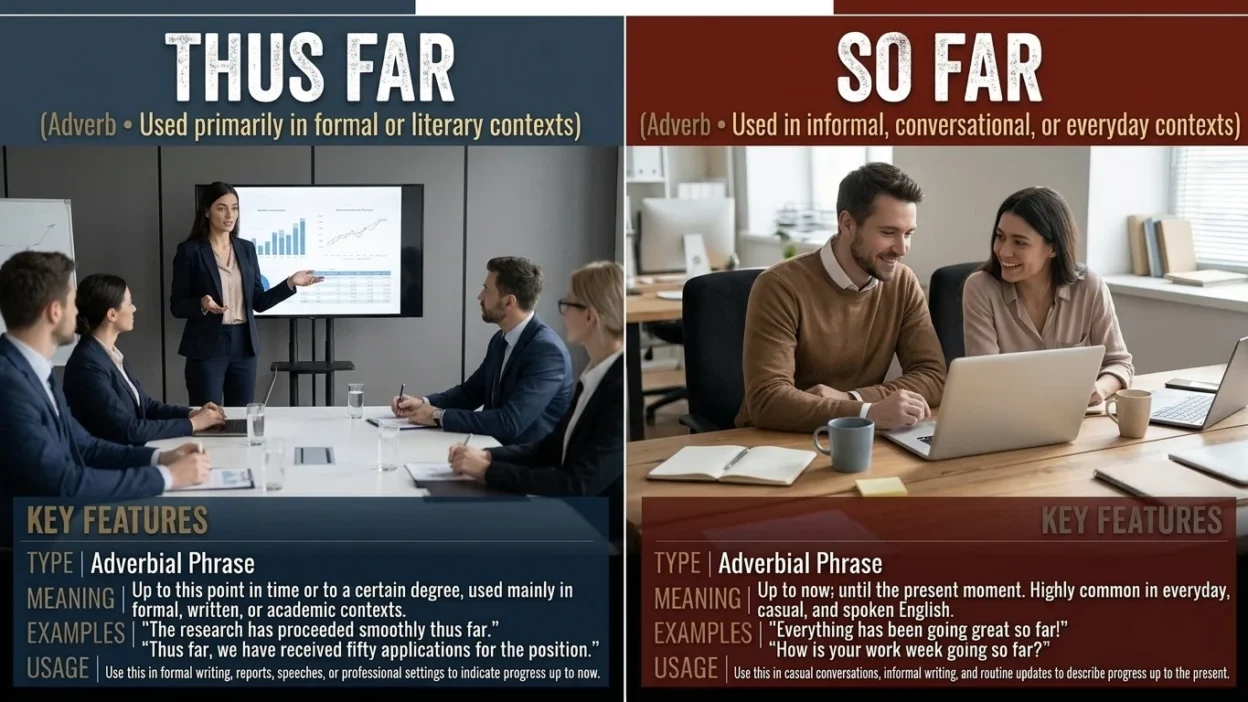
“Thus far” and “so far” both mean “until now” or “up to this point.”
They are often interchangeable, but they differ slightly in tone and usage.
“So far” is more common in everyday English, casual conversations, and informal writing.
“Thus far” sounds more formal and is often used in academic writing, reports, presentations, and professional discussions.
Understanding this difference will help you choose the expression that best fits your sentence.
Both phrases describe something that has happened, developed, or remained true up to the present moment.
For example, “So far, everything is going well” and “Thus far, everything is going well” communicate essentially the same message, although the second sounds more formal.
Neither phrase is grammatically incorrect, and both are useful in the right context. In this guide, you will learn their meanings, grammatical uses, differences in tone, and practical examples.
You will also discover common mistakes, easy memory tricks, and answers to frequently asked questions.
Quick Answer: What Is the Difference Between Thus Far and So Far?
Thus far and so far both mean “until now” or “up to this point.” The main difference is formality: so far is more natural in everyday conversation, while thus far is generally more formal and often appears in reports or academic writing. Both expressions are correct and can often be used interchangeably.
Why Do People Confuse Thus Far and So Far?
People confuse these expressions because they communicate almost the same idea. Both refer to a period that began in the past and extends to the present.
For example:
- So far: The project has gone well so far.
- Thus far: The project has gone well thus far.
Both sentences mean that the project has gone well up to the present point.
The main difference is not meaning but tone and context:
- So far is common in conversations, text messages, emails, and everyday writing.
- Thus far sounds more formal, deliberate, or report-like.
Understanding this difference helps you avoid making a sentence sound unnecessarily formal or too casual for its intended audience.
What Does “Thus Far” Mean?
Thus far is an adverbial expression meaning “until now,” “up to this point,” or “to this stage.” It is commonly used to summarize progress, results, observations, or developments that have occurred up to the present.
When Is “Thus Far” Used?
Use thus far when you want a formal or measured tone, particularly in academic, professional, or analytical writing.
Examples:
- The research has produced encouraging results thus far.
- Thus far, the team has completed three stages of the project.
- No significant problems have been reported thus far.
- The evidence gathered thus far supports the initial conclusion.
In these sentences, thus far connects past developments with the current situation.
Is “Thus Far” Formal?
Generally, yes. Thus far often sounds more formal than so far. It is useful in research papers, progress reports, business presentations, and formal summaries.
For example:
“The findings thus far indicate that further investigation is necessary.”
This sentence sounds appropriate in a research report. In casual conversation, however, “So far, the findings show that we need to investigate further” may sound more natural.
Simple definition: Thus far means up to the present point, usually with a formal tone.
What Does “So Far” Mean?
So far is an adverbial expression meaning “until now” or “up to this point.” It describes progress, experiences, results, or situations that have developed from the past to the present.
When Is “So Far” Used?
Use so far in everyday conversations and writing. It is natural in casual messages, workplace communication, discussions, and many forms of formal writing as well.
Examples:
- So far, everything is going well.
- I have read five chapters so far.
- The new employee has performed well so far.
- We have not received a reply so far.
The phrase often suggests that the situation may continue or change.
For example, “The weather has been pleasant so far” means the weather has been pleasant up to now, but it may change later.
Is “So Far” Informal?
So far is more conversational than thus far, but it is not limited to informal situations. It is perfectly acceptable in professional emails, reports, presentations, and academic writing when a straightforward tone is appropriate.
For example:
“So far, the results suggest that the new process is working.”
This is clear and suitable for many professional contexts.
Simple definition: So far means up to now and is the more common expression in everyday English.
Thus Far vs So Far: Comparison Table
| Feature | Thus Far | So Far |
|---|---|---|
| Main meaning | Until now; up to this point | Until now; up to this point |
| Formality | Generally more formal | More conversational and widely used |
| Common contexts | Reports, academic writing, formal summaries | Conversations, emails, everyday writing |
| Grammatical role | Adverbial expression | Adverbial expression |
| Example | The study has found no clear pattern thus far. | The study has found no clear pattern so far. |
| Interchangeable? | Often yes | Often yes |
| Main difference | Tone and style | Tone and style |
The central distinction is stylistic. Both phrases refer to the present point in time, but thus far often gives a sentence a more formal tone.
When Should You Use Thus Far or So Far?
Choose the expression that fits your audience, purpose, and writing style.
Use “Thus Far” in Formal Writing
Choose thus far when summarizing findings, progress, or developments in a formal or analytical context.
Examples:
- The investigation has uncovered no additional evidence thus far.
- The proposal has received positive feedback thus far.
- The research team has completed the first phase thus far.
The last example is understandable, but “The research team has completed the first phase so far” or “Thus far, the research team has completed the first phase” may sound more natural depending on the intended emphasis.
Use “So Far” in Everyday Conversation
Choose so far when speaking naturally or writing a straightforward message.
Examples:
- How is your new job going so far?
- So far, I really like this book.
- We have finished most of the work so far.
- The trip has been great so far.
Can You Use Both in Professional Writing?
Yes. Both expressions are acceptable in professional communication. Use so far for a direct, natural tone and thus far when a more formal or traditional style is appropriate.
For example:
- Natural business update: “So far, we have met all our deadlines.”
- More formal report: “Thus far, all project deadlines have been met.”
The choice is stylistic, not a strict grammatical rule.
Thus Far vs So Far: 14 Example Sentences
These examples show how both expressions work in different contexts.
Examples Using “Thus Far”
- The research has produced promising results thus far.
- Thus far, no major issues have been identified.
- The committee has reviewed six applications thus far.
- The evidence collected thus far supports the proposed explanation.
- Thus far, the company has achieved its main objectives.
- The investigation has revealed little new information thus far.
- The experiment has followed the expected pattern thus far.
Examples Using “So Far”
- So far, everything has gone according to plan.
- I have completed three assignments so far.
- How are you enjoying your new course so far?
- We have not received any complaints so far.
- The weather has been warm and sunny so far.
- So far, the team has worked well together.
- This is the most interesting book I have read so far.
Examples Using Both Expressions
- The project has stayed within budget so far, and the latest report confirms that it remains on track thus far.
- So far, the students have completed two assessments; thus far, their results have been encouraging.
Both expressions can appear in the same passage, but repeating them too closely may sound unnecessary. Choose the phrase that best suits the tone and avoid repetition when one expression is enough.
Common Mistakes With Thus Far and So Far
Both expressions are easy to use, but a few common mistakes are worth avoiding.
Mistake 1: Thinking One Phrase Is Grammatically Incorrect
Incorrect idea: “Thus far” is correct, but “so far” is too informal for proper English.
Correct understanding: Both expressions are grammatically correct. So far is also appropriate in many professional and academic contexts.
Mistake 2: Using Thus Far in Every Casual Sentence
Unnatural in casual conversation: “Thus far, I have enjoyed my lunch.”
More natural: “I’m enjoying my lunch so far.”
The first sentence is grammatically possible, but it may sound unnecessarily formal in an everyday setting.
Mistake 3: Assuming So Far Is Only for the Past
Incorrect idea: So far can refer only to completed past events.
Correct understanding: So far often describes a situation that began in the past and continues to the present.
Example: “I have enjoyed the course so far.”
The course is still in progress, and the speaker is describing the experience up to now.
Mistake 4: Using the Wrong Verb Tense
Less natural: “I finished three chapters so far.”
More natural in standard English: “I have finished three chapters so far.”
The present perfect is commonly used with so far when describing progress up to the present. The simple past may still be appropriate in certain contexts, but the present perfect is usually the best choice for an ongoing situation.
Mistake 5: Confusing Thus Far With Therefore
Thus far means “up to this point.” Therefore means “for that reason” or “as a result.”
Examples:
- “Thus far, we have received ten applications.” — Up to now.
- “The deadline has passed; therefore, we cannot accept more applications.” — As a result.
These expressions have different meanings and cannot generally replace each other.
Memory Trick: How to Remember Thus Far vs So Far
Use this simple memory trick:
- So far = everyday speech. Think of asking a friend, “How is your day going so far?”
- Thus far = formal tone. Think of a researcher writing, “The findings thus far are encouraging.”
Remember this sentence:
“So far sounds simple; thus far sounds formal.”
This is a general guideline rather than a strict rule. You can use so far in professional writing and thus far in conversation when the context makes it appropriate.
Thus Far vs So Far in American and British English
Both expressions are used in American and British English. Their meanings are essentially the same, and neither expression belongs exclusively to one variety.
| Feature | American English | British English |
|---|---|---|
| Thus far | Correct; generally more formal | Correct; generally more formal |
| So far | Correct; common in everyday English | Correct; common in everyday English |
| Meaning | Until now; up to this point | Until now; up to this point |
| Spelling | Same | Same |
| Common usage | Conversation, reports, professional writing | Conversation, reports, professional writing |
Differences in preference may occur between individual speakers, workplaces, or writing styles, but there is no major American-versus-British distinction in meaning or spelling.
Similar Expressions to Thus Far and So Far
Several expressions can communicate a similar idea. The best choice depends on the sentence and the meaning you want to emphasize.
1. Until Now
Means up to the present moment.
Example: “Until now, we have had no problems.”
2. Up to Now
Means up to the current time and is common in everyday English.
Example: “Up to now, everything has gone smoothly.”
3. To Date
Means up to the present time. It is often used in formal or professional contexts.
Example: “The company has received 200 applications to date.”
4. As Yet
Usually refers to something that has not happened or been completed up to the present time.
Example: “We have not received a final decision as yet.”
5. So Far as
This expression has a different grammatical function in many sentences and can mean “to the extent that” or introduce a qualification.
Example: “So far as I know, the office is still open.”
It should not be treated as a direct replacement for so far in every sentence.
6. To This Point
Means up to the current stage or moment.
Example: “To this point, the project has stayed on schedule.”
7. Up to This Point
A clear alternative that emphasizes the stage reached in a process.
Example: “Up to this point, we have followed the original plan.”
These expressions overlap in meaning, but they are not interchangeable in every grammatical structure.
Final Verdict: Thus Far or So Far?
Both thus far and so far mean “until now” or “up to this point.” The main difference is tone: so far is more common in everyday English, while thus far generally sounds more formal.
Use so far for natural conversation, casual messages, and straightforward professional communication. Choose thus far when you want a more formal or analytical tone, especially in reports or academic writing.
For example, “So far, the project is going well” is a natural everyday sentence. “Thus far, the project has met all its objectives” may fit a formal progress report. Both are correct, so let the context guide your choice.
Frequently Asked Questions
1. Are thus far and so far the same?
They have essentially the same meaning: “until now” or “up to this point.” The main difference is tone. So far is more common in everyday English, while thus far often sounds more formal.
2. Is thus far more formal than so far?
Generally, yes. Thus far is often preferred in formal reports, academic writing, and analytical discussions. However, so far is also acceptable in professional and academic writing when a more direct, conversational style is suitable.
3. Can I use so far in academic writing?
Yes. So far is grammatically correct in academic writing. For example: “So far, the findings support the original hypothesis.” You may choose thus far if you want a more formal tone, but it is not automatically better.
4. Can thus far and so far be used interchangeably?
Often, yes. For example, “We have received five applications so far” and “We have received five applications thus far” have essentially the same meaning. The difference is mainly stylistic.
5. Which phrase is better for a business email?
Both are suitable. So far is usually a natural choice for everyday workplace updates, while thus far can fit a more formal report or summary. Choose the phrase that matches your audience and the tone of your message.
6. What is another word for thus far?
Depending on the sentence, alternatives include so far, until now, up to now, to date, and up to this point. Each has slightly different uses, so check that the replacement fits the sentence grammatically.
7. What tense is commonly used with so far?
The present perfect is commonly used with so far because it describes progress or experience from the past up to the present. For example: “I have completed four lessons so far.” Other tenses can be appropriate depending on the context.
8. Is thus far old-fashioned?
Thus far can sound formal or traditional, but it is still used in modern English, particularly in formal writing and reports. It is not incorrect or obsolete. In everyday conversation, so far usually sounds more natural.
Remember This
- Thus far = until now; generally more formal.
- So far = until now; more common in everyday English.
- Both expressions are grammatically correct.
- Both can describe progress, results, or situations up to the present.
- The present perfect often works naturally with both phrases.
- Memory trick: So far sounds simple; thus far sounds formal.
Conclusion
The difference between thus far and so far is mainly about style rather than meaning. Both expressions describe what has happened or remained true up to the present moment. So far is widely used in daily conversation and straightforward writing, while thus far often sounds more formal and is common in reports, academic discussions, and analytical summaries.
To use them naturally, consider your audience and the tone you want to create. Choose so far when you want a simple, conversational expression, and use thus far when a more formal tone fits the context. Remember that both are correct, and the best choice is the one that makes your sentence clear and natural.