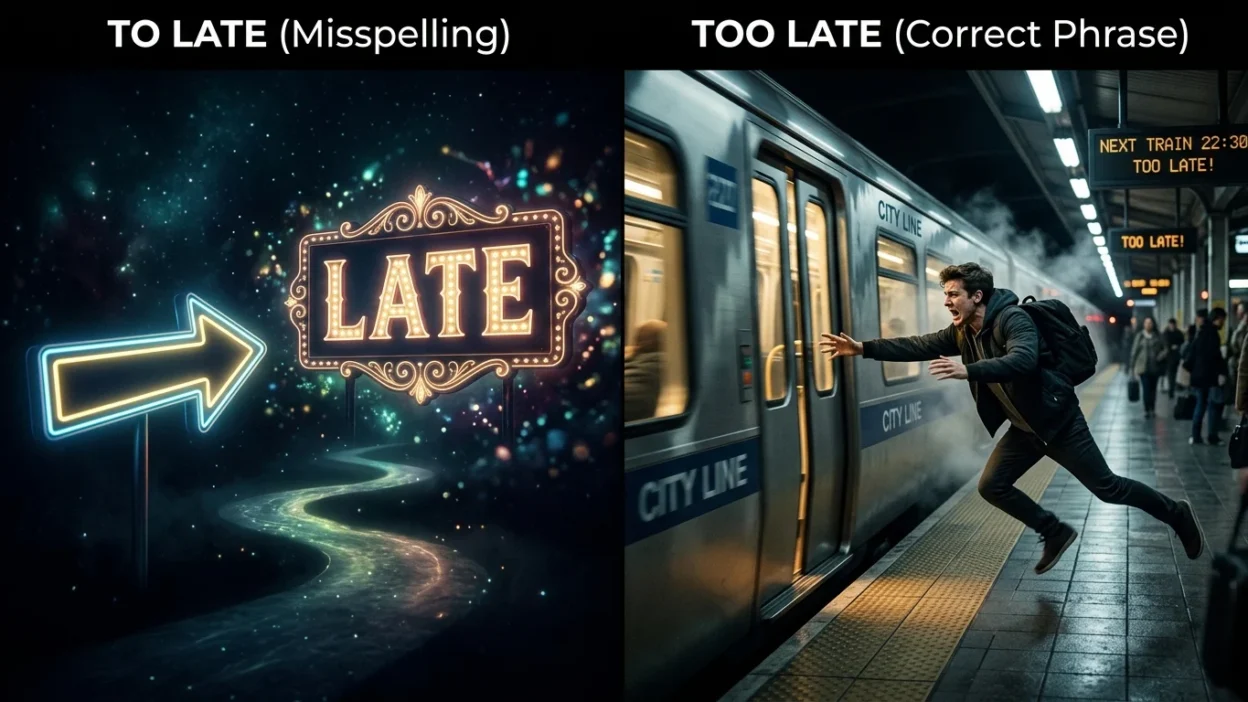
If you are wondering whether “to late” or “too late” is correct, the answer is simple:
“too late” is correct when you mean that something happens after the appropriate or possible time.
For example, “I arrived too late to catch the bus.” “To late” is not normally correct because to and too have different grammatical functions.
This is a common mistake because to, too, and two sound alike in many varieties of English.
However, their meanings are different. To is usually a preposition or part of an infinitive, while too can mean “more than necessary” or “also.”
When you want to say that something happened after the right time, use too late.
Quick Answer
“Too late” is correct; “to late” is generally incorrect. Use too late when something happens after the suitable, expected, or possible time. For example, “It is too late to call him.” Here, too means “more than is acceptable or possible,” while late means “after the expected time.”
Why Do People Confuse “To” and “Too”?
People often confuse to and too because they are pronounced alike in standard English. They are examples of homophones: words that sound the same but have different spellings and meanings.
Compare:
- to → usually shows direction, connection, or an infinitive
- too → means “also” or “more than necessary”
- two → the number 2
So, when you mean “later than the appropriate or possible time,” the correct expression is too late.
What Does “To” Mean?
To is a very common English word with several grammatical uses.
1. “To” for direction
“She went to school.”
Here, to indicates direction or destination.
2. “To” before a verb
To is also used to form an infinitive:
“I want to leave.”
“He needs to study.”
Notice that to is followed by the base form of a verb.
3. “To” for a relationship or connection
“This letter is addressed to Maria.”
“The answer is important to me.”
However, to does not normally belong directly before the adjective late when you are trying to express the idea of excessive lateness.
What Does “Too” Mean?
Too has two main meanings.
1. “Too” means more than necessary
“The coffee is too hot.”
This means the coffee has a higher temperature than is desirable.
Similarly:
“It is too late to change the decision.”
Here, too late means that the time has passed beyond what is suitable or possible.
2. “Too” means also
“I want to go too.”
Here, too means also.
This second meaning is different from the meaning in too late, but the spelling is the same.
To Late vs Too Late: Comparison Table
| Expression | Correct? | Meaning | Example |
|---|---|---|---|
| to late | ❌ Usually incorrect | Does not normally express excessive lateness | “I arrived to late.” ❌ |
| too late | ✅ Correct | Later than the appropriate or possible time | “I arrived too late.” |
| to | ✅ Correct | Direction, connection, or infinitive marker | “I went to work.” |
| too | ✅ Correct | More than necessary or also | “It is too late.” |
When Should You Use “To” or “Too”?
Use to when it has a grammatical function such as showing direction or introducing an infinitive.
- “I went to the store.”
- “She wants to sleep.”
- “Give the book to him.”
Use too when you mean more than necessary or also.
- “The bag is too heavy.”
- “It is too late.”
- “I want one too.”
A useful test is to replace too with very or also.
If the sentence makes sense with “very” in the sense of excessive degree, too may be correct:
“It is too late.”
If you mean “also”:
“I am coming too.”
10+ Examples of “Too Late”
- “I arrived too late to see the beginning of the movie.”
- “It was too late to call my friend.”
- “She realized it was too late to change her plans.”
- “We got there too late to buy tickets.”
- “He apologized, but it was too late.”
- “Is it too late to apply for the course?”
- “The doctor said it was not too late to start treatment.”
- “I woke up too late for breakfast.”
- “They came too late to help us.”
- “It may be too late to stop the train.”
- “I understood the instructions too late.”
- “She called me too late at night.”
Common Mistakes
Mistake 1: Writing “to late”
Incorrect:
“I arrived to late.”
Correct:
“I arrived too late.”
Mistake 2: Using “too” before a verb
Incorrect:
“I too go to school.”
If you mean direction or an infinitive, you need to:
“I want to go to school.”
If you mean “also,” you could say:
“I go to school too.”
Mistake 3: Confusing “too late” with “two late”
Two refers to the number 2.
“I have two books.”
It has nothing to do with the expression too late.
Mistake 4: Thinking “too” always means “very”
“Too” can indicate an excessive degree, but it does not simply mean “very.”
Compare:
“The box is very heavy.”
This says the box has a high weight.
“The box is too heavy to lift.”
This says its weight is excessive for a particular purpose.
The same distinction applies to too late.
Memory Trick: To Late or Too Late?
Remember:
Too = more than necessary.
So:
Too late = later than acceptable or possible.
You can also remember the expression by connecting too with excess:
- too hot
- too cold
- too expensive
- too difficult
- too late
If you can say “more than is suitable”, too is usually the right word.
American vs British English
There is no meaningful difference between American and British English in the basic use of too late.
Both varieties use:
“It is too late.”
“I arrived too late.”
The spelling and grammatical distinction between to and too remains the same.
Pronunciation can vary slightly by accent, but the words are commonly pronounced alike, which is why spelling mistakes can occur in both American and British English.
Similar Words and Expressions
Several expressions are related to too late.
Too early
This is the opposite idea:
“You arrived too early.”
It means someone arrived earlier than was appropriate or necessary.
Late
Late simply means after the expected or usual time.
“The train is late.”
Very late
Very late emphasizes a high degree of lateness without necessarily saying that the lateness is excessive for a particular purpose.
“He arrived very late.”
No longer in time
This can express a similar idea to too late:
“We were no longer in time to catch the train.”
However, too late is usually more natural in everyday English.
Final Verdict
The correct expression is “too late”, not “to late,” when you mean that something happens after the appropriate, expected, or possible time.
Use to for functions such as direction and infinitives:
“I went to school.”
Use too when you mean “more than necessary” or “also”:
“It is too late.”
The easiest rule is: If you mean excessive lateness, use “too late.”
Frequently Asked Questions
Is “to late” ever correct?
The exact sequence “to late” can theoretically occur when to belongs to something before or after it in a larger grammatical construction, but it is not the normal expression for saying that something happened after the right time. For that meaning, use “too late.”
Is it “too late” or “to late”?
It is “too late.” Use too because it expresses a degree that has gone beyond what is appropriate or possible.
What is the meaning of “too late”?
Too late means that something happens after the suitable, expected, or possible time.
Example:
“It is too late to catch the bus.”
Is “too late” grammatically correct?
Yes. Too functions as an adverb modifying late, indicating an excessive degree of lateness.
What is the difference between “late” and “too late”?
Late means after the expected time. Too late means later than is acceptable, useful, or possible for a particular purpose.
Compare:
“I am late.”
“I am too late to catch the train.”
Can I say “too late to”?
Yes. Too late to + base verb is a very common structure.
Examples:
- “It is too late to leave.”
- “We were too late to help.”
- “She arrived too late to see the show.”
What is the difference between “to,” “too,” and “two”?
- To → direction or infinitive: “Go to school”; “want to learn”
- Too → also or excessively: “Me too”; “too late”
- Two → the number 2: “two books”
Remember This
Too late = later than the right time.
Think:
too hot → too expensive → too difficult → too late
And remember:
to = direction/action
too = also/excess
two = number 2
Conclusion
The correct phrase is “too late” when you want to describe something that happens after the appropriate, expected, or possible time. The word too expresses an excessive degree, while late describes the timing. Together, they form a common and useful English expression.
The spelling “to late” is generally a mistake when this meaning is intended. Learning the basic difference between to and too can prevent many similar errors. Whenever you mean that something happened later than was acceptable or possible, remember to write too late.