Learning different synonyms of infinitive can help students, ESL learners, writers, and content creators understand grammar discussions more easily.
While the word infinitive has a specific grammatical meaning, there are several related words and expressions that are used in grammar, linguistics, education, and writing depending on the context.
Knowing these alternatives improves your vocabulary and helps you communicate more accurately.
Some words are technical grammar terms, while others are broader expressions used in teaching, language learning, and writing.
This guide explains each synonym in simple English with clear examples and practical usage notes.
What Is an Infinitive?
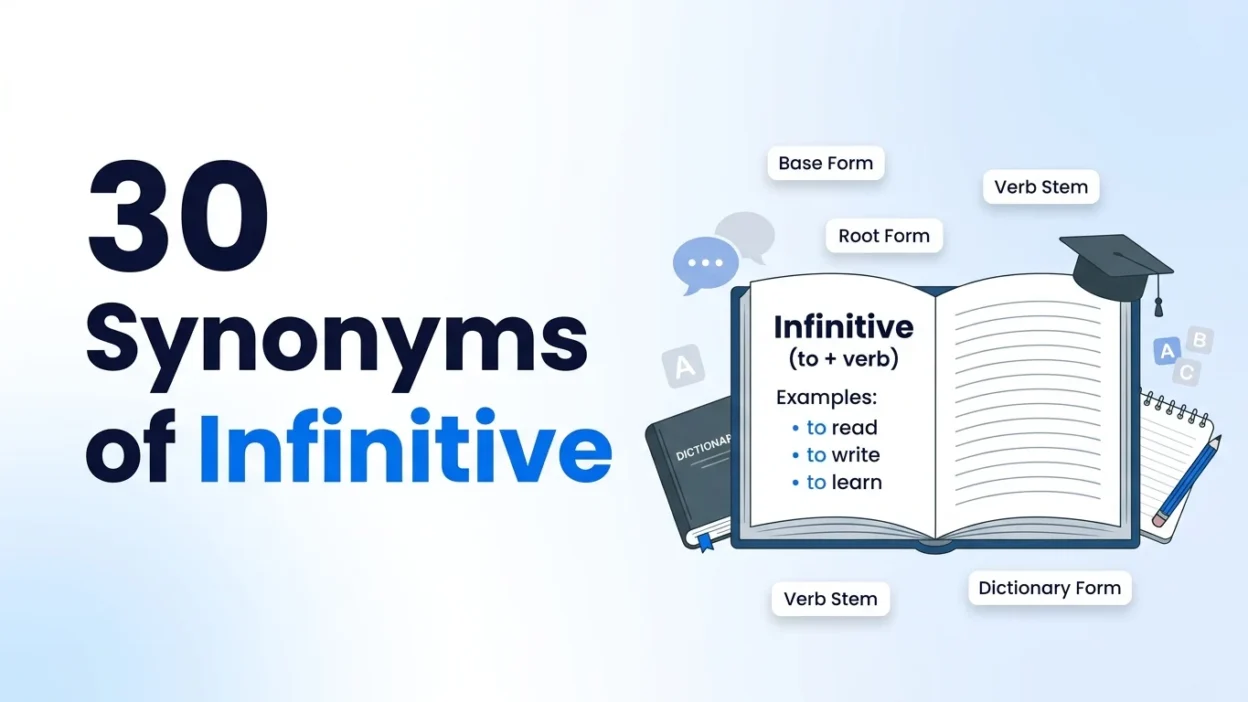
An infinitive is the basic form of a verb. In English, it usually appears with to, such as to read, to write, to learn, or to speak. It can function as a noun, adjective, or adverb within a sentence.
The word infinitive comes from Latin and refers to a verb form that is not limited by tense, person, or number. Because of this, people sometimes use related grammar terms instead of repeating the word infinitive.
30 Synonyms of Infinitive
1. Base Form
Meaning: The simplest form of a verb.
Example: The base form of “running” is “run.”
Best Usage Context: Basic grammar lessons.
2. Root Form
Meaning: The original form from which other verb forms develop.
Example: Students should identify the root form before conjugating verbs.
Best Usage Context: Grammar and language learning.
3. Basic Verb Form
Meaning: The standard form of a verb without changes.
Example: Always learn the basic verb form first.
Best Usage Context: ESL education.
4. Verb Stem
Meaning: The main part of a verb before endings are added.
Example: The verb stem remains the same in many tenses.
Best Usage Context: Linguistics.
5. Dictionary Form
Meaning: The form of a verb listed in dictionaries.
Example: Look up the dictionary form of the verb.
Best Usage Context: Dictionaries and reference books.
6. Citation Form
Meaning: The standard form used to identify a word.
Example: The citation form is shown in grammar books.
Best Usage Context: Linguistics.
7. Unconjugated Form
Meaning: A verb that has not been changed for tense or subject.
Example: Write the unconjugated form first.
Best Usage Context: Grammar explanations.
8. Verb Prototype
Meaning: The original model of a verb.
Example: The prototype helps learners understand verb changes.
Best Usage Context: Academic writing.
9. Original Verb Form
Meaning: The earliest or unchanged form of a verb.
Example: Find the original verb form before adding endings.
Best Usage Context: Beginner grammar.
10. Plain Form
Meaning: A simple verb form without modification.
Example: English often uses the plain form after modal verbs.
Best Usage Context: English grammar.
11. Bare Infinitive
Meaning: An infinitive used without “to.”
Example: You must go now.
Best Usage Context: Grammar lessons.
12. To-Infinitive
Meaning: An infinitive beginning with “to.”
Example: She wants to travel.
Best Usage Context: English teaching.
13. Non-Finite Verb
Meaning: A verb that does not show tense.
Example: An infinitive is a non-finite verb.
Best Usage Context: Advanced grammar.
14. Verb Base
Meaning: The foundation of a verb.
Example: Start with the verb base before adding endings.
Best Usage Context: ESL instruction.
15. Canonical Form
Meaning: The standard or accepted form.
Example: The canonical form appears in dictionaries.
Best Usage Context: Linguistics.
16. Lexical Form
Meaning: The dictionary version of a word.
Example: The lexical form is useful for vocabulary learning.
Best Usage Context: Language studies.
17. Fundamental Form
Meaning: The most basic version of a verb.
Example: Students should memorize the fundamental form.
Best Usage Context: Education.
18. Standard Verb Form
Meaning: The commonly accepted verb form.
Example: Use the standard verb form in exercises.
Best Usage Context: Grammar teaching.
19. Verb Entry Form
Meaning: The form used as a dictionary entry.
Example: The entry form is easy to find.
Best Usage Context: Dictionaries.
20. Primitive Form
Meaning: The earliest or original form.
Example: The primitive form helps explain word history.
Best Usage Context: Historical linguistics.
21. Verb Origin
Meaning: The original version of a verb.
Example: Study the verb origin to understand its structure.
Best Usage Context: Language history.
22. Core Verb Form
Meaning: The central version of a verb.
Example: The core verb form is easy to recognize.
Best Usage Context: ESL grammar.
23. Primary Form
Meaning: The first or main form.
Example: Learn the primary form before verb conjugation.
Best Usage Context: Beginner lessons.
24. Default Form
Meaning: The normal form used unless changed.
Example: The default form appears in vocabulary lists.
Best Usage Context: Grammar instruction.
25. Simple Verb Form
Meaning: The easiest version of a verb.
Example: Children learn the simple verb form first.
Best Usage Context: Elementary English.
26. Verb Root
Meaning: The basic root from which forms develop.
Example: The verb root stays the same in many words.
Best Usage Context: Linguistics.
27. Verbal Base
Meaning: The base structure of a verb.
Example: The verbal base is important in grammar analysis.
Best Usage Context: Academic grammar.
28. Uninflected Form
Meaning: A verb without grammatical endings.
Example: The uninflected form is often used in dictionaries.
Best Usage Context: Linguistics.
29. Verb Foundation
Meaning: The starting form of a verb.
Example: Build grammar knowledge from the verb foundation.
Best Usage Context: Educational content.
30. Basic Lexical Form
Meaning: The simplest dictionary version of a verb.
Example: Memorize the basic lexical form for vocabulary practice.
Best Usage Context: Language learning.
Comparison Guide: When to Use Different Synonyms
Everyday Learning
| Synonym | Best For |
|---|---|
| Base Form | School grammar |
| Root Form | Beginners |
| Basic Verb Form | ESL students |
| Simple Verb Form | Children |
| Dictionary Form | Vocabulary learning |
Academic Grammar
| Synonym | Best For |
|---|---|
| Non-Finite Verb | Grammar studies |
| Bare Infinitive | English grammar |
| To-Infinitive | Teaching English |
| Verb Stem | Linguistics |
| Canonical Form | Academic writing |
Linguistics and Research
| Synonym | Best For |
|---|---|
| Lexical Form | Language research |
| Citation Form | Dictionaries |
| Uninflected Form | Linguistics |
| Verbal Base | Grammar analysis |
| Primitive Form | Word history |
How to Choose the Right Synonym
For Beginners
Choose Base Form, Basic Verb Form, Simple Verb Form, or Dictionary Form because these are easy to understand.
For ESL Learners
Use Root Form, Verb Base, To-Infinitive, and Bare Infinitive when studying English grammar.
For Academic Writing
Select Non-Finite Verb, Canonical Form, Lexical Form, or Verb Stem for precise grammar discussions.
For Dictionaries and Language References
Use Dictionary Form, Citation Form, or Entry Form because these terms describe how verbs are listed in reference materials.
Conclusion
Understanding the synonyms of infinitive helps you build stronger grammar knowledge and expand your vocabulary. Although infinitive is a specific grammatical term, related expressions such as base form, root form, dictionary form, and non-finite verb are useful in different learning situations.
Whether you are a student, an ESL learner, a teacher, or a content creator, choosing the right synonym depends on your audience and purpose. By learning these 30 alternatives, you’ll be able to read grammar books more confidently, explain language concepts more clearly, and improve your overall writing skills.

Liam Henry is a content author at Synonymed, specializing in vocabulary enrichment and synonym guides. He creates clear, engaging resources that help learners improve English word knowledge and language fluency.