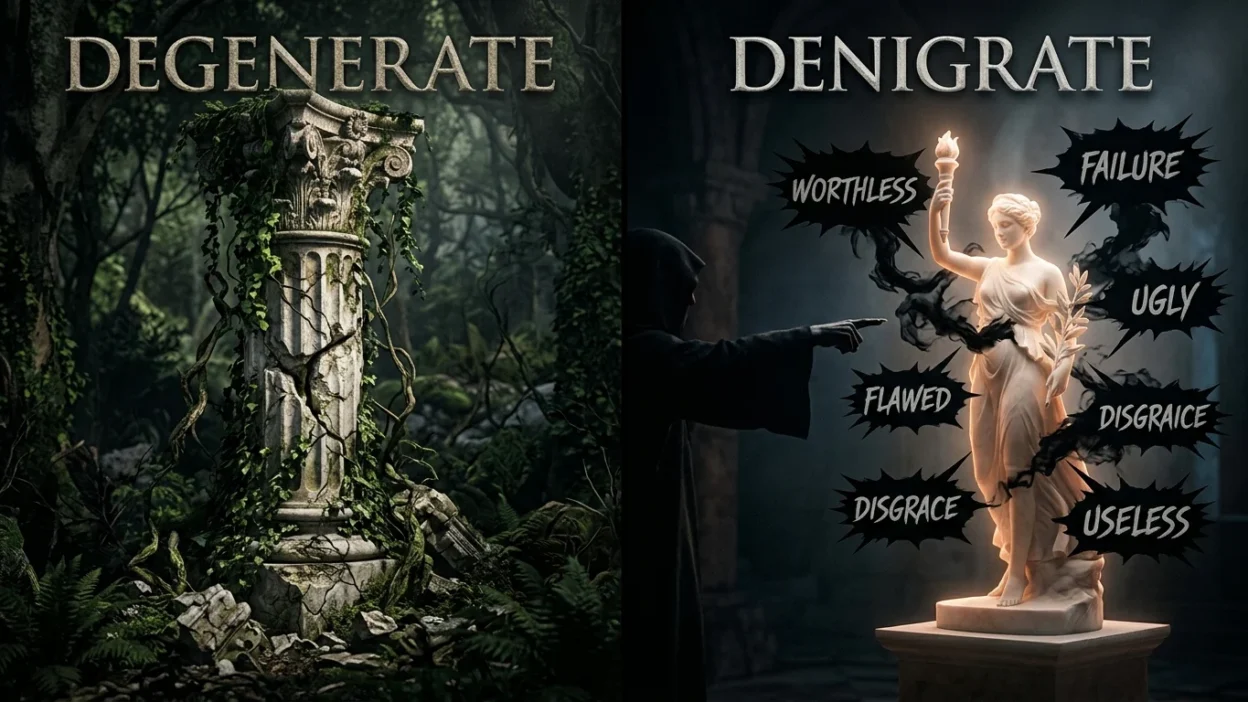
Degenerate and denigrate are both negative words, but they have very different meanings.
Degenerate usually means to become worse, weaker, or lower in quality or behavior. Denigrate means to unfairly criticize, insult, or make someone or something seem less valuable or important.
These words are easy to confuse because they both describe something negative and begin with de-.
However, they are used differently in a sentence. Degenerate can describe a decline in quality, condition, behavior, or standards, while denigrate is mainly about speaking negatively about a person, group, idea, or thing.
Understanding the difference is useful because choosing the wrong word can change the meaning of your sentence.
This guide explains both words in simple English, shows how to use them correctly, and provides practical examples to help you remember the difference.
Quick Answer: Degenerate vs Denigrate
Degenerate means to become worse, lower, or less desirable, or to behave in a morally bad way. Denigrate means to criticize, insult, or belittle someone or something. In short, degenerate describes decline or deterioration, while denigrate describes negative speech or criticism.
Why Do People Confuse Degenerate and Denigrate?
People often confuse degenerate and denigrate because both words have negative meanings and can appear in discussions about bad behavior, people, or situations.
The key difference is the action involved:
- Degenerate = become worse or cause something to become worse.
- Denigrate = speak about someone or something in a disrespectful or negative way.
For example:
The conversation degenerated into an argument.
This means the conversation became worse.
He tried to denigrate his opponent.
This means he tried to make his opponent seem less worthy or important.
What Does “Degenerate” Mean?
Degenerate can be a verb, adjective, or noun, depending on how it is used.
As a verb, degenerate means to become worse in quality, condition, behavior, or standards.
The discussion quickly degenerated into an argument.
As an adjective, degenerate can describe something that has declined from a better or normal condition. When used about a person, it can be insulting and may suggest seriously immoral or bad behavior.
The novel describes a society in a degenerate state.
As a noun, degenerate can refer to a person considered morally corrupt or socially unacceptable. This use is often insulting.
The character is portrayed as a degenerate.
Simple meaning of degenerate
Degenerate = to become worse, deteriorate, or decline in quality or behavior.
What Does “Denigrate” Mean?
Denigrate is a verb. It means to speak about someone or something in a way that makes them seem less valuable, respectable, important, or worthy.
It is often used when someone belittles, disparages, insults, or puts down another person or thing.
She did not want to denigrate her colleague’s achievements.
Here, denigrate means to speak negatively about the colleague’s achievements in a way that reduces their perceived value.
Simple meaning of denigrate
Denigrate = to criticize, belittle, or speak disrespectfully about someone or something.
Degenerate vs Denigrate: Comparison Table
| Feature | Degenerate | Denigrate |
|---|---|---|
| Main meaning | Become worse or decline | Criticize or belittle |
| Part of speech | Verb, adjective, noun | Verb |
| Main idea | Deterioration or decline | Negative speech or judgment |
| Often used with | Situations, conditions, behavior, standards | People, ideas, achievements, groups, products |
| Example | The debate degenerated into an argument. | He denigrated her work. |
| Synonyms | Deteriorate, decline, worsen | Belittle, disparage, criticize |
| Common opposite | Improve, develop | Praise, respect, commend |
When Should You Use “Degenerate” and “Denigrate”?
Use “degenerate” when something becomes worse
Use degenerate when you are talking about a decline in quality, condition, behavior, order, or standards.
The peaceful meeting degenerated into chaos.
The meeting became worse and less orderly.
The situation degenerated rapidly.
The situation deteriorated.
Use “denigrate” when someone puts another person or thing down
Use denigrate when someone speaks negatively about another person, group, idea, achievement, or thing.
The article denigrated the contributions of local workers.
The article presented those contributions as less valuable or important.
You should not denigrate someone else’s efforts.
The meaning is that you should not unfairly belittle their efforts.
Degenerate vs Denigrate: 12 Examples
- The peaceful discussion degenerated into a heated argument.
- The condition of the building continued to degenerate over the years.
- Without proper care, the garden may degenerate into an overgrown area.
- The conversation degenerated when the participants began shouting.
- The team’s performance degenerated during the final part of the season.
- He was accused of trying to denigrate his rival.
- The review seemed designed to denigrate the author’s work.
- She refused to denigrate her former colleagues.
- The speaker should present evidence instead of denigrating other people’s opinions.
- His comments appeared to denigrate the importance of education.
- The debate degenerated into personal insults.
- The campaign of criticism attempted to denigrate the scientist’s achievements.
Notice the difference in examples 11 and 12:
- Degenerated = the debate became worse.
- Denigrate = someone tried to make another person’s achievements seem less important.
Common Mistakes with Degenerate and Denigrate
Mistake 1: Using “denigrate” to mean “become worse”
Incorrect:
The situation denigrated into chaos.
Correct:
The situation degenerated into chaos.
A situation can degenerate when it becomes worse.
Mistake 2: Using “degenerate” when you mean “insult”
Incorrect:
She degenerated her colleague’s work.
Correct:
She denigrated her colleague’s work.
Here, the person is criticizing or belittling the work, so denigrate is the correct word.
Mistake 3: Forgetting that “denigrate” needs an object
You normally denigrate someone or something.
He denigrated his opponent.
She denigrated the proposal.
By contrast, degenerate can be used without a direct object:
The conversation degenerated.
Mistake 4: Treating “degenerate” as only an insult
The word degenerate can be used negatively about a person, but its basic verb meaning is about decline or deterioration.
The discussion degenerated into an argument.
This sentence is about a change in the discussion, not an insult directed at a person.
Memory Trick: How to Remember the Difference
Think of the two words this way:
DEGENERATE = DECLINE
Both ideas involve something becoming worse.
DENIGRATE = DISPARAGE
Both involve putting someone or something down.
A quick memory sentence is:
Things degenerate; people denigrate.
This is not an absolute grammar rule, but it is a useful way to remember the central difference.
American vs British English
There is no major difference in meaning or spelling between degenerate and denigrate in American and British English.
Both forms are standard in both varieties:
- American English: degenerate, denigrate
- British English: degenerate, denigrate
The words may appear in formal writing, journalism, academic discussions, and everyday speech. However, denigrate is generally more formal than simple words such as criticize or put down.
Also remember that degenerate can have different grammatical roles, while denigrate is used as a verb.
Similar Words
Words similar to “degenerate”
- Deteriorate — become worse in condition or quality
- Decline — become weaker or less successful
- Worsen — become worse
- Degrade — become lower in quality or condition
- Deterioration — the process of becoming worse
Example:
The situation deteriorated quickly.
Words similar to “denigrate”
- Belittle — make someone or something seem unimportant
- Disparage — speak about someone or something without respect
- Criticize — point out faults or problems
- Insult — speak offensively to someone
- Decry — publicly criticize something strongly
Example:
He disparaged her achievements.
Final Verdict: Degenerate vs Denigrate
The difference is simple:
Degenerate means to become worse, decline, or deteriorate.
Denigrate means to criticize, belittle, or make someone or something seem less valuable.
Use degenerate when the focus is on decline. Use denigrate when the focus is on negative criticism or belittling.
Compare:
The discussion degenerated into an argument.
The discussion became worse.
He denigrated the other speaker’s ideas.
He spoke about the ideas in a way that made them seem less valuable.
FAQs About Degenerate vs Denigrate
Is “degenerate” the same as “denigrate”?
No. Degenerate means to become worse or decline, while denigrate means to criticize or belittle someone or something.
What is the difference between “degrade” and “denigrate”?
Degrade can mean to lower the quality, condition, or status of something. Denigrate specifically means to speak about someone or something in a way that reduces its perceived value or reputation.
Can “degenerate” be used for a person?
Yes. Degenerate can be used as a noun or adjective for a person, but this use can be insulting. As a verb, it more generally describes something becoming worse.
Is “denigrate” a negative word?
Yes. Denigrate describes negative or disrespectful criticism that belittles someone or something.
What is the opposite of “denigrate”?
Depending on the context, possible opposites include praise, commend, respect, and appreciate.
What is the opposite of “degenerate”?
Depending on the context, possible opposites include improve, develop, progress, and advance.
Can I say “the situation denigrated”?
Usually, no, if you mean that the situation became worse. The natural expression is:
The situation degenerated.
Denigrate normally involves criticizing or belittling something or someone.
Remember This
- Degenerate = become worse or decline
- Denigrate = criticize or belittle
- Degenerate can be a verb, adjective, or noun.
- Denigrate is a verb.
- A situation can degenerate.
- Someone can denigrate another person or their work.
- Degenerate = decline
- Denigrate = disparage
Conclusion
Although degenerate and denigrate sound somewhat similar, they describe different ideas. Degenerate focuses on deterioration, decline, or a movement toward a worse condition. Denigrate focuses on negative speech that belittles or reduces the perceived value of a person, idea, achievement, or thing.
The easiest way to remember the difference is to connect degenerate with decline and denigrate with disparage. Once you understand whether your sentence is about something becoming worse or someone being put down, choosing the correct word becomes much easier.