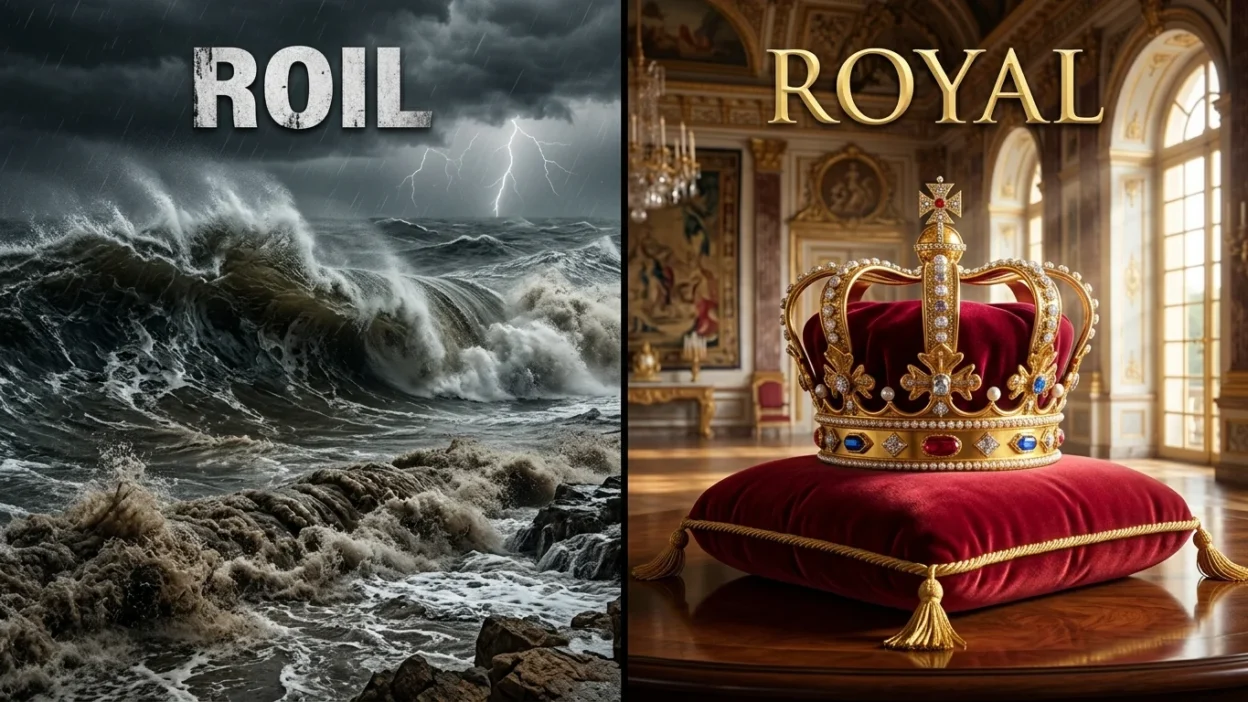
English contains many words that sound similar but have completely different meanings. Roil and royal are a good example.
Although both words contain the same “roi” sound, they are not interchangeable.
Understanding the difference can help students, ESL learners, and anyone improving their English avoid common spelling and vocabulary mistakes.
Roil is mainly a verb meaning to disturb, stir up, or make something turbulent.
It can describe physically agitated water, as well as situations that become tense or troubled.
Royal, on the other hand, is an adjective connected with a king, queen, or royal family.
It can also describe something magnificent or regal.
The key difference is simple: roil describes disturbance or agitation, while royal describes something related to royalty. Once you connect each word with its meaning, the distinction becomes much easier to remember and use correctly.
Quick Answer
Roil means to disturb, stir, or make turbulent, especially water or a troubled situation. Royal means relating to a king, queen, or monarchy, or having a regal quality. They look and sound somewhat similar, but they have different meanings, grammatical uses, and contexts.
Why Do People Confuse “Roil” and “Royal”?
People often confuse these words because they begin with the same letters, roi-, and their pronunciations are similar.
However, their meanings are unrelated:
- Roil → disturbance, agitation, turbulence
- Royal → king, queen, monarchy, regal
Another reason for confusion is that roil is less common in everyday conversation than royal. Learners may recognize “royal” more easily but accidentally use it when they mean “roil.”
What Does “Roil” Mean?
Roil is primarily a verb. It means to stir up, disturb, agitate, or make turbulent.
It can be used literally:
“Strong winds roiled the ocean.”
Here, roiled means that the winds made the water rough and turbulent.
It can also be used figuratively:
“The controversy roiled the organization.”
In this sentence, the controversy caused conflict, unrest, or disturbance within the organization.
Common forms of “Roil”
- Roil — present form
- Roiled — past tense and past participle
- Roiling — present participle
Examples:
- “The waves roiled around the boat.”
- “The political dispute is roiling the country.”
- “The news roiled investors.”
What Does “Royal” Mean?
Royal is primarily an adjective. It describes something connected with a king, queen, or monarchy.
For example:
“The royal family attended the ceremony.”
Here, royal means associated with a king or queen.
It can also describe something that appears especially magnificent, grand, or regal:
“The hotel has a royal appearance.”
Common expressions include:
- royal family
- royal palace
- royal wedding
- royal residence
- royal ceremony
- royal tradition
Noun Forms Related to “Royal”
The related noun royalty refers to royal people or the status of being royal.
For example:
“Several members of the royalty attended the event.”
The adjective is royal, while the noun is commonly royalty.
Roil vs Royal: Comparison Table
| Feature | Roil | Royal |
|---|---|---|
| Part of speech | Mainly verb | Mainly adjective |
| Basic meaning | To disturb or agitate | Related to royalty |
| Main idea | Turbulence or unrest | Kings, queens, or monarchy |
| Common use | Water, emotions, situations, markets | Families, palaces, ceremonies, traditions |
| Example | “The waves roiled the sea.” | “The royal family arrived.” |
| Related word | Roiled, roiling | Royalty, royally |
When Should You Use “Roil” or “Royal”?
Use roil when you are talking about something being stirred, disturbed, agitated, or made turbulent.
- “The storm roiled the water.”
- “The dispute roiled the company.”
- “The scandal roiled the political party.”
Use royal when you are talking about kings, queens, monarchies, or something described as regal.
- “The royal palace is open to visitors.”
- “She watched the royal ceremony.”
- “The royal family appeared at the event.”
A useful question to ask yourself is:
Is something being disturbed? → roil.
Is it connected to royalty? → royal.
10+ Examples of “Roil” and “Royal”
Examples with “Roil”
- “The powerful winds roiled the ocean.”
- “The storm roiled the normally calm lake.”
- “The announcement roiled the financial markets.”
- “The controversy roiled the organization.”
- “Anger roiled beneath the surface.”
- “The dispute continues to roil the community.”
Examples with “Royal”
- “The royal family attended the celebration.”
- “They visited the royal palace.”
- “The museum displays several royal artifacts.”
- “The royal ceremony attracted international attention.”
- “She wore a dress fit for a royal occasion.”
- “The building has a grand, royal appearance.”
Common Mistakes with Roil and Royal
Mistake 1: Using “royal” when you mean “disturb”
Incorrect:
“The scandal royaled the company.”
Correct:
“The scandal roiled the company.”
Royal is not the verb you need here.
Mistake 2: Using “roil” for royalty
Incorrect:
“The roil family attended the event.”
Correct:
“The royal family attended the event.”
The family is associated with royalty, so royal is correct.
Mistake 3: Confusing “roiled” with “royal”
These words can look particularly confusing in writing.
- roiled = disturbed or agitated
- royal = related to royalty
Compare:
“The debate roiled the organization.”
“The royal family visited the organization.”
Memory Trick: Roil vs Royal
Use this simple association:
Roil = trouble or turbulence.
Think: roil → turmoil.
Royal = royalty.
Think: royal → royalty → king or queen.
If something is rough, stirred, disturbed, or unsettled, think roil.
If something is connected to a king, queen, palace, or monarchy, think royal.
American vs British English
There is no major difference in the basic meanings of roil and royal between American and British English.
Both varieties use:
- roil for disturbing or agitating something
- royal for something connected with royalty
There can be differences in pronunciation among individual speakers and regional accents, but the meanings and standard spellings remain the same.
Similar Words
Words Similar to “Roil”
Depending on the context, words with similar meanings include:
- disturb
- agitate
- stir
- upset
- trouble
- unsettle
- churn
- churn up
For example:
“The news roiled the market.”
could be expressed as:
“The news agitated the market.”
The exact synonym depends on the context.
Words Similar to “Royal”
Related words include:
- regal
- kingly
- queenly
- majestic
- monarchical
- aristocratic
However, these words are not always exact synonyms. Royal specifically relates to royalty, while words such as majestic can describe something impressive without any connection to a monarchy.
Final Verdict
Roil and royal are different words with different meanings and grammatical functions.
Use roil as a verb when something is disturbed, stirred up, or made turbulent. Use royal as an adjective when something is connected with a king, queen, monarchy, or regal appearance.
The easiest distinction is:
Roil = disturb or agitate.
Royal = related to royalty.
Frequently Asked Questions
Is “roil” the same as “royal”?
No. Roil means to disturb, agitate, or make turbulent, while royal means related to a king, queen, or monarchy.
Is “roil” a verb or an adjective?
Roil is primarily a verb. It means to disturb, stir up, or agitate something.
Is “royal” a noun or an adjective?
Royal is primarily an adjective. It describes something associated with royalty. The related noun royalty refers to royal people or their status.
What is an easy synonym for “roil”?
Depending on the context, disturb, agitate, stir, or trouble can be synonyms for “roil.”
What is an easy synonym for “royal”?
Regal is a common synonym for “royal,” although the two words are not identical in every context.
How do you use “roil” in a sentence?
You can say:
“The controversy roiled the company.”
This means the controversy caused disturbance or unrest within the company.
How do you use “royal” in a sentence?
You can say:
“The royal family attended the ceremony.”
Here, royal means connected with a king or queen.
Is “roiled” the past tense of “roil”?
Yes. Roiled is the past tense and past participle of roil.
Remember This
Roil = disturbance.
Royal = royalty.
Think roil → turmoil and royal → royalty. This simple connection can help you remember which word to use.
Conclusion
Although roil and royal look and sound somewhat alike, their meanings are completely different. Roil is a verb used for disturbing, agitating, or making something turbulent. It can describe physical movement, such as rough water, or figurative unrest, such as conflict within an organization.
Royal is an adjective associated with kings, queens, monarchy, or a regal quality. When you see words such as “family,” “palace,” “ceremony,” or “wedding” in a context involving monarchy, royal is usually the relevant word. When the context involves disturbance or agitation, choose roil.