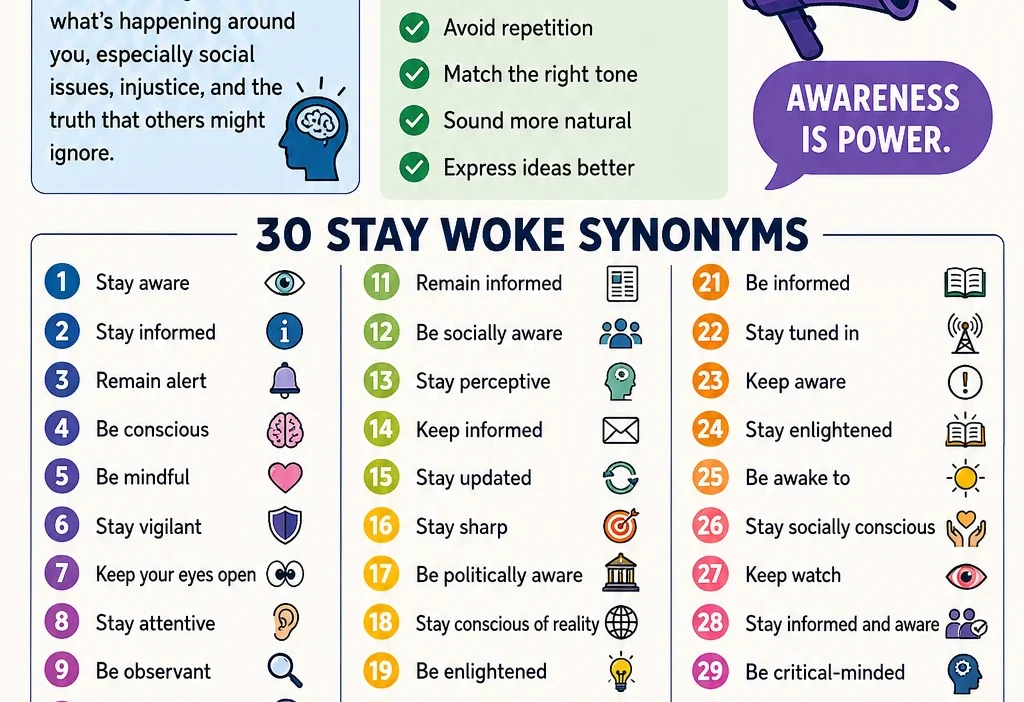
“Stay woke” became a popular expression in modern English, especially in about social awareness, , equality, and critical thinking.
Many students, ESL learners, writers, and content creators search for stay woke synonyms because they want alternatives that sound more formal, academic, professional, or suitable for different situations.
This guide explains the meaning of stay woke in simple English and provides 30 useful synonyms with meanings, sentences, and usage notes.
if you are writing an essay, creating social media content, improving your vocabulary, or speaking in English more confidently, this article will help you choose the right word.
Unlike a dictionary list, this article explains the tone and context of each synonym, so you can understand when it is appropriate to use it.
What Does “Stay Woke” Mean?
The phrase stay woke means remain aware, informed, and alert about social issues, injustice, discrimination, or important events. In everyday English, it can also mean pay attention and think critically instead of accepting everything without question.
Simple meaning
- Be aware of what is happening around you.
- Stay informed about important issues.
- Think carefully and critically.
- Notice unfairness or hidden problems.
Tone and usage
The phrase is often informal and conversational. In academic writing, business communication, or formal essays, other words may sound more appropriate.
Example: Students should stay woke about misinformation online.
In a formal essay, you might write: Students should remain informed and think critically about misinformation online.
30 Stay Woke Synonyms (Easy Meanings + Examples)
1. Aware
Meaning: Knowing about something.
Example: She is aware of the environmental problems in her city.
Best usage: General and neutral.
2. Informed
Meaning: Having accurate knowledge.
Example: Good citizens stay informed about current events.
Best usage: Academic and professional writing.
3. Conscious
Meaning: Aware of ideas, feelings, or social issues.
Example: He is socially conscious and supports local charities.
Best usage: Social and ethical topics.
4. Alert
Meaning: Paying close attention.
Example: Drivers must remain alert on busy roads.
Best usage: Safety and attention contexts.
5. Vigilant
Meaning: Carefully watching for problems or danger.
Example: The community stayed vigilant during the storm.
Best usage: Serious or protective situations.
6. Mindful
Meaning: Thoughtfully aware of actions and surroundings.
Example: Be mindful of other people’s feelings.
Best usage: Personal behavior and communication.
7. Observant
Meaning: Good at noticing details.
Example: Observant students often learn quickly.
Best usage: Learning and daily life.
8. Attentive
Meaning: Listening or watching carefully.
Example: The teacher appreciated attentive students.
Best usage: Classroom and workplace settings.
9. Watchful
Meaning: Carefully noticing what happens.
Example: Parents remained watchful at the park.
Best usage: Protective or caring tone.
10. Awake
Meaning: Mentally aware; not ignoring reality.
Example: The documentary helped viewers become awake to social problems.
Best usage: Informal awareness.
11. Enlightened
Meaning: Having greater understanding or insight.
Example: Reading widely can make people more enlightened.
Best usage: Intellectual or educational tone.
12. Educated
Meaning: Well informed through learning.
Example: An educated voter researches candidates carefully.
Best usage: Formal and academic.
13. Knowledgeable
Meaning: Having a lot of knowledge about a topic.
Example: She is knowledgeable about climate science.
Best usage: Expertise and study.
14. Socially Aware
Meaning: Understanding social issues and other people’s experiences.
Example: Socially aware leaders listen to different communities.
Best usage: Equality and community discussions.
15. Politically Aware
Meaning: Understanding political events and policies.
Example: Politically aware students often follow the news closely.
Best usage: Politics and civics.
16. Critical
Meaning: Thinking carefully instead of accepting ideas immediately.
Example: Critical readers check facts before sharing articles.
Best usage: Academic thinking.
17. Discerning
Meaning: Able to judge carefully.
Example: Discerning consumers compare products before buying.
Best usage: Judgment and decision-making.
18. Perceptive
Meaning: Quick to understand people or situations.
Example: Her perceptive comments improved the discussion.
Best usage: Insightful observations.
19. Insightful
Meaning: Showing deep understanding.
Example: The essay offered insightful analysis.
Best usage: Academic and professional writing.
20. Thoughtful
Meaning: Carefully considering ideas or feelings.
Example: He gave a thoughtful response to the question.
Best usage: Respectful communication.
21. Reflective
Meaning: Thinking deeply about experiences or ideas.
Example: Reflective writing helps students learn from mistakes.
Best usage: Education and self-improvement.
22. Sensitive
Meaning: Aware of other people’s feelings or issues.
Example: Be sensitive when discussing personal topics.
Best usage: Emotional and social situations.
23. Responsible
Meaning: Acting with awareness of consequences.
Example: Responsible social media users verify information first.
Best usage: Behavior and ethics.
24. Engaged
Meaning: Actively involved and interested.
Example: Engaged citizens participate in community events.
Best usage: Community and civic life.
25. Active
Meaning: Taking part instead of remaining passive.
Example: Active volunteers helped organize the event.
Best usage: Participation and action.
26. Conscious-Minded
Meaning: Intentionally aware and considerate.
Example: Conscious-minded consumers avoid unnecessary waste.
Best usage: Lifestyle and ethics.
27. Open-Eyed
Meaning: Seeing reality clearly.
Example: She approached the job market with an open-eyed attitude.
Best usage: Realistic awareness.
28. Streetwise
Meaning: Aware of practical real-world situations.
Example: Streetwise travelers avoid unsafe areas.
Best usage: Informal, practical awareness.
29. Savvy
Meaning: Smart and well informed, especially practically.
Example: Savvy internet users protect their privacy online.
Best usage: Technology, business, and modern life.
30. Clued-In
Meaning: Well informed about what is happening.
Example: She is clued-in to the latest education trends.
Best usage: Informal conversation.
Quick Comparison Table: Which Synonym Should You Use?
| Situation | Best Synonyms |
|---|---|
| Academic essay | informed, educated, critical, insightful |
| Social justice discussion | socially aware, conscious, enlightened |
| Workplace communication | informed, attentive, responsible |
| Everyday conversation | aware, mindful, clued-in, savvy |
| Safety or risk | alert, vigilant, watchful |
| Personal growth | reflective, thoughtful, mindful |
| Politics | politically aware, informed |
| Practical real-world advice | streetwise, savvy |
Formal vs Informal Stay Woke Synonyms
Formal alternatives
- Informed
- Educated
- Insightful
- Reflective
- Socially aware
- Politically aware
Neutral alternatives
- Aware
- Mindful
- Attentive
- Thoughtful
Informal alternatives
- Clued-in
- Savvy
- Streetwise
- Awake
Choosing the right level of formality is important, especially for students and ESL learners.
How to Choose the Right Synonym
If you mean “know the facts”
Use informed, educated, or knowledgeable.
If you mean “care about society”
Use socially aware, conscious, or mindful.
If you mean “think carefully”
Use critical, reflective, thoughtful, or insightful.
If you mean “pay attention now”
Use alert, attentive, or watchful.
If you mean “understand real-life situations”
Use streetwise or savvy.
A simple rule: formal writing = informed; everyday speech = aware; social issues = socially aware.
Common Mistakes ESL Learners Should Avoid
1. Using “woke” in formal essays
Instead of stay woke, write remain informed or remain socially aware.
2. Confusing “aware” and “alert”
- Aware = know something.
- Alert = actively paying attention.
3. Using “critical” to mean “negative”
In academic English, critical thinking means careful analysis, not complaining.
Example Sentences for Writers and Content Creators
- Content creators should stay informed about copyright rules.
- Writers need to be mindful of cultural differences.
- Journalists must remain vigilant against misinformation.
- Students should develop critical thinking skills.
- Social media users should be socially aware when sharing sensitive topics.
These examples show how stay woke synonyms can improve vocabulary and make writing sound more natural.
Why Learning Stay Woke Synonyms Improves Your English
Learning synonyms helps you:
- Avoid repeating the same phrase.
- Write more naturally.
- Speak with greater confidence.
- Match the tone of academic, professional, or casual situations.
- Understand subtle differences in meaning.
For ESL learners, synonym study is one of the fastest ways to expand vocabulary.
Final Thoughts
The phrase stay woke is useful in conversation, but it is not always the best choice for every audience.
Students, writers, ESL learners, and content creators can communicate more clearly by using alternatives such as aware, informed, mindful, socially aware, critical, reflective, and savvy.
Remember the key idea behind all these words: pay attention, stay informed, think carefully, and understand the world around you. If you choose the synonym that matches your purpose and tone, your English will sound more accurate, natural, and effective in both speech and writing.