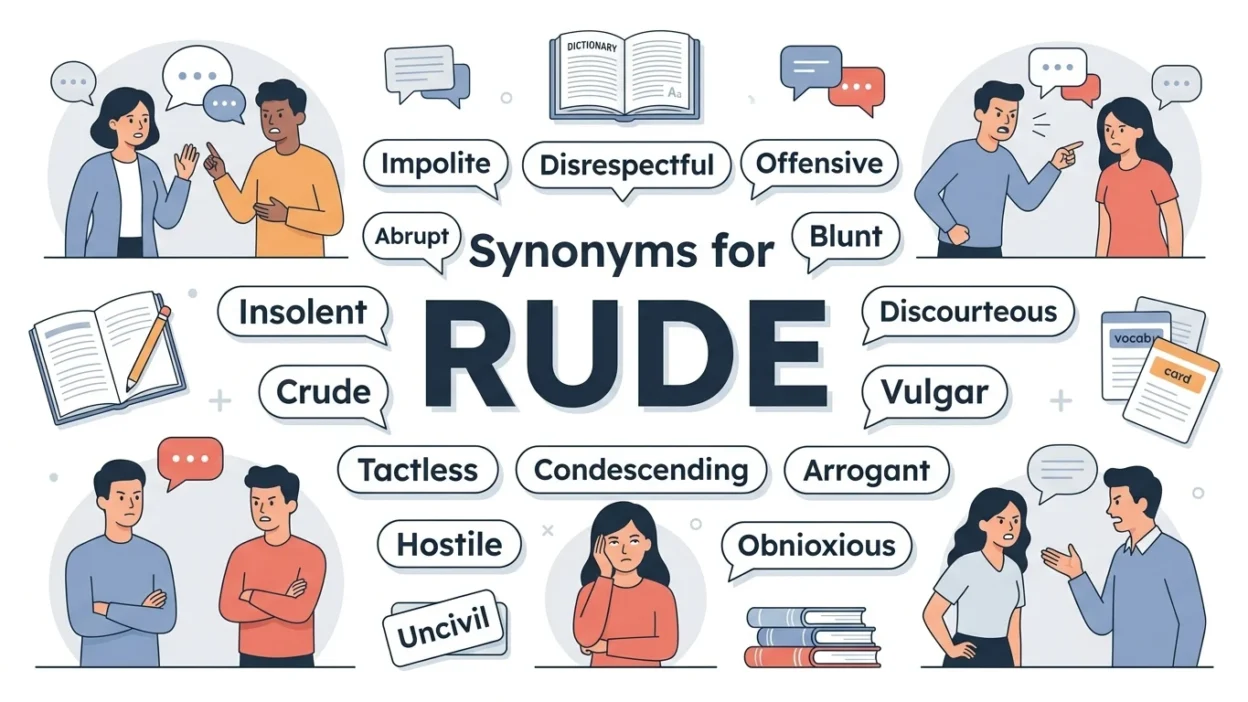
The word rude is commonly used to describe someone who behaves in an impolite, disrespectful, or offensive way.
While it is a simple and useful word, English has many other words that express different levels and types of rude behavior.
Learning these synonyms for rude helps you improve your vocabulary and choose the most accurate word for different situations.
Whether you’re a student, ESL learner, writer, blogger, or content creator, understanding these alternatives can make your writing more natural and expressive.
Some synonyms describe mild impoliteness, while others refer to aggressive or offensive behavior.
This guide explains each synonym in simple English with easy examples, making it suitable for learners of all levels.
What Does “Rude” Mean?
Definition of Rude
The word rude describes someone who behaves without respect, good manners, or consideration for other people. A rude person may speak harshly, interrupt others, ignore social rules, or act in an offensive way.
The word can describe a person’s attitude, words, actions, or behavior. Depending on the context, some synonyms are stronger or more formal than others.
Common Examples of “Rude”
- A rude customer shouted at the cashier.
- Please don’t be rude to your classmates.
- His rude comment upset everyone.
- She apologized for her rude behavior.
- Interrupting someone is considered rude.
30 Synonyms for Rude
1. Impolite
Meaning: Not showing good manners.
Example Sentence: It is impolite to interrupt someone while they are speaking.
Best Usage Context: Everyday conversations and school.
2. Disrespectful
Meaning: Showing a lack of respect.
Example Sentence: His disrespectful attitude disappointed his teacher.
Best Usage Context: School, family, and workplace.
3. Insolent
Meaning: Showing rude disrespect, especially toward authority.
Example Sentence: The student gave an insolent reply.
Best Usage Context: Formal writing and literature.
4. Discourteous
Meaning: Not polite or respectful.
Example Sentence: The employee was discourteous to customers.
Best Usage Context: Business and customer service.
5. Offensive
Meaning: Causing hurt or anger.
Example Sentence: His joke was offensive to many people.
Best Usage Context: Social discussions.
6. Abrupt
Meaning: Speaking suddenly without being polite.
Example Sentence: Her abrupt answer surprised everyone.
Best Usage Context: Communication.
7. Blunt
Meaning: Very direct, sometimes sounding rude.
Example Sentence: He was blunt but honest.
Best Usage Context: Honest conversations.
8. Crude
Meaning: Lacking manners or refinement.
Example Sentence: His crude remarks offended the audience.
Best Usage Context: Informal and social situations.
9. Coarse
Meaning: Rough and lacking politeness.
Example Sentence: The movie contained coarse language.
Best Usage Context: Literature and reviews.
10. Vulgar
Meaning: Offensive or lacking good taste.
Example Sentence: They avoided using vulgar language.
Best Usage Context: Formal writing.
11. Boorish
Meaning: Rough and bad-mannered.
Example Sentence: His boorish behavior embarrassed everyone.
Best Usage Context: Literature and formal English.
12. Uncivil
Meaning: Not polite or respectful.
Example Sentence: The debate became uncivil.
Best Usage Context: News and formal writing.
13. Ill-mannered
Meaning: Having poor manners.
Example Sentence: The child behaved in an ill-mannered way.
Best Usage Context: Everyday English.
14. Bad-mannered
Meaning: Acting without proper manners.
Example Sentence: People dislike bad-mannered behavior.
Best Usage Context: General descriptions.
15. Arrogant
Meaning: Acting as if you are better than others.
Example Sentence: His arrogant attitude seemed rude.
Best Usage Context: Personality descriptions.
16. Condescending
Meaning: Speaking as if others are less intelligent.
Example Sentence: Her condescending tone upset the team.
Best Usage Context: Workplace communication.
17. Sarcastic
Meaning: Using mocking words that may sound rude.
Example Sentence: His sarcastic comment hurt her feelings.
Best Usage Context: Conversations and writing.
18. Snobbish
Meaning: Looking down on others.
Example Sentence: She seemed snobbish at the party.
Best Usage Context: Personality descriptions.
19. Curt
Meaning: Very short and sometimes impolite.
Example Sentence: He gave a curt reply.
Best Usage Context: Professional communication.
20. Sharp
Meaning: Speaking in a harsh way.
Example Sentence: She answered in a sharp voice.
Best Usage Context: Everyday communication.
21. Tactless
Meaning: Saying things without considering others’ feelings.
Example Sentence: His tactless remark embarrassed everyone.
Best Usage Context: Social situations.
22. Thoughtless
Meaning: Not thinking about how others feel.
Example Sentence: Leaving without saying goodbye was thoughtless.
Best Usage Context: Personal relationships.
23. Insensitive
Meaning: Not caring about other people’s emotions.
Example Sentence: His insensitive joke upset the audience.
Best Usage Context: Emotional discussions.
24. Mean
Meaning: Unkind or intentionally hurtful.
Example Sentence: It was mean to laugh at someone.
Best Usage Context: Everyday English.
25. Harsh
Meaning: Unkind and severe in speech.
Example Sentence: The coach was harsh during practice.
Best Usage Context: Criticism and communication.
26. Hostile
Meaning: Showing anger or unfriendliness.
Example Sentence: The customer became hostile.
Best Usage Context: Conflict situations.
27. Aggressive
Meaning: Forceful in an unfriendly way.
Example Sentence: His aggressive behavior frightened others.
Best Usage Context: Workplace and social situations.
28. Obnoxious
Meaning: Extremely unpleasant or annoying.
Example Sentence: Everyone avoided his obnoxious behavior.
Best Usage Context: Informal conversations.
29. Unpleasant
Meaning: Not nice or enjoyable.
Example Sentence: The waiter seemed unpleasant.
Best Usage Context: General descriptions.
30. Churlish
Meaning: Rude and difficult to deal with.
Example Sentence: His churlish response ended the discussion.
Best Usage Context: Formal and literary writing.
Comparison Guide: When to Use Different Synonyms
Synonym Comparison Table
| Synonym | Best Used For | Tone |
|---|---|---|
| Impolite | Everyday situations | Neutral |
| Disrespectful | School and workplace | Strong |
| Blunt | Direct communication | Neutral |
| Offensive | Hurtful comments | Strong |
| Abrupt | Short conversations | Mild |
| Crude | Bad language | Informal |
| Vulgar | Offensive speech | Formal |
| Condescending | Workplace | Professional |
| Tactless | Social mistakes | Neutral |
| Mean | Everyday speech | Casual |
| Hostile | Conflict | Strong |
| Obnoxious | Very annoying behavior | Informal |
How to Choose the Right Synonym
For Everyday Conversations
Use impolite, bad-mannered, ill-mannered, mean, or thoughtless. These words are easy to understand and commonly used.
For Professional or Academic Writing
Choose discourteous, uncivil, condescending, insolent, or churlish for a more formal tone.
For Describing Communication
Use blunt, abrupt, sharp, sarcastic, or tactless when talking about someone’s way of speaking.
For Strongly Negative Behavior
Words like hostile, aggressive, offensive, obnoxious, and vulgar describe more serious forms of rude behavior.
For Personality Descriptions
Choose arrogant, snobbish, coarse, insensitive, or boorish when describing a person’s character or attitude.
Conclusion
Learning different synonyms for rude helps you express ideas more accurately and naturally.
Although every synonym relates to impolite behavior, each word has a slightly different meaning and level of intensity.
Understanding these differences allows you to choose the best word for conversations, essays, creative writing, and professional communication.
Whether you’re improving your English vocabulary, preparing for exams, or writing articles, these 30 synonyms will help you communicate with greater confidence and precision.
Practice using them in real life situations to strengthen your language skills and make your writing more engaging.