The English language offers many ways to express complex ideas. One word that often appears in academic writing, business communication, and everyday conversations is multidimensional.
Learning multidimensional synonyms can help you write more naturally, avoid repetition, and communicate your ideas with greater precision.
if you are a student, an ESL learner, a writer, or a content creator, understanding different words with similar meanings can strengthen your vocabulary.
This guide explains the meaning of multidimensional in simple English and introduces 30 useful synonyms with meanings, examples, and the best situations to use them.
What Does “Multidimensional” Mean?
The word multidimensional describes something that has many different aspects, features, layers, or parts. It can refer to people, ideas, problems, characters, objects, or situations that cannot be understood from just one point of view.
Common Usage Contexts
- Academic writing
- Literature and storytelling
- Psychology
- Business analysis
- Research papers
- Everyday conversations about complex topics
30 Multidimensional Synonyms
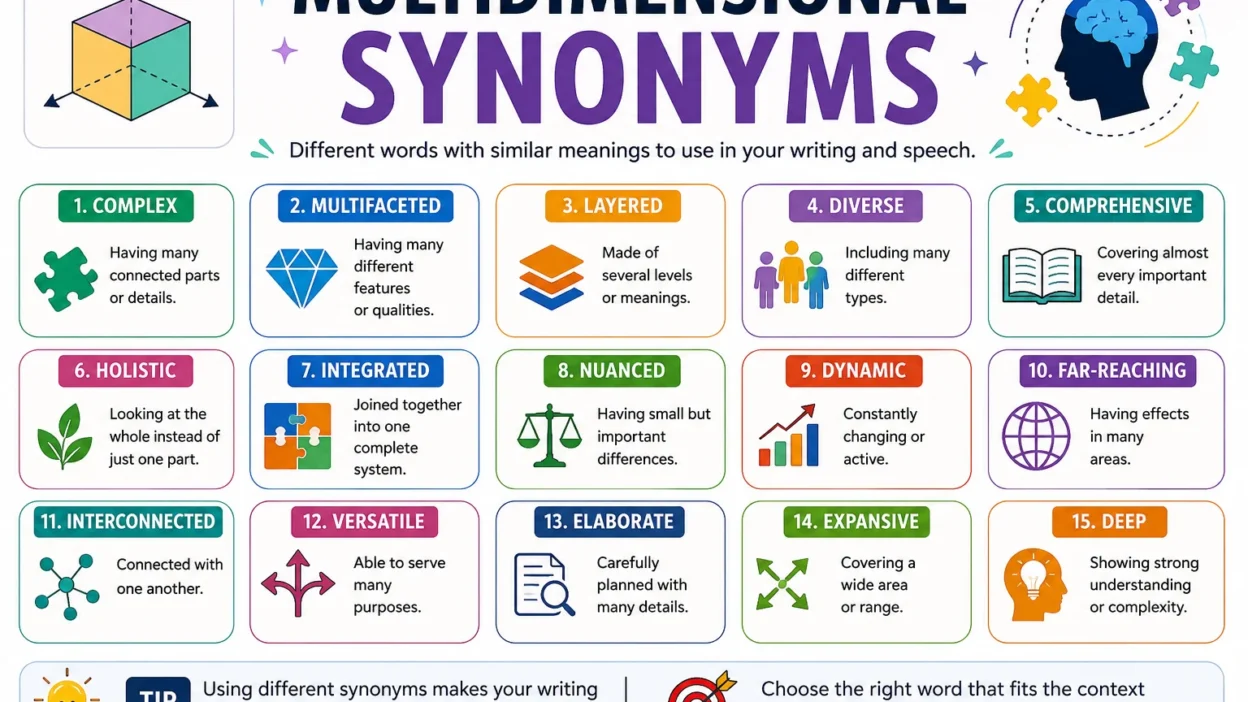
1. Complex
Meaning: Having many connected parts or details.
Example: The project is too complex to finish in one day.
Best Usage: Problems, systems, research, ideas.
2. Multifaceted
Meaning: Having many different features or qualities.
Example: She has a multifaceted personality.
Best Usage: People, skills, personalities.
3. Layered
Meaning: Made of several levels or meanings.
Example: The novel has a layered storyline.
Best Usage: Stories, emotions, writing.
4. Diverse
Meaning: Including many different types.
Example: The team has diverse talents.
Best Usage: Groups, cultures, communities.
5. Varied
Meaning: Containing different kinds.
Example: The course includes varied learning activities.
Best Usage: Collections, experiences.
6. Comprehensive
Meaning: Covering almost every important detail.
Example: The report provides a comprehensive review.
Best Usage: Reports, studies, guides.
7. Broad
Meaning: Covering many subjects or areas.
Example: She has broad knowledge of history.
Best Usage: Knowledge, topics.
8. Extensive
Meaning: Large in amount or range.
Example: They conducted extensive research.
Best Usage: Research, experience.
9. Holistic
Meaning: Looking at the whole instead of only one part.
Example: Doctors recommend a holistic approach.
Best Usage: Health, education, management.
10. Integrated
Meaning: Joined together into one complete system.
Example: The software has an integrated design.
Best Usage: Technology, systems.
11. Intricate
Meaning: Very detailed and complicated.
Example: The artist created intricate patterns.
Best Usage: Art, designs, structures.
12. Sophisticated
Meaning: Advanced and carefully developed.
Example: The company uses sophisticated technology.
Best Usage: Technology, products.
13. Nuanced
Meaning: Having small but important differences.
Example: Her opinion is more nuanced than it first appears.
Best Usage: Writing, discussions, analysis.
14. Detailed
Meaning: Including many facts or descriptions.
Example: He gave a detailed explanation.
Best Usage: Reports, instructions.
15. Rich
Meaning: Full of interesting details.
Example: The documentary offers rich historical information.
Best Usage: Content, experiences.
16. Dynamic
Meaning: Constantly changing or active.
Example: The market is highly dynamic.
Best Usage: Business, environments.
17. Versatile
Meaning: Able to serve many purposes.
Example: This tool is very versatile.
Best Usage: Skills, products.
18. Inclusive
Meaning: Considering many different people or ideas.
Example: The policy is inclusive.
Best Usage: Communities, workplaces.
19. All-Encompassing
Meaning: Covering everything important.
Example: The guide provides an all-encompassing overview.
Best Usage: Reviews, guides.
20. Far-Reaching
Meaning: Having effects in many areas.
Example: The decision had far-reaching consequences.
Best Usage: Policies, decisions.
21. Interconnected
Meaning: Connected with one another.
Example: These systems are interconnected.
Best Usage: Networks, ideas.
22. Compound
Meaning: Made from two or more parts.
Example: It is a compound problem.
Best Usage: Problems, chemistry.
23. Elaborate
Meaning: Carefully planned with many details.
Example: They developed an elaborate strategy.
Best Usage: Plans, designs.
24. Multi-Layered
Meaning: Having several levels.
Example: The investigation revealed a multi-layered issue.
Best Usage: Stories, problems.
25. Well-Rounded
Meaning: Balanced with many strengths.
Example: She is a well-rounded student.
Best Usage: Education, personal development.
26. Expansive
Meaning: Covering a wide area or range.
Example: The museum has an expansive collection.
Best Usage: Collections, knowledge.
27. Multi-Part
Meaning: Divided into several sections.
Example: The course includes a multi-part assessment.
Best Usage: Courses, documents.
28. Wide-Ranging
Meaning: Including many different subjects.
Example: The survey covered wide-ranging topics.
Best Usage: Reports, discussions.
29. Deep
Meaning: Showing strong understanding or complexity.
Example: The book offers deep insights.
Best Usage: Analysis, thinking.
30. Many-Sided
Meaning: Having many aspects or viewpoints.
Example: It is a many-sided debate.
Best Usage: Discussions, opinions.
Comparison Guide: When to Use Different Multidimensional Synonyms
| Synonym | Best For | Tone |
|---|---|---|
| Complex | Problems, systems | Neutral |
| Multifaceted | People, personalities | Professional |
| Layered | Stories, emotions | Creative |
| Holistic | Health, education | Formal |
| Comprehensive | Reports, research | Academic |
| Nuanced | Analysis, writing | Advanced |
| Diverse | Groups, cultures | Everyday |
| Extensive | Research, experience | Professional |
| Dynamic | Business, markets | Modern |
| Versatile | Skills, tools | Everyday |
| Interconnected | Networks, systems | Technical |
| Well-Rounded | Students, professionals | Positive |
How to Choose the Right Synonym
For Academic Writing
Use:
- Comprehensive
- Nuanced
- Holistic
- Extensive
- Complex
These words sound formal and fit essays, research papers, and reports.
For Creative Writing
Choose:
- Layered
- Rich
- Intricate
- Multifaceted
- Deep
These words help create vivid descriptions and engaging storytelling.
For Business and Professional Writing
Best options include:
- Dynamic
- Integrated
- Comprehensive
- Far-Reaching
- Sophisticated
These words are common in reports, presentations, and workplace communication.
For Everyday Conversations
Easy and natural choices are:
- Broad
- Diverse
- Varied
- Versatile
- Detailed
These words are simple and easy for English learners to understand.
For Describing People
Use:
- Multifaceted
- Well-Rounded
- Versatile
- Dynamic
- Many-Sided
These synonyms highlight different talents, qualities, or personalities.
Why Learning Multidimensional Synonyms Matters
Expanding your vocabulary helps you become a stronger communicator. Instead of repeating the same word, you can choose a synonym that better matches your message.
This makes your writing more engaging, improves clarity, and demonstrates a deeper understanding of English.
For students, using the right synonym can improve essays and assignments. Writers can make stories more expressive, while content creators can produce more engaging and SEO-friendly articles.
ESL learners also benefit by understanding subtle differences between similar words.
Conclusion
Understanding multidimensional synonyms is an excellent way to improve your English vocabulary and writing skills.
While multidimensional refers to something with many aspects or layers, its synonyms each carry slightly different meanings and work best in different situations.
Words like complex, multifaceted, holistic, layered, comprehensive, and nuanced are all useful alternatives depending on your context.
By learning when and how to use each one, you can write more naturally, avoid repetition, and communicate your ideas with greater confidence. Keep practicing these synonyms in everyday writing, and your vocabulary will continue to grow.

Liam Henry is a content author at Synonymed, specializing in vocabulary enrichment and synonym guides. He creates clear, engaging resources that help learners improve English word knowledge and language fluency.