The word stoic describes someone who remains calm and controlled, especially when facing pain, difficulty, disappointment, or stress.
A stoic person does not easily show strong emotions and often accepts difficult situations without complaining.
Understanding stoic synonyms can help students, ESL learners, writers, and content creators express different shades of meaning.
Some alternatives emphasize calmness, while others suggest emotional strength, self-control, patience, or a lack of visible feeling.
Choosing the right synonym matters because these words are not always exact replacements.
For example, composed usually sounds positive, while unemotional can sound neutral or slightly negative. This guide explains 30 useful alternatives in simple English, with examples and context notes.
What Does “Stoic” Mean?
Simple meaning
Stoic means staying calm and not showing much emotion, especially during a difficult or painful situation.
Example:
She remained stoic after hearing the disappointing news.
Here, stoic suggests that she felt the disappointment but did not openly show it.
Tone and usage
“Stoic” is often used positively when describing someone who handles hardship with strength and self-control.
However, it can sometimes suggest that a person hides emotions too much or appears distant.
Stoic can describe:
- Emotional control
- Calmness under pressure
- Mental strength
- Patience during hardship
- Limited emotional expression
- Acceptance of difficult circumstances
The exact meaning depends on the context.
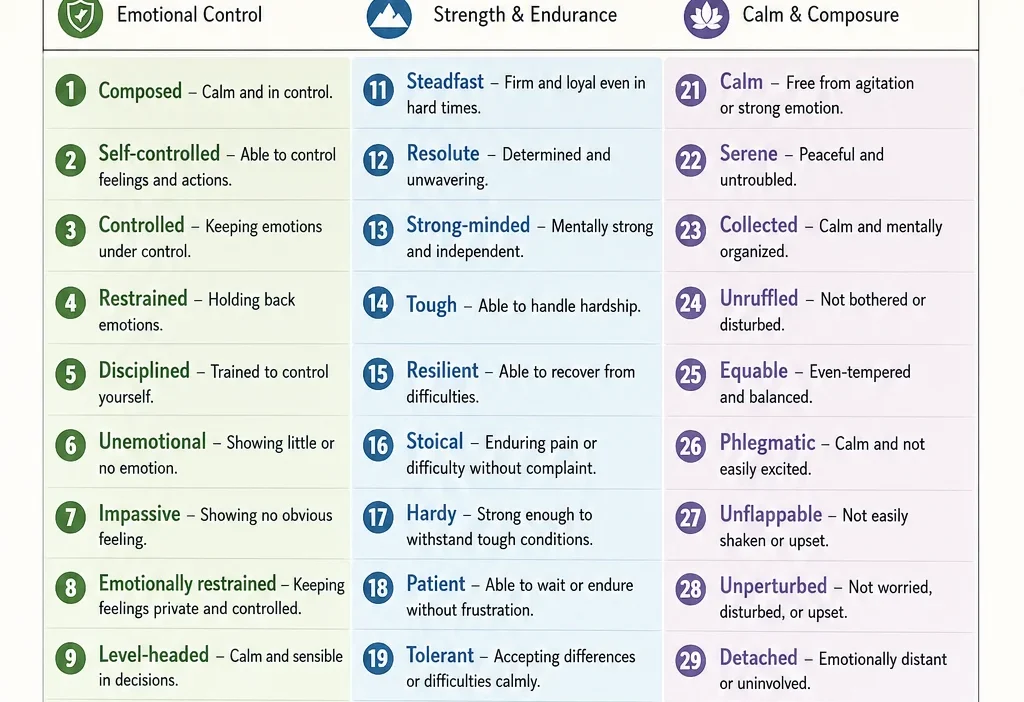
30 Stoic Synonyms
1. Composed
Meaning: Calm and in control of your emotions.
Example:
She remained composed during the difficult interview.
Best usage context: Use composed when someone stays calm in a stressful or formal situation.
2. Calm
Meaning: Not nervous, angry, excited, or upset.
Example:
He stayed calm even when the situation became confusing.
Best usage context: A simple, common choice for everyday English.
3. Unemotional
Meaning: Showing very little emotion.
Example:
His unemotional response surprised everyone.
Best usage context: Use this when the main idea is a lack of visible emotion.
4. Impassive
Meaning: Showing no obvious feelings or reactions.
Example:
The witness remained impassive throughout the questioning.
Best usage context: Useful in formal, literary, or serious writing.
5. Self-controlled
Meaning: Able to control your feelings and actions.
Example:
She was highly self-controlled and refused to react angrily.
Best usage context: Good when emphasizing discipline and emotional control.
6. Collected
Meaning: Calm and mentally organized, especially in a difficult situation.
Example:
Despite the unexpected problem, the manager stayed collected.
Best usage context: Suitable for situations involving pressure or uncertainty.
7. Serene
Meaning: Very peaceful and calm.
Example:
He looked serene despite the chaos around him.
Best usage context: Best for peaceful, graceful, or almost tranquil calmness.
8. Unruffled
Meaning: Not disturbed, worried, or upset by something.
Example:
She remained unruffled when the plan suddenly changed.
Best usage context: Excellent for describing someone who stays calm when others might panic.
9. Steadfast
Meaning: Firm and determined, even when facing difficulties.
Example:
He remained steadfast in his decision despite criticism.
Best usage context: Use this when stoic means emotionally strong and determined rather than simply quiet.
10. Resolute
Meaning: Very determined and unwilling to change your decision.
Example:
The leader was resolute in the face of opposition.
Best usage context: Best for determination and strong decisions.
11. Patient
Meaning: Able to wait or deal with problems without becoming angry or frustrated.
Example:
She was patient while waiting for the difficult situation to improve.
Best usage context: Use when endurance and tolerance are more important than emotional silence.
12. Tolerant
Meaning: Able to accept difficult behavior, opinions, or situations without becoming angry.
Example:
He was tolerant of the criticism and continued working.
Best usage context: Best when the person calmly accepts something unpleasant or different.
13. Resigned
Meaning: Accepting something unpleasant because you believe you cannot change it.
Example:
He gave a resigned smile when the flight was canceled again.
Best usage context: Use carefully because resigned can suggest giving up rather than showing strength.
14. Phlegmatic
Meaning: Calm and not easily excited, worried, or upset.
Example:
His phlegmatic personality helped him handle emergencies effectively.
Best usage context: A formal or less common word, useful in advanced writing.
15. Equable
Meaning: Calm and steady in mood.
Example:
Her equable temperament made her a reliable colleague.
Best usage context: Best for formal descriptions of a consistently calm personality.
16. Unflappable
Meaning: Unable to be easily upset or worried.
Example:
The doctor remained unflappable during the emergency.
Best usage context: Excellent for someone who stays calm under intense pressure.
17. Level-headed
Meaning: Sensible and calm when making decisions.
Example:
We need a level-headed person to handle the problem.
Best usage context: Common in everyday English, especially for practical decision-making.
18. Cool-headed
Meaning: Able to stay calm and think clearly in a stressful situation.
Example:
Her cool-headed response prevented a serious mistake.
Best usage context: Great for emergencies, conflicts, and high-pressure situations.
19. Detached
Meaning: Emotionally distant or not personally involved.
Example:
He sounded detached when discussing the difficult experience.
Best usage context: Use when emotional distance is important. It can have a negative or neutral tone.
20. Restrained
Meaning: Controlled and not excessive in emotion or behavior.
Example:
His restrained response showed that he did not want to create a conflict.
Best usage context: Useful in formal writing when describing controlled emotional expression.
21. Controlled
Meaning: Kept under control rather than allowed to become extreme.
Example:
She gave a controlled response to the criticism.
Best usage context: Good for emotional reactions, speech, or behavior.
22. Disciplined
Meaning: Able to control yourself and follow a plan or set of rules.
Example:
His disciplined approach helped him remain focused during difficult times.
Best usage context: Best when self-control comes from training, habits, or personal discipline.
23. Tough
Meaning: Able to deal with difficult situations without giving up easily.
Example:
She is tough enough to handle the pressure.
Best usage context: Informal and conversational; focuses more on resilience than emotional restraint.
24. Resilient
Meaning: Able to recover from difficulties and continue moving forward.
Example:
The resilient athlete returned to training after a major setback.
Best usage context: Use when the focus is recovery and emotional or mental strength.
25. Hardy
Meaning: Strong enough to survive difficult conditions.
Example:
The hardy traveler continued despite the harsh weather.
Best usage context: More often used for physical endurance, people, plants, or animals.
26. Strong-minded
Meaning: Mentally strong and not easily influenced or discouraged.
Example:
She is strong-minded and does not give up when things become difficult.
Best usage context: Good for describing determination and mental strength.
27. Unperturbed
Meaning: Not worried, disturbed, or upset by something.
Example:
He seemed completely unperturbed by the criticism.
Best usage context: Formal and precise; particularly useful in essays and professional writing.
28. Unconcerned
Meaning: Not worried or interested in something.
Example:
He appeared unconcerned about the delay.
Best usage context: Use carefully because it can mean someone genuinely does not care, not simply that they remain calm.
29. Stoical
Meaning: Showing the ability to endure pain or difficulty without complaining.
Example:
Her stoical attitude impressed everyone during the long recovery.
Best usage context: Very close to stoic and useful when emphasizing endurance.
30. Emotionally restrained
Meaning: Keeping feelings under control instead of expressing them openly.
Example:
His emotionally restrained manner made it difficult to know what he was thinking.
Best usage context: Useful when you want to clearly describe limited emotional expression.
Stoic Synonyms Comparison Guide
Not every synonym of stoic has the same meaning or emotional tone. The best choice depends on what you want to emphasize.
| Synonym | Main idea | Tone | Best for |
|---|---|---|---|
| Composed | Calm and controlled | Positive | Stressful situations |
| Calm | Free from agitation | Neutral | Everyday situations |
| Unemotional | Shows little feeling | Neutral/negative | Emotional expression |
| Impassive | Shows no reaction | Formal | Serious situations |
| Self-controlled | Controls emotions | Positive | Personal discipline |
| Serene | Peaceful and calm | Positive | Peaceful settings |
| Unruffled | Not easily disturbed | Positive | Unexpected problems |
| Steadfast | Firm and determined | Positive | Difficult decisions |
| Resigned | Accepts something unpleasant | Negative/neutral | Unavoidable situations |
| Unflappable | Cannot easily be upset | Positive | Pressure and emergencies |
| Level-headed | Calm and sensible | Positive | Decisions |
| Detached | Emotionally distant | Neutral/negative | Emotional distance |
| Restrained | Holds emotions back | Neutral | Formal writing |
| Tough | Handles hardship | Positive/informal | Difficult experiences |
| Resilient | Recovers from setbacks | Positive | Challenges and recovery |
| Unperturbed | Not disturbed | Positive/formal | Essays and formal prose |
| Unconcerned | Not worried or interested | Neutral/negative | Lack of concern |
| Stoical | Endures without complaint | Positive/formal | Pain and hardship |
How to Choose the Right Synonym
For calmness
Choose calm, composed, serene, collected, or unruffled when the main idea is that someone remains peaceful.
Example:
She remained composed during the presentation.
These words are usually good choices for positive descriptions.
For emotional control
Choose self-controlled, controlled, restrained, or emotionally restrained when you want to emphasize control over feelings.
Example:
He gave a restrained response to the accusation.
These words work particularly well in formal and analytical writing.
For strength during hardship
Choose steadfast, resolute, tough, resilient, or strong-minded when the focus is mental strength or determination.
Example:
Her resilient attitude helped her overcome the setback.
These words are useful when describing someone who continues despite difficulties.
For a lack of visible emotion
Choose unemotional, impassive, or stoical when the person does not visibly express feelings.
Example:
The actor remained impassive while listening to the criticism.
These alternatives are especially useful when describing facial expressions or reactions.
For formal or advanced writing
Choose impassive, phlegmatic, equable, unperturbed, or resolute.
These words can make academic, literary, or professional writing more precise, but some are less common in everyday conversation.
For emotional distance
Choose detached or unconcerned when the person seems distant or does not appear personally affected.
Be careful with these words because they can imply a lack of caring rather than admirable self-control.
Stoic vs. Similar Words: Important Differences
Stoic vs. calm
Calm simply means that someone is not upset or excited. Stoic usually carries the additional idea of enduring difficulty without showing much emotion.
He was calm during the meeting.
This only tells us about his emotional state.
He was stoic after receiving the bad news.
This suggests that he faced something painful without openly expressing his feelings.
Stoic vs. unemotional
Unemotional focuses on how little emotion a person shows. Stoic often suggests emotional strength and endurance.
Someone can be unemotional without necessarily being strong or patient.
Stoic vs. composed
Composed usually has a positive meaning: the person successfully keeps control of themselves.
Stoic is more strongly connected with hardship, pain, or unpleasant circumstances.
Stoic vs. detached
Detached suggests emotional distance or a lack of personal involvement. Stoic usually suggests that emotions exist but are being controlled or kept private.
Stoic vs. resilient
Resilient means recovering from difficulty. Stoic means enduring difficulty with little outward emotional reaction.
A resilient person may openly express emotions and still recover successfully. A stoic person may keep those emotions hidden.
Quick Guide to Using Stoic Synonyms
If you want to say someone is…
- Calm: use calm or composed
- Peaceful: use serene
- Not easily upset: use unflappable or unruffled
- Emotionally controlled: use self-controlled or restrained
- Showing little emotion: use unemotional or impassive
- Mentally strong: use strong-minded or tough
- Able to recover: use resilient
- Firm in a decision: use resolute or steadfast
- Emotionally distant: use detached
- Accepting an unpleasant outcome: use resigned
- Calm and sensible: use level-headed
- Formal and advanced: use phlegmatic, equable, or unperturbed
Why Learning Stoic Synonyms Matters
Learning synonyms is not only about avoiding repetition. It helps you communicate more accurately.
For example, saying that a person is calm is different from saying that they are resilient. One describes their present emotional state, while the other describes their ability to recover from difficulty.
Likewise, unemotional and composed can describe similar behavior but create different impressions. Composed often praises someone’s self-control, while unemotional may simply point out that they do not display feelings.
For ESL learners, understanding these differences is especially useful because dictionary definitions do not always explain tone and context.
Common Questions About Stoic Synonyms
What is the closest synonym for stoic?
Some of the closest alternatives are stoical, impassive, unemotional, composed, and self-controlled. The best choice depends on whether you want to emphasize endurance, calmness, or limited emotional expression.
Is “calm” a synonym for “stoic”?
Yes, but they are not always interchangeable. Calm describes a peaceful emotional state, while stoic often suggests remaining calm while dealing with pain, pressure, or hardship.
Is “unemotional” positive or negative?
It can be either. It may describe admirable emotional control, but it can also suggest that someone seems cold or disconnected.
What is a positive synonym for stoic?
Composed, self-controlled, unflappable, steadfast, resilient, and level-headed are often positive alternatives.
What is a formal synonym for stoic?
Impassive, phlegmatic, equable, unperturbed, and stoical can work well in formal writing, depending on the sentence.
What is the opposite of stoic?
Possible opposites include emotional, expressive, sensitive, reactive, excitable, and demonstrative. The best antonym depends on which meaning of stoic you are contrasting.
Final Takeaways
The word stoic describes someone who remains controlled and does not openly show much emotion, particularly during difficult situations. However, its synonyms carry different shades of meaning.
Use composed for calm self-control, unemotional for limited emotional expression, resilient for recovery after hardship, steadfast for determination, and unflappable for someone who stays calm under pressure.
The most effective synonym is not always the one that looks closest in a dictionary.
Consider the tone, situation, emotional meaning, and purpose of your sentence.
By choosing the word that matches your exact intention, you can make your English more natural, precise, and engaging.