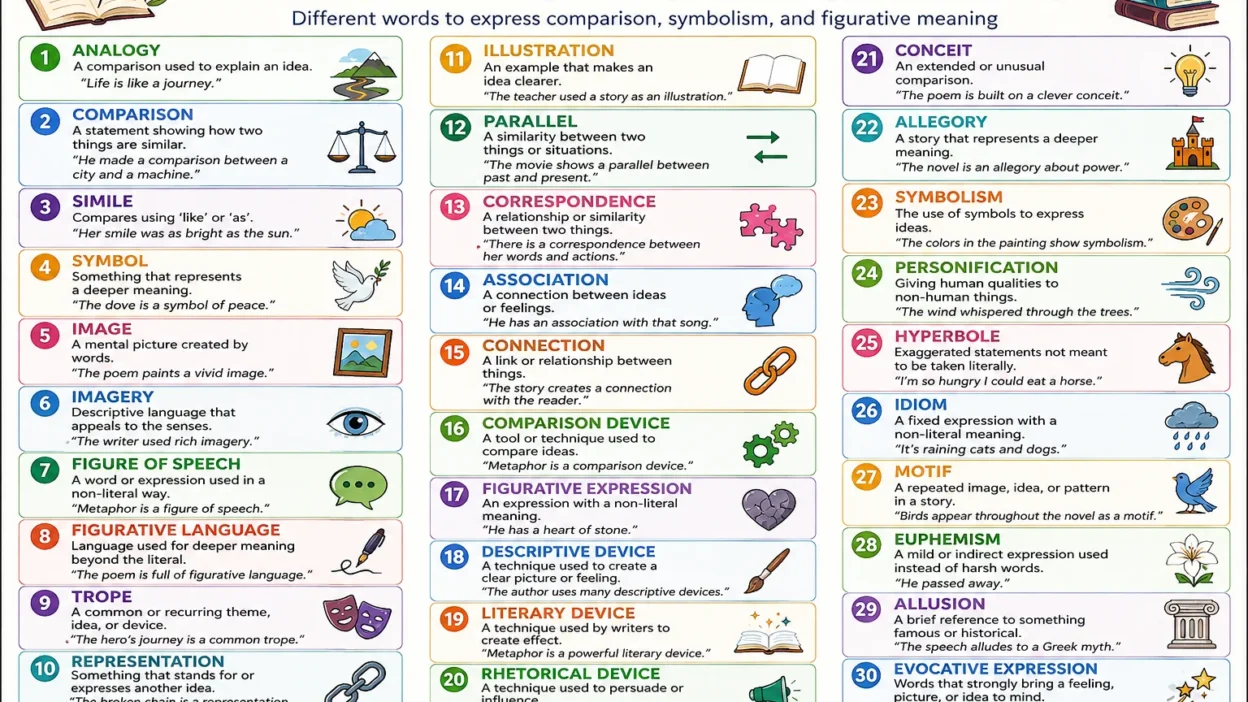
A metaphor is a way of describing one thing by saying it is another thing, without using “like” or “as.”
Metaphors help writers express ideas in a more vivid, emotional, and memorable way.
For example, saying “Time is a thief” does not mean that time literally steals things. It suggests that time takes moments away from us.
Learning metaphor synonyms and related words can make your vocabulary more flexible.
Students can use them to understand literature, ESL learners can build stronger vocabulary, and writers can choose more precise language when explaining comparisons, symbols, or figurative ideas.
It is important to remember that not every word below is a perfect dictionary synonym for metaphor.
Some are closely related literary terms, while others describe different kinds of comparisons or figurative language.
Knowing these differences helps you choose the right word for the situation.
What Does “Metaphor” Mean?
Simple meaning
A metaphor is a figure of speech that describes one thing as another thing to create a comparison or deeper meaning.
For example:
The voice is not literally music. The metaphor means that the voice sounded especially pleasant.
Tone and usage
The word metaphor is common in literature, academic writing, creative writing, journalism, speeches, and everyday conversation. It usually has a neutral and educational tone.
You might say:
- “The author uses a metaphor to describe loneliness.”
- “The phrase ‘life is a journey’ is a common metaphor.”
- “This metaphor makes the character’s emotions easier to understand.”
30 Metaphor Synonyms and Related Words
1. Analogy
Meaning: An analogy explains one idea by comparing it with another idea that is easier to understand.
Example: “Learning a language is like building a house; you need a strong foundation first.”
Best usage context: Use analogy when you want to explain or clarify a difficult idea.
2. Comparison
Meaning: A comparison shows how two things are similar or different.
Example: “The writer makes a comparison between a busy city and a living machine.”
Best usage context: Use comparison as a broad, simple term when discussing similarities.
3. Simile
Meaning: A simile compares two different things using words such as “like” or “as.”
Example: “The child was as quiet as a mouse.”
Best usage context: Use simile when the comparison clearly uses “like” or “as.”
4. Symbol
Meaning: A symbol is an object, person, place, or idea that represents a deeper meaning.
Example: “The dove is often used as a symbol of peace.”
Best usage context: Use symbol when something represents a larger idea or emotion.
5. Image
Meaning: An image is a mental picture created through descriptive language.
Example: “The writer creates a powerful image of a lonely road at sunset.”
Best usage context: Use image when focusing on the picture or feeling created in the reader’s mind.
6. Imagery
Meaning: Imagery is descriptive language that helps readers imagine something through their senses.
Example: “The poem uses rich imagery to describe the cold winter forest.”
Best usage context: Use imagery when discussing descriptive writing, poetry, or sensory details.
7. Figure of Speech
Meaning: A figure of speech is an expression that uses words in a non-literal or special way.
Example: “Calling someone a ‘walking encyclopedia’ is a figure of speech.”
Best usage context: Use this broad term when discussing metaphor, simile, personification, and other forms of figurative language.
8. Figurative Language
Meaning: Figurative language uses words beyond their literal meaning to create an idea, image, or feeling.
Example: “The author uses figurative language to make the story more emotional.”
Best usage context: Use it in English, literature, and writing discussions.
9. Trope
Meaning: A trope is a familiar or recurring idea, image, theme, or figurative device.
Example: “The journey from darkness to light is a common literary trope.”
Best usage context: Use trope in literary analysis, storytelling, film, and popular culture.
10. Representation
Meaning: A representation is something that stands for or shows another idea, object, or concept.
Example: “The broken mirror becomes a representation of the character’s damaged identity.”
Best usage context: Use representation in academic, literary, artistic, and cultural discussions.
11. Illustration
Meaning: An illustration is an example or description that makes an idea easier to understand.
Example: “The teacher used the story as an illustration of human courage.”
Best usage context: Use illustration when an example helps explain a concept.
12. Parallel
Meaning: A parallel is a similarity between two situations, ideas, or experiences.
Example: “The novel draws a parallel between childhood and old age.”
Best usage context: Use parallel when two subjects share an important similarity.
13. Correspondence
Meaning: Correspondence means a relationship or similarity between two things.
Example: “There is a clear correspondence between the character’s stormy emotions and the dark weather.”
Best usage context: Use it in formal or academic writing.
14. Association
Meaning: An association is a connection between two ideas, objects, feelings, or experiences.
Example: “The color white often has an association with purity.”
Best usage context: Use association when one idea naturally brings another idea to mind.
15. Connection
Meaning: A connection is a relationship or link between two things.
Example: “The poem creates a connection between nature and human freedom.”
Best usage context: Use this simple word when you want clear, accessible language.
16. Representation of an Idea
Meaning: This phrase describes something that expresses or stands for an abstract idea.
Example: “The empty chair becomes a representation of loss.”
Best usage context: Useful when analyzing symbols and deeper meanings in literature.
17. Comparison Device
Meaning: A comparison device is a writing technique used to connect one idea with another.
Example: “The author uses a comparison device to make the scientific concept easier for readers to understand.”
Best usage context: Use it when discussing writing techniques in an educational setting.
18. Figurative Expression
Meaning: A figurative expression uses language in a non-literal way.
Example: “He has a heart of stone” is a figurative expression describing someone as emotionally cold.
Best usage context: Use this phrase when explaining unusual or non-literal expressions.
19. Descriptive Device
Meaning: A descriptive device is a writing technique that helps communicate an image, feeling, or idea.
Example: “The author uses a descriptive device to make the setting feel mysterious.”
Best usage context: Useful in literary analysis and writing lessons.
20. Literary Device
Meaning: A literary device is a technique writers use to create meaning, emotion, emphasis, or interest.
Example: “Metaphor is an important literary device in poetry.”
Best usage context: Use this broad term when talking about techniques used in literature.
21. Rhetorical Device
Meaning: A rhetorical device is a technique used to make communication more persuasive, memorable, or effective.
Example: “The speaker uses a metaphor as a rhetorical device to influence the audience.”
Best usage context: Best for speeches, persuasive writing, essays, and public communication.
22. Conceit
Meaning: A conceit is an extended or unusual comparison between two very different things.
Example: “The poem develops a conceit comparing love to a long voyage.”
Best usage context: Common in literary studies, especially when analyzing complex poetry.
23. Allegory
Meaning: An allegory is a story, image, or work in which characters and events represent deeper ideas.
Example: “The story can be read as an allegory about the dangers of unchecked power.”
Best usage context: Use allegory for extended symbolic stories rather than a single metaphor.
24. Symbolism
Meaning: Symbolism is the use of symbols to communicate deeper meanings or ideas.
Example: “The novel uses symbolism to explore death and rebirth.”
Best usage context: Use it when discussing repeated symbols and their meanings.
25. Personification
Meaning: Personification gives human qualities to animals, objects, or ideas.
Example: “The wind whispered through the trees.”
Best usage context: Use personification when something non-human is described as behaving like a person.
26. Hyperbole
Meaning: Hyperbole is deliberate exaggeration used for emphasis or effect.
Example: “I have told you a million times.”
Best usage context: Use it when the writer clearly exaggerates something for humor, emotion, or emphasis.
27. Idiom
Meaning: An idiom is a common expression whose meaning is different from the literal meaning of its individual words.
Example: “After hearing the news, she was over the moon.”
Best usage context: Use idiom when discussing familiar expressions with non-literal meanings.
28. Motif
Meaning: A motif is a repeated image, idea, object, or pattern that supports a larger theme.
Example: “Birds appear throughout the novel as a motif representing freedom.”
Best usage context: Use motif when the same symbolic element appears repeatedly in a literary work.
29. Euphemism
Meaning: A euphemism is a softer or less direct expression used instead of a potentially unpleasant word.
Example: “The company said that some workers would be ‘let go’ instead of saying they would be fired.”
Best usage context: Use euphemism when discussing polite, indirect, or softened language.
30. Evocative Expression
Meaning: An evocative expression is language that strongly brings a particular feeling, memory, picture, or idea to mind.
Example: “The writer uses an evocative expression to capture the sadness of leaving home.”
Best usage context: Use it when emphasizing emotional or imaginative impact.
Metaphor Synonyms: Quick Comparison Guide
Different related terms are useful in different situations. Choosing the right one depends on what you are trying to describe.
| Word or Term | Main Purpose | Best Context |
|---|---|---|
| Metaphor | Creates an implied comparison | Creative writing and literature |
| Analogy | Explains an idea through comparison | Teaching and explanation |
| Simile | Makes a direct comparison using “like” or “as” | Creative writing |
| Symbol | Represents a deeper meaning | Literature and art |
| Imagery | Creates sensory pictures | Poetry and descriptive writing |
| Figure of speech | Describes non-literal language broadly | Grammar and literature |
| Trope | Describes a familiar recurring device or idea | Literature, film, storytelling |
| Allegory | Communicates deeper ideas through an extended story | Literature and philosophy |
| Personification | Gives human qualities to non-human things | Poetry and creative writing |
| Hyperbole | Uses exaggeration for effect | Everyday speech and creative writing |
| Idiom | Uses a fixed non-literal expression | Everyday English |
| Motif | Repeats an important image or idea | Literary analysis |
| Rhetorical device | Strengthens communication or persuasion | Speeches and essays |
| Conceit | Develops an unusual extended comparison | Advanced literary analysis |
How to Choose the Right Synonym
For simple comparisons
Choose comparison, simile, or analogy when your main purpose is to show a relationship between two things.
Use comparison for a general similarity.
Use simile when the comparison uses “like” or “as.”
Use analogy when the comparison is designed to explain something.
For deeper literary meaning
Choose symbol, symbolism, motif, or allegory when the language has a deeper meaning beyond its surface message.
A symbol can represent an idea.
Symbolism describes the broader use of symbols.
A motif is usually repeated throughout a work.
An allegory often uses an entire story or narrative to communicate another meaning.
For descriptive writing
Choose image, imagery, or evocative expression when you want to focus on the mental or emotional picture created by language.
For example, a writer may use imagery to help readers imagine the smell of rain, the sound of a crowded street, or the appearance of a dark forest.
For non-literal language
Choose figurative expression, figure of speech, or figurative language when you want a broad term for language that should not be understood literally.
These terms are especially useful for ESL learners because they cover many different techniques.
For persuasive communication
Choose rhetorical device when the language is being used to influence, persuade, or engage an audience.
Metaphors are often rhetorical devices because they can make complicated ideas easier to remember.
For repeated literary patterns
Choose motif or trope when the idea or device appears repeatedly or follows a recognizable storytelling pattern.
These terms are particularly useful for advanced literary analysis.
Metaphor vs. Simile: What Is the Difference?
Metaphor
A metaphor directly identifies one thing with another.
Example: “The classroom was a zoo.”
The classroom is not literally a zoo. The sentence suggests that it was noisy, crowded, or difficult to control.
Simile
A simile makes the comparison more directly by using “like” or “as.”
Example: “The classroom was like a zoo.”
Both sentences communicate a similar idea, but the grammatical structure is different.
Metaphor vs. Analogy: What Is the Difference?
Metaphor
A metaphor is usually short and imaginative.
Example: “Knowledge is a key.”
It suggests that knowledge helps people unlock opportunities or understand difficult things.
Analogy
An analogy usually explains a relationship in greater detail.
Example: “Learning vocabulary is like building a toolbox. The more words you learn, the more tools you have to express your ideas.”
An analogy is therefore especially useful for teaching and explanation.
Metaphor vs. Symbol: What Is the Difference?
Metaphor
A metaphor creates a comparison.
Example: “Her words were arrows.”
The words are compared with arrows to suggest that they were painful or hurtful.
Symbol
A symbol represents an idea or concept.
Example: “A broken chain can symbolize freedom.”
The chain does not need to be part of a direct comparison. Instead, it represents the idea of freedom or release.
Common Mistakes When Using Metaphor Synonyms
Treating every related term as an exact synonym
Words such as symbol, idiom, simile, and allegory are closely connected to metaphor, but they do not mean exactly the same thing.
Using the most precise term makes your writing clearer.
Confusing similes with metaphors
Remember this simple rule:
Metaphor: “The moon is a silver coin.”
Simile: “The moon is like a silver coin.”
The first creates a metaphor. The second creates a simile.
Using technical words when simple words are better
If you are writing for beginners, comparison may be clearer than correspondence or conceit.
Choose vocabulary based on your audience.
Forgetting the context
A word can be appropriate in one situation but unnatural in another.
For example, motif works well in literary criticism, while connection is more natural in everyday English.
Why Learning Metaphor Synonyms Matters
Learning related vocabulary does more than give you extra words. It helps you understand how English communicates ideas in different ways.
For students, these words can make literary analysis easier.
For ESL learners, they provide useful vocabulary for discussing books, movies, essays, and everyday communication.
For writers and content creators, they make it easier to describe language techniques accurately.
The key is not to memorize all 30 terms as if they were interchangeable. Instead, learn the main difference between them and notice how native speakers and professional writers use them.
Final Thoughts on Metaphor Synonyms
A metaphor is a powerful way to create an implied comparison and communicate an idea more vividly. However, many related words describe different forms of comparison, symbolism, figurative language, and literary technique.
The most useful alternatives depend on your purpose. Use analogy for explanation, simile for direct comparisons using “like” or “as,” symbol for representation, imagery for sensory description, and motif for repeated literary ideas.
For broader discussions, terms such as figure of speech, figurative language, and literary device can be useful.
If you understand these differences, your vocabulary becomes more precise. Instead of simply saying that a writer “uses a metaphor,” you can explain exactly what type of language or literary technique is being used and why it works.

Liam Henry is a content author at Synonymed, specializing in vocabulary enrichment and synonym guides. He creates clear, engaging resources that help learners improve English word knowledge and language fluency.