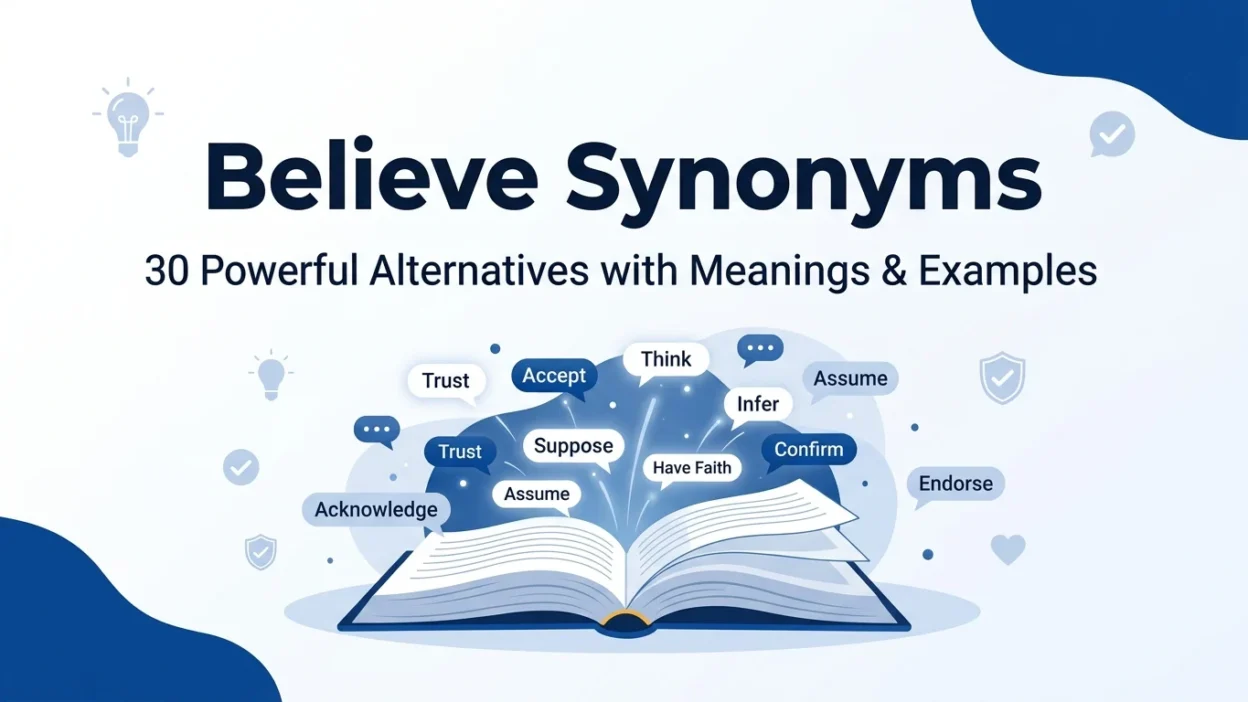
The word believe is one of the most common verbs in the English language. It is used to express trust, confidence, acceptance, or the feeling that something is true.
If you’re writing an essay, telling a story, or having a conversation, knowing different believe synonyms can help you communicate your ideas more naturally and accurately.
For students, ESL learners, writers, and content creators, expanding vocabulary is an excellent way to improve writing and speaking skills.
While many words are similar to believe, each has its own meaning and tone. Learning when to use the right synonym will make your English sound more fluent, engaging, and professional.
What Does “Believe” Mean?
Meaning of Believe
The word believe means to think that something is true, to have confidence in someone or something, or to accept an idea without complete proof.
Depending on the situation, believe can mean:
- Thinking something is true.
- Trusting another person.
- Having faith in an idea or religion.
- Feeling confident that something will happen.
Examples:
- I believe she is telling the truth.
- We believe in hard work.
- Many people believe that practice leads to success.
30 Believe Synonyms with Meanings, Examples, and Usage
1. Trust
Meaning: To have confidence in someone or something.
Example: I trust my best friend completely.
Best Usage: Relationships and reliability.
2. Accept
Meaning: To agree that something is true.
Example: She accepted the explanation without hesitation.
Best Usage: Facts and opinions.
3. Assume
Meaning: To think something is true without proof.
Example: Don’t assume everyone agrees.
Best Usage: Everyday conversations.
4. Think
Meaning: To have an opinion.
Example: I think this book is interesting.
Best Usage: Informal speech.
5. Suppose
Meaning: To believe something is probably true.
Example: I suppose he’ll arrive soon.
Best Usage: Casual conversation.
6. Imagine
Meaning: To think or picture something in your mind.
Example: Imagine living by the sea.
Best Usage: Creative writing.
7. Consider
Meaning: To think carefully about something.
Example: I consider honesty very important.
Best Usage: Formal discussions.
8. Expect
Meaning: To believe something will happen.
Example: We expect good results this year.
Best Usage: Predictions and planning.
9. Presume
Meaning: To believe something based on available information.
Example: The police presumed he was innocent.
Best Usage: Formal writing.
10. Conclude
Meaning: To decide after careful thinking.
Example: Scientists concluded the study successfully.
Best Usage: Research and reports.
11. Infer
Meaning: To reach a conclusion from evidence.
Example: We can infer the answer from the data.
Best Usage: Academic writing.
12. Judge
Meaning: To form an opinion.
Example: Don’t judge people too quickly.
Best Usage: Everyday English.
13. Reckon
Meaning: To think or believe.
Example: I reckon it’ll rain today.
Best Usage: Informal British English.
14. Guess
Meaning: To believe without certainty.
Example: I guess she’s at work.
Best Usage: Casual conversations.
15. Suspect
Meaning: To think something may be true.
Example: I suspect he’s hiding something.
Best Usage: Mystery or uncertainty.
16. Be Convinced
Meaning: To feel completely certain.
Example: She’s convinced the plan will succeed.
Best Usage: Strong confidence.
17. Have Faith
Meaning: To trust deeply.
Example: Have faith in yourself.
Best Usage: Inspiration and religion.
18. Count On
Meaning: To depend on someone.
Example: You can count on me.
Best Usage: Trust and teamwork.
19. Depend On
Meaning: To rely on someone or something.
Example: Farmers depend on rainfall.
Best Usage: Reliability.
20. Credit
Meaning: To believe something someone says.
Example: Few people credited his story.
Best Usage: Formal contexts.
21. Buy
Meaning: To accept an idea as true.
Example: I don’t buy that excuse.
Best Usage: Informal English.
22. Subscribe To
Meaning: To agree with an opinion or belief.
Example: I don’t subscribe to that theory.
Best Usage: Academic and formal writing.
23. Endorse
Meaning: To publicly support or believe in something.
Example: Many experts endorse this method.
Best Usage: Business and public statements.
24. Affirm
Meaning: To state that something is true.
Example: She affirmed her commitment.
Best Usage: Legal and formal writing.
25. Verify
Meaning: To confirm something is true.
Example: Please verify the information.
Best Usage: Research and business.
26. Confirm
Meaning: To establish that something is correct.
Example: The test confirmed the results.
Best Usage: Professional communication.
27. Recognize
Meaning: To accept that something exists or is true.
Example: We recognize the importance of education.
Best Usage: Formal writing.
28. Acknowledge
Meaning: To admit or accept something.
Example: He acknowledged his mistake.
Best Usage: Professional and academic writing.
29. Certify
Meaning: To officially confirm something.
Example: The document was certified by the office.
Best Usage: Legal and official contexts.
30. Convince Yourself
Meaning: To make yourself believe something.
Example: She convinced herself everything would be fine.
Best Usage: Personal thoughts and storytelling.
Comparison Guide: When to Use Different Believe Synonyms
Quick Comparison Table
| Synonym | Best For | Tone |
|---|---|---|
| Trust | Confidence in people | Neutral |
| Accept | Agreeing with facts | Neutral |
| Think | Personal opinion | Informal |
| Suppose | Likely assumption | Casual |
| Guess | Uncertain belief | Informal |
| Presume | Logical assumption | Formal |
| Infer | Evidence-based conclusions | Academic |
| Have Faith | Strong belief | Inspirational |
| Endorse | Public support | Professional |
| Confirm | Proving something | Formal |
| Verify | Checking facts | Technical |
| Acknowledge | Accepting reality | Professional |
How to Choose the Right Synonym
For Trusting People
Use:
- Trust
- Count On
- Depend On
- Have Faith
These words show confidence in people or relationships.
For Personal Opinions
Choose:
- Think
- Suppose
- Guess
- Reckon
These are common in everyday conversations.
For Logical Conclusions
Use:
- Infer
- Conclude
- Presume
- Consider
These fit academic, scientific, and professional writing.
For Accepting Facts
Good choices include:
- Accept
- Recognize
- Acknowledge
- Confirm
- Verify
These are useful in formal communication and reports.
For Strong Conviction
Use:
- Be Convinced
- Endorse
- Affirm
These express confidence and certainty.
Why Learn Believe Synonyms?
Improve Your Vocabulary
Learning different words helps you avoid repetition and express yourself more clearly.
Write More Naturally
Using a variety of synonyms makes essays, stories, and articles more engaging.
Strengthen English Skills
Students and ESL learners gain confidence by understanding subtle differences between similar words.
Create Better Content
Content creators and bloggers can improve readability by selecting the most appropriate synonym for each context.
Common Mistakes to Avoid
Treating Every Synonym the Same
Not all believe synonyms have identical meanings. Some express trust, while others describe assumptions, opinions, or evidence-based conclusions.
Ignoring the Tone
Words like guess are casual, while infer and affirm are more formal. Choose the one that fits your audience.
Repeating the Same Word
Instead of using believe repeatedly, naturally include suitable alternatives to make your writing more interesting and polished.
Final Thoughts
Learning believe synonyms is an excellent way to build a richer English vocabulary and improve both speaking and writing skills. Whether you’re expressing trust, sharing an opinion, making a logical conclusion, or showing confidence, there is a synonym that fits your purpose.
By understanding the meanings, examples, and best uses of these 30 alternatives, you’ll write with greater clarity, confidence, and variety in any situation.