The phrase dark play can describe play, behavior, or storytelling that feels disturbing, sinister, unsettling, secretive, or morally troubling.
The exact meaning depends on context. For example, a writer might use “dark play” to describe a disturbing game, while a critic might use it to describe a theatrical performance with grim or unsettling themes.
Learning dark play synonyms can help students, ESL learners, writers, and content creators express these ideas more precisely.
Instead of repeating the same phrase, you can choose a word that shows if something is frightening, mysterious, cruel, mischievous, or morally questionable.
What Does “Dark Play” Mean?
Simple meaning
Dark play generally refers to play, action, or storytelling with a disturbing, sinister, serious, mysterious, or morally troubling quality.
The word “dark” changes the feeling of “play.” Ordinary play may be fun and harmless, while dark play can suggest danger, fear, manipulation, secrecy, or uncomfortable subjects.
Usage and tone
The best synonym depends on what you mean by “dark.” Some alternatives are suitable for everyday conversation, while others work better in literature, psychology, film criticism, or creative writing.
For example:
- Sinister suggests something threatening or evil.
- Mischievous suggests playful troublemaking.
- Unsettling describes something that makes people uncomfortable.
- Morbid relates to death or disturbing subjects.
- Macabre often describes a fascination with death in an artistic or unusual way.
- Twisted suggests something disturbing or morally strange.
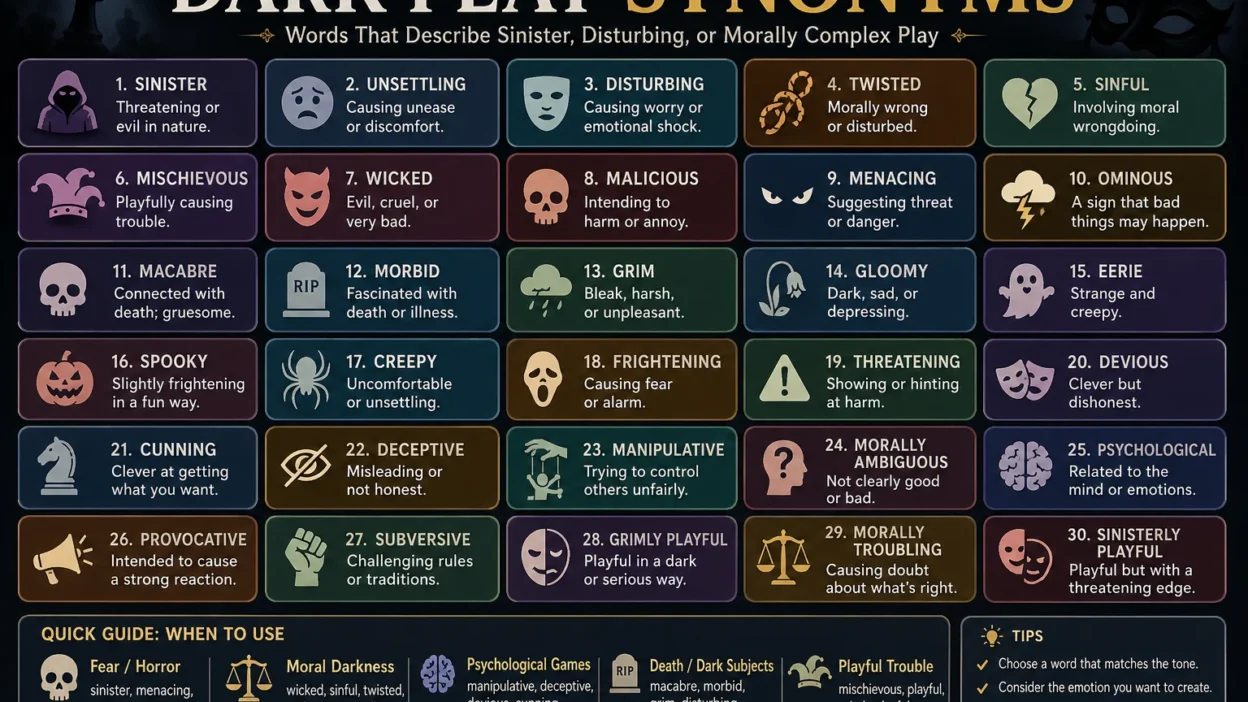
30 Dark Play Synonyms
1. Sinister
Meaning: Something that seems dangerous, evil, or threatening.
Example: The children noticed a sinister quality in the mysterious game.
Best usage context: Use sinister when “dark play” suggests hidden danger or evil intentions.
2. Unsettling
Meaning: Something that makes you feel uncomfortable, nervous, or worried.
Example: The film included an unsettling game between the two characters.
Best usage context: Excellent for situations that feel disturbing without necessarily being frightening.
3. Disturbing
Meaning: Something that causes worry, discomfort, or emotional unease.
Example: The novel contains several disturbing scenes of psychological manipulation.
Best usage context: Use this when the subject creates a strong negative emotional reaction.
4. Twisted
Meaning: Strange, disturbing, or morally wrong in an unusual way.
Example: The story revolves around a twisted game of revenge.
Best usage context: Common in informal writing, reviews, fiction, and descriptions of morally strange behavior.
5. Sinful
Meaning: Involving behavior considered morally wrong.
Example: The story portrays the characters’ sinful games of deception.
Best usage context: Best when the darkness is connected to morality, religion, or wrongdoing.
6. Mischievous
Meaning: Playfully causing trouble or minor problems.
Example: His mischievous play caused everyone to laugh.
Best usage context: Choose this when “dark” means playful troublemaking rather than something frightening.
7. Wicked
Meaning: Bad, cruel, or morally wrong; sometimes used playfully to mean clever or extreme.
Example: The villain enjoyed his wicked games with his enemies.
Best usage context: Useful in fiction and informal descriptions, especially for villains or morally bad behavior.
8. Malicious
Meaning: Intending to hurt, annoy, or harm someone.
Example: What appeared to be a harmless game became a malicious attempt to embarrass him.
Best usage context: Use when the person deliberately wants to cause harm.
9. Menacing
Meaning: Showing or suggesting a threat or danger.
Example: The character’s menacing games made the audience nervous.
Best usage context: Strong choice for suspense, horror, crime, and threatening situations.
10. Ominous
Meaning: Suggesting that something bad is likely to happen.
Example: An ominous game began as the storm approached.
Best usage context: Good for stories where dark play creates a feeling that trouble is coming.
11. Macabre
Meaning: Connected with death or frightening aspects of death.
Example: The artist created a macabre game involving skeletons and abandoned graves.
Best usage context: Particularly useful in literature, art, horror, and film criticism.
12. Morbid
Meaning: Unusually interested in death, disease, or disturbing subjects.
Example: His morbid fascination with dangerous games became a major part of the novel.
Best usage context: Use when death or disturbing subjects are central to the activity.
13. Grim
Meaning: Serious, bleak, unpleasant, or without much hope.
Example: The characters took part in a grim game with serious consequences.
Best usage context: Suitable for serious fiction, dramatic writing, and bleak situations.
14. Gloomy
Meaning: Dark, sad, depressing, or lacking happiness.
Example: The gloomy atmosphere made the children’s game seem strangely serious.
Best usage context: Best when the darkness comes from mood or atmosphere rather than evil.
15. Eerie
Meaning: Strange and frightening in a quiet or mysterious way.
Example: An eerie game unfolded inside the abandoned house.
Best usage context: Great for horror, mystery, ghost stories, and atmospheric writing.
16. Spooky
Meaning: Slightly frightening, especially in a fun or supernatural way.
Example: The children invented a spooky game for Halloween.
Best usage context: Use in casual English, children’s writing, Halloween content, and light horror.
17. Creepy
Meaning: Strange or frightening in a way that makes you uncomfortable.
Example: The dolls made their game feel incredibly creepy.
Best usage context: Common in everyday English and informal writing.
18. Frightening
Meaning: Causing fear.
Example: The frightening game quickly turned into a struggle for survival.
Best usage context: Use when the main effect of the play is fear.
19. Threatening
Meaning: Showing an intention or possibility of causing harm.
Example: His threatening behavior changed the playful competition completely.
Best usage context: Best when the activity contains a clear sense of danger.
20. Devious
Meaning: Clever but dishonest or indirect.
Example: The characters used devious tricks during their dangerous game.
Best usage context: Use when the darkness involves cheating, schemes, or dishonest methods.
21. Cunning
Meaning: Clever at achieving something, especially through indirect methods.
Example: The villain used cunning moves to control the game.
Best usage context: Useful when intelligence and strategy are more important than fear.
22. Deceptive
Meaning: Designed to make someone believe something that is not true.
Example: The deceptive game hid the character’s real intentions.
Best usage context: Choose this when deception or misleading behavior is central.
23. Manipulative
Meaning: Trying to control another person unfairly.
Example: The character’s manipulative games gradually isolated his friends.
Best usage context: Strong for psychological stories and descriptions of controlling behavior.
24. Morally Ambiguous
Meaning: Not clearly good or bad.
Example: The novel presents a morally ambiguous game in which every character has a hidden motive.
Best usage context: Excellent for literary analysis, fiction reviews, and serious discussions.
25. Psychological
Meaning: Related to the mind, thoughts, feelings, or behavior.
Example: The film focuses on a psychological game between two rivals.
Best usage context: Use when the “play” involves mental pressure, strategy, fear, or manipulation.
26. Provocative
Meaning: Intended to cause a strong reaction, thought, or debate.
Example: The playwright created a provocative game that challenged the audience’s beliefs.
Best usage context: Useful when “dark” refers to challenging or controversial ideas rather than horror.
27. Subversive
Meaning: Challenging established ideas, rules, or systems.
Example: The play uses subversive humor to question social expectations.
Best usage context: Particularly useful in literary criticism, theater, politics, and cultural analysis.
28. Grimly Playful
Meaning: Playful in style but serious, bleak, or disturbing in subject.
Example: The story uses a grimly playful tone to discuss death.
Best usage context: A useful descriptive phrase for fiction, film, theater, and creative writing.
29. Morally Troubling
Meaning: Causing people to question whether something is right or wrong.
Example: The characters’ morally troubling games reveal their selfish motivations.
Best usage context: Best for essays, literary analysis, reviews, and thoughtful discussions.
30. Sinisterly Playful
Meaning: Playful in appearance but carrying a threatening or evil feeling.
Example: The villain’s sinisterly playful behavior made the scene more frightening.
Best usage context: Particularly effective in creative writing when you want to combine humor with danger.
Dark Play Synonyms: Quick Comparison Guide
Different synonyms communicate different shades of meaning. The following guide can help you choose the most natural word.
| Synonym | Main idea | Tone | Best for |
|---|---|---|---|
| Sinister | Hidden evil or danger | Strong | Horror, fiction |
| Unsettling | Emotional discomfort | Moderate | Reviews, stories |
| Disturbing | Strong discomfort | Strong | Serious subjects |
| Twisted | Strange or morally wrong | Strong | Fiction, informal writing |
| Mischievous | Playful trouble | Light | Everyday English |
| Menacing | Clear threat | Strong | Crime, horror |
| Ominous | Bad things may happen | Strong | Suspense |
| Macabre | Connected with death | Dark | Art, literature |
| Eerie | Mysterious and frightening | Moderate | Horror, mystery |
| Spooky | Light supernatural fear | Light | Casual English |
| Creepy | Uncomfortable and strange | Moderate | Everyday English |
| Morbid | Interest in death | Dark | Literature, psychology |
| Manipulative | Psychological control | Serious | Character analysis |
| Devious | Dishonest cleverness | Moderate | Fiction, crime |
| Psychological | Mind games | Neutral/serious | Drama, thrillers |
| Subversive | Challenges accepted ideas | Intellectual | Literary criticism |
How to Choose the Right Synonym
For fear or horror
Choose words such as sinister, menacing, eerie, creepy, spooky, frightening, or ominous.
These words work when you want the reader to feel fear, suspense, or danger.
Example:
“The children played an eerie game in the abandoned house.”
For moral darkness
Use wicked, sinful, twisted, malicious, morally troubling, or morally ambiguous.
These words focus more on right and wrong than on physical fear.
Example:
“The novel explores the morally ambiguous games people play to gain power.”
For psychological manipulation
Choose manipulative, deceptive, devious, cunning, or psychological.
These are especially useful when characters are trying to control, deceive, or outsmart one another.
Example:
“The thriller centers on a psychological game between two intelligent rivals.”
For death and dark subjects
Use macabre, morbid, grim, or disturbing.
These words are appropriate when death, suffering, or bleak themes are important.
Example:
“The author creates a macabre atmosphere through images of abandoned cemeteries.”
For playful troublemaking
If “dark play” is actually meant to describe harmless or humorous trouble, mischievous may be a better choice.
Example:
“The mischievous children invented a game to surprise their teacher.”
For literary or academic writing
For essays and literary analysis, consider morally ambiguous, psychologically complex, provocative, subversive, or disturbing.
These words are more precise when discussing themes rather than simply describing something as scary.
Dark Play vs. Similar Expressions
Dark play vs. sinister play
Dark play is broad and can describe many kinds of unsettling or serious play. Sinister play is more specific because it suggests evil or threatening intentions.
Dark play vs. disturbing play
Disturbing play emphasizes the emotional reaction of the audience or participant. It suggests discomfort, shock, or unease.
Dark play vs. mischievous play
Mischievous play is usually much lighter. It describes playful behavior that causes minor trouble rather than serious danger or fear.
Dark play vs. psychological games
Psychological games focus on the mind. They may involve manipulation, strategy, deception, or emotional pressure. They do not always have to be dark.
Common Mistakes When Using Dark Play Synonyms
Using “sinister” for every dark situation
Not everything dark is sinister. A sad or serious story may be grim without being evil.
Using “macabre” when death is not involved
Macabre usually has a strong connection to death or disturbing images of death. For a general uncomfortable feeling, unsettling may be better.
Using “mischievous” for serious wrongdoing
Mischievous normally describes relatively harmless troublemaking. It may sound too light when someone deliberately causes serious harm.
Confusing “creepy” and “eerie”
Both words can describe something frightening, but creepy often suggests an uncomfortable feeling caused by a person, object, or situation. Eerie often describes a strange, mysterious atmosphere.
Frequently Asked Questions About Dark Play Synonyms
What is the best synonym for dark play?
There is no single best synonym because the meaning depends on context. Sinister, unsettling, disturbing, twisted, eerie, and psychological can all work in different situations.
What is a simple synonym for dark?
Depending on the context, simple alternatives include gloomy, grim, scary, creepy, strange, and sad. The correct choice depends on what “dark” means in the sentence.
What is a synonym for dark and disturbing?
Good choices include unsettling, sinister, disturbing, creepy, twisted, macabre, and ominous.
What is a synonym for a dark game?
Depending on the meaning, you could say sinister game, disturbing game, psychological game, dangerous game, twisted game, or morally troubling game.
Is “twisted” a synonym for dark?
Yes, in some contexts. Twisted can describe something strange, disturbing, cruel, or morally wrong. However, it is not a direct synonym for every meaning of “dark.”
Which dark play synonym is best for ESL learners?
Unsettling, disturbing, creepy, sinister, and spooky are useful words to learn first. They cover common meanings while remaining relatively easy to understand.
Final Takeaways
The phrase dark play can have several meanings, so choosing the right synonym requires attention to context. If the subject involves danger, sinister or menacing may be appropriate. If it creates discomfort, unsettling or disturbing may be better.
For death-related themes, consider macabre or morbid. For manipulation, deceptive, devious, or psychological can be more precise. And when the behavior is simply playful troublemaking, mischievous is usually the better choice.
The key is not to replace “dark play” with a random synonym. Instead, identify the exact feeling or idea you want to communicate, then choose the word that expresses that meaning most clearly.