The word psyop can sound unfamiliar when you first see it in a news article, online discussion, military context, or social media post.
It is a short form of psychological operation, and its meaning can change slightly depending on how it is being used.
Finding the right psyop synonyms can make your writing clearer and more precise.
However, not every alternative has exactly the same meaning.
Some terms focus on influencing people, while others emphasize propaganda, communication, persuasion, or information.
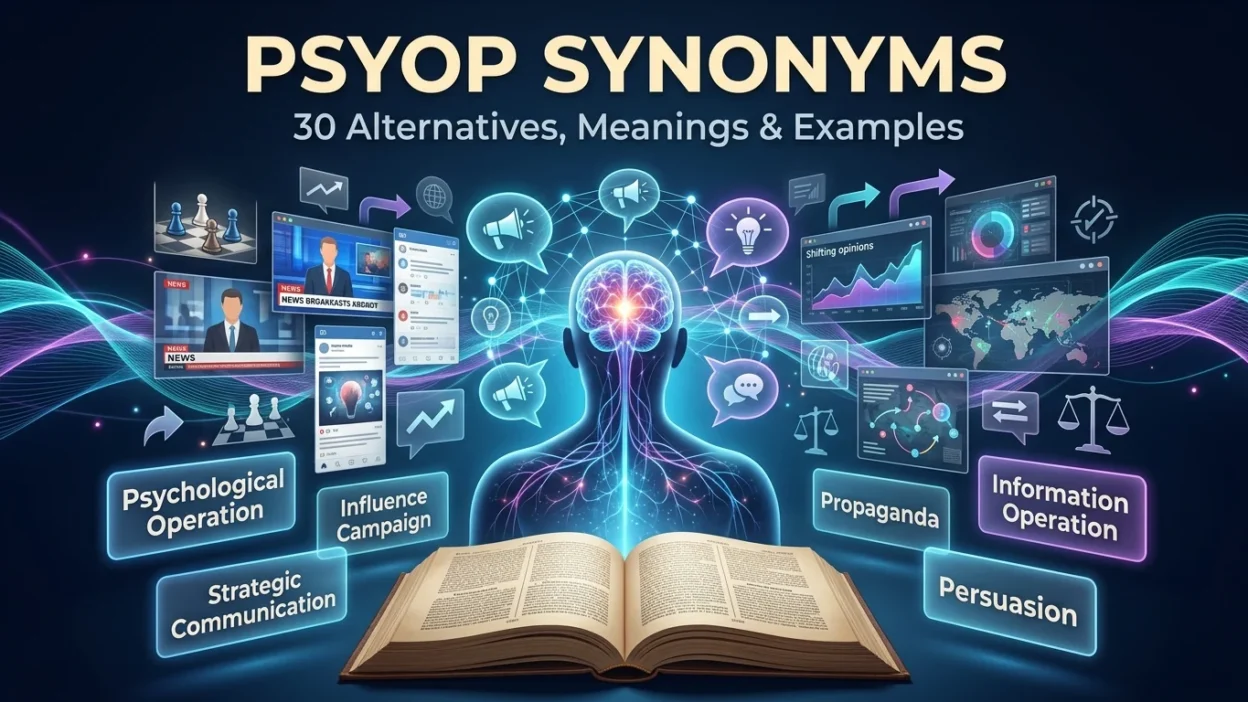
This guide explains 30 useful alternatives to “psyop” in simple English.
Each word or phrase includes a clear meaning, an example sentence, and a note explaining when it works best.
What Does Psyop Mean?
Simple Definition
Psyop is a shortened form of psychological operation. It generally refers to an organized effort to influence the perceptions, emotions, beliefs, attitudes, or behavior of a particular audience.
The term is strongly associated with military and strategic contexts, but it is also commonly used informally online.
For example, someone might call a surprising social media campaign a “psyop” because they believe it was designed to influence public opinion.
Tone and Usage Context
“Psyop” can be technical, military, political, or informal, depending on the context.
In formal writing, psychological operation is usually clearer than “psyop.” In general writing, alternatives such as influence campaign, propaganda campaign, or persuasion strategy may be easier for readers to understand.
Because some alternatives have broader meanings, always choose a term that accurately describes the situation.
30 Psyop Synonyms and Related Alternatives
1. Psychological Operation
Meaning: An organized effort designed to influence the thoughts, emotions, attitudes, or behavior of a target audience.
Example: The report examined the psychological operation and its intended audience.
Best usage: Military, academic, historical, and formal contexts.
2. Psychological Warfare
Meaning: The use of psychological methods to weaken an opponent or influence attitudes and behavior.
Example: The campaign was discussed as a form of psychological warfare.
Best usage: Military history, conflict, and strategic discussions.
3. Influence Operation
Meaning: An organized activity intended to influence how people think or behave.
Example: Analysts investigated whether the activity was an influence operation.
Best usage: Politics, security, international affairs, and journalism.
4. Influence Campaign
Meaning: A planned effort to change people’s opinions, attitudes, or decisions.
Example: The organization launched an influence campaign aimed at changing public attitudes.
Best usage: General writing, media, politics, and social issues.
5. Information Operation
Meaning: A coordinated effort involving information to influence an audience or achieve a strategic objective.
Example: Researchers studied how the information operation spread its message online.
Best usage: Military, cybersecurity, political, and policy writing.
6. Propaganda Campaign
Meaning: A planned campaign that presents information in a way intended to influence people’s opinions or beliefs.
Example: Historians examined the propaganda campaign used during the conflict.
Best usage: Historical, political, media, and critical-analysis writing.
7. Propaganda Operation
Meaning: An organized activity designed to spread persuasive or biased information.
Example: The documentary explored the propaganda operation behind the campaign.
Best usage: Historical and political contexts.
8. Perception Management
Meaning: An effort to shape how people understand or interpret a situation.
Example: The organization was accused of using perception management to influence public opinion.
Best usage: Strategic communication, politics, business, and public relations.
9. Strategic Communication
Meaning: Planned communication designed to achieve a particular goal or influence an audience.
Example: The government developed a strategic communication plan for the crisis.
Best usage: Formal, government, business, and public-relations writing.
10. Persuasion Campaign
Meaning: An organized effort to convince people to adopt a particular idea or position.
Example: The group created a persuasion campaign to encourage public support.
Best usage: Marketing, politics, advocacy, and general writing.
11. Influence Strategy
Meaning: A planned method for changing or shaping people’s attitudes or decisions.
Example: The company developed an influence strategy for communicating with customers.
Best usage: Business, marketing, politics, and general contexts.
12. Persuasion Strategy
Meaning: A deliberate approach used to convince someone of an idea or encourage an action.
Example: The writer used a careful persuasion strategy to reach skeptical readers.
Best usage: Marketing, communication, education, and writing.
13. Messaging Campaign
Meaning: A coordinated set of messages designed for a particular audience or goal.
Example: The organization launched a messaging campaign across several platforms.
Best usage: Public relations, marketing, politics, and social media.
14. Information Campaign
Meaning: A planned effort to distribute information to a particular audience.
Example: The public health agency created an information campaign for local residents.
Best usage: Education, health communication, government, and public awareness.
15. Influence Effort
Meaning: An attempt to change someone’s opinion, behavior, or perception.
Example: Investigators described the activity as an organized influence effort.
Best usage: Journalism, analysis, and general writing.
16. Psychological Strategy
Meaning: A planned approach that uses psychological factors to influence people’s reactions or decisions.
Example: The negotiator used a psychological strategy to encourage cooperation.
Best usage: Psychology, negotiation, communication, and strategy.
17. Behavioral Influence
Meaning: An attempt or process that affects how people behave.
Example: The study examined behavioral influence in online communities.
Best usage: Psychology, sociology, marketing, and academic writing.
18. Opinion-Shaping Campaign
Meaning: A campaign designed to influence what people think about an issue.
Example: Critics described the media effort as an opinion-shaping campaign.
Best usage: Journalism, media analysis, and politics.
19. Narrative-Shaping Campaign
Meaning: An organized effort to influence the story or interpretation surrounding an event.
Example: The campaign was criticized as an attempt at narrative-shaping.
Best usage: Media analysis, politics, and online discourse.
20. Perception Campaign
Meaning: An effort intended to change how an audience views a person, organization, or event.
Example: The company launched a perception campaign after receiving criticism.
Best usage: Public relations, business, politics, and media.
21. Disinformation Campaign
Meaning: An organized effort to spread false or misleading information with the intention of influencing people.
Example: Researchers investigated the suspected disinformation campaign.
Best usage: Journalism, cybersecurity, politics, and information analysis.
22. Misinformation Campaign
Meaning: A coordinated or repeated spread of incorrect information, although the term itself does not necessarily establish an intent to deceive.
Example: The researchers tracked the misinformation campaign across social platforms.
Best usage: Media literacy, journalism, and information studies.
23. Psychological Influence
Meaning: The effect of psychological methods on people’s thoughts, emotions, or behavior.
Example: The study explored psychological influence in advertising.
Best usage: Psychology, marketing, education, and research.
24. Persuasive Operation
Meaning: An organized activity intended to persuade an audience.
Example: Analysts examined the persuasive operation and its communication methods.
Best usage: Formal analysis and communication studies.
25. Strategic Influence
Meaning: Planned influence used to achieve a broader objective.
Example: The organization relied on strategic influence to improve its public image.
Best usage: Government, business, politics, and international affairs.
26. Public Opinion Campaign
Meaning: A campaign designed to influence how the public thinks about an issue or event.
Example: The group organized a public opinion campaign before the vote.
Best usage: Politics, advocacy, social campaigns, and journalism.
27. Social Influence Campaign
Meaning: A planned effort to affect people’s opinions, attitudes, or behavior within a social environment.
Example: Researchers analyzed the social influence campaign on the platform.
Best usage: Social media, sociology, psychology, and communication.
28. Communication Operation
Meaning: A coordinated communication effort designed to achieve a particular objective.
Example: The organization described the project as a communication operation.
Best usage: Strategic communication, government, and institutional contexts.
29. Ideological Campaign
Meaning: A campaign designed to promote or reinforce a particular set of beliefs or ideas.
Example: The movement developed an ideological campaign around its central beliefs.
Best usage: Politics, history, sociology, and cultural analysis.
30. Strategic Messaging
Meaning: Carefully planned communication intended to influence how an audience understands an issue.
Example: The organization used strategic messaging during the public debate.
Best usage: Public relations, politics, business, and media.
Psyop Synonyms Comparison Guide
Different alternatives emphasize different parts of the original concept. Choosing the right term can make your writing much more accurate.
| Term | Main Focus | Best Context | Formality |
|---|---|---|---|
| Psychological operation | Organized psychological influence | Military/formal | High |
| Psychological warfare | Influence during conflict | Military/history | High |
| Influence operation | Organized influence | Security/politics | High |
| Influence campaign | Planned public influence | General/political | Medium |
| Information operation | Strategic use of information | Security/military | High |
| Propaganda campaign | Persuasive or biased messaging | Politics/history | Medium |
| Perception management | Shaping how something is viewed | Strategy/PR | High |
| Strategic communication | Goal-oriented communication | Government/business | High |
| Persuasion campaign | Convincing an audience | Marketing/politics | Medium |
| Disinformation campaign | Deliberate false information | Media/security | High |
| Misinformation campaign | Spread of incorrect information | Media literacy | Medium |
| Strategic messaging | Planned persuasive communication | PR/politics | High |
How to Choose the Right Psyop Synonym
For Military or Security Writing
If you’re discussing formal military or security activities, use terms that preserve the strategic meaning.
Good choices include:
- Psychological operation
- Psychological warfare
- Influence operation
- Information operation
- Strategic influence
These expressions are more precise than informal terms such as “mind game.”
For Politics and Public Opinion
When discussing attempts to influence voters, citizens, or public attitudes, consider:
- Influence campaign
- Public opinion campaign
- Propaganda campaign
- Perception campaign
- Opinion-shaping campaign
- Narrative-shaping campaign
The best choice depends on whether you want to emphasize persuasion, information, or the public’s perception.
For Media and Social Media
Online discussions often use “psyop” loosely. More precise alternatives can make your writing easier to understand.
Useful options include:
- Influence campaign
- Information campaign
- Disinformation campaign
- Misinformation campaign
- Social influence campaign
- Strategic messaging
Be careful with disinformation, because it generally implies intentional deception, while misinformation does not necessarily establish that intent.
For Business and Marketing
If your topic is advertising, branding, customer behavior, or public relations, military terminology may sound too strong.
Consider:
- Persuasion strategy
- Influence strategy
- Strategic communication
- Perception management
- Strategic messaging
- Messaging campaign
These terms communicate influence without automatically suggesting military activity.
For Casual Online Writing
If you’re explaining internet slang or social media conversations, psyop itself may be appropriate.
You can also explain it with simpler phrases such as:
- Influence effort
- Manipulation attempt
- Persuasion campaign
- Opinion-shaping effort
- Influence campaign
However, “manipulation” can carry a stronger negative meaning than “psyop,” so use it only when that implication is justified.
Psyop vs. Propaganda: What’s the Difference?
Psyop
A psyop generally refers to an organized psychological operation intended to influence an audience’s perceptions, emotions, attitudes, or behavior.
Propaganda
Propaganda generally refers to information or messaging deliberately presented to influence beliefs or opinions.
The two concepts can overlap, but they are not always identical.
A propaganda campaign may be part of a broader influence operation, while an influence operation may use several methods beyond propaganda.
Psyop vs. Misinformation vs. Disinformation
Psyop
Focuses on influence and psychological effects.
Misinformation
Refers to incorrect or false information, without necessarily proving that the information was deliberately created to deceive.
Disinformation
Generally refers to false or misleading information intentionally spread to deceive or influence.
These terms should not be treated as interchangeable. The right word depends on what you actually know about the activity.
Common Mistakes When Using Psyop Synonyms
Treating Every Alternative as an Exact Synonym
Words such as “strategic communication” and “propaganda” overlap with psyop but do not always mean the same thing.
Use the narrowest accurate term.
Calling Every Persuasive Message a Psyop
A normal advertisement or political speech is not automatically a psyop.
The word usually suggests a more deliberate, organized, or strategic effort to influence an audience.
Confusing Misinformation With Disinformation
The distinction matters.
Misinformation generally describes false or inaccurate information, while disinformation emphasizes deliberate deception.
Using Military Language in Everyday Situations
Calling a normal marketing campaign a “psychological operation” can sound dramatic.
In business or general writing, persuasion strategy, influence campaign, or strategic messaging may be more natural.
Examples of Replacing Psyop in Sentences
Original
“The report described the activity as a psyop.”
Formal Alternative
“The report described the activity as a psychological operation.”
General Alternative
“The report described the activity as an influence campaign.”
Media-Focused Alternative
“The report described the activity as a coordinated messaging campaign.”
False-Information Context
“The researchers investigated the activity as a possible disinformation campaign.”
Each version changes the emphasis slightly, so choose according to the facts and context.
When Should You Avoid Using a Psyop Synonym?
Sometimes the best choice is simply psyop or psychological operation.
If you’re discussing a specific military or historical concept, replacing the term with a broader phrase may reduce accuracy.
For example, strategic communication is much broader than psychological operations. Likewise, persuasion can describe ordinary interpersonal communication.
Use an alternative when it genuinely improves clarity, not simply to avoid repeating the original word.
Frequently Asked Questions About Psyop Synonyms
What is the best synonym for psyop?
The closest formal alternative is psychological operation. Depending on context, influence operation, psychological warfare, or information operation may also be appropriate.
What does psyop mean in simple English?
Psyop is short for psychological operation. It generally means an organized effort designed to influence how a particular audience thinks, feels, perceives something, or behaves.
Is propaganda the same as a psyop?
Not exactly. Propaganda focuses on persuasive information or messaging, while a psyop is a broader concept involving organized psychological influence. The two can overlap.
What is another word for an influence campaign?
Possible alternatives include influence operation, persuasion campaign, public opinion campaign, perception campaign, strategic influence, and opinion-shaping campaign.
What is the difference between misinformation and disinformation?
Misinformation is incorrect or misleading information, while disinformation generally refers to false or misleading information deliberately spread to deceive or influence.
Is “psyop” formal or informal?
“Psyop” can be used formally in certain military or security contexts, but it is also widely used as informal internet slang. In general writing, spelling out psychological operation is often clearer.
Final Thoughts on Psyop Synonyms
The best psyop synonyms depend on what you want to emphasize. If you need a precise formal term, psychological operation is usually the safest choice.
For broader influence, influence operation or influence campaign can work well. For information focused activities, information operation may be more appropriate.
If your subject involves false information, distinguish carefully between misinformation and disinformation. For business or public relations, terms such as strategic communication, persuasion strategy, and strategic messaging are usually more natural.
The key is to choose a word based on meaning, audience, tone, and context. A good synonym does more than prevent repetition it helps your reader understand exactly what you mean.