Understanding demure synonyms can help you describe people, behavior, clothing, and personalities more accurately.
The word demure has a gentle meaning, but its exact tone can change depending on the situation.
For students, ESL learners, writers, and content creators, learning synonyms is more than memorizing similar words.
It helps you choose the word that expresses the exact feeling or attitude you want.
For example, modest, reserved, shy, and unassuming are related to demure, but they are not always interchangeable.
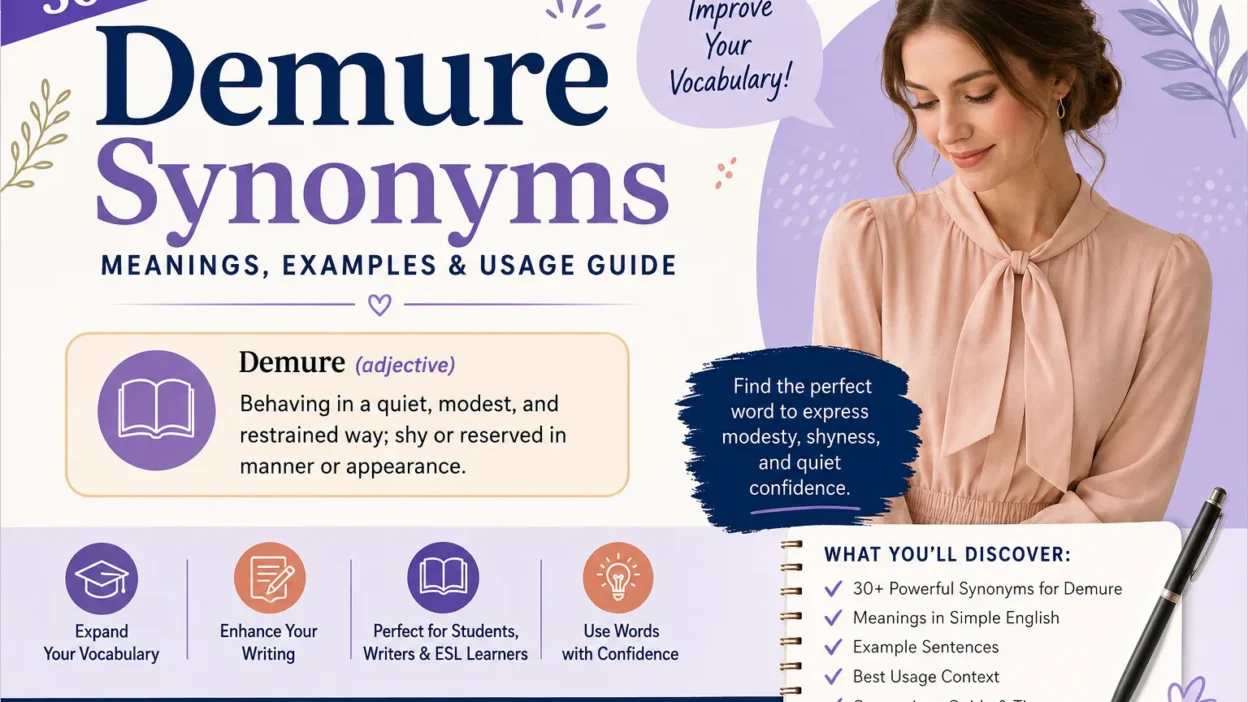
This guide explains 30 useful synonyms for demure in simple English. Each word includes an easy definition, an example sentence, and a short note about when it works best.
What Does “Demure” Mean?
Demure describes someone who behaves in a quiet, modest, and somewhat shy way. It can suggest that a person avoids drawing too much attention to themselves.
The word is often used for someone’s behavior, appearance, manner, or clothing. It usually has a gentle or positive tone, although the meaning can depend on context.
Example:
“She gave a demure smile when everyone praised her.”
In this sentence, demure suggests that her smile was modest, quiet, and slightly shy.
Simple Meaning of Demure
In simple English, demure means quiet, modest, and not trying to attract attention.
Demure: Tone and Usage
Demure is often associated with:
- Quiet behavior
- Modest appearance
- Gentle manners
- Shyness
- Reserved personality
- Traditional or elegant clothing
It is more specific than simply saying someone is quiet. A quiet person may not talk much, while a demure person may also behave in a modest, restrained, or shy manner.
30 Demure Synonyms
The following words are useful alternatives to demure. Some are close synonyms, while others describe only one part of the meaning.
1. Modest
Meaning: Not showing off or trying to attract attention.
Example:
“She wore a modest dress to the formal event.”
Best usage context: Clothing, behavior, achievements, and personality.
2. Reserved
Meaning: Quiet and not very open about your thoughts or feelings.
Example:
“He is reserved when meeting new people.”
Best usage context: Personality and social behavior.
3. Shy
Meaning: Nervous or uncomfortable around other people, especially strangers.
Example:
“The shy student spoke softly during the presentation.”
Best usage context: People who lack confidence in social situations.
4. Retiring
Meaning: Quiet and avoiding attention or social activity.
Example:
“She had a retiring personality and preferred small gatherings.”
Best usage context: Formal or literary descriptions of personality.
5. Unassuming
Meaning: Not acting as if you are important or special.
Example:
“Despite his success, he remained unassuming.”
Best usage context: Humble people and understated personalities.
6. Quiet
Meaning: Making little noise or speaking very little.
Example:
“She was quiet and thoughtful throughout the meeting.”
Best usage context: General descriptions of behavior.
7. Bashful
Meaning: Easily embarrassed or shy, especially when receiving attention.
Example:
“She became bashful when her friends complimented her.”
Best usage context: Friendly, gentle, or slightly playful descriptions of shyness.
8. Timid
Meaning: Lacking confidence or courage in certain situations.
Example:
“The timid child stayed close to her mother.”
Best usage context: Shyness, nervousness, or lack of confidence.
9. Mild
Meaning: Gentle and not strong, extreme, or aggressive.
Example:
“He has a mild and pleasant manner.”
Best usage context: Personality, behavior, or temperament.
10. Gentle
Meaning: Kind, calm, and careful rather than rough or aggressive.
Example:
“She had a gentle way of speaking.”
Best usage context: Personality, voice, behavior, and manner.
11. Subdued
Meaning: Quiet, restrained, or less noticeable than usual.
Example:
“She wore subdued colors to the ceremony.”
Best usage context: Appearance, emotions, colors, and behavior.
12. Unobtrusive
Meaning: Not attracting attention or interfering with others.
Example:
“The receptionist was polite and unobtrusive.”
Best usage context: People, design, behavior, and objects.
13. Unpretentious
Meaning: Not trying to appear more important, fashionable, or impressive than you are.
Example:
“She has an unpretentious style that many people admire.”
Best usage context: Personality, lifestyle, writing, design, and fashion.
14. Humble
Meaning: Not believing that you are better or more important than others.
Example:
“Even after winning the award, she remained humble.”
Best usage context: Character, achievements, and personal attitude.
15. Unassuming
Meaning: Quietly confident or ordinary without seeking attention.
Example:
“The author was surprisingly unassuming despite her fame.”
Best usage context: People who are successful but do not show off.
16. Self-effacing
Meaning: Avoiding praise or attention by making yourself seem less important.
Example:
“His self-effacing humor made everyone feel comfortable.”
Best usage context: Humor, personality, and modest behavior.
17. Coy
Meaning: Shy or pretending to be shy, sometimes in a playful or flirtatious way.
Example:
“She gave him a coy smile.”
Best usage context: Romantic, playful, or flirtatious situations.
18. Demure
Meaning: Quiet, modest, and somewhat shy in behavior or appearance.
Example:
“She looked demure in her simple, elegant dress.”
Best usage context: The original word itself; especially appearance and manner.
19. Dainty
Meaning: Small, delicate, and attractive.
Example:
“She wore a dainty necklace.”
Best usage context: Appearance, clothing, jewelry, movements, and objects.
Note: Dainty is related to delicate appearance but does not always mean shy or reserved.
20. Delicate
Meaning: Gentle, fine, or easily affected or damaged.
Example:
“She had a delicate and graceful manner.”
Best usage context: Appearance, physical features, manners, and style.
21. Modest-Mannered
Meaning: Behaving in a quiet and respectful way without seeking attention.
Example:
“The modest-mannered guest thanked everyone quietly.”
Best usage context: Describing respectful and understated behavior.
22. Unpretending
Meaning: Natural and without an attempt to impress people.
Example:
“Her unpretending manner made her easy to talk to.”
Best usage context: Personality and social behavior.
23. Restrained
Meaning: Controlled and not showing strong emotions or behavior.
Example:
“He gave a restrained response to the criticism.”
Best usage context: Emotions, reactions, writing, and formal behavior.
24. Composed
Meaning: Calm and in control of your emotions.
Example:
“She remained composed during the difficult interview.”
Best usage context: Calmness under pressure rather than shyness.
25. Meek
Meaning: Very quiet, gentle, and unlikely to argue or fight.
Example:
“The meek student rarely challenged the teacher.”
Best usage context: Quiet or submissive behavior.
Note: Meek can sound more negative than demure because it may suggest weakness or a lack of confidence.
26. Docile
Meaning: Easy to control, teach, or manage.
Example:
“The normally energetic dog became docile after the long walk.”
Best usage context: Animals or people who are easy to manage.
Note: Docile is not a direct synonym for demure and should be used carefully.
27. Sedate
Meaning: Calm, quiet, and serious.
Example:
“The restaurant had a sedate atmosphere.”
Best usage context: Formal settings, places, behavior, and atmosphere.
28. Soft-Spoken
Meaning: Speaking in a quiet and gentle voice.
Example:
“She was soft-spoken but very confident.”
Best usage context: Voice and communication style.
29. Unpretentious
Meaning: Simple and natural without trying to impress others.
Example:
“The café has an unpretentious atmosphere.”
Best usage context: People, places, lifestyles, and styles.
30. Bashful
Meaning: Shy or embarrassed when receiving attention.
Example:
“The bashful child hid behind her father when guests arrived.”
Best usage context: Friendly descriptions of shy behavior.
Demure Synonyms Comparison Guide
Not every synonym for demure has exactly the same meaning. Choosing the right word depends on what you want to emphasize.
| Synonym | Main Idea | Tone | Best Used For |
|---|---|---|---|
| Modest | Not seeking attention | Positive/neutral | Clothing, behavior |
| Reserved | Not emotionally open | Neutral | Personality |
| Shy | Nervous around others | Neutral | Social behavior |
| Bashful | Easily embarrassed | Gentle | Shyness |
| Timid | Lacking confidence | Neutral/negative | Personality |
| Unassuming | Not showing importance | Positive | Personality |
| Humble | Not boastful | Positive | Character |
| Coy | Playfully shy | Playful | Romance |
| Restrained | Emotionally controlled | Formal | Reactions |
| Composed | Calm and controlled | Positive | Difficult situations |
| Soft-spoken | Quiet voice | Positive/neutral | Communication |
| Meek | Very quiet and submissive | Often negative | Behavior |
| Gentle | Calm and kind | Positive | Personality |
| Subdued | Less noticeable or intense | Neutral | Appearance/emotions |
| Unobtrusive | Not attracting attention | Neutral/positive | People and things |
How to Choose the Right Synonym
The best synonym depends on the exact meaning you want to communicate.
Use “Modest” for Appearance
Choose modest when you are talking about clothing, behavior, or someone who does not show off.
Example:
“She prefers modest clothing.”
This is often the closest choice when demure describes someone’s appearance.
Use “Reserved” for Personality
Choose reserved when someone does not easily share feelings, opinions, or personal information.
Example:
“Although friendly, she is reserved around strangers.”
The focus is emotional openness rather than appearance.
Use “Shy” or “Bashful” for Social Situations
Use shy when someone feels nervous or uncomfortable around others.
Use bashful when the person becomes embarrassed or shy after receiving attention.
Example:
“She was shy during her first class.”
Example:
“He became bashful after receiving the compliment.”
Use “Unassuming” or “Humble” for Character
Choose unassuming when someone does not behave as though they are important.
Choose humble when someone does not boast about their abilities or achievements.
Example:
“Despite becoming famous, she remained humble.”
Use “Coy” for Playful Shyness
Coy is useful when shyness has a playful, teasing, or romantic quality.
Example:
“She gave him a coy smile.”
Be careful with this word because it can suggest intentional or flirtatious behavior.
Use “Restrained” for Controlled Emotions
Choose restrained when someone deliberately controls their emotional response.
Example:
“He gave a restrained answer even though he was angry.”
This word focuses more on self-control than modesty.
Use “Soft-Spoken” for Voice
If you mean that someone speaks quietly and gently, soft-spoken is more precise than demure.
Example:
“The soft-spoken teacher explained the lesson clearly.”
Use “Composed” for Calmness
Choose composed when someone remains calm and controlled, especially during a difficult situation.
Example:
“She stayed composed during the interview.”
A composed person is not necessarily shy or modest.
Demure vs. Similar Words
Demure vs. Modest
These words are closely related. Demure often suggests a quiet, shy, or restrained manner, while modest more broadly means not showing off or being excessively revealing.
Demure:
“She gave a demure smile.”
Modest:
“She chose a modest outfit.”
Demure vs. Shy
Shy focuses mainly on nervousness or discomfort around other people. Demure can include shyness but also suggests modesty and restraint.
Shy: A person may avoid talking to strangers.
Demure: A person may behave quietly and modestly without necessarily feeling nervous.
Demure vs. Reserved
A reserved person tends not to express their thoughts or feelings openly. A demure person may be quiet, modest, and slightly shy.
Therefore, reserved is especially useful when discussing someone’s personality.
Demure vs. Coy
These words can both describe a shy manner, but coy often has a playful or flirtatious meaning.
Demure is generally more restrained and modest.
Demure vs. Timid
Timid suggests a lack of confidence or courage. Demure is usually softer and can have a positive or elegant meaning.
Calling someone timid may suggest weakness, while calling someone demure often sounds more complimentary.
Common Uses of “Demure”
The word demure can be used in several common ways.
Demure Clothing
When describing clothing, demure often means modest, elegant, and not designed to attract excessive attention.
Example:
“She chose a demure dress for the formal dinner.”
Demure Smile
A demure smile usually suggests a shy, modest, or restrained smile.
Example:
“She responded with a demure smile.”
Demure Personality
A demure personality is generally quiet, modest, and reserved.
Example:
“Her demure personality made her seem calm and graceful.”
Demure Behavior
Demure behavior involves avoiding excessive attention and behaving in a restrained way.
Example:
“He appreciated her demure and polite manner.”
Why Learn Demure Synonyms?
Learning synonyms improves both vocabulary and writing quality.
For ESL learners, synonyms help make communication more precise. Instead of repeatedly using words such as quiet or shy, you can choose a more accurate word.
For writers, synonyms help create stronger descriptions. A character who is reserved is different from one who is timid, while a coy character has a different personality from a humble one.
For students and content creators, understanding these distinctions also makes writing sound more natural and varied.
Quick Guide to the Best Demure Synonyms
If you need a quick answer, use this guide:
- Demure → quiet, modest, and slightly shy
- Modest → not showing off or revealing too much
- Reserved → not openly expressing feelings
- Shy → nervous around people
- Bashful → easily embarrassed by attention
- Timid → lacking confidence
- Unassuming → not acting important
- Humble → not boasting about achievements
- Coy → playfully or flirtatiously shy
- Restrained → controlled and not emotional
- Composed → calm and in control
- Soft-spoken → speaking quietly and gently
- Gentle → kind and calm
- Subdued → quiet or not very noticeable
Frequently Asked Questions About Demure Synonyms
What is the closest synonym for demure?
Modest is often one of the closest synonyms for demure, especially when describing clothing or appearance. Reserved and shy can also be close depending on the context.
Is shy a synonym for demure?
Yes, shy can be a synonym for demure in some contexts. However, demure usually includes an additional sense of modesty or restraint.
What is a positive synonym for demure?
Words such as modest, graceful, gentle, humble, unassuming, and reserved can have positive meanings depending on the sentence.
What is the difference between demure and modest?
Demure often describes a quiet, shy, and restrained manner, while modest has a broader meaning and can describe clothing, behavior, achievements, or personality.
Is demure a positive word?
Generally, demure has a neutral to positive meaning. It can suggest modesty, elegance, gentleness, and good manners. However, the tone can change depending on the context.
Can demure describe a man?
Yes. Although demure has traditionally been used more often for women, it can describe anyone whose behavior or appearance is quiet, modest, and reserved.
Conclusion
Knowing demure synonyms allows you to express subtle differences in personality, appearance, behavior, and tone. While modest, shy, reserved, bashful, and unassuming may seem similar, each word emphasizes a slightly different quality.
The key is to choose the synonym based on your intended meaning. Use modest for a lack of showiness, reserved for emotional distance, shy for social nervousness, humble for a lack of pride, and coy for playful shyness.
For students and ESL learners, practicing these words in complete sentences is one of the best ways to remember them. For writers and content creators, understanding these subtle differences can make descriptions clearer, more natural, and much more engaging.

Liam Henry is a content author at Synonymed, specializing in vocabulary enrichment and synonym guides. He creates clear, engaging resources that help learners improve English word knowledge and language fluency.