
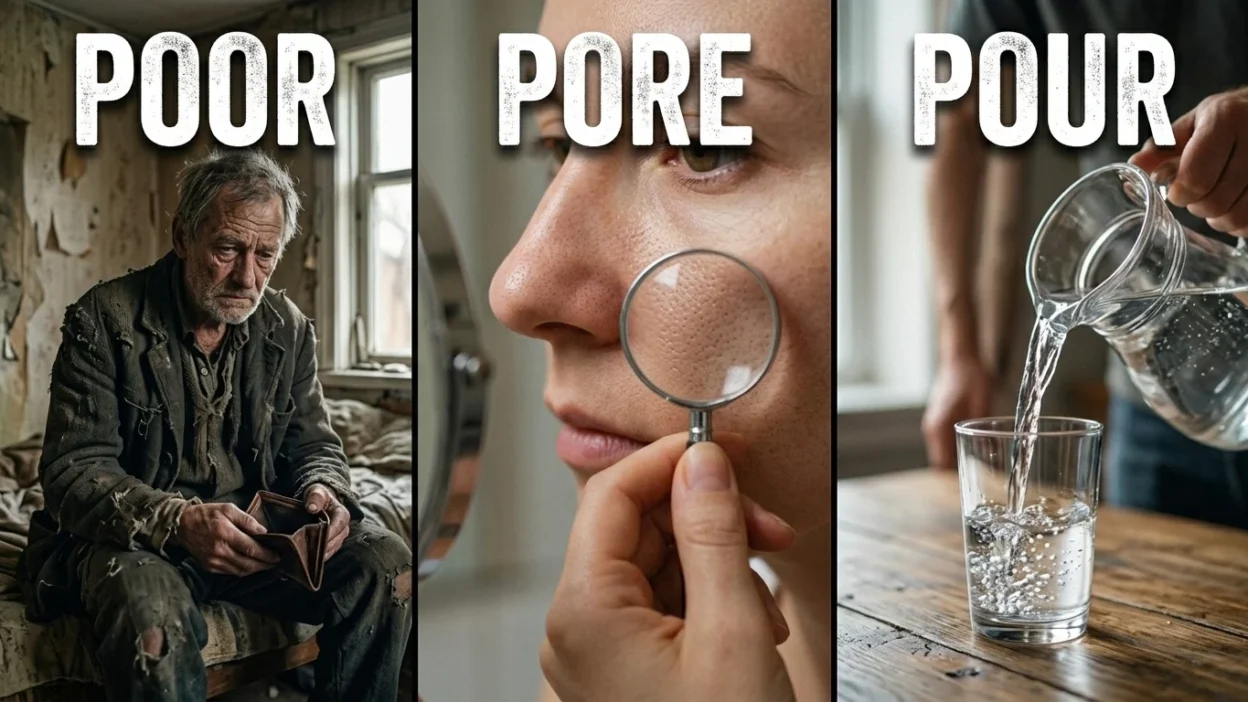
Have you ever confused poor, pore, and pour when writing in English?
These three words sound exactly the same in most varieties of English, but their meanings and uses are completely different.
Choosing the wrong word can change the meaning of a sentence, even when the spelling mistake is easy to overlook.
The easiest way to remember the difference is to connect each word with its meaning. Poor describes someone or something lacking money, quality, or another important resource.
Pore is a tiny opening in the skin or another material, and it is also a verb meaning to study something carefully.
Pour means to make a liquid flow from one place or container to another.
Once you understand these definitions and learn a few practical examples, you will be able to use poor, pore, and pour confidently in everyday conversations, schoolwork, and professional writing.
Quick Answer: Poor vs Pore vs Pour
Poor means having little money or being low in quality. Pore means a tiny opening, especially in the skin, or to study something carefully. Pour means to make a liquid flow. All three words usually sound alike, but their meanings, spellings, and grammatical uses are different.
Why Do People Confuse Poor, Pore, and Pour?
People confuse these words because they are homophones: words that sound alike but have different meanings and spellings.
When spoken aloud, the sentence “The poor man poured water” contains two of these words with different meanings. The listener relies on context to understand them, while a writer must choose the correct spelling.
Here is a simple comparison:
- The poor family needed help. (Poor describes financial hardship.)
- Sweat came out through a pore in the skin. (Pore is a tiny opening.)
- Please pour the milk into the glass. (Pour describes moving liquid.)
The best way to avoid mistakes is to learn each word separately and connect it with a familiar example.
What Does “Poor” Mean?
Poor is an adjective that describes someone or something lacking money, resources, quality, or ability.
1. Poor Means Having Little Money
When describing a person or family, poor often means having insufficient money to meet basic needs.
Examples:
- The poor family needed food and shelter.
- He grew up in a poor neighborhood.
- The charity provides meals for poor children.
The word can describe financial circumstances, but it should be used thoughtfully when discussing people.
2. Poor Means Low in Quality
Poor can also describe something that is unsatisfactory, weak, or below an expected standard.
Examples:
- She received poor marks on the test.
- The company provided poor customer service.
- His poor health prevented him from working.
3. Poor Means Unfortunate or Unsatisfactory
In some expressions, poor describes an unfortunate person or an unsuccessful result.
Examples:
- The poor child lost his favorite toy.
- That was a poor decision.
- He made a poor attempt to solve the problem.
Remember: Use poor when describing a lack of money, quality, ability, or another desirable condition.
What Does “Pore” Mean?
Pore has two main meanings. As a noun, it refers to a tiny opening. As a verb, it means to study or examine something carefully.
1. Pore as a Noun
A pore is a small opening in the skin or another material. In human skin, pores are associated with hair follicles and the openings of sweat glands.
Examples:
- Sweat can reach the skin’s surface through pores.
- Dust may collect in the pores of a material.
- The skincare product is designed to clean clogged pores.
The plural of pore is pores.
2. Pore as a Verb
The expression “pore over” means to read, study, or examine something with close attention.
Examples:
- She pored over her notes before the exam.
- The detective pored over the documents.
- He spent hours poring over the map.
Notice the spelling: when describing careful study, the past tense is pored, not poured.
Remember: Use pore for a tiny opening or in the expression pore over, meaning to study something carefully.
What Does “Pour” Mean?
Pour is a verb meaning to make a liquid flow from one place or container to another. It can also describe something flowing continuously or falling heavily, such as rain.
1. Pour a Liquid
Examples:
- Please pour some water into the glass.
- She poured tea for her guests.
- He poured milk over his cereal.
2. Pour as Continuous Flow
The word can also describe rain or other things falling or flowing in large amounts.
Examples:
- Rain began to pour from the sky.
- People poured out of the stadium.
- Messages poured into her inbox after the announcement.
The word pour can be used literally or figuratively.
Its common forms are:
- Present: pour
- Present participle: pouring
- Past tense: poured
- Past participle: poured
Remember: Use pour when something flows, is transferred as a liquid, or moves in a steady stream.
Poor vs Pore vs Pour: Comparison Table
| Feature | Poor | Pore | Pour |
|---|---|---|---|
| Part of speech | Usually an adjective | Noun or verb | Verb |
| Main meaning | Lacking money or quality | Tiny opening; study carefully | Make a liquid flow |
| Example | They live in a poor area. | Sweat passes through a pore. | Pour water into the cup. |
| Common expression | Poor quality | Pore over a book | Pour out the water |
| Past tense | Not applicable as an adjective | Pored (verb) | Poured |
| Memory clue | Poverty or low quality | Opening or close study | Liquid flow |
When Should You Use Poor, Pore, or Pour?
When to Use Poor
Use poor when describing financial hardship, low quality, limited ability, or an unsatisfactory condition.
- The poor family received assistance.
- The restaurant received poor reviews.
- He showed poor judgment.
When to Use Pore
Use pore when referring to a tiny opening or when someone examines something carefully.
- The cream may help remove dirt from the pores.
- She likes to pore over historical books.
- The student pored over the difficult questions.
When to Use Pour
Use pour when transferring liquid, describing heavy rain, or describing something flowing in large amounts.
- Pour the juice into the jug.
- It started to pour during the afternoon.
- Fans poured into the arena.
A quick test can help: if you mean money or quality, choose poor. If you mean a tiny opening or careful study, choose pore. If you mean liquid flowing, choose pour.
15 Examples of Poor, Pore, and Pour in Sentences
Examples With “Poor”
- The poor family needed help paying for food.
- He received poor grades because he did not prepare.
- The road is in poor condition.
- She felt sorry for the poor kitten.
- Poor communication caused confusion among the workers.
Examples With “Pore”
- The skin has tiny pores.
- Sweat can emerge through pores in the skin.
- She likes to pore over old photographs.
- The lawyer pored over the contract before signing it.
- He spent the evening poring over his research notes.
Examples With “Pour”
- Please pour the water into the bottle.
- She poured coffee into two cups.
- Rain began to pour just as we left home.
- The crowd poured through the entrance.
- He poured the remaining soup into a bowl.
These examples demonstrate how context determines the correct spelling.
Common Mistakes to Avoid
1. Writing “Poor Over” Instead of “Pore Over”
Incorrect: She likes to poor over her books.
Correct: She likes to pore over her books.
The expression means to study something carefully.
2. Writing “Poured” When You Mean “Pored”
Incorrect: He poured over the report for hours.
Correct: He pored over the report for hours.
Use pored for careful study and poured for flowing liquid.
3. Using “Pour” Instead of “Poor”
Incorrect: The pour family needed assistance.
Correct: The poor family needed assistance.
The sentence describes financial hardship, not liquid movement.
4. Assuming “Pore” Only Refers to Skin
A pore can be a tiny opening, but pore over is also a common verb phrase.
Example: She pored over the instructions before assembling the furniture.
5. Forgetting That “Pour” Has Figurative Meanings
Pouring does not always involve liquid.
Example: Compliments poured in after her performance.
This sentence means that many compliments arrived.
What Is an Easy Memory Trick?
Use these three simple associations:
- Poor = Poverty: Think about money, resources, or poor quality.
- Pore = Opening or reading: Think of skin pores or poring over a book.
- Pour = Liquid: Think about pouring water, tea, or milk.
You can also remember this sentence:
“The poor student pored over the notes before he poured water into his glass.”
Each word has a different job:
- Poor describes the student.
- Pored means studied carefully.
- Poured means transferred liquid.
This single sentence is a useful way to remember all three spellings.
American vs British English: Poor, Pore, and Pour
There is no significant spelling difference between American and British English for these three words. Poor, pore, and pour are spelled the same way in both varieties.
Their standard meanings are also the same:
- American English: Please pour me a glass of water.
- British English: Please pour me a glass of water.
- American English: She pored over the report.
- British English: She pored over the report.
Pronunciation can vary slightly by accent, but the words are commonly homophones in both varieties. In most contexts, listeners distinguish them through meaning and sentence structure rather than sound.
Similar Words You Should Know
Learning a few related words can help you understand these distinctions more clearly.
Poor vs Poverty
Poor is an adjective describing someone or something lacking money or resources. Poverty is a noun referring to the condition of being poor.
- The family is poor.
- The family lives in poverty.
Pore vs Pour
Pore can refer to a tiny opening or careful study, while pour describes flowing or transferring something.
- She pored over the book.
- She poured water into a cup.
Pored vs Poured
Both words are pronounced alike in many accents, but their meanings differ.
- He pored over the documents. (He studied them carefully.)
- He poured water into the container. (He transferred liquid.)
Poor vs Bad
Poor and bad can both describe low quality, but poor is common in phrases such as poor performance, poor health, and poor service.
- The team gave a poor performance.
- The team played badly.
The adjective poor describes the performance, while badly describes how the team played.
Final Verdict: Which Word Is Correct?
Poor, pore, and pour are all correct words, but they have different meanings. The correct choice depends on what you want to communicate.
- Choose poor for financial hardship, low quality, or an unfortunate situation.
- Choose pore for a tiny opening or the act of studying something carefully.
- Choose pour for making liquid flow or describing something moving in large amounts.
The most common mistake is confusing pore over with pour over. When you mean to study a book or document carefully, use pore over. When you mean to transfer a liquid, use pour.
Frequently Asked Questions
1. What is the difference between poor, pore, and pour?
Poor describes a lack of money or quality. Pore means a tiny opening or to study carefully. Pour means to make a liquid flow.
2. Are poor, pore, and pour homophones?
Yes. They are generally pronounced alike but have different spellings and meanings. These words are distinguished by context in spoken English.
3. Is it “pore over” or “pour over”?
Use pore over when you mean to study or examine something carefully. For example, “She pored over her notes before the exam.”
4. Is it “poor quality” or “pore quality”?
The correct phrase is poor quality because poor means low or unsatisfactory in quality.
5. Is it “pour water” or “pore water”?
Use pour water when you mean to make water flow into or out of a container. Pore does not mean to transfer liquid.
6. What is the past tense of pore?
The past tense of pore is pored when the verb means to study carefully. For example, “He pored over the textbook.”
7. What is the past tense of pour?
The past tense of pour is poured. For example, “She poured water into the glass.”
Remember This
- Poor: Money, resources, or quality.
- Pore: A tiny opening or careful study.
- Pour: Liquid flowing from one place to another.
- Pored over: Studied something carefully.
- Poured out: Emptied or transferred liquid.
If you remember these meanings, you can choose the correct word even though all three sound alike.
Conclusion
The difference between poor, pore, and pour becomes easy to understand when you connect each spelling with its meaning. Poor describes financial hardship, low quality, or an unfortunate condition. Pore refers to a tiny opening and appears in the expression pore over, which means to study something carefully. Pour describes transferring liquid or something flowing in large amounts. Although the words sound alike, they cannot be used interchangeably.
To avoid spelling mistakes, pay attention to the meaning of the whole sentence before choosing a word. Remember that you pore over a book but pour water into a glass, while a person can be described as poor because of financial hardship. Practicing these examples will help you improve your vocabulary, write more accurately, and use English with greater confidence.