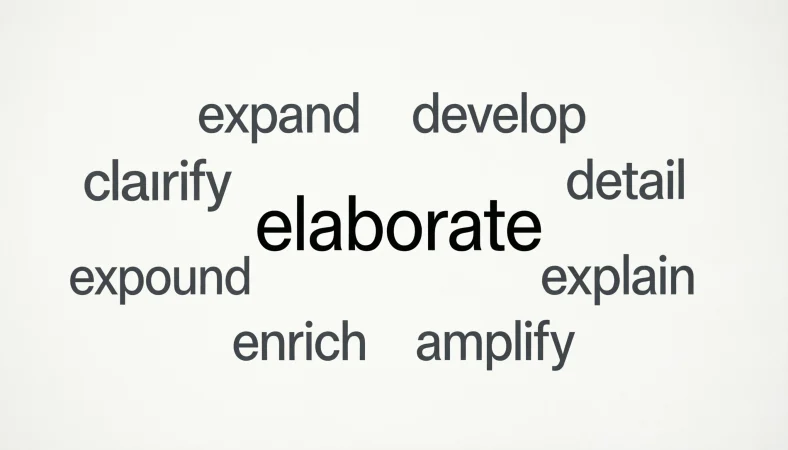
The word elaborate is useful when you want to describe something detailed, carefully developed, or explained with many details.
It can describe an idea, plan, design, story, explanation, or even a physical object.
Learning elaborate synonyms can help students, ESL learners, writers, and content creators make their language more precise. Instead of repeating “elaborate,” you can choose a word that communicates exactly what you mean, if you want to emphasize detail, complexity, careful planning, decoration, or explanation.
However, these synonyms are not always interchangeable. Words such as detailed, complex, intricate, and ornate have related meanings, but each carries a slightly different tone.
Understanding these differences helps you sound more natural and confident in both everyday and academic English.
What Does “Elaborate” Mean?
Simple Meaning of Elaborate
Elaborate has two common uses.
As an adjective, it means something is detailed, complicated, or carefully developed.
Example: “The architect created an elaborate design for the new building.”
As a verb, elaborate means to give more information or explain something in greater detail.
Example: “Could you elaborate on your answer?”
The meaning depends on how the word is used in a sentence.
Tone and Usage Context
“Elaborate” is common in both everyday and formal English. It is especially useful in academic writing, business communication, essays, reports, journalism, and creative writing.
When used as an adjective, it can sometimes suggest that something is more detailed or complicated than necessary. When used as a verb, it usually means simply “explain further.”
30 Elaborate Synonyms
1. Detailed
Meaning: Containing many specific pieces of information.
Example: “The teacher gave us detailed instructions for the project.”
Best usage context: Academic writing, instructions, reports, and explanations.
2. Complex
Meaning: Made up of many connected or difficult parts.
Example: “The scientists studied a complex system of chemical reactions.”
Best usage context: Science, technology, academic writing, and difficult ideas.
3. Intricate
Meaning: Having many small parts or details that fit together carefully.
Example: “The artist created an intricate pattern on the vase.”
Best usage context: Designs, artwork, systems, and highly detailed work.
4. Complicated
Meaning: Difficult to understand, manage, or explain because it has many parts.
Example: “The instructions were too complicated for beginners.”
Best usage context: Everyday English and situations involving difficulty.
5. Thorough
Meaning: Complete and careful, with attention given to all important details.
Example: “The researcher conducted a thorough investigation.”
Best usage context: Research, reviews, investigations, and professional writing.
6. Comprehensive
Meaning: Including almost everything important about a subject.
Example: “The report provides a comprehensive analysis of the problem.”
Best usage context: Academic, professional, and formal writing.
7. Extensive
Meaning: Large in amount, range, or scope.
Example: “The company has extensive experience in international markets.”
Best usage context: Experience, research, knowledge, resources, and projects.
8. Sophisticated
Meaning: Highly developed, advanced, or showing careful thought.
Example: “The software uses a sophisticated security system.”
Best usage context: Technology, ideas, systems, fashion, and professional writing.
9. Detailed-out
Meaning: Developed by adding specific information or details.
Example: “The team presented a detailed-out plan for the next stage.”
Best usage context: Informal contexts; “detailed” or “fully developed” is usually more natural.
10. Fully Developed
Meaning: Complete and carefully formed rather than simple or unfinished.
Example: “She presented a fully developed argument in her essay.”
Best usage context: Academic writing, ideas, arguments, and creative projects.
11. Nuanced
Meaning: Showing small but important differences in meaning or feeling.
Example: “The author gives a nuanced view of the social issue.”
Best usage context: Essays, criticism, literature, politics, and thoughtful analysis.
12. In-Depth
Meaning: Covering a subject carefully and with considerable detail.
Example: “The article provides an in-depth discussion of climate change.”
Best usage context: Articles, research, interviews, reports, and analysis.
13. Meticulous
Meaning: Extremely careful about small details.
Example: “She kept meticulous records of every experiment.”
Best usage context: Research, professional work, planning, and precision-focused tasks.
14. Elaborated
Meaning: Made more detailed or fully explained.
Example: “The writer later elaborated on his original argument.”
Best usage context: Formal writing and descriptions of expanded explanations.
15. Ornate
Meaning: Highly decorated with many attractive or complicated details.
Example: “The old palace had ornate doors and ceilings.”
Best usage context: Architecture, furniture, clothing, art, and decoration.
16. Decorative
Meaning: Intended to make something more attractive or visually interesting.
Example: “The room was filled with decorative objects.”
Best usage context: Design, interiors, art, and physical objects.
17. Embellished
Meaning: Made more attractive or interesting by adding extra details.
Example: “The storyteller embellished the tale with colorful details.”
Best usage context: Stories, descriptions, speeches, and creative writing.
18. Detailed-Heavy
Meaning: Containing a very large amount of information or detail.
Example: “The manual is detail-heavy and may be difficult for new users.”
Best usage context: Informal descriptions of documents, manuals, and technical material.
19. Extensive
Meaning: Covering a broad area or involving a large amount of something.
Example: “The project required extensive preparation.”
Best usage context: Formal and professional contexts.
20. Labyrinthine
Meaning: Extremely complicated and difficult to follow.
Example: “The legal process was labyrinthine and confusing.”
Best usage context: Formal or literary writing about complicated systems or situations.
21. Sophisticate
Meaning: A person who is knowledgeable and experienced, especially about culture or society.
Example: “The novel’s main character is a sophisticated art collector.”
Best usage context: Describing people; note that it is a noun, not a direct synonym for the adjective “elaborate.”
22. Complexly Designed
Meaning: Created with many carefully connected parts.
Example: “The machine was complexly designed to operate in extreme conditions.”
Best usage context: Technical and descriptive writing.
23. Ornamental
Meaning: Used mainly to decorate something rather than for practical purposes.
Example: “The garden contained several ornamental statues.”
Best usage context: Art, architecture, gardens, furniture, and decoration.
24. Convoluted
Meaning: Extremely complicated and difficult to understand.
Example: “The explanation was so convoluted that nobody understood the main point.”
Best usage context: Criticism of arguments, explanations, rules, or systems.
25. Multifaceted
Meaning: Having many different aspects, qualities, or parts.
Example: “Education is a multifaceted issue that cannot be solved by one simple approach.”
Best usage context: Academic writing, social issues, people, and complex subjects.
26. Sophisticatedly Developed
Meaning: Created with advanced thinking, skill, or planning.
Example: “The researchers developed a sophisticatedly designed testing method.”
Best usage context: Technical and formal writing; simpler alternatives are often more natural.
27. Intricately Detailed
Meaning: Filled with many carefully arranged small details.
Example: “The manuscript contained intricately detailed illustrations.”
Best usage context: Art, design, literature, historical objects, and visual descriptions.
28. Carefully Crafted
Meaning: Made or written with considerable care and attention.
Example: “She delivered a carefully crafted speech.”
Best usage context: Writing, speeches, arguments, campaigns, and creative work.
29. Highly Detailed
Meaning: Containing a large number of specific details.
Example: “The engineer prepared a highly detailed blueprint.”
Best usage context: Technical documents, reports, plans, and descriptions.
30. Well-Developed
Meaning: Carefully formed, organized, or expanded.
Example: “The student presented a well-developed argument in the final paragraph.”
Best usage context: Essays, arguments, plans, characters, and ideas.
Elaborate Synonyms Comparison Guide
Different synonyms are best for different meanings of “elaborate.” Use this guide to choose a more precise word.
| Synonym | Main Meaning | Tone | Best Used For |
|---|---|---|---|
| Detailed | Many specific details | Neutral | Instructions and descriptions |
| Complex | Many connected parts | Neutral/Formal | Systems and ideas |
| Intricate | Very detailed and carefully connected | Formal | Designs and artwork |
| Complicated | Difficult to understand or manage | Neutral | Problems and processes |
| Thorough | Complete and careful | Formal | Research and investigations |
| Comprehensive | Covers nearly everything important | Formal | Reports and studies |
| Extensive | Large in scope or amount | Formal | Research and experience |
| Sophisticated | Advanced and highly developed | Formal | Technology and systems |
| Nuanced | Contains subtle differences | Formal | Arguments and analysis |
| In-depth | Detailed examination | Formal | Articles and research |
| Meticulous | Extremely careful | Formal | Records and procedures |
| Ornate | Highly decorated | Descriptive | Buildings and objects |
| Embellished | Made richer with added details | Literary | Stories and descriptions |
| Convoluted | Unnecessarily complicated | Often negative | Explanations and arguments |
| Multifaceted | Having many aspects | Formal | Issues and subjects |
| Carefully crafted | Made with care | Positive | Writing and speeches |
How to Choose the Right Synonym
When You Mean “Full of Details”
Use detailed, highly detailed, intricate, or intricately detailed.
These choices are appropriate when the important idea is the number and quality of specific details.
Example: “The document contains a detailed explanation of the procedure.”
When You Mean “Complicated”
Use complex, complicated, convoluted, or labyrinthine.
Be careful with the tone. Complex can be neutral or positive, while convoluted usually suggests that something is unnecessarily difficult.
Example: “The machine uses a complex operating system.”
When You Mean “Complete”
Use thorough, comprehensive, in-depth, or extensive.
These words work especially well in academic and professional English.
Example: “The researcher conducted a comprehensive review of previous studies.”
When You Mean “Carefully Made”
Use meticulous, carefully crafted, well-developed, or fully developed.
These words emphasize effort, planning, care, or quality.
Example: “The writer created a carefully crafted argument.”
When You Mean “Highly Decorated”
Use ornate, ornamental, decorative, or embellished.
These synonyms are particularly useful when describing physical objects, architecture, clothing, art, or creative descriptions.
Example: “The room featured ornate furniture and decorative mirrors.”
When You Mean “Many Different Aspects”
Use multifaceted or nuanced.
These are especially useful for academic and analytical writing.
Example: “The novel presents a nuanced portrait of modern family life.”
Elaborate as an Adjective vs. Verb
Elaborate as an Adjective
When “elaborate” is an adjective, it describes something that is detailed, complex, carefully planned, or highly decorated.
Example: “They organized an elaborate celebration.”
Possible alternatives include:
- Detailed
- Complex
- Intricate
- Sophisticated
- Extensive
- Ornate
- Carefully crafted
Elaborate as a Verb
When “elaborate” is a verb, it means to explain something in more detail.
Example: “Could you elaborate on your reasons?”
Good alternatives include:
- Explain further
- Expand on
- Clarify
- Develop
- Describe in detail
- Give more information
- Discuss further
The verb meaning is different from the adjective meaning, so choosing the synonym requires attention to sentence structure.
Common Mistakes When Using Elaborate Synonyms
Confusing Complex With Detailed
Something can be detailed without being complex.
For example, a simple set of instructions may contain many details but still be easy to understand.
“Complex” focuses more on interconnected parts or difficulty.
Using Convoluted as a Positive Word
Convoluted generally has a negative meaning. It suggests that something is unnecessarily complicated or difficult to follow.
If you want a positive meaning, use sophisticated, intricate, or carefully crafted instead.
Using Ornate for Ideas
Ornate usually describes physical decoration or highly decorative artistic features.
You would normally say:
“an ornate building”
rather than:
“an ornate argument”
For a detailed argument, nuanced, comprehensive, or well-developed would usually be better.
Choosing Formal Words in Casual Conversation
Words such as comprehensive, meticulous, multifaceted, and labyrinthine are useful, but they may sound too formal in everyday conversation.
For simple communication, detailed, complicated, thorough, or carefully planned may sound more natural.
Why Learning Elaborate Synonyms Matters
For Students
Using precise synonyms can make essays and assignments clearer and less repetitive. It also helps students understand the difference between related vocabulary words.
For ESL Learners
Learning synonyms with examples makes it easier to understand tone, formality, and context rather than memorizing isolated dictionary definitions.
For Writers
Writers need precise vocabulary to create the right mood. Intricate can suggest craftsmanship, while convoluted can suggest unnecessary complexity.
For Content Creators
Good word choice can make articles, captions, scripts, and educational content more engaging and natural. Using the exact word for the intended meaning also improves clarity.
Quick Synonym Guide
If you need a fast replacement for elaborate, consider the meaning first:
- Many details → detailed
- Many connected parts → complex
- Very fine details → intricate
- Complete and careful → thorough
- Covers a broad subject → comprehensive
- Large in scope → extensive
- Advanced → sophisticated
- Subtle differences → nuanced
- Careful examination → in-depth
- Extremely careful → meticulous
- Highly decorated → ornate
- Added creative details → embellished
- Unnecessarily complicated → convoluted
- Many different aspects → multifaceted
- Carefully made → carefully crafted
Conclusion
Learning elaborate synonyms is more than memorizing a list of similar words. The most useful skill is understanding the small differences between them.
Use detailed when you want to emphasize specific information, complex when something has many connected parts, and intricate when those parts are especially fine or carefully arranged.
Choose thorough or comprehensive for complete explanations, while ornate is better for highly decorated objects and buildings.
For academic and professional writing, words such as nuanced, sophisticated, multifaceted, and in-depth can add precision.
In creative writing, embellished, carefully crafted, and intricate can create a stronger descriptive effect.
The best synonym is always the one that matches your exact meaning, tone, and audience.
By learning these differences, you can make your English more natural, precise, and expressive.