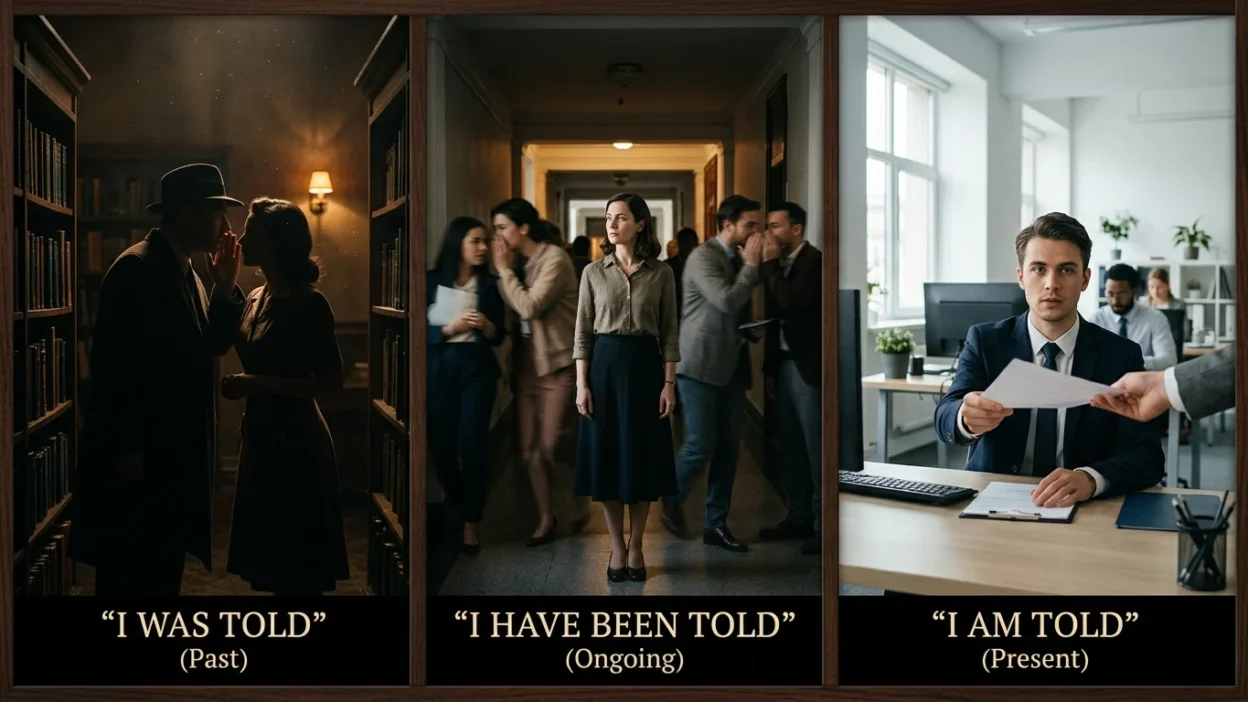
“I was told,” “I have been told,” and “I am told” are all grammatically correct, but they are used in different situations.
“I was told” usually refers to information given to you at a particular time in the past.
“I have been told” emphasizes that you received the information at some point before now and that it is relevant now. “
I am told” is a more formal way to say that you understand or have been informed of something.
The difference is mainly about time, connection to the present, and tone. “I was told” uses the simple past passive, “
I have been told” uses the present perfect passive, and “I am told” uses the present simple passive.
Once you understand what each tense emphasizes, choosing the right expression becomes much easier.
The same principles apply to related phrases such as “I was informed,” “I have been informed,” and “I am informed.”
Quick Answer
Use “I was told” for information given at a specific or completed time in the past. Use “I have been told” when the information was given before now and remains relevant. Use “I am told” for a current report or a formal way of saying “I understand” or “I have been informed.”
Why Do People Confuse “I Was Told,” “I Have Been Told,” and “I Am Told”?
All three expressions use the verb tell in the passive voice:
- I was told → past simple passive
- I have been told → present perfect passive
- I am told → present simple passive
The confusing part is that all three can communicate roughly the same basic idea: someone gave me information.
The difference lies in what the speaker wants to emphasize.
Compare:
I was told that the meeting was canceled.
This presents the information as something communicated in the past.
I have been told that the meeting is canceled.
This connects the earlier information with the present situation.
I am told that the meeting is canceled.
This presents the information as something the speaker has been informed about or currently understands, often with a more formal tone.
What Does “I Was Told” Mean?
“I was told” is the simple past passive form of “tell.”
It means that someone told you something in the past.
The focus is usually on a completed past event of receiving information.
Examples
I was told about the change yesterday.
I was told to wait outside.
I was told that the store was closed.
I was told by my manager to finish the report.
You can mention a specific past time:
I was told this last week.
I was told this yesterday.
I was told this when I arrived.
When “I was told” is natural
Use it when:
- The telling happened in the past.
- You are describing a past conversation or instruction.
- The time or situation of the telling is important.
- You are simply reporting what someone said.
What Does “I Have Been Told” Mean?
“I have been told” is the present perfect passive form.
It means that someone told you something at some point before now, and the information has a connection with the present.
The exact time is often not stated because it is not the main point.
Examples
I have been told that the office is closed today.
I have been told to bring my passport.
I have been told that she is very experienced.
I have been told about the new policy several times.
The phrase can also suggest that you have received the same information repeatedly:
I have been told many times to be careful.
When “I have been told” is natural
Use it when:
- The information is relevant now.
- The exact time is unimportant.
- You are reporting information you have received before now.
- The information may have been repeated.
- You want to emphasize the current result or knowledge.
What Does “I Am Told” Mean?
“I am told” is the present simple passive form.
It can mean “people tell me” or “I understand from what I have been told.”
It often sounds more formal than “I was told” or “I have been told.”
For example:
I am told that the meeting will begin at nine.
This means approximately:
I understand that the meeting will begin at nine because someone has told me so.
It is particularly common in:
- Formal speech
- Formal writing
- News-style language
- Professional communication
- Polite reporting
Examples
I am told that the problem has been resolved.
I am told that the company plans to expand.
I am told that you are the person in charge.
I am told that the road is closed.
In everyday conversation, “I’ve been told” or “I was told” may sound more natural depending on the context.
I Was Told vs I Have Been Told vs I Am Told
| Expression | Tense | Main idea | Typical focus | Example |
|---|---|---|---|---|
| I was told | Past simple passive | Someone told me in the past | Past event | I was told yesterday. |
| I have been told | Present perfect passive | Someone has told me before now | Present relevance | I have been told that it is closed. |
| I am told | Present simple passive | I understand from what I am told | Current/formal report | I am told that the road is closed. |
When Should You Use Each Expression?
Use “I was told” for a past event
Choose I was told when you are thinking about the act of being told as something that happened in the past.
I was told about the problem yesterday.
The word yesterday clearly places the event in the past.
Use “I have been told” for present relevance
Choose I have been told when the information received earlier matters now.
I have been told that the train is delayed.
The important point is the information you have now, not exactly when you received it.
Use “I am told” for a current report
Choose I am told when you want to present information as something you currently understand or have been informed about.
I am told that the new manager will arrive tomorrow.
This can sound formal or somewhat detached.
12 Examples: I Was Told, I Have Been Told, and I Am Told
1. A specific past time
I was told about the meeting yesterday.
The word “yesterday” makes the past simple natural.
2. Present information
I have been told that the meeting has been canceled.
The information is relevant now.
3. Formal report
I am told that the meeting has been canceled.
This sounds more formal and presents the information as something the speaker understands from others.
4. Past instruction
I was told to submit the form by Friday.
Someone gave the instruction in the past.
5. Repeated instruction
I have been told to submit the form several times.
The present perfect emphasizes the experience up to now.
6. Formal announcement
I am told that the application process has changed.
This sounds formal and somewhat detached.
7. A past conversation
I was told about your new job when I saw John.
The speaker refers to a particular past occasion.
8. Information received before now
I have been told that you are an excellent teacher.
The speaker has received this information before the current moment.
9. Formal introduction
I am told that you are the new director.
The expression sounds polite and formal.
10. Past warning
I was told not to touch the machine.
The speaker is reporting a past instruction.
11. Repeated warning
I have been told not to touch the machine.
This can imply that the warning has been given more than once or remains relevant.
12. Formal report about a situation
I am told that the machine is no longer working.
The speaker is reporting information received from another source.
Common Mistakes
Mistake 1: Using “I have been told yesterday”
Usually incorrect:
I have been told yesterday that the office was closed.
With a finished past time such as yesterday, use the simple past:
I was told yesterday that the office was closed.
The present perfect normally does not combine with a finished past-time expression such as yesterday, last week, in 2020, or two days ago.
Mistake 2: Thinking “I was told” is always better
“I was told” is not automatically better. It is appropriate when you are presenting the telling as a past event.
If the information has a clear connection with the present, I have been told may be more appropriate.
Mistake 3: Using “I am told” in every situation
“I am told” is grammatical, but it can sound formal.
In casual conversation, you might naturally say:
I’ve been told that she is coming.
rather than:
I am told that she is coming.
Mistake 4: Confusing “told” and “said”
After tell, we normally identify the person who receives the information:
She told me the news.
After say, we normally do not use a direct personal object in the same way:
She said that she was tired.
Therefore:
I was told the news.
not:
I was said the news.
Mistake 5: Using the wrong tense for a finished past time
If you say:
I was told this last month.
the simple past is natural because last month is a finished past period.
Memory Trick
Use three simple questions.
1. Is it a completed past event?
Use:
I was told
Think: past event → was told
2. Is the information connected to now?
Use:
I have been told
Think: before now + present relevance → have been told
3. Am I making a formal/current report?
Use:
I am told
Think: current report → am told
A quick memory formula is:
Past event = I was told
Past information relevant now = I have been told
Formal/current report = I am told
American vs British English
All three expressions are used in both American English and British English.
The main difference is not geographical. It is related to tense, context, and style.
American English commonly uses the simple past in situations where British English may sometimes prefer the present perfect, particularly when talking about recent events. However, the distinction depends heavily on context, and both varieties use “I was told” and “I have been told.”
For formal reporting, “I am told” is also available in both varieties.
Similar Expressions
I was informed
This is a more formal alternative to I was told.
I was informed that the office was closed.
I have been informed
This is the present perfect equivalent.
I have been informed that the policy has changed.
I am informed
This is a formal expression meaning that information has been communicated to you.
I am informed that the documents have arrived.
I heard
This is generally more informal and can suggest that you received information indirectly.
I heard that the meeting was canceled.
I understand
This can be used when reporting information you believe to be true.
I understand that the meeting starts at nine.
According to what I was told
This clearly shows that the information comes from another person.
According to what I was told, the store closes at six.
Final Verdict
“I was told,” “I have been told,” and “I am told” are all correct, but they express different perspectives on information you received.
- I was told → focuses on a completed past event.
- I have been told → focuses on information received before now that is relevant now.
- I am told → presents information as a current or formal report.
For everyday English, “I was told” and “I have been told” are especially common. “I am told” is also correct but often has a more formal or detached tone.
The best choice depends on the time and context, not simply on which expression sounds more formal.
Frequently Asked Questions
What is the difference between “I was told” and “I have been told”?
“I was told” describes a past event when someone gave you information. “I have been told” describes information received before now with a connection to the present.
Is “I am told” grammatically correct?
Yes. “I am told” is grammatically correct and is often used to report information in a formal or current context.
Can I say “I have been told yesterday”?
Normally, no. Use the simple past with a finished time such as “yesterday”:
I was told yesterday.
Which is more natural: “I was told” or “I have been told”?
Both are natural. “I was told” is suitable for a past event, while “I have been told” is suitable when the information received earlier remains relevant now.
Is “I am told” formal?
It can sound more formal or detached than “I was told” or “I’ve been told.” It is common when someone is reporting information from another source.
What is the difference between “I was told” and “I heard”?
“I was told” clearly indicates that someone communicated the information to you. “I heard” is broader and can mean that you received the information from someone, something you read, or another indirect source.
Can “I have been told” mean someone told me many times?
Yes. Context can make this meaning clear:
I have been told many times to be careful.
It can also refer to a single occasion when the exact time is not important.
Why can’t I say “I was said”?
Because tell normally takes a person as its object:
She told me the news.
But say works differently:
She said that she was tired.
Therefore, the passive form is:
I was told, not “I was said.”
Remember This
I was told = a past telling.
I have been told = information received before now and relevant now.
I am told = a current or formal report.
If you remember those three ideas—past event, present connection, current report—you can usually choose the correct expression.
Conclusion
The difference between “I was told,” “I have been told,” and “I am told” is mainly about tense and perspective. “I was told” places the act of telling in the past, especially when a particular past time or situation is involved. “I have been told” connects information received before now with the present, while “I am told” presents information as a current report and can sound more formal.
For learners of English, the most important point is not to memorize one expression as universally correct. Instead, consider when the information was given and why you are mentioning it now. If you are talking about a completed past event, choose “I was told.” If the information matters now, “I have been told” may fit better. If you are making a formal report, “I am told” can be appropriate.