English has many words that sound similar but have completely different meanings and uses. “Pass time,” “past time,” and “pastime” are a common example.
They may look and sound alike, but they are not interchangeable. Choosing the wrong form can change the meaning of your sentence or make it grammatically incorrect.
The good news is that the difference is easy to understand once you know what each expression means. Pass time is usually a verb phrase meaning to spend time doing something.
Past time is normally an adjective-and-noun combination meaning a time that has already gone by, although “past time” can also appear in expressions such as “past time to leave.”
Quick Answer
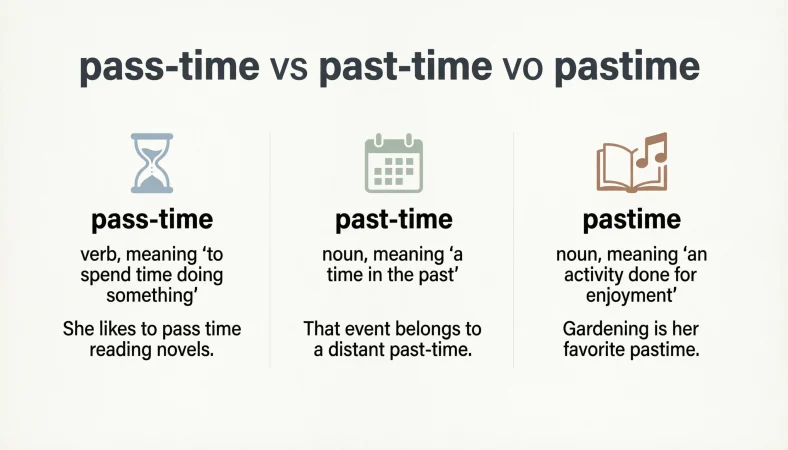
Pass time means to spend or occupy time: “I read books to pass time.” Past time refers to a time that has gone by or, in some contexts, something that should already have happened.
Pastime is a noun for a leisure activity or hobby: “Reading is my favorite pastime.” Remember: pass time = spend time, past time = time gone by, pastime = hobby.
Why Do People Confuse “Pass Time,” “Past Time,” and “Pastime”?
The confusion mainly comes from pronunciation and spelling. Pass time and pastime can sound very similar in ordinary speech, while past time contains the familiar word “past.”
There is also a connection between the meanings. When you pass time, you occupy yourself while time goes by. A pastime, meanwhile, is an activity you use to enjoy or occupy your free time.
What Does “Pass Time” Mean?
Pass time is a verb phrase. It means to spend or occupy time, usually while waiting or when you have nothing specific to do.
Examples
- I played games to pass time while waiting for the bus.
- She watches movies to pass time on long flights.
- We talked to pass the time before the meeting started.
- He reads newspapers to pass time during his lunch break.
You will also frequently see “pass the time.”
We played cards to pass the time.
Here, pass is the verb and time is the noun.
What Does “Past Time” Mean?
Past time consists of two separate words: past + time.
It can refer literally to a time that has already gone by.
For example:
- We cannot change the past time.
- Memories from a past time can be meaningful.
- People often remember a past time with affection.
However, “past time” is much less common than “pastime” when talking about hobbies.
There is another important expression:
It is past time to leave.
This means that the appropriate time to leave has already arrived or even passed.
For example:
- It is past time to go home.
- It is past time to make a decision.
- It is past time for us to act.
In many contexts, “past time” can sound more natural as part of a longer expression than as a standalone phrase.
What Does “Pastime” Mean?
Pastime is one word and is a noun. It means an activity you regularly enjoy during your free time.
Common pastimes include:
- Reading
- Gardening
- Painting
- Playing chess
- Watching movies
- Hiking
- Cooking
- Listening to music
Example
Gardening is her favorite pastime.
Here, pastime means a leisure activity or hobby.
Pass Time vs Past Time vs Pastime: Comparison Table
| Term | Meaning | Grammar | Example |
|---|---|---|---|
| pass time | Spend or occupy time | Verb phrase | I read to pass time. |
| past time | A time that has gone by; also used in expressions about something being overdue | Adjective + noun | It is past time to leave. |
| pastime | A leisure activity or hobby | Noun | Chess is my favorite pastime. |
When Should You Use Each One?
Use “pass time” when you mean “spend time”
Use pass time when someone is doing something to make time go by.
I listen to music to pass time.
A more common version is:
I listen to music to pass the time.
Use “past time” when referring to time that has gone by
Use past time when past describes a period or time.
The traditions belong to a past time.
It is also useful in the expression:
It is past time to leave.
Use “pastime” for a hobby or leisure activity
Use pastime when naming an activity someone enjoys in their free time.
Photography is his favorite pastime.
A useful test is to ask:
Can I replace the word with “hobby”?
If yes, pastime is probably the correct choice.
10+ Examples of Pass Time, Past Time, and Pastime
Examples with “pass time”
- I read novels to pass time on long journeys.
- She played a mobile game to pass the time.
- We chatted while waiting to pass time.
- He watches documentaries to pass the time during weekends.
- Listening to podcasts helps me pass the time.
Examples with “past time”
- It is past time to leave.
- Those customs belong to a past time.
- The story describes a past time in the country’s history.
- It is past time for us to start preparing.
- They were discussing events from a past time.
Examples with “pastime”
- Reading is my favorite pastime.
- Gardening is a relaxing pastime.
- Chess has been a popular pastime for centuries.
- Her favorite pastime is painting.
- Fishing is a common pastime in the area.
Common Mistakes
Mistake 1: Using “pastime” as a verb
❌ I pastime by watching television.
✅ I pass time by watching television.
Pastime is a noun, not a verb.
Mistake 2: Writing “past time” when you mean a hobby
❌ My favorite past time is reading.
✅ My favorite pastime is reading.
When you mean a hobby or recreational activity, write pastime as one word.
Mistake 3: Confusing “pass time” with “pastime”
❌ Reading is a great way to pastime.
✅ Reading is a great way to pass the time.
Mistake 4: Assuming “past time” always means a hobby
Past time and pastime have different meanings.
It is past time to go.
Walking is my favorite pastime.
The first refers to timing; the second refers to an activity.
A Simple Memory Trick
Use this three-part trick:
- PASS time → spend time
- PAST time → time that has gone by / time that is overdue
- PASTIME → hobby
Think of the final -ime in pastime as part of one complete noun. If you can replace the word with hobby, choose pastime.
Reading is my favorite pastime.
= Reading is my favorite hobby.
American vs British English
The distinction between pass time, past time, and pastime is essentially the same in American and British English.
Similarly, both American and British speakers use pass the time for spending time, especially while waiting.
For example:
We played cards to pass the time.
The main point for learners is therefore not an American-versus-British spelling difference. The important distinction is meaning and grammatical function.
Similar Words
Understanding a few related words can make the distinction easier.
Hobby
A hobby is an activity you regularly do for pleasure in your free time.
Photography is my hobby.
Leisure
Leisure means free time when you are not working or dealing with obligations.
I enjoy reading during my leisure time.
Recreation
Recreation refers to activities done for enjoyment, relaxation, or refreshment.
Swimming is a popular form of recreation.
Spend time
Spend time means to use a period of time doing something.
I spend time reading every evening.
This is often a natural alternative to pass time.
Past
Past can refer to a time before the present.
We learned about events from the past.
Final Verdict
Pass time is a verb phrase meaning to spend or occupy time.
Past time is two words and generally refers to a time that has gone by, or appears in expressions such as “It is past time to…”
Pastime is one word and means a hobby or enjoyable leisure activity.
The easiest distinction is:
Pass time = spend time
Past time = time gone by / overdue time
Pastime = hobby
Frequently Asked Questions
Is “pastime” one word or two?
Pastime is one word when it means a hobby or leisure activity.
Reading is my favorite pastime.
Is it “pass time” or “pastime”?
It depends on the meaning. Use pass time as a verb phrase meaning to spend or occupy time. Use pastime as a noun meaning a hobby.
Is “pass time” grammatically correct?
Yes. Pass time is grammatically correct, although “pass the time” is often the more natural expression.
We talked to pass the time.
What is the difference between pastime and hobby?
A pastime is an enjoyable activity done during free time, while a hobby is an activity someone regularly pursues for pleasure. Their meanings overlap considerably.
What does “it is past time” mean?
“It is past time” means that the appropriate time for something has arrived or has already been exceeded.
It is past time to leave.
Is “past time” the same as “pastime”?
No. Past time is two words and has a different meaning. Pastime is one word meaning a hobby or recreational activity.
What is the easiest way to remember the difference?
Remember:
Pass time = spend time.
Past time = time gone by.
Pastime = hobby.
Remember This
If you are talking about doing something while waiting, use pass time:
I read to pass the time.
If you are talking about a time that has already gone by, use past time:
That belongs to a past time.
If you are talking about a hobby or enjoyable free-time activity, use pastime:
Reading is my favorite pastime.
Conclusion
The difference between pass time, past time, and pastime is mainly a matter of meaning, word form, and grammatical function.
Although the expressions look and sound similar, they cannot normally be substituted for one another.
Pass time is a verb phrase, past time contains two separate words, and pastime is a noun.