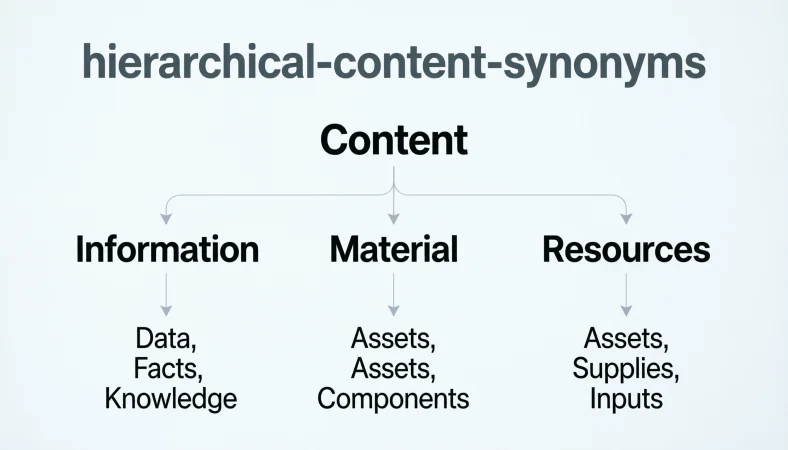
When writers talk about hierarchical content, they usually mean information arranged in levels, categories, or layers.
Some ideas are more general, while others are more specific and placed underneath them.
This structure helps readers understand how different pieces of information are connected.
Learning hierarchical content synonyms is useful for students, ESL learners, writers, bloggers, editors, and content creators.
Knowing several ways to express the same or a closely related idea can make your writing clearer, more natural, and less repetitive.
The right synonym also depends on context. A term that works well in academic writing may sound too technical in a blog post.
Likewise, a phrase suitable for website organization may not fit a sentence about ideas or information.
What Does “Hierarchical Content” Mean?
Simple meaning
Hierarchical content is content organized from higher-level ideas to lower-level or more specific ideas.
For example:
Main topic → Category → Subcategory → Specific detail
A website might use this structure:
Travel → Asia → Japan → Tokyo → Attractions
Here, “Travel” is the broadest level, while “Attractions” is more specific.
Usage and tone
The phrase hierarchical content has a professional and technical tone. It is common in content strategy, information architecture, website design, education, databases, and knowledge management.
In simple writing, you may prefer terms such as structured content, organized information, or layered content, depending on what you mean.
30 Hierarchical Content Synonyms and Related Terms
The following terms can replace or closely relate to “hierarchical content.” Some are direct alternatives, while others describe a similar type of organization.
1. Structured content
Meaning: Content arranged in a clear and logical format.
Example: The website uses structured content to make information easier to find.
Best usage context: General writing, websites, content strategy, and SEO.
2. Organized content
Meaning: Information arranged neatly and logically.
Example: Organized content helps students find important information quickly.
Best usage context: Everyday writing and beginner-friendly explanations.
3. Tiered content
Meaning: Content divided into different levels or tiers.
Example: The course provides tiered content for beginners, intermediate learners, and experts.
Best usage context: Education, marketing, training, and audience segmentation.
4. Layered content
Meaning: Information presented in several levels, with each layer adding more detail.
Example: The article uses layered content so readers can start with basic ideas and explore advanced details.
Best usage context: Educational content, UX writing, and detailed guides.
5. Nested content
Meaning: Content placed inside larger categories or sections.
Example: The website has nested content under several main product categories.
Best usage context: Websites, software, information architecture, and technical writing.
6. Content hierarchy
Meaning: The order and levels used to organize content from broad to specific.
Example: A strong content hierarchy makes the page easier to scan.
Best usage context: SEO, web design, UX, and content strategy.
7. Hierarchical information
Meaning: Information arranged according to different levels of importance or detail.
Example: The report presents hierarchical information from general findings to specific results.
Best usage context: Academic, technical, and professional writing.
8. Information hierarchy
Meaning: A system that organizes information according to levels or importance.
Example: Good information hierarchy helps readers understand the main message first.
Best usage context: UX design, websites, presentations, and reports.
9. Structured information
Meaning: Information arranged according to a clear system or pattern.
Example: Structured information makes the database easier to search.
Best usage context: Technical writing, databases, websites, and business communication.
10. Organized information
Meaning: Information arranged in a logical and easy-to-follow way.
Example: The teacher gave us organized information about the history of the country.
Best usage context: General, academic, and educational writing.
11. Tiered information
Meaning: Information separated into different levels.
Example: The guide offers tiered information for new and experienced users.
Best usage context: Education, training, business, and user guides.
12. Layered information
Meaning: Information presented in levels, often moving from simple to complex.
Example: The lesson provides layered information about climate change.
Best usage context: Education, research, and explanatory writing.
13. Nested information
Meaning: Information grouped inside broader categories.
Example: The application stores nested information under each customer account.
Best usage context: Technology, databases, and information architecture.
14. Multi-level content
Meaning: Content divided into several levels or stages.
Example: The course contains multi-level content for learners with different abilities.
Best usage context: Education, training, websites, and documentation.
15. Multi-level information
Meaning: Information organized across multiple levels of detail.
Example: The dashboard provides multi-level information about company performance.
Best usage context: Business, analytics, reports, and technical communication.
16. Categorized content
Meaning: Content grouped into specific categories.
Example: Categorized content makes the online library easier to navigate.
Best usage context: Blogs, websites, libraries, and content management.
17. Categorized information
Meaning: Information divided into groups based on shared characteristics.
Example: The researcher presented categorized information about the participants.
Best usage context: Research, education, databases, and reports.
18. Layered structure
Meaning: An arrangement made up of several connected levels.
Example: The website has a layered structure that guides visitors from broad topics to detailed pages.
Best usage context: Website architecture, design, and technical discussions.
19. Nested structure
Meaning: A structure in which smaller sections exist inside larger sections.
Example: The document follows a nested structure with chapters, sections, and subsections.
Best usage context: Documents, software, websites, and technical writing.
20. Tree-structured content
Meaning: Content organized like the branches of a tree, starting with a main point and dividing into smaller topics.
Example: The knowledge base uses tree-structured content to connect related subjects.
Best usage context: Information architecture, databases, and technical writing.
21. Content tree
Meaning: A visual or logical representation of content arranged from parent topics to child topics.
Example: The editor reviewed the content tree before publishing the new website.
Best usage context: Websites, content management, and SEO planning.
22. Parent-child content structure
Meaning: A system where broad topics act as “parents” and more specific topics act as “children.”
Example: The website uses a parent-child content structure for its product pages.
Best usage context: CMS platforms, websites, SEO, and technical writing.
23. Content organization
Meaning: The way content is arranged and connected.
Example: Better content organization can improve the reader’s experience.
Best usage context: General writing, content strategy, websites, and publishing.
24. Information structure
Meaning: The way information is arranged and connected.
Example: The information structure of the guide makes complex subjects easier to understand.
Best usage context: Academic writing, websites, UX, and knowledge management.
25. Logical content structure
Meaning: Content arranged according to a clear pattern or sequence.
Example: The writer created a logical content structure before drafting the article.
Best usage context: Essays, blogs, reports, and educational content.
26. Content layering
Meaning: The process of organizing content into different levels of detail.
Example: Content layering allows readers to choose how deeply they want to explore a topic.
Best usage context: UX, web content, instructional design, and publishing.
27. Hierarchical structure
Meaning: A structure where items are arranged from higher levels to lower levels.
Example: The company uses a hierarchical structure to organize its internal documents.
Best usage context: Business, technology, organizations, and information design.
28. Hierarchical organization
Meaning: The arrangement of information or items into levels.
Example: Hierarchical organization helps readers see which ideas are primary and which are secondary.
Best usage context: Academic writing, research, websites, and data organization.
29. Progressive content structure
Meaning: Content that moves from basic or broad information toward more detailed information.
Example: The tutorial follows a progressive content structure, beginning with simple concepts.
Best usage context: Tutorials, education, guides, and instructional content.
30. Parent-to-child content
Meaning: Content arranged from a broad parent topic to narrower child topics.
Example: The site organizes its articles using a parent-to-child content system.
Best usage context: SEO, websites, content management systems, and information architecture.
Hierarchical Content Synonyms: Quick Comparison Guide
Not every synonym has exactly the same meaning. Choosing the right word depends on what you want to emphasize.
| Term | Main idea | Best context | Tone |
|---|---|---|---|
| Structured content | Clear organization | SEO, websites, general writing | Neutral |
| Organized content | Neat arrangement | Everyday and academic writing | Simple |
| Tiered content | Separate levels | Education, marketing | Professional |
| Layered content | Levels of detail | UX, education | Modern |
| Nested content | Content inside content | Technology, websites | Technical |
| Content hierarchy | Ranking and levels | SEO, UX, web design | Technical |
| Information hierarchy | Importance and order | UX, presentations | Professional |
| Categorized content | Grouping by category | Blogs, websites | Neutral |
| Multi-level content | Several levels | Training, education | Neutral |
| Content tree | Parent-child organization | Websites, CMS | Technical |
| Information structure | Arrangement and connections | Research, UX | Professional |
| Hierarchical structure | Levels within a system | Business, technology | Formal |
How to Choose the Right Synonym
For simple and everyday writing
Choose organized content, organized information, or content organization when your readers may not understand technical terminology.
These expressions are easy to understand and work well for ESL learners.
For academic writing
Use terms such as structured information, information hierarchy, hierarchical organization, or logical content structure.
These choices sound more formal and are useful in essays, reports, research papers, and educational material.
For websites and SEO
The most useful terms include content hierarchy, structured content, information architecture, nested content, and content tree.
These terms are especially suitable when discussing navigation, categories, internal linking, website structure, or content planning.
For education and training
Consider tiered content, multi-level content, layered content, and progressive content structure.
These phrases work particularly well when material is designed for different skill levels.
For technical contexts
Use nested content, nested structure, tree-structured content, or parent-child content structure.
These terms are more precise when discussing databases, software, content management systems, or information architecture.
For a reader-friendly tone
If your goal is clarity, choose organized content or structured content.
These terms communicate the idea without making the sentence sound overly technical.
Examples of Hierarchical Content in Real Writing
Website example
A website can arrange its pages like this:
Home → Blog → Technology → Artificial Intelligence → AI Writing Tools
The broad topic comes first, followed by increasingly specific topics. This is a basic example of hierarchical content.
Academic example
A student writing about environmental science might organize an essay like this:
Environment → Pollution → Air Pollution → Causes → Vehicle Emissions
This structure helps the reader understand how the specific point relates to the larger subject.
Educational example
A course might use:
English → Grammar → Verb Tenses → Past Tense → Past Perfect
Each level becomes more specific. This is useful for learners because they can understand the larger subject before studying a smaller concept.
Why Understanding Hierarchical Content Synonyms Matters
It prevents repetitive writing
Using the same phrase repeatedly can make writing feel mechanical. Knowing related expressions gives you more flexibility.
For example, instead of repeatedly writing “hierarchical content,” you might use structured content, layered information, or content hierarchy, when those terms accurately describe your meaning.
It improves vocabulary
ESL learners can use synonym knowledge to understand articles, textbooks, websites, and professional documents more easily.
Synonyms also show how small changes in wording can change the tone or focus of a sentence.
It improves content clarity
A good synonym does more than replace a word. It tells the reader exactly what aspect of the idea matters.
For example, categorized content focuses on grouping, while content hierarchy focuses on levels and relationships.
It helps content creators communicate precisely
Bloggers, UX writers, SEO specialists, and editors often need to explain how information is organized. Using the correct term makes those explanations more professional.
Hierarchical Content vs. Related Concepts
Hierarchical content vs. structured content
These terms are closely related, but structured content is broader.
Structured content can simply mean content arranged in a consistent format. Hierarchical content specifically emphasizes levels or relationships between broader and narrower information.
Hierarchical content vs. categorized content
Categorized content focuses on grouping information.
Hierarchical content focuses on levels between groups or topics.
A website can therefore have categories without having a strong hierarchy.
Hierarchical content vs. layered content
Layered content often emphasizes different depths of information.
Hierarchical content emphasizes the relationship between higher and lower levels.
The two expressions can overlap, but they are not always interchangeable.
Hierarchical content vs. nested content
Nested content usually means that one item exists inside another.
It is therefore a more technical term and is especially common in software, databases, websites, and structured data.
Tips for Using Synonyms Naturally
Check the exact meaning
Do not replace a word simply because another term looks similar.
For example, categorized content may not be the best replacement for hierarchical content if the original sentence is specifically about parent-child relationships.
Consider your audience
Use simple expressions such as organized content when writing for general readers.
Use more technical expressions such as nested structure when writing for developers or information architects.
Think about tone
Some terms sound formal, while others sound conversational.
For example:
- Organized information — simple and natural
- Structured information — professional
- Information hierarchy — technical
- Tree-structured content — highly technical
Avoid forced synonyms
Good writing does not require replacing every repeated word.
If hierarchical content is the most accurate term, use it. Clarity is more important than avoiding repetition.
Frequently Asked Questions About Hierarchical Content Synonyms
What is the simplest synonym for hierarchical content?
Structured content is one of the simplest and most useful alternatives. However, organized content may be even easier for beginner readers.
Is “structured content” the same as “hierarchical content”?
Not always. Structured content is a broader term. Hierarchical content specifically describes organization into levels, such as main topics, subtopics, and detailed points.
What is another word for content hierarchy?
Possible alternatives include information hierarchy, hierarchical structure, content organization, and information structure, depending on the context.
What is hierarchical information?
Hierarchical information is information arranged from broad or higher-level ideas to narrower or more specific ideas.
What synonym is best for SEO writing?
Structured content, content hierarchy, and information hierarchy are useful terms in SEO-related discussions. The best choice depends on the specific idea you are explaining.
What is the difference between nested and hierarchical content?
Nested content places one item inside another. Hierarchical content is a broader concept involving levels and relationships between information.
Why are synonyms important for ESL learners?
Synonyms help ESL learners recognize different ways of expressing similar ideas. They also help learners understand tone, context, and differences in meaning.
Final Takeaways
Understanding hierarchical content synonyms can make your vocabulary stronger and your writing more precise.
The most useful alternatives include structured content, organized content, tiered content, layered content, nested content, content hierarchy, information hierarchy, categorized content, multi-level content, and hierarchical structure.
However, these terms are not always perfect replacements for one another. Some focus on levels, some focus on categories, and others focus on technical parent-child relationships.
The best synonym is the one that matches your meaning, audience, and tone. For simple writing, choose clear terms such as “organized content.” For professional or technical writing, terms such as “content hierarchy” or “nested structure” may be more precise.
By understanding these differences, students, ESL learners, writers, and content creators can communicate complex ideas in a clearer and more natural way.