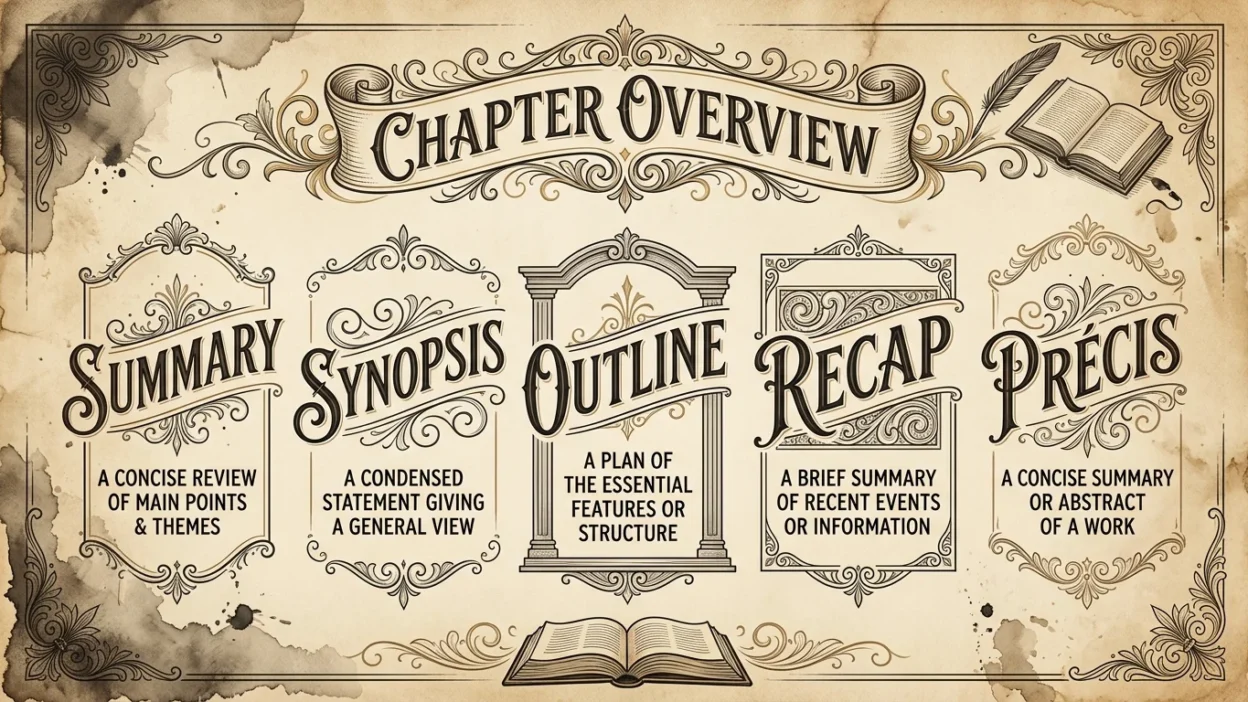
Understanding chapter overview synonyms can help students, writers, ESL learners, and content creators express the idea in different ways.
Instead of repeating “chapter overview,” you can choose a more precise phrase depending on whether you are describing, summarizing, reviewing, or introducing a chapter.
A chapter overview usually gives readers a short explanation of what a chapter contains.
It highlights the main topics, ideas, events, arguments, or lessons without explaining every detail. Learning related words makes your writing more natural and gives you more flexibility.
In this guide, you will find 30 chapter overview synonyms and closely related expressions, along with simple meanings, example sentences, and advice about when to use each one.
What Does “Chapter Overview” Mean?
Simple meaning
A chapter overview is a brief description of the main content of a chapter. It helps readers understand what they can expect to learn or read.
For example:
“The chapter overview explains the main ideas discussed in Chapter 4.”
The phrase is common in textbooks, study guides, books, academic writing, online courses, and educational content.
Tone and usage
“Chapter overview” has a neutral and informative tone. It works well in both academic and general writing.
Depending on your purpose, you might use words such as chapter summary, chapter outline, chapter introduction, or chapter synopsis instead.
30 Chapter Overview Synonyms and Related Expressions
1. Chapter Summary
Meaning: A short explanation of the main points or events in a chapter.
Example:
“The chapter summary helps students review the most important concepts.”
Best usage context:
Ideal for textbooks, study guides, assignments, and educational websites.
2. Chapter Outline
Meaning: A structured list or description of the main sections and ideas in a chapter.
Example:
“The chapter outline shows the topics covered in each section.”
Best usage context:
Best when you want to emphasize structure and organization.
3. Chapter Synopsis
Meaning: A brief summary that explains what a chapter is about.
Example:
“The chapter synopsis gives readers a quick idea of the story’s development.”
Best usage context:
Useful for books, fiction, publishing, and formal writing.
4. Chapter Introduction
Meaning: An opening explanation that introduces the subject or purpose of a chapter.
Example:
“The chapter introduction explains why this topic is important.”
Best usage context:
Use it when the information appears at the beginning of a chapter.
5. Chapter Review
Meaning: A short examination or recap of the important material in a chapter.
Example:
“The chapter review covers the key lessons before the final test.”
Best usage context:
Common in educational materials and exam preparation.
6. Chapter Recap
Meaning: A quick reminder of what happened or what was discussed in a chapter.
Example:
“The chapter recap reminds readers of the main events.”
Best usage context:
Good for informal, reader-friendly, and online content.
7. Chapter Breakdown
Meaning: An explanation of the different parts, topics, or ideas within a chapter.
Example:
“This chapter breakdown explains each section in simple language.”
Best usage context:
Useful for blogs, study resources, tutorials, and detailed explanations.
8. Chapter Guide
Meaning: Information designed to help readers understand or navigate a chapter.
Example:
“The chapter guide helps students find the most important information.”
Best usage context:
Good for study materials, textbooks, courses, and educational websites.
9. Chapter Description
Meaning: A general explanation of what a chapter contains.
Example:
“The chapter description introduces the main subject discussed in the lesson.”
Best usage context:
Useful when you need a broad and neutral term.
10. Chapter Summary Guide
Meaning: A guide that presents the major points or ideas from a chapter.
Example:
“This chapter summary guide makes revision easier for students.”
Best usage context:
Best for educational resources and revision materials.
11. Chapter Synopsis
Meaning: A concise account of the main content, events, or argument of a chapter.
Example:
“The chapter synopsis reveals the central conflict without giving every detail.”
Best usage context:
Especially suitable for literature and fiction.
12. Chapter Digest
Meaning: A condensed version of the main information in a chapter.
Example:
“The chapter digest presents the essential information in a few paragraphs.”
Best usage context:
Useful in formal, academic, or reference-style writing.
13. Chapter Abstract
Meaning: A very brief statement describing the main subject, purpose, or findings of a chapter.
Example:
“The chapter abstract outlines the research question and major findings.”
Best usage context:
Best for academic and research-oriented writing. It is not always interchangeable with “overview.”
14. Chapter Highlights
Meaning: The most important points, events, or ideas from a chapter.
Example:
“The chapter highlights include three important theories.”
Best usage context:
Excellent for quick revision and reader-friendly content.
15. Chapter Key Points
Meaning: The most important ideas that readers should remember.
Example:
“Review the chapter key points before completing the exercise.”
Best usage context:
Best for textbooks, lessons, revision notes, and educational blogs.
16. Chapter Key Ideas
Meaning: The central thoughts, concepts, or arguments presented in a chapter.
Example:
“The chapter key ideas are explained with simple examples.”
Best usage context:
Useful when focusing on concepts rather than chapter structure.
17. Chapter Recap Guide
Meaning: A guide that briefly reviews the main information from a chapter.
Example:
“The chapter recap guide is useful for students preparing for exams.”
Best usage context:
Good for study websites and revision resources.
18. Chapter Content Summary
Meaning: A condensed explanation of the material included in a chapter.
Example:
“The chapter content summary covers all the major topics.”
Best usage context:
Useful when discussing educational or informational material.
19. Chapter Content Overview
Meaning: A general description of the material covered in a chapter.
Example:
“The chapter content overview appears at the start of the online lesson.”
Best usage context:
A very close alternative to “chapter overview.”
20. Chapter Roadmap
Meaning: A guide showing what readers will encounter or learn in a chapter.
Example:
“The chapter roadmap explains how the discussion will develop.”
Best usage context:
Useful in textbooks, courses, academic writing, and professional content.
21. Chapter Preview
Meaning: A short introduction to what readers will find in a chapter.
Example:
“The chapter preview introduces the main questions explored in the lesson.”
Best usage context:
Best when the information comes before readers study the chapter.
22. Chapter Guidepost
Meaning: A brief sign or explanation that helps readers understand where the chapter is going.
Example:
“The chapter guidepost prepares readers for the topics that follow.”
Best usage context:
More literary or instructional; less common in everyday writing.
23. Chapter Summary Notes
Meaning: Short notes containing the most important information from a chapter.
Example:
“She used chapter summary notes to prepare for her exam.”
Best usage context:
Excellent for students and revision materials.
24. Chapter Study Guide
Meaning: A resource containing summaries, questions, explanations, or key information about a chapter.
Example:
“The chapter study guide helped me understand the difficult concepts.”
Best usage context:
Best for education, homework, exam preparation, and learning resources.
25. Chapter Learning Overview
Meaning: A short explanation of what students are expected to learn from a chapter.
Example:
“The chapter learning overview lists the skills students should develop.”
Best usage context:
Useful for courses, e-learning platforms, and educational content.
26. Chapter At-a-Glance
Meaning: A quick view of the most important information in a chapter.
Example:
“The chapter at-a-glance section makes revision much faster.”
Best usage context:
Great for textbooks, study websites, guides, and visually organized content.
27. Chapter Snapshot
Meaning: A very brief picture or summary of a chapter.
Example:
“The chapter snapshot gives readers the main idea in less than a minute.”
Best usage context:
Good for blogs, online learning, and informal content.
28. Chapter Brief
Meaning: A short statement explaining the main content or purpose of a chapter.
Example:
“The chapter brief explains the main argument before the detailed discussion.”
Best usage context:
Suitable for professional, academic, and concise writing.
29. Chapter Content Guide
Meaning: A guide explaining the subjects, sections, or material included in a chapter.
Example:
“The chapter content guide helps readers navigate the lesson.”
Best usage context:
Useful for textbooks, online courses, and instructional websites.
30. Chapter Digest Summary
Meaning: A condensed presentation of the most important chapter information.
Example:
“The chapter digest summary provides a useful review before the exam.”
Best usage context:
Best when emphasizing condensed information and quick review.
Chapter Overview Synonyms: Quick Comparison Guide
Different synonyms have slightly different meanings. Choosing the right one depends on what you want the reader to understand.
| Synonym | Main Focus | Tone | Best For |
|---|---|---|---|
| Chapter Summary | Main information | Neutral | Students, textbooks |
| Chapter Outline | Structure | Organized | Academic writing |
| Chapter Synopsis | Main events/content | Formal | Books, fiction |
| Chapter Introduction | Opening information | Neutral | Textbooks, lessons |
| Chapter Review | Review of material | Educational | Exams, study |
| Chapter Recap | Reminder | Friendly | Blogs, readers |
| Chapter Breakdown | Parts and details | Informative | Tutorials |
| Chapter Guide | Reader assistance | Helpful | Study resources |
| Chapter Preview | What comes next | Forward-looking | Books, courses |
| Chapter Highlights | Important points | Concise | Revision |
| Chapter Roadmap | Direction and structure | Professional | Academic writing |
| Chapter Snapshot | Very brief summary | Casual | Online content |
How to Choose the Right Synonym
For academic writing
Choose chapter summary, chapter outline, chapter brief, or chapter content overview when writing essays, reports, research materials, or textbooks.
These expressions sound clear and professional.
For students and study materials
Use chapter summary, chapter review, chapter key points, chapter summary notes, or chapter study guide.
These terms clearly tell students that the material is designed for learning or revision.
For fiction and literature
Use chapter synopsis, chapter recap, chapter description, or chapter preview.
A “synopsis” is especially useful when you want to describe the events or storyline without giving every detail.
For blogs and websites
Consider chapter breakdown, chapter recap, chapter highlights, chapter snapshot, or chapter at-a-glance.
These terms feel approachable and can make online content easier to scan.
For online courses
Use chapter roadmap, chapter learning overview, chapter guide, or chapter content guide.
These expressions work well when helping learners understand what they will study.
For a very short summary
Choose chapter snapshot, chapter brief, chapter highlights, or chapter at-a-glance.
These suggest that the reader can understand the main idea quickly.
Chapter Overview vs. Chapter Summary
What is the difference?
“Chapter overview” and “chapter summary” are closely related, but they are not always identical.
A chapter overview normally tells readers what a chapter covers. It can be written before someone reads the chapter.
A chapter summary usually condenses what the chapter actually explains or contains. It is often used after or during reading.
Example:
- Overview: “This chapter discusses the causes and effects of climate change.”
- Summary: “The chapter explains three major causes of climate change and describes their environmental effects.”
The overview gives the reader a general direction, while the summary usually provides more information about the actual content.
Chapter Overview vs. Chapter Outline
How are they different?
A chapter outline focuses more on structure.
For example:
- Introduction
- Main causes
- Major effects
- Possible solutions
- Conclusion
A chapter overview, on the other hand, might explain the chapter in a short paragraph.
Therefore, use outline when organization and sections are important. Use overview when you want a general understanding of the content.
Chapter Overview vs. Chapter Synopsis
When should you use “synopsis”?
A synopsis is a concise summary of content, often used for books, stories, films, or other narrative works.
For example:
“The chapter synopsis explains how the main character discovers the hidden letter.”
For academic textbooks, chapter summary or chapter overview may sound more natural.
Why Use Synonyms for “Chapter Overview”?
Avoid repetition
Using the same phrase repeatedly can make writing sound mechanical.
Instead of writing “chapter overview” five times, you can naturally use terms such as “chapter summary,” “chapter outline,” and “chapter recap” when their meanings fit.
Improve vocabulary
Learning synonyms helps ESL learners understand differences in tone and meaning.
It also gives students more choices when writing essays, reports, reviews, and assignments.
Make writing more precise
Not every synonym means exactly the same thing.
For example, chapter outline emphasizes structure, while chapter highlights emphasizes important information.
Choosing the more precise word can make your writing clearer.
Improve reader experience
Clear headings and descriptive terms help readers quickly understand what a section contains.
This is particularly useful for educational websites, study guides, and online courses.
Common Mistakes When Using Chapter Overview Synonyms
Treating every synonym as exactly the same
Words that are similar do not always have identical meanings.
For example, “chapter introduction” usually refers to the beginning of a chapter, while “chapter summary” can describe the chapter as a whole.
Using overly formal vocabulary
Words such as “digest” or “synopsis” can sound formal in casual writing.
For a student-friendly blog, “chapter summary” or “chapter recap” may be more natural.
Choosing “outline” for a paragraph summary
An outline generally presents information in an organized structure. If you are writing a paragraph that describes the main ideas, “overview” or “summary” may be a better choice.
Ignoring the audience
Think about who will read your content.
Students may prefer “study guide” or “chapter summary,” while academic readers may be more comfortable with “chapter outline” or “chapter brief.”
Frequently Asked Questions About Chapter Overview Synonyms
What is the best synonym for chapter overview?
Chapter summary is usually the best general synonym because it is clear, common, and easy to understand.
What is another word for a chapter summary?
Possible alternatives include chapter overview, chapter recap, chapter synopsis, chapter review, chapter digest, and chapter breakdown.
The best choice depends on the context.
Is “chapter outline” the same as “chapter overview”?
Not exactly. A chapter outline focuses mainly on the organization and structure of a chapter, while an overview gives a broader description of its content.
What is a simple word for chapter overview?
For beginner-friendly writing, chapter summary or chapter description is often easiest to understand.
Which chapter overview synonym is best for students?
Chapter summary, chapter review, chapter key points, and chapter study guide are particularly useful for students.
Which synonym is best for fiction?
Chapter synopsis or chapter recap often works well for fiction because these expressions can describe the main events or storyline.
Can I use “chapter preview” instead of “chapter overview”?
Yes, when you are introducing material that readers are about to study. “Preview” emphasizes what comes next, while “overview” is more general.
Final Takeaways
Knowing chapter overview synonyms gives you more control over your writing. Although many alternatives have similar meanings, each one has a slightly different purpose.
Use chapter summary for a general summary, chapter outline for structure, chapter synopsis for concise narrative content, and chapter review for educational revision. For online and informal content, expressions such as chapter recap, chapter breakdown, and chapter snapshot can sound more natural.
The key is not simply to replace one word with another. Instead, choose the expression that matches your audience, purpose, tone, and type of content.
This approach will make your writing clearer, more natural, and more useful to readers.