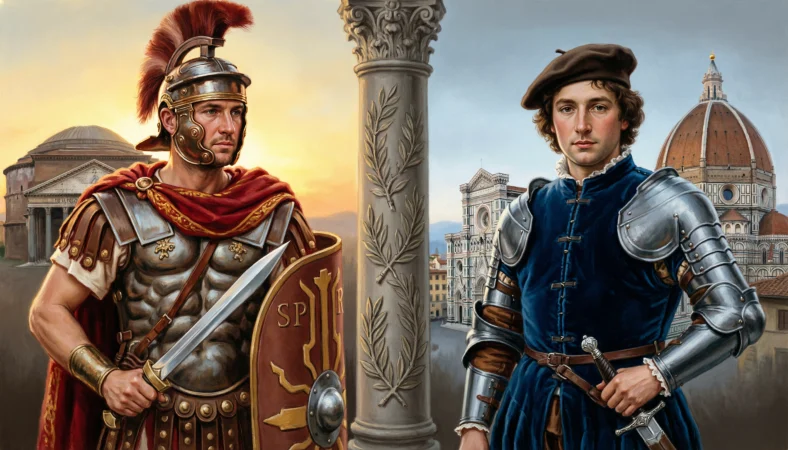
When learning English, words such as Roman and Italian can be confusing because both are strongly connected with Italy and Rome.
However, they do not mean the same thing. Roman usually relates to Rome, especially the ancient city and the Roman Empire, while Italian generally relates to modern Italy, its people, language, or culture.
The key difference is historical and geographical. A person from modern Italy is generally called Italian, while someone or something connected with ancient Rome can be described as Roman.
“Roman” can also describe a modern person or thing from Rome, so context matters. For example, Roman history usually means the history of ancient Rome, while Italian history refers to the history of Italy broadly.
Quick Answer
Roman usually means connected with Rome, especially ancient Rome and the Roman Empire.
Italian means connected with modern Italy, its people, language, or culture. A Roman can refer to a person from ancient Rome or, in some contexts, a modern resident of Rome. Modern Italians are people from Italy.
Why Do People Confuse “Roman” and “Italian”?
The confusion comes mainly from history and geography.
Modern Italy occupies much of the same general region where ancient Rome developed. Rome is also the capital of Italy today. However, ancient Rome and modern Italy are not the same thing.
There is also an important language distinction:
- Roman can describe something related to Rome.
- Italian is the name of the modern language spoken in Italy.
- Latin was the main language of ancient Rome.
- Ancient Romans were not simply “modern Italians” in the historical sense.
First Word: Roman
Roman is an adjective and noun associated with Rome.
It can refer to:
- Ancient Rome
- Roman Empire
- Roman soldiers
- Roman architecture
- Roman mythology
- Roman law
- The city of Rome
- Roman restaurants
- Roman streets
- Roman citizens
- Ancient Roman people
- Roman emperor
- Roman citizen
- Roman senator
Examples of “Roman”
- The Roman Empire controlled a huge territory.
- We studied Roman history at school.
- The Colosseum is a famous example of Roman architecture.
- Latin was widely used in the Roman world.
- Ancient Roman soldiers were highly organized.
- Rome contains many important Roman ruins.
The exact meaning depends on context. “Roman” does not always mean ancient. For example, a Roman restaurant can simply mean a restaurant serving food associated with Rome.
Second Word: Italian
Italian usually relates to Italy, its people, language, or culture.
It can describe:
- A person from Italy
- She is Italian.
- He is an Italian.
- The Italian language
- I am learning Italian.
- Italian is widely studied as a foreign language.
- Modern Italy
- Italian cities
- Italian government
- Italian history
- Italian culture
- Things associated with Italy
- Italian food
- Italian music
- Italian fashion
- Italian literature
Examples of “Italian”
- She is Italian.
- I am learning Italian.
- Pizza is strongly associated with Italian cuisine.
- Milan is an important Italian city.
- Italian art has influenced European culture.
- He bought an Italian dictionary.
Roman vs Italian: Comparison Table
| Word | Main Meaning | Usually Refers To | Example |
|---|---|---|---|
| Roman | Related to Rome | Rome, ancient Rome, or Roman culture | Roman Empire |
| Italian | Related to Italy | Modern Italy, its people, language, or culture | Italian language |
| Roman | A person associated with Rome | Ancient Romans or modern residents of Rome, depending on context | He was a Roman citizen. |
| Italian | A person from Italy | Modern Italy | She is Italian. |
| Latin | Language of ancient Rome | Ancient Roman language and literature | The inscription is in Latin. |
When Should You Use “Roman” and “Italian”?
Use Roman when the subject is specifically connected with Rome or ancient Roman civilization.
Use “Roman” for:
- Roman Empire
- Roman Republic
- Roman army
- Roman law
- Roman architecture
- Roman mythology
- Roman roads
- Roman history
Use Italian when talking about modern Italy, its people, language, or national culture.
Use “Italian” for:
- Italian language
- Italian people
- Italian cities
- Italian food
- Italian culture
- Italian history
- Italian fashion
- Italian government
A useful rule
Ask yourself:
“Am I talking about Rome, especially ancient Rome?”
→ Roman
“Am I talking about modern Italy, its people, or its language?”
→ Italian
10+ Examples of Roman vs Italian
- The Roman Empire was one of the largest empires of the ancient world.
Here, “Roman” refers to ancient Rome. - She is Italian.
Here, “Italian” refers to her nationality. - He is studying Roman history.
The subject is ancient Rome. - He is studying Italian history.
The subject is the history of Italy as a country and region. - I want to learn Italian.
“Italian” means the language. - The museum contains Roman statues.
The statues are associated with Roman civilization. - They visited Rome and explored several Roman ruins.
“Roman” refers to sites connected with ancient Rome. - We had an Italian meal last night.
The food is associated with Italy. - Roman law influenced later legal traditions.
The reference is to the legal system of ancient Rome. - Italian is a Romance language.
“Italian” refers to the modern language. - The Roman Senate played an important role in ancient Rome.
“Roman” identifies the ancient political institution. - She works for an Italian company.
The company is associated with modern Italy. - The building has Roman architectural features.
The features are associated with Roman architecture. - He bought an Italian dictionary.
The dictionary is for or about the Italian language.
Common Mistakes
Mistake 1: Saying “Roman” when you mean the Italian language
Incorrect in normal modern usage:
I am learning Roman.
Correct:
I am learning Italian.
The modern language of Italy is Italian. “Roman” is not the normal name for it.
Mistake 2: Calling every Italian person a Roman
Not every Italian is Roman.
A person from Rome can be called Roman in the appropriate context, but Italy contains many other cities and regions.
For example:
- Someone from Rome → Roman
- Someone from Naples → Neapolitan
- Someone from Milan → Milanese
- Someone from Italy generally → Italian
Mistake 3: Treating ancient Romans and modern Italians as identical
Ancient Roman civilization and modern Italian national identity developed in very different historical periods.
It is more accurate to say that modern Italy has deep historical connections with ancient Rome rather than simply saying that ancient Romans were “Italians” in the modern national sense.
Mistake 4: Confusing Roman with Latin
Roman and Latin are related but different.
- Roman = connected with Rome or Roman civilization
- Latin = the language of ancient Rome and the Roman world
For example:
Roman literature was often written in Latin.
Memory Trick
Remember:
ROMAN → ROME
ITALIAN → ITALY
If the word reminds you of Rome, think Roman.
If it refers to Italy or its modern language, think Italian.
Another easy example:
Roman Empire → ancient Rome
Italian language → modern Italy
American vs British English
There is no major American-versus-British difference in the basic meanings of Roman and Italian.
American and British English speakers generally use:
- Roman for things connected with Rome
- Italian for things connected with Italy
- Italian for the modern language
The main differences you may notice are related to pronunciation, accent, or vocabulary in other areas of English, rather than a different meaning for these two words.
Similar Words
Several related words can make this topic easier to understand.
Roman
Connected with Rome or ancient Roman civilization.
Italian
Connected with modern Italy, its people, language, or culture.
Latin
The ancient language associated with Rome and much of the Roman world.
Rome
The capital city of Italy and the historic center of ancient Roman civilization.
Italy
The modern European country in which Rome is located.
Romance language
A language that developed from forms of Latin. Italian, Spanish, French, Portuguese, and Romanian are examples.
Ancient Roman
A person or thing specifically connected with the civilization of ancient Rome.
Final Verdict
Roman and Italian are not interchangeable.
Use Roman when you mean something connected with Rome, particularly ancient Roman civilization. Use Italian when you mean something connected with modern Italy, its people, culture, or language.
The simplest distinction is:
Roman = Rome
Italian = Italy
Remember that context matters. A modern resident of Rome may be described as Roman, while that same person is also Italian by nationality. Therefore, the two words can sometimes describe the same person from different perspectives.
Frequently Asked Questions
1. Is Roman the same as Italian?
No. Roman usually relates to Rome, while Italian relates to modern Italy. A person from Rome can be both Roman and Italian, but the words have different meanings.
2. Is Roman an ethnicity or a nationality?
Historically, “Roman” could describe people connected with the Roman state and civilization. In modern English, “Roman” can also describe someone from Rome. It is not the standard nationality term for people from modern Italy; Italian is.
3. Is Italian descended from Roman?
Italian developed primarily from Vulgar Latin, the varieties of Latin spoken in the Roman world. It is therefore historically connected to the language of ancient Rome, although modern Italian is not simply “Roman.”
4. Did Romans speak Italian?
Ancient Romans generally spoke varieties of Latin, not modern Italian. Over many centuries, spoken Latin developed into the Romance languages, including Italian.
5. Can someone be both Roman and Italian?
Yes. A modern person who lives in or comes from Rome can be described as Roman and Italian. “Roman” identifies a connection with Rome, while “Italian” identifies a connection with Italy.
6. Is Rome Italian or Roman?
Modern Rome is Italian because Rome is the capital of Italy. It can also be described as Roman when referring to its people, local culture, or connection with Rome.
7. What is the difference between Roman and Latin?
Roman describes Rome or Roman civilization. Latin refers primarily to the language used by ancient Romans and other peoples in the Roman world. For example, Roman writers could write in Latin.
8. Should I say Roman food or Italian food?
It depends on what you mean. Italian food refers broadly to cuisine from Italy, while Roman food refers specifically to food associated with Rome and the Roman culinary tradition.
Remember This
- Roman = related to Rome
- Italian = related to modern Italy
- Italian = the modern language of Italy
- Latin = the major language of ancient Rome
- A person from modern Rome can be both Roman and Italian
- Ancient Romans should not simply be equated with modern Italians
Conclusion
The difference between Roman and Italian is mainly about context, geography, and history.
Roman usually points to Rome, particularly ancient Roman civilization, while Italian normally points to modern Italy, its , language, and culture.
Learning this distinction makes it much easier to understand historical texts as well as everyday English.
When you are unsure, use the simple memory rule: Roman means Rome, and Italian means Italy.
If you are talking about the language spoken in modern Italy, the correct word is Italian, not Roman.
If you are discussing the Roman Empire, Roman law, or ancient Roman architecture, Roman is the appropriate choice.