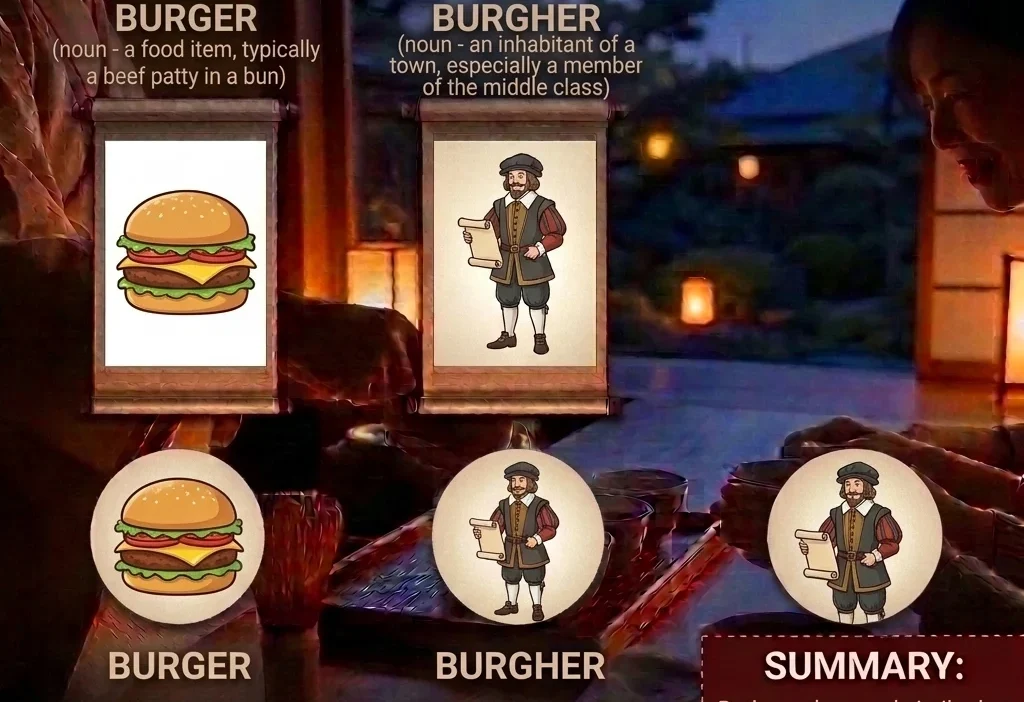
Burger and burgher are both correct English words, but they have completely different meanings.
Burger is a common word for a food made from a cooked patty, usually served in a bun.
Burgher is a much less common word with historical meanings, usually referring to a citizen or inhabitant of a borough or town.
For example, “I ordered a cheeseburger” uses burger correctly, while “The wealthy burgher lived in the medieval town” uses burgher correctly.
The two words look and sound somewhat similar, which makes them easy to confuse, especially for English learners.
However, they belong to very different areas of vocabulary.
Burger is mainly associated with food and restaurants, whereas burgher is associated with towns, citizenship, and history.
Understanding this difference will help you recognize and use both words correctly.
The word burger is extremely common in modern English, while burgher is relatively uncommon and usually appears in historical, literary, political, or specialized writing.
Burger can refer to a hamburger or, more broadly, a sandwich containing a patty or similar filling. Burgher, on the other hand, has a historical connection with the word borough and was traditionally used for a citizen or inhabitant of a town.
In historical contexts, it could also refer to a member of the middle class, particularly a town-dwelling merchant or property owner.
Although the spelling is similar, there is no food-related meaning of burgher and no citizenship-related meaning of burger in standard modern English.
Quick Answer
Burger means a type of food, usually a cooked patty served in a bun. Burgher is a historical or formal word for a citizen or inhabitant of a town or borough. They are different words with different meanings. Use burger for food and burgher for historical or civic contexts.
Why People Confuse It
The two words are easy to confuse because their spellings are very similar:
- burger
- burgher
Both contain burg, and both can be pronounced somewhat similarly depending on the speaker and context.
However, their meanings are unrelated in modern English.
Burger is connected with food:
I ordered a burger for lunch.
Burgher is connected with a town or its citizens:
The burghers of the town gathered at the meeting.
There is also an interesting historical connection between burgher and Germanic words related to towns and fortified places. But for everyday English, the most important distinction is simple:
Burger = food
Burgher = town citizen
First Word: Burger
Burger is a noun that usually refers to a hamburger or a similar food served in a bun.
A traditional hamburger generally consists of a cooked patty, often made from ground beef, placed inside a sliced bun. Modern burgers can contain many different ingredients.
Common types of burgers
You may hear:
- hamburger
- cheeseburger
- chicken burger
- veggie burger
- fish burger
- bean burger
- turkey burger
For example:
She ordered a cheeseburger and fries.
Burger as a general food term
In modern English, burger does not necessarily mean a beef burger.
It can refer to different kinds of patties served as sandwiches:
I prefer a vegetable burger.
He ordered a chicken burger.
The exact meaning can depend on the type of burger being discussed.
Second Word: Burgher
Burgher is a noun with a historical or formal meaning.
Traditionally, a burgher was a citizen or inhabitant of a borough or town. The word is especially associated with historical European towns.
In historical contexts, a burgher could be a person who belonged to the established urban population and had certain civic rights.
For example:
The wealthy burgher owned a shop in the medieval town.
The word can also refer to a member of the urban middle class in historical contexts.
Why “burgher” is uncommon
You are unlikely to hear burgher in ordinary modern conversation.
Instead, modern English normally uses words such as:
- citizen
- resident
- inhabitant
- townspeople
- townsman
- town resident
Burgher is most likely to appear in:
- History books
- Historical fiction
- Academic writing
- Discussions of medieval or early modern towns
- Descriptions of European social classes
Burger vs Burgher: Comparison Table
| Word | Meaning | Part of Speech | Common Context | Example |
|---|---|---|---|---|
| burger | A food, usually a patty served in a bun | Noun | Food, restaurants, cooking | I ordered a burger. |
| burgher | A citizen or inhabitant of a town or borough, especially historically | Noun | History, civic life, literature | The burgher owned a shop in the town. |
The easiest distinction is:
Burger = something you eat.
Burgher = a town citizen, especially in historical contexts.
When to Use Each
Use “burger” when talking about food
Use burger when referring to a hamburger or similar sandwich.
We had burgers for dinner.
This restaurant makes excellent burgers.
Use “burger” in food descriptions
The word commonly appears in compound terms:
- beef burger
- chicken burger
- cheeseburger
- veggie burger
- fish burger
She ordered a spicy chicken burger.
Use “burgher” in historical contexts
Use burgher when describing citizens or residents of a town, particularly in historical contexts.
The wealthy burghers controlled much of the town’s trade.
Use “burgher” when discussing historical social groups
The word can be useful when discussing the urban middle class of certain historical European societies.
The painting depicts a prosperous burgher family.
In ordinary modern conversation, however, citizen or resident is usually more natural.
14 Examples of Burger and Burgher
- I ordered a burger with extra cheese.
- The restaurant serves grilled chicken burgers.
- He ate a burger and a salad for lunch.
- She prefers vegetable burgers.
- We stopped for burgers after the game.
- The menu includes several different burger options.
- The medieval burgher owned a successful business.
- The wealthy burghers lived inside the town walls.
- The burgher served on the town council.
- Several burghers gathered in the marketplace.
- The historical novel describes the life of a Dutch burgher.
- The museum displays belongings once owned by a wealthy burgher.
- The town’s burghers had certain civic privileges.
- The painting shows a prosperous burgher and his family.
The first six examples use burger as a food term. The remaining examples use burgher in historical or civic contexts.
Common Mistakes
Mistake 1: Using “burgher” for food
Incorrect:
I ordered a burgher with fries.
Correct:
I ordered a burger with fries.
Unless you are deliberately making a joke or using a name, burgher does not mean hamburger.
Mistake 2: Assuming “burger” means a citizen
Incorrect:
The medieval burgers had special civic rights.
If you mean historical town citizens, the word is:
The medieval burghers had special civic rights.
Be careful because burger and burgher have different meanings.
Mistake 3: Confusing “burgher” with “burger”
The extra h is important.
burger = food
burgher = historical town citizen
Mistake 4: Using “burgher” in ordinary modern conversation
Although burgher is a legitimate word, it can sound old-fashioned or highly specialized.
Instead of:
He is a burgher of the town.
Modern English would usually say:
He is a citizen of the town.
Memory Trick
Use this simple memory trick:
BURGER → BUN
A burger is food, and you normally eat it in a bun.
For burgher, remember:
BURGHER → BURGH
A burgh is a town or borough, especially in historical or Scottish usage.
So:
Burger → food
Burgher → burgh/town
The extra h in burgher can remind you that the word is connected with a burgh, not a hamburger.
American vs British English
Burger is common in both American and British English.
There are some differences in food terminology between the two varieties, but burger itself is widely understood and commonly used in both.
For example:
American English: burger
British English: burger
Burgher also exists in both varieties, but it is much less common in everyday English. It is mainly encountered in historical, literary, or academic contexts.
In modern British English, burgher may also appear because burgh is a historical and administrative term associated particularly with Scotland.
Similar Words
Hamburger
A hamburger is a burger, traditionally made with a beef patty.
He ordered a hamburger.
Cheeseburger
A cheeseburger is a burger served with cheese.
She wants a cheeseburger.
Citizen
A citizen is a person who is legally recognized as a member of a country or community.
In modern English, citizen is usually much more common than burgher.
Resident
A resident is someone who lives in a particular place.
She is a resident of the town.
This is a useful modern alternative to burgher when you simply mean someone who lives in a place.
Inhabitant
Inhabitant means a person or animal that lives in a particular place.
The inhabitants of the town gathered in the square.
Borough
A borough is a town or district with a particular administrative or historical status.
The word is closely related to the historical sense of burgher.
Final Verdict
Burger and burgher are completely different words. Burger is a common modern food word referring to a hamburger or similar patty served as a sandwich. Burgher is a much less common historical or formal noun meaning a citizen or inhabitant of a town or borough.
If you are talking about lunch, a restaurant, or a sandwich, use burger. If you are discussing historical towns, medieval society, or traditional civic groups, burgher may be the appropriate word.
The easiest way to remember the difference is burger = food and burgher = town citizen. The h in burgher can help remind you of burgh, a word connected with a town.
Frequently Asked Questions
Is “burger” or “burgher” correct for food?
Burger is correct. A burger is a type of food, usually a cooked patty served in a bun. Burgher does not mean hamburger.
What does “burgher” mean?
A burgher traditionally means a citizen or inhabitant of a town or borough. The word is especially common in historical contexts.
Is “burgher” still used today?
Yes, but it is relatively uncommon in everyday modern English. It is more likely to appear in historical, academic, literary, or specialized contexts.
Is a burgher the same as a citizen?
Historically, a burgher could be a citizen of a town or borough, often with particular civic rights. In modern English, citizen is usually the more natural word.
Why does “burgher” have an “h”?
The spelling reflects its historical relationship with words such as burgh, which refer to towns or fortified settlements. It is unrelated in meaning to the food word burger.
Is “burger” short for “hamburger”?
Yes. Burger is commonly used as a shortened form of hamburger, and it can also be used more broadly for similar patty-based sandwiches.
What is the difference between a burger and a hamburger?
A hamburger traditionally refers to a burger made with beef. Burger is a broader term that can also describe chicken, fish, vegetable, bean, or other types of patty sandwiches.
Is “burgher” a British word?
Burgher is used in British English, particularly in historical contexts. It is also found in American English, especially in historical or academic writing.
Remember This
Burger = food.
Burgher = town citizen, especially historically.
Remember the extra h:
Burger → bun
Burgher → burgh
If you can eat it, it is probably a burger. If you are reading about historical town citizens, it may be a burgher.
Conclusion
The words burger and burgher look similar, but their meanings are entirely different. Burger is the familiar modern word for a food made from a patty, usually served in a bun. It is common in everyday conversations, restaurant menus, recipes, and food writing. Burgher, by contrast, refers to a citizen or inhabitant of a town or borough and is mainly found in historical, literary, or academic contexts.
The simplest way to avoid confusion is to connect each word with its meaning. Burger belongs to the world of food, while burgher belongs to the world of towns and historical citizenship. Remember burger → bun and burgher → burgh, and you will quickly know which spelling and meaning you need.