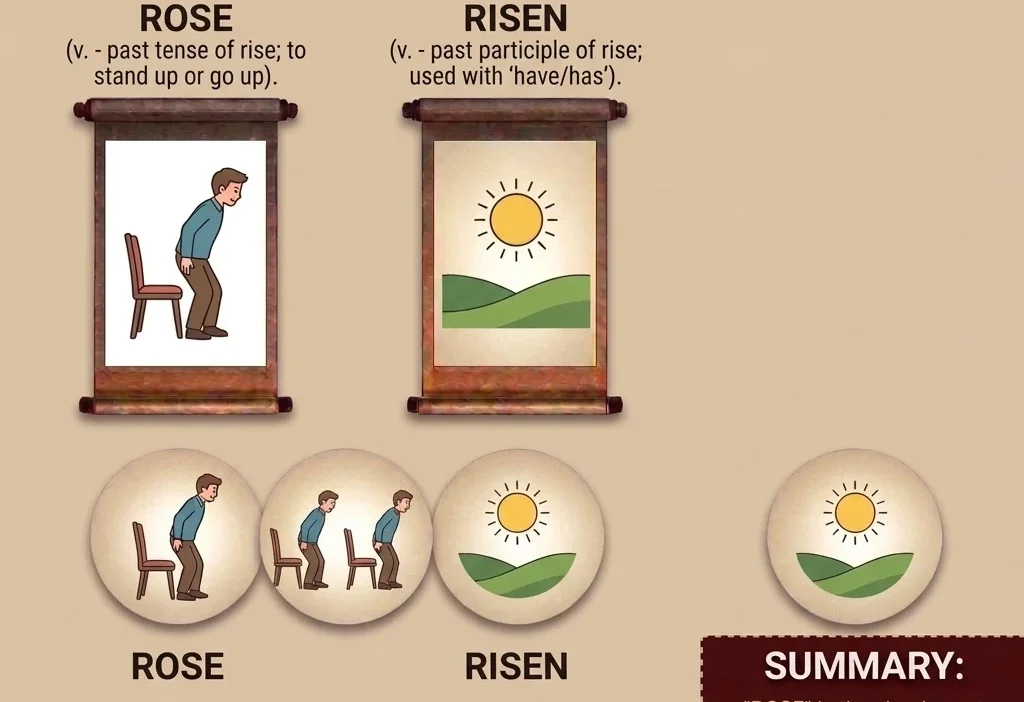
The words rose and risen are both forms of the irregular verb rise, but they are used differently.
Rose is the simple past tense of rise, while risen is the past participle.
For example, “The sun rose at 6 a.m.” is correct because the action happened in the past.
However, “The sun has risen” is correct because risen follows the helping verb has.
Understanding this difference is important because rise does not follow the regular pattern of adding -ed.
The verb rise means to move upward, get up, increase, or become higher.
Its three main forms are rise → rose → risen. Use rose for a completed action in the simple past, and use risen with helping verbs such as has, have, and had. Once you learn this pattern, choosing between rose and risen becomes much easier in everyday English, academic writing, and conversation.
Quick Answer
Rose is the simple past form of rise, while risen is the past participle. Say “The temperature rose yesterday,” but “The temperature has risen.” Remember the verb pattern: rise → rose → risen. Rose can stand alone as the past tense, while risen normally needs a helping verb.
Why People Confuse It
People often confuse rose and risen because both describe something that moved upward or became higher.
The main difference is grammatical:
- Rise = present/base form
- Rose = simple past
- Risen = past participle
Compare these sentences:
The sun rose early.
The sun has risen.
The first sentence uses rose because rise is in the simple past tense.
The second uses risen because it follows has.
A useful way to remember the complete verb is:
rise → rose → risen
First Word: Rose
Rose is the simple past tense of rise.
It describes an action that happened at a particular time in the past or is presented as a completed past event.
Examples of “rose”
- The sun rose at 6:00 a.m.
- Prices rose last year.
- She rose from her chair.
- The water level rose after the storm.
- The balloon rose into the air.
In each example, rose works as the main verb without a helping verb.
What does “rose” mean?
Depending on the context, rose can mean:
- moved upward
- became higher
- got up from a sitting or lying position
- increased in amount or level
- appeared above the horizon
For example:
The temperature rose quickly.
Here, rose means the temperature increased.
Second Word: Risen
Risen is the past participle of rise.
It is normally used with a helping verb, especially has, have, or had.
Examples of “risen”
- The sun has risen.
- Prices have risen sharply.
- The water level has risen.
- She has risen from her seat.
- The moon had risen before we arrived.
You generally should not use risen by itself as the simple past tense.
❌ The sun risen at 6:00 a.m.
✅ The sun rose at 6:00 a.m.
But:
✅ The sun has risen.
The verb forms
| Form | Verb | Example |
|---|---|---|
| Base form | rise | Prices rise every year. |
| Simple past | rose | Prices rose last year. |
| Past participle | risen | Prices have risen this year. |
| Present participle | rising | Prices are rising. |
Comparison Table
| Word | Grammatical Form | How It Is Used | Example |
|---|---|---|---|
| Rose | Simple past | Describes a completed past action | The sun rose early. |
| Risen | Past participle | Usually follows has, have, or had | The sun has risen. |
When to Use Each
Use “rose” for the simple past
Use rose when talking about something that happened in the past.
Common time expressions include:
- yesterday
- last night
- last year
- two hours ago
- in 2020
- this morning, when referring to a completed past action
Examples:
The price rose yesterday.
She rose from her chair.
Use “risen” with perfect tenses
Use risen after helping verbs such as:
- has
- have
- had
Examples:
The price has risen.
Prices have risen significantly.
The water had risen before the rescue team arrived.
Use “rising” for continuous forms
Do not confuse risen with rising.
The temperature is rising.
This describes an action that is happening or developing.
14 Examples of Rose and Risen
- The sun rose over the mountains.
Rose is the simple past form of rise. - The sun has risen above the horizon.
Risen follows has. - The price of fuel rose last month.
The increase happened in the past. - The price of fuel has risen again.
The present perfect uses has risen. - The river rose after several hours of rain.
The water level increased in the past. - The river has risen several inches.
Has risen describes an increase connected to the present. - She rose from her chair.
She stood up. - She has risen from her chair.
Risen follows has. - The smoke rose into the sky.
The smoke moved upward. - The smoke has risen above the building.
The upward movement is expressed with the present perfect. - Temperatures rose sharply yesterday.
The increase happened yesterday. - Temperatures have risen sharply this week.
The increase is connected with the present period. - The moon rose at midnight.
The moon appeared above the horizon. - The moon had risen before we left.
Risen follows had to form the past perfect.
Common Mistakes
Mistake 1: Using “risen” as the simple past
❌ The temperature risen yesterday.
✅ The temperature rose yesterday.
Because yesterday refers to a completed past action, rose is needed.
Mistake 2: Using “rose” after “has”
❌ The price has rose.
✅ The price has risen.
After has, use the past participle risen.
Mistake 3: Using “rose” after “have”
❌ Prices have rose significantly.
✅ Prices have risen significantly.
The structure is have + past participle.
Mistake 4: Confusing “risen” with “rising”
❌ The water is risen.
✅ The water is rising.
With is/are/was/were for a continuous action, use rising.
Compare:
- The water rose yesterday.
- The water has risen.
- The water is rising.
Mistake 5: Confusing “rise” with “raise”
Rise usually describes something moving upward by itself.
Prices rose.
Raise normally means someone or something causes another thing to move upward.
The company raised prices.
The past forms are different:
- rise → rose → risen
- raise → raised → raised
Memory Trick
Remember the three forms as a simple sequence:
Rise → Rose → Risen
Then remember:
Rose = past
Risen = has/have/had
For example:
Yesterday, prices rose.
Prices have risen.
A quick question can also help:
Is there a helping verb such as has, have, or had?
- No → rose may be the correct simple past form.
- Yes → risen is usually needed.
American vs British English
There is no significant difference between American and British English in the basic use of rose and risen.
Both varieties use the same irregular verb pattern:
rise → rose → risen
Examples such as “The sun rose early” and “Prices have risen” are standard in both American and British English.
Similar Words
Rise
Rise is the base form of the verb.
Prices rise when demand increases.
It can describe upward movement, an increase, or getting up.
Rising
Rising is the present participle.
The temperature is rising.
It is commonly used in continuous verb forms.
Raise
Raise is a different verb. It usually means to cause something to move upward or increase.
The company raised its prices.
Raised
Raised is the past and past participle form of raise.
They raised the price last year.
Do not confuse raised with risen.
Increased
Increased can have a similar meaning to rose when talking about amounts, numbers, prices, or levels.
Prices increased last year.
Prices rose last year.
Both can be correct, although the exact wording and context may differ.
Final Verdict
Rose and risen are two different forms of the irregular verb rise. Use rose as the simple past form: “The temperature rose yesterday.” Use risen as the past participle, normally after has, have, or had: “The temperature has risen.”
The easiest pattern to memorize is rise → rose → risen. If you are describing a completed past action without a perfect-tense helping verb, rose is usually the right choice. If you are forming a perfect tense with has, have, or had, use risen.
Frequently Asked Questions
Is “rose” the past tense of “rise”?
Yes. Rose is the simple past tense of rise.
The sun rose at 6 a.m.
Is “risen” the past tense of “rise”?
No. Risen is the past participle of rise. It is normally used with a helping verb.
The sun has risen.
Is it “has rose” or “has risen”?
The correct form is has risen.
The price has risen.
Is it “prices rose” or “prices risen”?
Use prices rose for the simple past.
Prices rose last year.
Use prices have risen when using the present perfect.
Prices have risen this year.
What are the three forms of rise?
The three main forms are:
rise → rose → risen
The present participle is rising.
What is the difference between “rose” and “risen”?
Rose is the simple past form, while risen is the past participle.
The river rose yesterday.
The river has risen.
Is “the sun has rose” correct?
No. The correct sentence is:
The sun has risen.
After has, use the past participle risen.
Remember This
- Rise = base form
- Rose = simple past
- Risen = past participle
- Rising = present participle
- Rose can stand as the main past-tense verb.
- Risen normally needs a helping verb such as has, have, or had.
- The complete pattern is rise → rose → risen.
- Do not say has rose; say has risen.
Conclusion
The difference between rose and risen is mainly a matter of verb tense and form. Rose is the simple past form of rise, so it is used for completed actions in the past. Risen is the past participle, so it normally appears with has, have, or had in perfect constructions.
When you are unsure, remember the pattern rise → rose → risen. Think “rose = past” and “risen = has/have/had.” With this simple rule and a little practice, you can use rose and risen correctly in both everyday and formal English.