
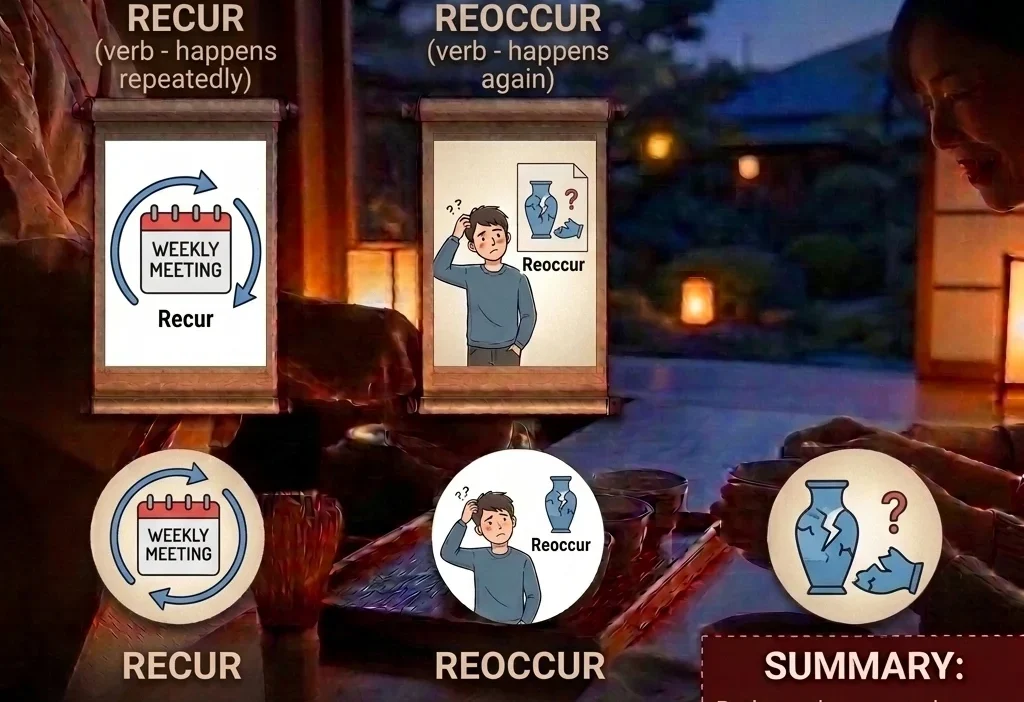
Recur and reoccur both describe something that happens again, but they are not always used in exactly the same way.
Recur usually suggests that something happens repeatedly, often in a pattern or at regular or expected intervals.
Reoccur simply means that something happens again, especially after it happened before.
For example, “The problem recurs every winter” suggests a repeated pattern, while “The problem reoccurred after the repair” simply says that it happened again. \
Both words are standard English, but recur is often the better choice when repetition or recurrence is an important part of the meaning.
Understanding this small difference can help students, ESL learners, and general readers choose the more precise word in academic, professional, medical, technical, and everyday writing.
The distinction becomes especially useful when describing problems, symptoms, events, patterns, or situations that happen more than once.
The two words are easy to confuse because they share the root cur, which comes from a Latin word related to “run,” and both contain the idea of happening again.
Their prefixes also provide a useful clue: re- means “again.” Historically, recur developed with a stronger sense of returning or happening repeatedly, while reoccur emphasizes happening again. In modern English, however, their meanings overlap considerably, and many speakers use them interchangeably in some contexts.
The safest approach is to consider whether you want to emphasize a repeated pattern or simply a second or subsequent occurrence. This article explains the difference between recur and reoccur, shows how each word works in sentences, and provides practical examples and memory tips.
Quick Answer
Recur means to happen repeatedly or return, often in a pattern or at intervals. Reoccur means to happen again after happening before.
The meanings overlap, but recur emphasizes repetition or recurrence, while reoccur emphasizes another occurrence. Both are correct standard English words.
Why People Confuse It
People confuse recur and reoccur because both words describe something happening again.
For example:
The problem recurred every year.
The problem reoccurred after two months.
Both sentences describe a problem happening again.
The subtle difference is what the speaker emphasizes.
Recur often suggests:
- Repeated occurrence
- A recurring pattern
- Something happening periodically
- Something returning over time
Reoccur usually focuses on:
- Another occurrence
- Something happening again
- A previous event happening again
The distinction is useful, but it is not an absolute rule. In some contexts, either word can be appropriate.
First Word: Recur
Recur is a verb meaning to happen again, especially repeatedly or at intervals.
The noun form is recurrence.
The past forms are:
- recur
- recurs
- recurring
- recurred
- recurrence
Notice that recur follows the spelling pattern recur → recurred, with the final r doubled before -ed.
When “recur” emphasizes a pattern
The problem recurs every winter.
This tells us that the problem happens repeatedly and suggests a pattern.
Her headaches recurred throughout the year.
The headaches happened more than once.
Recur in formal and technical contexts
Recur is common in areas such as:
- Medicine
- Mathematics
- Computer science
- Academic writing
- Business
- History
For example:
The disease can recur after treatment.
Or:
The same pattern recurs throughout the study.
In these contexts, the idea of repetition or returning is often important.
Second Word: Reoccur
Reoccur means to occur again.
It generally emphasizes that an event, situation, or problem happened again after a previous occurrence.
The related forms include:
- reoccur
- reoccurs
- reoccurring
- reoccurred
- reoccurrence
For example:
The error reoccurred after the software update.
The sentence focuses on the fact that the error happened again.
Reoccur for another occurrence
The problem may reoccur if the underlying cause is not fixed.
This means that the problem may happen again.
The incident reoccurred several years later.
The emphasis is on another occurrence of the incident.
“Reoccur” does not necessarily imply a regular pattern
Compare:
The festival recurs every year.
This clearly suggests a regular pattern.
But:
The technical problem reoccurred after the repair.
This simply tells us that the problem happened again.
Recur vs Reoccur: Comparison Table
| Feature | Recur | Reoccur |
|---|---|---|
| Basic meaning | Happen again, especially repeatedly | Happen again |
| Main emphasis | Repetition, return, or pattern | Another occurrence |
| Suggests a pattern? | Often | Not necessarily |
| Common with regular events | Yes | Less natural |
| Common with problems | Yes | Yes |
| Common with symptoms | Yes | Yes |
| Noun form | Recurrence | Reoccurrence |
| Example | The problem recurs every year. | The problem reoccurred after repairs. |
The simplest distinction is:
Recur = happen repeatedly or return.
Reoccur = happen again.
When to Use Each
Use “recur” for repeated patterns
Choose recur when something happens again and again, particularly when the repetition forms a pattern.
The festival recurs every spring.
The same theme recurs throughout the novel.
Use “recur” for symptoms or conditions that return
Recur is especially natural when discussing something that disappears and later returns.
The symptoms recurred after several months.
The infection may recur.
Here, the idea of returning is important.
Use “reoccur” when something simply happens again
Use reoccur when your main point is that an event happened again.
The error reoccurred after the computer was restarted.
The sentence does not necessarily suggest a regular pattern.
Use “reoccur” for repeated incidents
The incident reoccurred the following year.
The word simply highlights another occurrence.
When either word can work
Sometimes the difference is very small.
The problem recurred after the repair.
The problem reoccurred after the repair.
Both can mean that the problem happened again.
The first can suggest that the problem returned as part of a recurring issue. The second puts more emphasis on another occurrence.
14 Examples of Recur and Reoccur
- The same problem recurs every winter.
- Her symptoms recurred several months later.
- The theme recurs throughout the book.
- The error recurred after the update.
- The festival recurs every year.
- The disease may recur if treatment is unsuccessful.
- The software problem reoccurred after the restart.
- Similar events recurred throughout history.
- The issue may reoccur if the settings are changed.
- The pattern recurs in several parts of the experiment.
- The disagreement reoccurred during the next meeting.
- The character’s dream recurs throughout the story.
- The same mistake reoccurred despite the warning.
- The problem has recurred several times this month.
These examples show that recur is particularly useful when repetition or a pattern matters, while reoccur can simply indicate another occurrence.
Common Mistakes
Mistake 1: Thinking “reoccur” is always wrong
It is not.
Reoccur is a legitimate English verb meaning to occur again.
The problem reoccurred after the repair.
This is correct.
Mistake 2: Thinking the words are completely interchangeable
Their meanings overlap, but recur often carries a stronger sense of repeated or patterned occurrence.
Compare:
The problem recurs every month.
This clearly describes a pattern.
The problem reoccurred last month.
This describes another occurrence.
Mistake 3: Using “recur” only for regular events
A recurring event does not have to happen on a perfectly regular schedule.
For example:
Her symptoms recurred several times.
The important idea is that they returned repeatedly.
Mistake 4: Confusing “recur” with “occur”
Occur means to happen.
Recur means to happen again, often repeatedly.
The accident occurred yesterday.
Similar accidents recurred over the following years.
Mistake 5: Using “reoccurring” when “recurring” is more precise
Both forms can be correct, but recurring is usually more natural when something repeatedly happens as a pattern.
a recurring problem
a recurring event
When you simply want to emphasize that something happened again, reoccurring may be appropriate.
Memory Trick
Use this simple distinction:
Recur = return repeatedly.
Reoccur = occur again.
Think of recur as something that comes back.
For example:
The problem recurs every winter.
It keeps returning.
Think of reoccur as:
It occurred again.
That makes the meaning easy to remember.
Another shortcut:
Pattern → recur
Another event → reoccur
American vs British English
Recur and reoccur are both used in American and British English.
There is no major difference in meaning between the two varieties of English. In both, recur commonly suggests something happening repeatedly or returning, while reoccur means happening again.
The same distinction applies to related nouns:
- recurrence
- reoccurrence
For example:
The recurrence of the problem was unexpected.
The reoccurrence of the error caused concern.
In everyday and professional English, recurrence is generally the more established choice when discussing a repeated or returning condition.
Similar Words
Occur
Occur simply means to happen.
The accident occurred at noon.
It does not itself mean that something happened before.
Happen
Happen is a common, general word meaning to take place.
What happened yesterday?
It is less formal than occur in some contexts.
Repeat
Repeat means to do or say something again.
Please repeat the question.
It focuses on an action being done again rather than an event naturally happening again.
Return
Return means to come or go back.
The symptoms returned after treatment.
In some contexts, return is very close in meaning to recur.
Recurring
Recurring is an adjective or present participle describing something that happens repeatedly.
We have a recurring problem with the system.
Repeated
Repeated means happening more than once.
He made repeated attempts to solve the problem.
It does not necessarily suggest a natural cycle or return.
Final Verdict
Recur and reoccur are both correct words, but recur usually emphasizes something happening repeatedly, returning, or following a recurring pattern. Reoccur focuses more simply on something happening again after it has happened before.
Choose recur for recurring patterns, repeated symptoms, regular events, or situations that return over time. Choose reoccur when you want to emphasize another occurrence without necessarily suggesting a pattern.
When the meanings overlap, either word may work. However, if you are describing something that repeatedly returns, recur is often the more precise and natural choice.
Frequently Asked Questions
What is the difference between recur and reoccur?
Recur usually means to happen repeatedly or return, often as part of a pattern. Reoccur means to happen again. The two words overlap, but recur often emphasizes repetition.
Is “reoccur” a real word?
Yes. Reoccur is a standard English verb meaning to occur again. It is not simply a mistake or an unnecessary word.
Is recur more correct than reoccur?
No. Both are correct. The best choice depends on what you want to emphasize. Recur is often better for repeated or patterned events, while reoccur highlights another occurrence.
What is the difference between recurring and reoccurring?
Recurring commonly describes something that happens repeatedly or keeps returning. Reoccurring emphasizes something occurring again. In many contexts, both can be understood, but recurring is often the more natural choice for an ongoing repeated pattern.
Should I say “recurring problem” or “reoccurring problem”?
Recurring problem is generally the more natural choice when you mean a problem that keeps returning or happens repeatedly.
We have a recurring problem with the system.
Can a disease recur?
Yes. Recur is commonly used for medical conditions that return after improving or disappearing.
The disease recurred several years later.
Can an event reoccur?
Yes. Reoccur can describe an event happening again.
The incident reoccurred the following year.
What is the noun form of recur?
The noun form is recurrence.
The recurrence of the problem was unexpected.
The noun related to reoccur is reoccurrence.
Remember This
Recur = happen repeatedly or return.
Reoccur = happen again.
Think:
Recur → repeated return
Reoccur → occur again
If you are describing a pattern, recur is usually the better choice. If you are simply saying that something happened another time, reoccur can be appropriate.
Conclusion
The difference between recur and reoccur is subtle because both words involve the idea of something happening again. Recur generally emphasizes repetition, return, or a pattern, while reoccur focuses on another occurrence. For example, a problem that happens every month recurs, while an error that happens again after being fixed can reoccur.
Neither word is incorrect, and they can overlap in many sentences. The most useful rule is to choose recur when repeated return or a pattern is important, and reoccur when you simply want to say that something happened again. Understanding this distinction will help you make your writing more precise without treating the two words as completely separate concepts.