The word “bougie” is commonly used to describe someone or something that seems luxurious, sophisticated, fashionable, or overly concerned with an expensive lifestyle. It is an informal word that can be positive, playful, teasing, or slightly critical depending on the context.
Understanding bougie synonyms can help you describe people, places, products, food, fashion, and lifestyles more accurately.
For example, someone might be “elegant” without being “bougie,” while another person might be “pretentious” because they are trying too hard to appear sophisticated.
This guide explains 30 useful alternatives to “bougie” in simple English.
It is designed for students, ESL learners, writers, bloggers, and content creators who want to understand the differences between related words and choose the right one for each situation.
What Does “Bougie” Mean?
Simple meaning of bougie
Bougie is an informal word meaning fancy, luxurious, fashionable, or associated with an expensive lifestyle.
It comes from the French word bourgeois, which is connected to the middle or upper-middle social class. In modern English, however, “bougie” is usually used more casually.
Example:
“They went to a bougie restaurant with expensive dishes and stylish decorations.”
Here, “bougie” suggests that the restaurant feels luxurious, fashionable, or somewhat expensive.
Is “bougie” positive or negative?
The meaning depends heavily on tone.
Someone might say:
“I love this bougie coffee shop.”
This can be playful and positive.
But someone might say:
“He is acting so bougie.”
Here, the word may suggest that the person is trying too hard to appear wealthy or sophisticated.
For this reason, choosing the right synonym is important. Words such as luxurious and upscale are generally positive or neutral, while pretentious and snobbish are more critical.
30 Bougie Synonyms
1. Upscale
Meaning: High-quality, stylish, and usually more expensive than average.
Example: “They booked an upscale hotel near the beach.”
Best usage: Restaurants, hotels, neighborhoods, stores, and services.
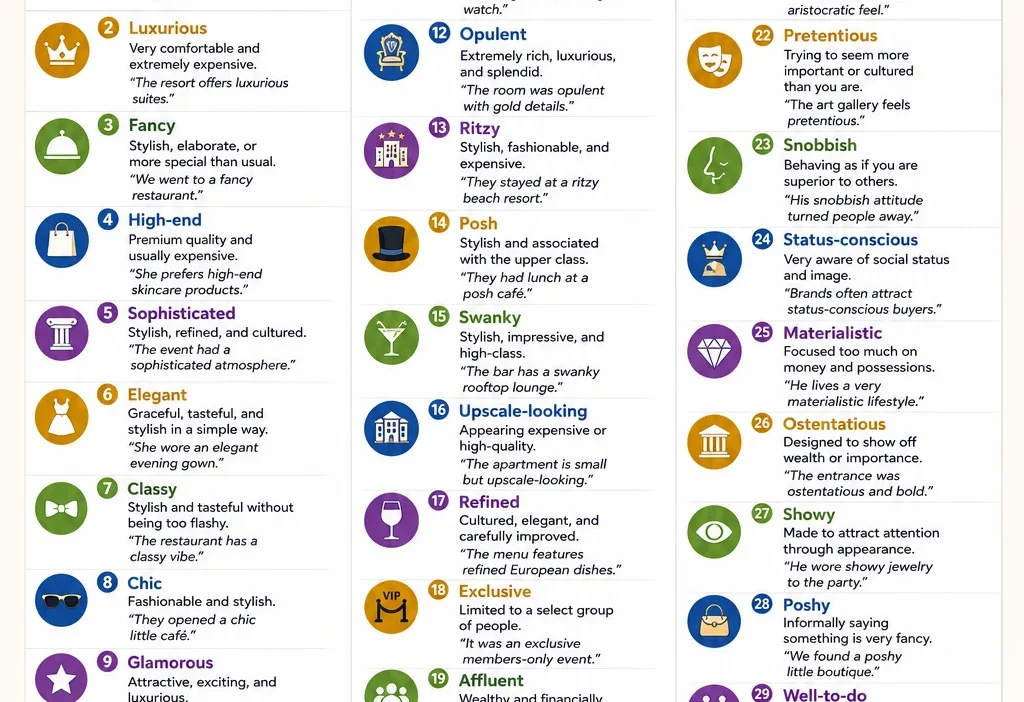
2. Luxurious
Meaning: Very comfortable, beautiful, and expensive.
Example: “The resort offers luxurious rooms with private balconies.”
Best usage: Positive descriptions of expensive products, places, and experiences.
3. Fancy
Meaning: More stylish, expensive, or elaborate than usual.
Example: “We went to a fancy restaurant for dinner.”
Best usage: Everyday conversation and informal writing.
4. High-end
Meaning: Very good quality and usually expensive.
Example: “She prefers high-end skincare products.”
Best usage: Fashion, beauty, technology, cars, restaurants, and products.
5. Sophisticated
Meaning: Stylish, refined, and developed in taste or appearance.
Example: “The hotel has a sophisticated interior design.”
Best usage: People, fashion, design, culture, and places.
6. Elegant
Meaning: Graceful, tasteful, and stylish in a simple or refined way.
Example: “She wore an elegant black dress to the event.”
Best usage: Fashion, decoration, manners, and personal style.
7. Classy
Meaning: Stylish and tasteful without looking cheap or excessive.
Example: “The restaurant has a classy atmosphere.”
Best usage: Casual descriptions of fashion, places, behavior, and style.
8. Chic
Meaning: Fashionable, stylish, and attractive.
Example: “They opened a chic little café downtown.”
Best usage: Fashion, interiors, restaurants, cafés, and lifestyle content.
9. Glamorous
Meaning: Attractive, exciting, luxurious, and fashionable.
Example: “The actress attended a glamorous evening event.”
Best usage: Fashion, celebrities, parties, events, and lifestyles.
10. Lavish
Meaning: Very luxurious, expensive, or generous.
Example: “They held a lavish wedding at a historic estate.”
Best usage: Weddings, parties, celebrations, homes, and spending.
11. Extravagant
Meaning: More expensive, elaborate, or excessive than necessary.
Example: “He bought an extravagant birthday gift.”
Best usage: Expensive purchases, events, lifestyles, and spending.
12. Opulent
Meaning: Extremely luxurious and rich in appearance.
Example: “The palace has opulent gold decorations and enormous chandeliers.”
Best usage: Formal writing about architecture, interiors, and wealth.
13. Ritzy
Meaning: Fashionable, expensive, and associated with wealthy people.
Example: “They stayed at a ritzy hotel in the city center.”
Best usage: Informal descriptions of expensive places and lifestyles.
14. Posh
Meaning: Stylish, expensive, and associated with a high social class.
Example: “They had dinner at a posh restaurant.”
Best usage: British English and informal descriptions of wealthy environments.
15. Swanky
Meaning: Stylish, impressive, and expensive-looking.
Example: “The company moved into a swanky new office.”
Best usage: Informal English for stylish places, offices, restaurants, and homes.
16. Upscale-looking
Meaning: Appearing expensive, stylish, or high quality.
Example: “The small apartment has an upscale-looking interior.”
Best usage: Describing appearance when you do not necessarily know the actual price.
17. Refined
Meaning: Elegant, cultured, and carefully developed in taste.
Example: “The restaurant is known for its refined atmosphere.”
Best usage: Formal writing about taste, manners, food, art, and design.
18. Exclusive
Meaning: Limited to a particular group, often because something is expensive or difficult to access.
Example: “They were invited to an exclusive private event.”
Best usage: Clubs, events, neighborhoods, products, and experiences.
19. Affluent
Meaning: Wealthy or financially comfortable.
Example: “The store is located in an affluent neighborhood.”
Best usage: People, communities, neighborhoods, and socioeconomic descriptions.
20. Wealthy
Meaning: Having a lot of money or valuable possessions.
Example: “The area is home to many wealthy families.”
Best usage: Straightforward descriptions of financial status.
21. Aristocratic
Meaning: Connected with an upper social class, especially traditional nobility.
Example: “The mansion has an aristocratic appearance.”
Best usage: Historical, literary, or formal descriptions.
22. Pretentious
Meaning: Trying to appear more important, intelligent, cultured, or sophisticated than you really are.
Example: “The restaurant’s complicated menu felt a little pretentious.”
Best usage: Critical descriptions of people, language, behavior, or places.
23. Snobbish
Meaning: Acting as though you are better than people because of your wealth, education, taste, or social position.
Example: “His snobbish attitude made the guests uncomfortable.”
Best usage: Negative descriptions of behavior and personality.
24. Status-conscious
Meaning: Very concerned about social position, wealth, popularity, or appearance.
Example: “The neighborhood attracts status-conscious buyers.”
Best usage: Formal or analytical writing about lifestyle and social behavior.
25. Materialistic
Meaning: Giving too much importance to money, possessions, and expensive things.
Example: “The advertisement promotes a highly materialistic lifestyle.”
Best usage: Critical discussions of consumer culture and lifestyle.
26. Ostentatious
Meaning: Designed to attract attention by showing wealth or importance.
Example: “The mansion had an ostentatious entrance with huge marble columns.”
Best usage: Formal writing about excessive displays of wealth.
27. Showy
Meaning: Designed to attract attention rather than simply being practical or tasteful.
Example: “He chose a showy car that attracted everyone’s attention.”
Best usage: Clothing, cars, decorations, jewelry, and possessions.
28. Poshy
Meaning: Informally describing something as especially fancy or upscale.
Example: “We found a poshy little restaurant near the theater.”
Best usage: Very informal, playful writing or conversation.
29. Well-to-do
Meaning: Financially comfortable or wealthy.
Example: “The neighborhood is popular with well-to-do families.”
Best usage: People and communities; slightly traditional English.
30. Bougie-looking
Meaning: Appearing fancy, expensive, or fashionable, whether or not it is actually expensive.
Example: “The apartment is small but surprisingly bougie-looking.”
Best usage: Casual social media, blogs, conversations, and lifestyle content.
Comparison Guide for Bougie Synonyms
The best synonym depends on whether you want to sound positive, neutral, playful, or critical.
| Synonym | Main idea | Tone | Best used for |
|---|---|---|---|
| Upscale | High quality and expensive | Positive | Places and services |
| Luxurious | Very comfortable and expensive | Positive | Hotels, homes, products |
| Fancy | Stylish or elaborate | Casual | Everyday situations |
| High-end | Premium quality | Neutral/positive | Products and services |
| Sophisticated | Refined and stylish | Positive | People, design, culture |
| Elegant | Tasteful and graceful | Positive | Fashion and design |
| Chic | Fashionable and stylish | Positive | Fashion and lifestyle |
| Glamorous | Attractive and luxurious | Positive | Events and lifestyles |
| Lavish | Very elaborate or expensive | Neutral | Events and celebrations |
| Extravagant | Excessively expensive | Mixed | Spending and possessions |
| Posh | Wealthy and fashionable | Casual | Places and lifestyles |
| Swanky | Stylish and impressive | Playful | Places and businesses |
| Refined | Cultured and tasteful | Formal | Food, art, manners |
| Exclusive | Limited and desirable | Neutral | Events and products |
| Affluent | Financially wealthy | Formal | People and neighborhoods |
| Pretentious | Trying too hard to seem sophisticated | Negative | Behavior and style |
| Snobbish | Acting superior to others | Negative | Personality |
| Materialistic | Too focused on possessions | Negative | Lifestyle |
| Ostentatious | Showing wealth excessively | Negative | Decorations and possessions |
| Showy | Designed to attract attention | Mixed | Clothes and possessions |
How to Choose the Right Synonym
For a positive meaning
If “bougie” is meant as a compliment, choose words such as:
- Luxurious
- Elegant
- Sophisticated
- Chic
- Classy
- High-end
- Upscale
- Glamorous
Example:
Instead of:
“She has a bougie apartment.”
You could write:
“She has a sophisticated, elegant apartment.”
This sounds more polished and positive.
For casual conversation
If you want to keep a relaxed, conversational tone, use:
- Fancy
- Posh
- Swanky
- Ritzy
- Classy
- Bougie-looking
These words work well in conversations, social media posts, blogs, and informal articles.
For formal writing
For academic, professional, or descriptive writing, consider:
- Affluent
- Refined
- Sophisticated
- Luxurious
- Exclusive
- Opulent
- Status-conscious
These words are generally more precise than slang.
For a negative meaning
If “bougie” means someone is trying too hard to appear wealthy or sophisticated, choose:
- Pretentious
- Snobbish
- Materialistic
- Ostentatious
- Showy
- Status-conscious
These words should be used carefully because they communicate criticism.
For describing wealth
If your main focus is money rather than style, use:
- Wealthy
- Affluent
- Well-to-do
- High-income
For example:
“The area is home to many affluent families.”
This is more precise than simply calling the area “bougie.”
For describing expensive places
Use:
- Upscale
- High-end
- Luxurious
- Posh
- Swanky
- Ritzy
For example:
“They chose an upscale restaurant for their anniversary.”
This sounds more specific than “a bougie restaurant.”
Bougie vs. Fancy
Bougie and fancy are similar, but they have different feelings.
Fancy is a very common English word that can simply mean special, decorative, expensive, or unusual.
Bougie often carries an additional suggestion of lifestyle, social status, or deliberate sophistication.
Compare:
“She bought a fancy dress.”
This simply means the dress is special or elegant.
“She loves bougie restaurants.”
This suggests she enjoys stylish, upscale dining experiences.
Bougie vs. Classy
Classy usually has a positive meaning. It suggests good taste, elegance, and style.
Bougie can be positive, but it can also be teasing or critical.
For example:
“Her outfit is classy.”
This is clearly a compliment.
“Her outfit is bougie.”
This could be a compliment, joke, or criticism depending on the speaker.
Bougie vs. Pretentious
These words should not be treated as exact synonyms.
Bougie can simply mean fancy or upscale.
Pretentious means trying to appear more sophisticated, important, or cultured than you really are.
Therefore, something can be bougie without being pretentious.
For example, an expensive restaurant may be luxurious and stylish without being pretentious.
Bougie vs. Luxurious
Luxurious is strongly associated with comfort, quality, and expense.
Bougie is more informal and can describe a broader lifestyle or aesthetic.
Compare:
“The hotel has luxurious rooms.”
“The hotel has a bougie vibe.”
The first sentence focuses on quality and comfort. The second focuses more on the overall fashionable or upscale feeling.
Bougie vs. Snobbish
Snobbish describes a person’s attitude toward other people.
Bougie can describe a person, place, product, style, or lifestyle.
For example:
“She has a bougie taste in home décor.”
But:
“He is snobbish toward people who earn less money.”
The second sentence describes social behavior, not simply an expensive taste.
Why Use Bougie Synonyms?
They make your writing more precise
Using “bougie” repeatedly can make your writing sound vague. A more exact synonym tells readers what you actually mean.
For example:
- Luxurious → emphasizes comfort and expense.
- Elegant → emphasizes tasteful style.
- Upscale → emphasizes quality and price.
- Pretentious → emphasizes artificial sophistication.
- Materialistic → emphasizes an excessive focus on possessions.
They help ESL learners understand tone
Synonyms are not always interchangeable.
Learning the difference between classy, luxurious, pretentious, and snobbish helps English learners avoid unintended meanings.
They improve SEO-friendly writing
For writers and content creators, using natural variations can make an article more useful and readable. Instead of repeating one keyword throughout a page, related vocabulary can explain the topic from different angles.
The goal is not to force synonyms into every sentence. The goal is to use the most accurate word for the meaning.
Common Phrases Related to Bougie
Here are some useful expressions related to the idea of being bougie:
- Bougie lifestyle
- Bougie restaurant
- Bougie neighborhood
- Bougie apartment
- Bougie aesthetic
- Bougie taste
- Bougie fashion
- Bougie coffee shop
- Bougie hotel
- Bougie dinner
- Bougie experience
- Bougie vibe
- Luxury lifestyle
- Upscale living
- High-end style
- Sophisticated taste
- Expensive lifestyle
- Refined taste
These phrases are especially common in informal lifestyle writing and social media.
Frequently Asked Questions About Bougie Synonyms
What is the best synonym for bougie?
There is no single perfect synonym. Upscale, fancy, luxurious, sophisticated, and high-end are useful positive alternatives. If “bougie” is being used negatively, pretentious, snobbish, or materialistic may be more accurate.
Is bougie a positive or negative word?
It can be either. “Bougie” may mean stylish and luxurious in a positive way, or it may suggest that someone is overly concerned with wealth and appearance.
What is a simple word for bougie?
Fancy is probably the simplest everyday alternative. Depending on the context, classy, upscale, or luxurious may also work.
Is classy the same as bougie?
Not exactly. Classy is usually positive and suggests good taste. Bougie is more informal and can be positive, playful, or critical.
Is luxurious a synonym for bougie?
Sometimes. Both can describe expensive and high-quality things, but luxurious specifically emphasizes comfort, quality, and expense, while “bougie” can also describe a social style or aesthetic.
What is the opposite of bougie?
Depending on the intended meaning, possible opposites include simple, modest, plain, unpretentious, low-key, and down-to-earth.
What is a negative synonym for bougie?
Possible negative alternatives include pretentious, snobbish, materialistic, ostentatious, and showy. Each has a slightly different meaning.
Can bougie describe a person?
Yes. In informal English, “bougie” can describe someone who enjoys expensive, fashionable, or sophisticated things. It can also suggest that the person is overly concerned with appearing wealthy or refined.
Conclusion
The best bougie synonyms depend on the exact meaning and tone you want to communicate. If you want a positive word, luxurious, elegant, classy, chic, and sophisticated are excellent choices.
For expensive places or products, upscale, high-end, ritzy, posh, and swanky can be more precise. If you want to express criticism, words such as pretentious, snobbish, materialistic, and ostentatious communicate a stronger negative meaning.
For ESL learners and writers, the most important lesson is that synonyms are not always exact replacements. Always consider the context, tone, and intended meaning before choosing a word.
Whether you are describing a restaurant, fashion style, neighborhood, lifestyle, or personality, the right synonym can make your writing clearer, more natural, and more expressive.